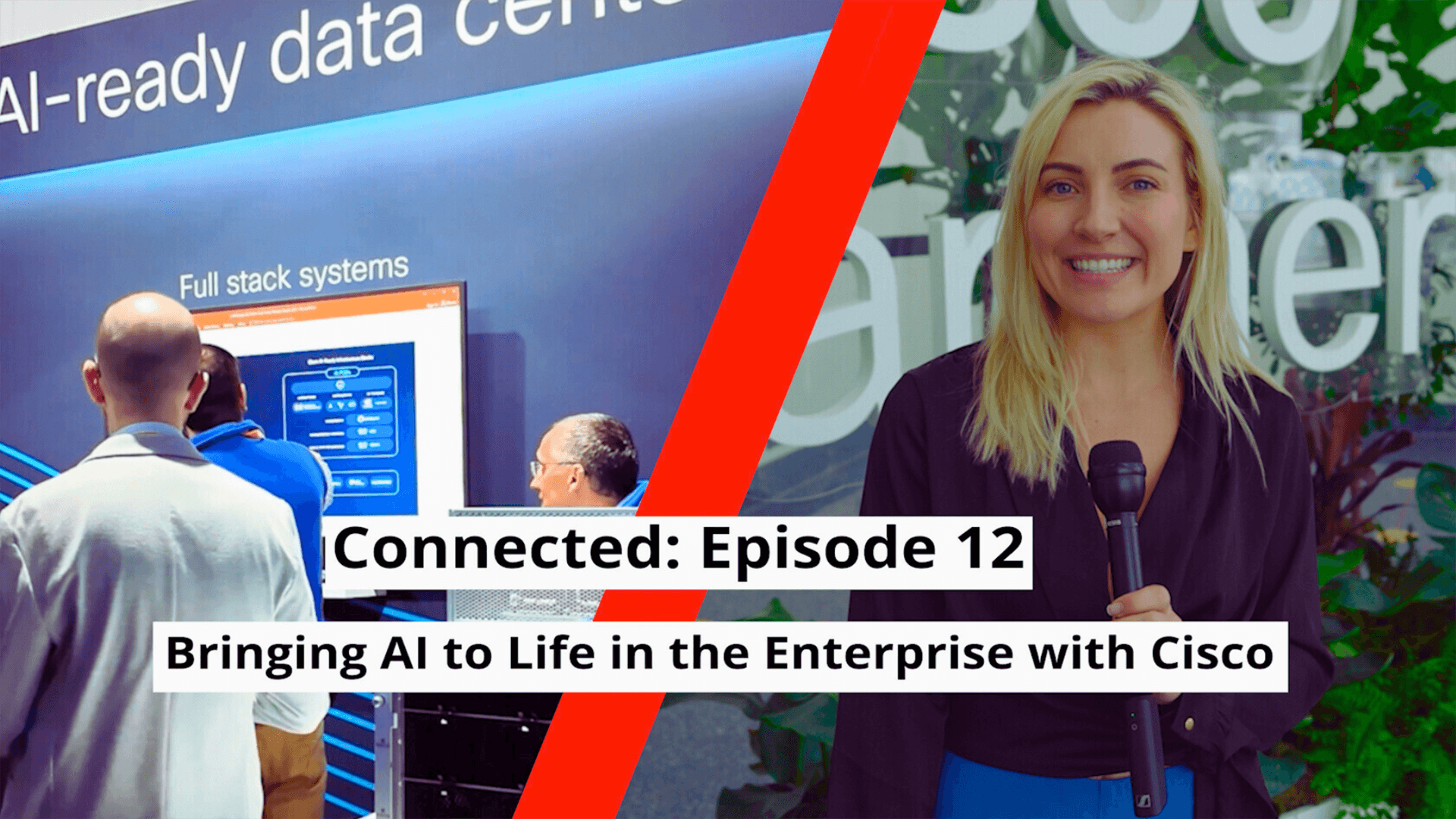
Can the company that hepled build the internet revolutionize AI? 🤔 Join host Diana Blass & Cisco leaders to learn how they’re simplifying AI for businesses & building a more adaptable future. This episode of Six Five Connected features Cisco’s Executive Vice President & Chief Product Officer Jeetu Patel, Technical Leader, Marketing, DCN BU Joey Ristaino, Chief Strategy Officer Mark Patterson, Chief People, Policy & Purpose Officer Francine Kastoudas, and Tim Ormrod Director, Ormit Solutions, LTD – Splash Access sharing insights on Cisco’s strategy to overcome the hurdles of enterprise AI adoption by providing the tools and resources for partner organizations to build resilient and adaptable networks.
Their discussion covers:
- The progression of Cisco from internet pioneers to tech transformers in the AI era
- The significant role Cisco has played in shaping today’s internet and their current focus on AI
- Insights from the Cisco Partner Summit, including strategic moves like the Splunk acquisition and a hefty investment in AI infrastructure
- The challenges and strategies around legacy systems, data privacy, and the promotion of industry-specific AI use cases and partner upskilling
- Predictions for the future of Cisco and the enterprise AI landscape
Learn more at Cisco.
Watch the video below at Six Five Media at the 2024 Cisco Partner Summit and be sure to subscribe to our YouTube channel, so you never miss an episode.
Or listen to the audio here:





Disclaimer: Six Five Connected is for information and entertainment purposes only. Over the course of this webcast, we may talk about companies that are publicly traded and we may even reference that fact and their equity share price, but please do not take anything that we say as a recommendation about what you should do with your investment dollars. We are not investment advisors, and we ask that you do not treat us as such.
Transcript:
Diana Blass: Back in the 1990s, Cisco was instrumental in laying the groundwork, what we now recognize as the internet. They built routers to link networks, pioneered IP-based networking to make data transfer seamless and introduce security measures to keep that data safe. Fast-forward and Cisco is eyeing a similar transformation, but this time they’re doing it for AI.
Jeetu Patel: We provide AI infrastructure to power AI. And so that’s a pretty important dimension that we had to get perfected and right, and we didn’t want to announce it until we actually had something meaningful to talk about.
Diana Blass: At Cisco Partner Summit, we saw how Cisco’s recent moves have aligned to tackle this challenge, from expanding its security portfolio to acquiring observability leader Splunk to investing in AI driven startups. Cisco was bringing all of its solutions together into a 360 approach for AI. All right, so over here in the AI hub, we see how Cisco is the partner in the AI era. That’s the message they’re really trying to get across here and the message that they are bringing their partners from all across our ecosystem together to work together to drive these AI outcomes. So we have a digital resilience hub over here. You can see it touches on observability. Over here, we have the AI-ready data centers.
Jeetu Patel: We announced today that we are going to make sure that we have training servers for AI.
Vendor 1: So this will be for very, very large customers which are doing rack, or it’ll be for customers which do training. So we’ll have eight GPUs from NVIDIA.
Jeetu Patel: But what we’ve also announced is we’ll have inferencing workloads that can actually be serviced with AI with AI pods.
Vendor 1: They can start with a very small one to the large one. There is a calculator which we are providing to the partners so they can calculate where the customer will go .
Diana Blass: With Cisco server, switches, and those AI-enabled pods, everything is now manageable in the public cloud under a unified platform called Nexus Hyperfabric AI.
Joey Ristaino: So we manage the software that’s running in that controller. If there’s new features or functionality that we want to push, we just do that. You just consume it as the user. And even things like upgrading, we would just prescribe to you what version we want you to run, keep it simple, and then let you schedule the upgrades of those devices based on a prescriptive-based consumption model.
Jeetu Patel: So what are we doing? At the basic level, we are saying let’s make sure that AI infrastructure is plug and play. We simplify AI infrastructure so that when organizations need agility in their data center, we can provide that to them, with having the right level of compute, the right level of networking.
Diana Blass: It’s all part of a strategy to address one of AI’s biggest industry hurdles, enterprise adoption.
Mark Patterson: We do a readiness survey every year, and it won’t surprise you that I think 95% of the enterprises say, “Hey, we understand that the load that’s going to be on the networks that’s coming is going to be so much greater than it’s been and they’re going to have to have so much more scale, etc.” And there’s only about 17% of them that say they have the networks that can scale.
Diana Blass: Cisco has announced over a billion dollars in purchase orders to build AI infrastructure for hyperscalers, a huge step forward. But bringing AI to enterprises isn’t as simple. Hurdles include dealing with legacy systems, navigating data privacy, securing organizational buy-in, and managing type budgets. To overcome these challenges, industry-specific use cases will be critical, which is why Cisco is making major investments like this. An $80 million investment to help your workforce using the same training that we provide our own sales force. With an $80 million investment, Cisco is upskilling its partners who generate 90% of its revenue by packaging and selling these solutions. To see how these use cases are unfolding, we turn to Cisco partner, Splash Access, which powers the networking solution at Purdue University. Here, it’s normal for about a hundred thousand devices to be connected to the network at any time.
Tim Ormrod: A lot of the technology that we’ve been adding on is adding value to the student experience. How can the student onboard into their campus network seamlessly? We’re now adding in IoT sensors, we’re adding in AI into the solution, and I know AI is everywhere at the moment, but being able to put it into a practical level is really important and campuses really understand that we’re adding value to that student’s experience and that’s what they want.
Diana Blass: When you talk about IoT, is that driving environmental efficiencies? What do you mean by how is IoT being deployed in these schools?
Tim Ormrod: The students want to know that they’ve got the home-like experience. They want to have the same functions and facilities they’ve got in their home network, inside their dormitory, inside their student’s house. So by adding in the IoT sensors, we can show them that they’ve got the temperature if somebody’s opened the dorm room and we can do water sensing. So all these additional functions, which you can do in the Cisco dashboard, we are bringing now to the student level.
Diana Blass: And now the AI element, is that driving more analytics into the findings?
Tim Ormrod: Exactly. We are looking at how we can really drill down on the analytics that come out of Cisco’s CMX feed and put that into an AI model that gives value to the university.
Diana Blass: So as you just heard, Purdue University’s network isn’t just a backbone for campus life. It’s a sneak peek into what AI-driven infrastructure can really do. And that’s just one example. Hospitals, corporations, cities, everybody’s looking to build networks that are resilient, flexible, and ready to adapt in real time. So we’re companies like Cisco innovating in the right ways to make that happen. If 2025 really is the year AI changes the game for enterprises, I guess you can say we’re about to find out. Thanks for joining us on Connected. I’m Diana Blass. See you next time.
Author Information

Diana Blass is a journalist with a background in technology news and analysis. Her work has appeared on Fox Television Stations, The Discovery Channel, CRN, Light Reading, and other Informa-owned media brands. In addition to her work at The Six Five, she manages Diana Blass Productions, where she develops and produces digital documentaries, podcasts, and commercials for media and corporate brands.