Why Quantum’s Next Phase Is an Industrialization Race, Why the SkyWater Acquisition Puts IonQ in the Top Echelon, and Why the Bet Still Has to Be Proven
Analyst: Daniel Newman
Publication Date: September 10, 2026
Document #: AIODN202609
The Thesis
The quantum race has changed sports. For a decade, the scoreboard was physics: qubit counts, fidelity records, supremacy claims. That contest produced remarkable science and almost no revenue. The next phase is an industrialization race, and it will be decided by the unglamorous disciplines that decided the classical semiconductor era: fabrication, packaging, iteration speed, supply chain control, and trusted manufacturing. Leadership will belong to whoever can turn quantum from a laboratory result into a production line.
That is the frame in which IonQ’s $1.8 billion acquisition of SkyWater Technology should be read. IonQ did not buy a foundry to add revenue. It bought the manufacturing floor of the quantum industry, becoming the only vertically integrated, full-stack quantum platform company with an accredited, onshore, merchant semiconductor foundry inside the walls. The deal closed on July 31, 2026, five days before IonQ reported the strongest quarter in its history, and the first fully integrated QPUs have already come off SkyWater lines.
My hypothesis is direct: the SkyWater bet, layered on top of a deliberate multi-year acquisition strategy across computing, networking, sensing, and security, puts IonQ in the top echelon of quantum plays, and arguably defines the echelon. This report makes that case in three parts. The platform IonQ assembled before it bought the factory. Why the foundry is the differentiator that the industrialization phase rewards. And the honest counterweights, because a bet this size carries integration, margin, and dilution risk that deserves the same scrutiny as the upside.
The Platform Came First, Then the Factory
SkyWater is not a pivot. It is the capstone of an acquisition arc that has been running for two years with unusual coherence. Oxford Ionics brought high-density 2D ion traps and electronic qubit control. Lightsynq brought the photonic interconnects that link modular systems. A super-majority stake in ID Quantique brought quantum-safe networking and security. Vector Atomic brought quantum sensing. Capella and Skyloom extended the platform into space. Nexus Photonics, closed at the end of June and disclosed with the second-quarter results, added integrated photonics. Each deal targeted a specific layer of a four-pillar platform: compute, networking, sensing, and cybersecurity. SkyWater adds the fifth layer no one else owns, the manufacturing spine underneath all of it.
The strategy is being validated where it counts, in the income statement. IonQ’s Q2 2026 revenue of $80.1 million grew 287% year over year, exceeded the company’s own guidance by 20%, and marked the fifth consecutive quarter of record results. Organic growth ran at 132%. Full-year standalone guidance was raised to $280 million to $290 million, implying roughly 100% organic growth for 2026. Roughly a quarter of revenue is now multi-product, which is the number that matters most for the platform thesis. This is no longer a company selling one machine to research labs. It is a portfolio compounding across quantum computing, networking, security, and sensing, with approximately $3.0 billion in cash and investments at June 30, roughly $2.0 billion pro forma after funding the SkyWater cash consideration, to keep executing.
Context sharpens the point. As recently as late 2022, ETR Insights panels of enterprise technology leaders described quantum as research-stage hype, compared it to the 1992 phase of the internet, and confirmed it was absent from budget conversations at the CIO level. Less than four years later, the category leader is guiding to $290 million at the high end. The enterprise conversation has moved from whether quantum is real to who can deliver it at scale. That is precisely the transition a manufacturing acquisition is designed to win.
Why the Foundry Is the Differentiator
IonQ’s own framing is that scaling to fault tolerance is now an engineering and manufacturing challenge, not solely a scientific one. The SkyWater transaction operationalizes that belief in five ways.
- Iteration speed becomes the moat. Embedded access to SkyWater’s Technology as a Service model is expected to compress 256-qubit chip cycle times from nine months to two, a 4.5x acceleration, while enabling multiple chip generations to be prototyped in parallel. In semiconductors, the company that learns fastest wins. IonQ just bought the learning rate.
The roadmap pulls forward. The combined company now forecasts its first 200,000 physical qubit QPUs, enabling 8,000 logical qubits, to begin functional testing in 2028, with commissioning of 256-qubit semiconductor-based systems targeted for the first half of 2027. The transition from laser-based to electronic qubit control on semiconductor chips is the architectural unlock, and it is a fab-dependent unlock. - Sovereignty is a product. SkyWater is the largest exclusively U.S.-based, pure-play semiconductor foundry, DMEA-accredited and Category 1A Trusted, with facilities in Minnesota, Florida, and Texas. Combined with IonQ’s sites, the result is an end-to-end U.S. chain of custody for quantum systems at the exact moment governments are treating quantum as strategic national infrastructure. For defense, intelligence, and critical-infrastructure buyers, trusted onshore manufacturing is not a feature. It is the qualification.
- The quantum resume predates the deal. SkyWater is not a generalist fab learning quantum on IonQ’s dime. Its quantum work began a decade ago, when D-Wave development started at the Minnesota fab, and the qubits behind D-Wave’s 2025 quantum supremacy result, published in Science, were fabricated at SkyWater. By late 2025, the company counted seven quantum customers spanning annealing, photonic, spin-based, and superconducting modalities, including PsiQuantum, Silicon Quantum Computing, and QuamCore, with niobium superconducting process integrations and cryogenic platforms already standard offerings. Sonderman was publicly positioning SkyWater as the quantum foundry, the TSMC of the category, before IonQ made its move. IonQ did not buy capacity it must teach. It bought ten years of quantum process learning already in production.
- The merchant model preserves the ecosystem play. SkyWater continues operating as an open foundry and trusted merchant supplier, with program firewalling and IP protection, following the hybrid-foundry precedent of Intel, Samsung, and Bosch. That means IonQ monetizes the industry’s scaling even where competing modalities win, a hedge no other quantum player holds. IonQ has not treated that as a reluctant concession. Management has publicly doubled down on serving SkyWater’s existing quantum customers, and the logic compounds: the more modalities that scale through SkyWater, the more of the industry’s path to production runs through IonQ-owned manufacturing, whichever qubit wins.
One honest caveat on the “only vertically integrated” claim. Rigetti has operated its own internal fab for years. The distinction is real but should be stated precisely: Rigetti’s Fab-1 builds Rigetti’s chips, while SkyWater is an accredited, 200mm-scale, revenue-generating merchant foundry with advanced packaging, government trust credentials, and an existing quantum ecosystem customer base. IonQ did not just internalize its supply chain. It acquired the industry’s supply chain and the option to sell it to everyone else.
The Field, and the Balanced Read
The comparison set now includes a wave of newly public names, which makes the scale gap visible for the first time.
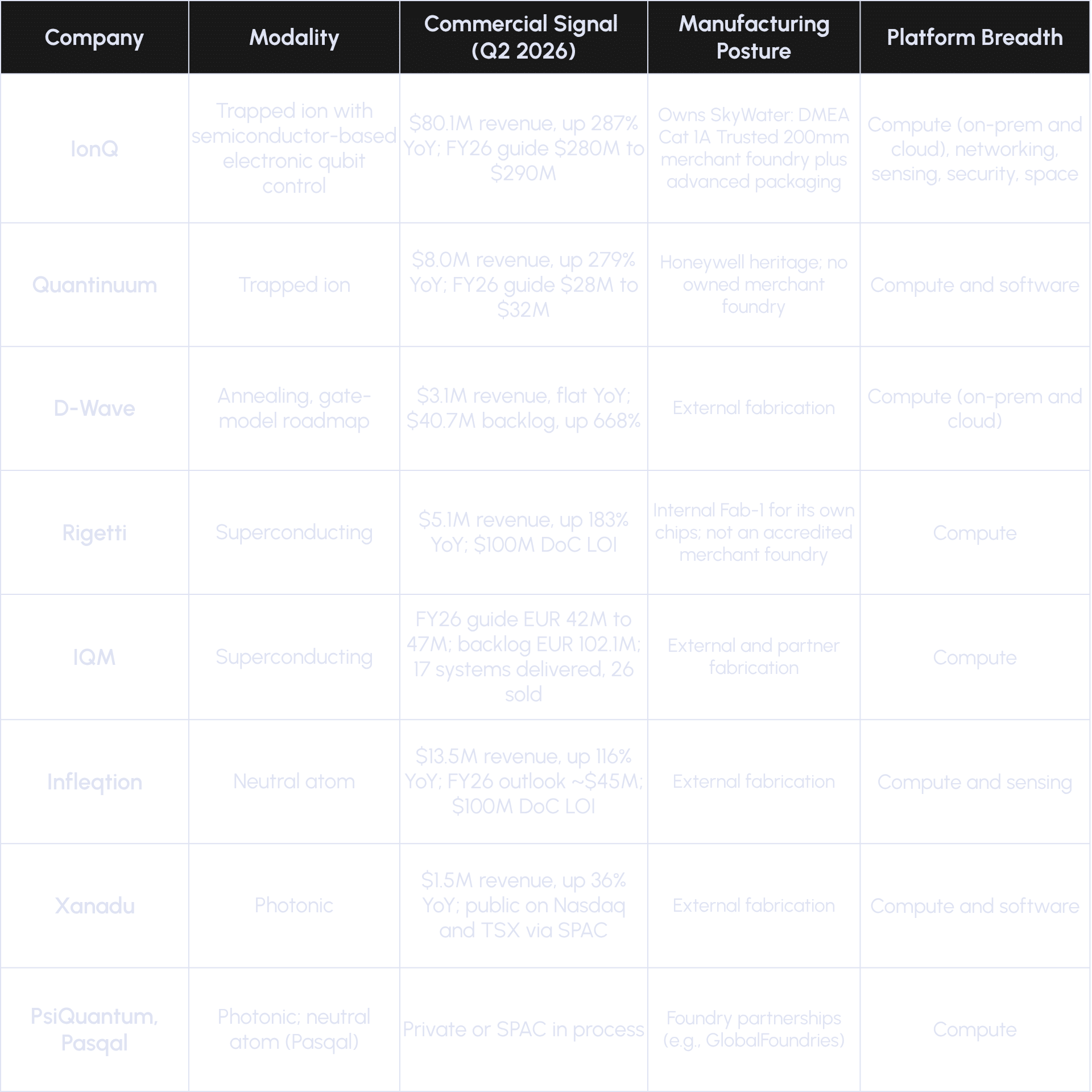
Read the revenue column first. IonQ’s single quarter of $80.1 million is larger than that of any other public pure-play. D-Wave is showing genuine commercial progress, with production applications at AT&T, Optum, and NTT Docomo, and a backlog up 668%, but on a $3.1 million quarter. Rigetti nearly tripled revenue to $5.1 million and secured a $100 million Department of Commerce letter of intent, a meaningful sovereign signal of its own. Quantinuum, now public and IonQ’s closest technology peer in trapped ion, printed $8.0 million in its first quarter as a listed company, up 279%, and guided 2026 to $28 million to $32 million. Infleqtion posted $13.5 million, up 116%, and raised its full-year outlook to roughly $45 million. But no one else in the pure-play field combines commercial scale, platform breadth, and owned manufacturing. Among the pure-plays, that combination is the top echelon, and today it has one occupant.
The IBM Question
The table covers the pure-plays. The incumbent deserves its own accounting, because IBM is the one name that can meet IonQ on every axis of this thesis. IBM designs and fabricates its own superconducting processors*, has delivered against its published roadmap for a decade, is targeting a verified demonstration of quantum advantage by the end of 2026 on its Nighthawk platform, and has committed to Starling, a fault-tolerant system running one hundred million gates on 200 logical qubits, by 2029. It distributes through one of the largest enterprise sales machines in technology, has built a large developer community around Qiskit, and funds all of it from an operating company balance sheet that never has to visit the capital markets.
The symmetry is the story. Both companies are vertically integrated quantum manufacturers. Both converged independently on qLDPC error correction: IBM in the Starling architecture, and IonQ with its break-even QEC demonstration, validating its walking cat architecture. Both have dated fault-tolerance milestones landing within twelve months of each other, IonQ’s 200,000-qubit QPUs enabling 8,000 logical qubits entering functional testing in 2028, and IBM’s 200 logical qubits shipping in a delivered system in 2029. And both now claim to be the only one, IBM asserting it is the only company positioned to scale quantum hardware, software, fabrication, and error correction together, and IonQ asserting it is the only vertically integrated full-stack quantum platform. When two companies each claim to be the only one, that is not a contradiction. That is a battleground. One discipline for readers keeping score: the milestone definitions are not apples to apples. Functional testing is not a shipped system, and logical qubit counts at different error rates are different claims. Compare trajectories, not headlines.
Where they diverge is the shape of the bet. IBM’s quantum program lives inside a global enterprise technology company, which buys it patience, distribution, and credibility, and costs it focus. IonQ is the pure-play inverse: the entire company is the bet, the platform spans networking, sensing, and security, with IonQ’s own software stack and developer tooling available across the major clouds, where IBM’s is compute-centric with software depth, and the merchant foundry means IonQ now manufactures for the industry while IBM manufactures for itself. Modality against modality, integration model against integration model, this is the true battleground for quantum leadership, and the 2027 to 2029 window decides it.
*Note: This piece was updated on September 17th to include the linked announcement from IBM.
Risks to the Thesis: What IonQ Must Execute to Keep the Advantage
A differentiated position is not a defended one. The SkyWater bet creates an advantage that only execution preserves, and the failure modes are specific enough to name. Each risk below carries the execution bar that neutralizes it.
- Integration is the work. IonQ is absorbing a merchant foundry with its own customer base and a different operating culture, on top of a 2025 acquisition cohort that, by the evidence of multi-product revenue, is already operating as one business. Vertical integration has a long failure record in semiconductors, but most of those failures share a signature: an acquirer buying capacity it then had to learn to use. IonQ is buying a fab it has already been designing into, with the leadership that built it staying in place, which is closer to the inverse profile. The bar: run SkyWater as SkyWater. Keeping Sonderman and the foundry leadership in place inside a firewalled subsidiary is the right design on paper. Keeping that team and culture intact through the first year of ownership is the test.
- Foundry economics is a different sport. IonQ has not operated a fab before, and fabs bring utilization pressure, yield management, and capital planning that quantum systems businesses have never had to price. Foundry gross margins are structurally lower than quantum systems margins, and roughly $120 million of IonQ’s own fiscal 2026 spend that would have been SkyWater revenue now gets eliminated in consolidation. Two facts soften the picture. SkyWater is not a traditional capital-hungry foundry: by its own filings, it has been adjusted-EBITDA positive at 10% to 13% of revenue for three consecutive years, including a record $442 million in fiscal 2025, and its capital intensity ran in the low single digits as a share of revenue before the Fab 25 purchase. That makes the transaction look less like a classic fab acquisition and more like securing capacity and accelerating technology. The bar: combined guidance that is honest about the blended margin trajectory, and then a record of hitting it.
- Merchant trust is fragile. The open-foundry commitment asks IonQ’s competitors to keep fabricating their most sensitive designs at a foundry a competitor now owns, and that is not hypothetical: D-Wave’s flagship qubits are fabricated at SkyWater today, and PsiQuantum runs development flows through the same fab. Program firewalling and IP protection are the promise, and the Intel, Samsung, and Bosch precedent says hybrid models can work. The bar: retained third-party quantum and defense customers, visibly. One high-profile defection reframes the open-foundry story from ecosystem enabler to walled garden, and the merchant hedge evaporates with it.
- The control-plane transition carries the whole roadmap. The move from laser-based to electronic qubit control on semiconductor chips is the architectural bet underneath every milestone, and functional testing of 200,000-qubit QPUs in 2028 is a forecast, not a product. The bar: commissioning the first 256-qubit semiconductor-based systems in the first half of 2027. That is the nearest hard checkpoint and the validation of management’s investment in semiconductor scaling, and the credibility of every milestone dated after it borrows from it.
- The financial math must hold. Adjusted EBITDA loss was $120.3 million in Q2, and while the headline $1.9 billion GAAP loss was dominated by a $1.6 billion non-cash warrant remeasurement, GAAP R&D, the largest operating expense line, still grew 57% year over year. The SkyWater equity consideration of 0.4883 IonQ shares per SkyWater share adds to a count already expanded by a rapid acquisition cadence. The roughly $2.0 billion pro forma cash position funds the roadmap, but the roadmap is expensive. The bar: organic growth that keeps outpacing the burn, and demonstrated absorption before the next deal.
- Two workforces, one company. Quantum scientists and 200mm process engineers are different labor markets with different retention risks, and acquisition integrations are when both walk. The bar: retention of the technical spine on both sides through the integration window, because the iteration-speed advantage is a people advantage before it is a machine advantage.
None of these is disqualifying, and all of them are watchable. But the honest framing is this: IonQ bought a lead, not a moat. The moat gets dug by execution, quarter by quarter, and the market will be measuring.
The Bottom Line
Every prior computing era ended the same way: the science commoditized, and the manufacturers won. IonQ is betting $1.8 billion that quantum follows the pattern, and it is making that bet from a position no peer occupies, with real and rapidly compounding revenue, a five-layer platform assembled through disciplined M&A, and now the only trusted, onshore, merchant-scale manufacturing capability in the industry. This is offense, and the scoreboard has changed with it: the physics contest is settled enough that the manufacturing contest now decides the standings. While much of the field raises capital to fund science, IonQ is spending capital to own the industrialization layer that every modality, including its competitors’, will eventually need.
The bet is not without cost. The margin profile gets heavier, though less than a traditional fab acquisition would imply, the integration burden gets larger, and the share count gets longer. But differentiation in this market was never going to come from another fidelity record. It comes from controlling the means of production in a category that governments have decided is strategic. On that axis, IonQ is not merely in the top echelon of quantum plays. Among the pure-plays, it is the echelon and the contest that decides the decade has narrowed to two names: IonQ and IBM, the two vertically integrated manufacturers with dated paths to fault tolerance. That fight will be won in fabs, not in physics journals.
What to Watch: How the Foundry Bet Gets Proven
The thesis is set. These are the checkpoints that confirm it or break it.
- The September 8 investor day and what it settles: Combined-company guidance, if it arrives there, and how much intercompany elimination and purchase accounting reshape the consolidated growth rate. If guidance comes later, that gap is itself the watch item.
- Commissioning of 256-qubit semiconductor-based systems in the first half of 2027, the first hard checkpoint on the electronic qubit control transition.
- SkyWater’s merchant retention: Whether third-party quantum and defense customers stay on an IonQ-owned foundry, the test of the open-foundry commitment.
- Peer trajectories now that the field has printed: Quantinuum guiding to $28 million to $32 million for 2026, with more than 100% growth signaled for 2027, and Infleqtion at roughly $45 million, are the curves to measure against IonQ’s $280 million to $290 million.
- IBM’s side of the scoreboard: The verified quantum advantage demonstration targeted for the end of 2026 and the Kookaburra fault-tolerant module, the incumbent’s checkpoints in the battleground.
- Government posture: Trusted-foundry and sovereign quantum funding flows, where the Cat 1A accreditation converts directly into contract eligibility.
Disclosure: Futurum is a research and advisory firm that engages or has engaged in research, analysis, and advisory services with many technology companies, including those mentioned in this report. This report reflects the analysis and opinions of the author and is provided for informational purposes only. It does not constitute investment advice or a recommendation regarding any security, and it contains no rating or price target. Read the full Futurum Group Disclosure.
Other Insights from Futurum
Quantum Fine-Tuning and the Energy Case for Quantum in AI
IonQ Q2 FY 2026: Tempo Quantum Computers Drive Growth Ahead of SkyWater Integration
Author Information

Daniel is the CEO of The Futurum Group. Living his life at the intersection of people and technology, Daniel works with the world’s largest technology brands exploring Digital Transformation and how it is influencing the enterprise.
From the leading edge of AI to global technology policy, Daniel makes the connections between business, people and tech that are required for companies to benefit most from their technology investments. Daniel is a top 5 globally ranked industry analyst and his ideas are regularly cited or shared in television appearances by CNBC, Bloomberg, Wall Street Journal and hundreds of other sites around the world.
A 7x Best-Selling Author including his most recent book “Human/Machine.” Daniel is also a Forbes and MarketWatch (Dow Jones) contributor.
An MBA and Former Graduate Adjunct Faculty, Daniel is an Austin Texas transplant after 40 years in Chicago. His speaking takes him around the world each year as he shares his vision of the role technology will play in our future.