Analyst(s): Brad Shimmin
Publication Date: May 22, 2026
What is Covered in This Article:
- Informatica’s transition to a headless data management model utilizing Model Context Protocol (MCP) servers to deliver context to artificial intelligence models.
- The introduction of the Agent Fabric Context Catalog for unified governance over both AI agents and enterprise data assets.
- Broad ecosystem integrations to support composable architectures beyond Salesforce to include AWS, Snowflake, Databricks, Google Cloud, and Microsoft.
- Deepened synergies with Salesforce, including bidirectional Data 360 connectivity and native Slack integrations.
- The deployment of specialized CLAIRE agents to automate manual data engineering tasks, such as data quality rule generation and metadata enrichment.
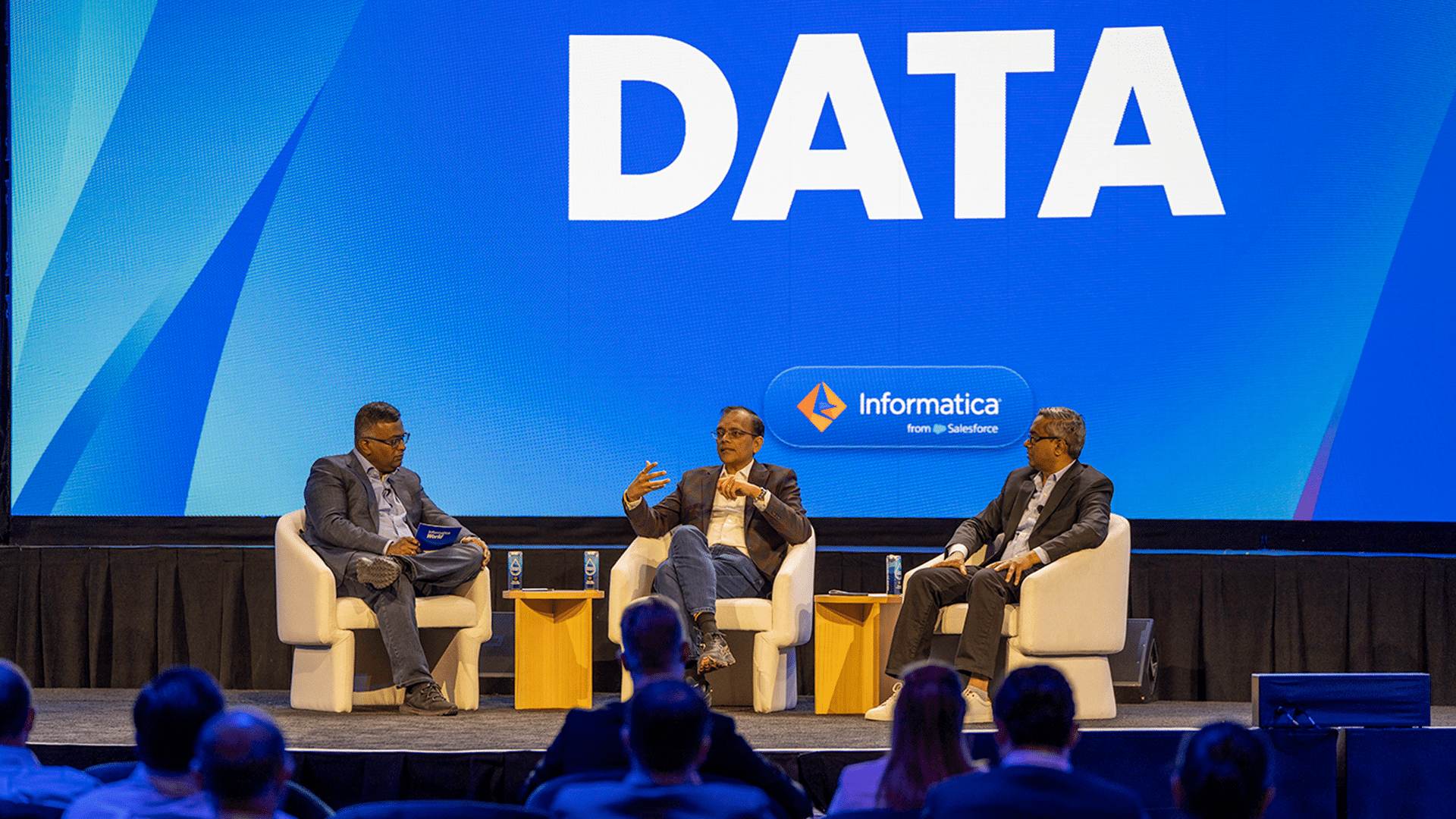
The Event — Major Themes & Vendor Moves: At Informatica World 2026, the company announced a sweeping architectural evolution of its Intelligent Data Management Cloud (IDMC). Now officially part of the Salesforce family of businesses, Informatica’s longstanding, well-regarded platform is adopting a headless data management model, exposing its core metadata, data quality, and master data management capabilities as modular, programmable services. By implementing the Model Context Protocol (MCP), Informatica is natively integrating these services across major cloud hyperscalers and data platforms. Developers can now invoke enterprise data management tools directly from their integrated development environments or conversational interfaces without requiring custom point-to-point connections. To support this transition, the company also introduced the Agent Fabric Context Catalog, a unified control plane that governs both enterprise data assets and AI agents, alongside specialized autonomous CLAIRE agents for automated data stewardship.
Informatica Unbundles the Monolith: Headless Data Management Meets the Agentic Enterprise
Analyst Take: The traditional, monolithic data management suite has hit an agentic AI-shaped wall. For decades, vendors assumed enterprises craved a singular, proprietary pane of glass to govern, cleanse, and manage their information. Informatica’s 2026 conference announcements obliterate that assumption. By transitioning to headless data management, the company effectively unbundles its Intelligent Data Management Cloud into a fleet of agile background utilities. Following its acquisition by Salesforce, skeptics anticipated a swift retreat into a walled-garden ecosystem. Thankfully, Informatica flipped that script, prioritizing broad, open interoperability.
Conventional data management interfaces have served the industry well for decades, but in the age of agentic AI, they increasingly act as massive bottlenecks. Engineers building autonomous systems loathe context-switching between AI development environments and clunky governance consoles. At Futurum, we are currently tracking a reorganization of how businesses build their data supply chains, noting that enterprise data architectures are moving away from monolithic, all-in-one platforms toward modular, composable intelligence stacks utilizing open standards. Informatica’s headless data management approach synergizes with this trend, serving as the foundational connective tissue required for these composable environments.
The technical linchpin of this strategy is the adoption of the Model Context Protocol. Through native MCP servers, developers building autonomous workflows in AWS Bedrock AgentCore, Snowflake Cortex AI, or Microsoft Foundry can invoke Informatica’s microservices directly. In this way, MCP acts as a universal translator. It allows an AI agent to query an external system for specific context, such as the lineage of a customer record or the data quality score of a specific table, and receive a deterministic answer. This reduces the need for developers to build and maintain brittle, point-to-point application programming interfaces.
Developers want to build agents where they work, and they need a standardized way to ground those agents in reality. Our 1H 2026 DIAI Market Sizing & Five-Year Forecast Report indicates that 20% of respondents interested in agentic AI are already running MCP in production. Like so many of its competitors, Informatica is jumping on this bandwagon, encouraging engineers to use MCP to embed trusted context into their applications.
If a Databricks user needs to run an address verification check or a Snowflake user needs to query a metadata catalog, they can trigger that action via MCP without ever logging into an Informatica user interface. This turns a comprehensive enterprise software suite into an embedded utility. The Databricks Unity Catalog tag extraction and the Snowflake Iceberg Tables governance capabilities demonstrate a willingness to play nicely within competing ecosystems. By automatically extracting governance tags and mapping lineage across these different platforms, Informatica provides a unified metadata foundation regardless of where the physical data resides.
Scaling autonomous systems in this way, however, requires a new approach to oversight. Futurum Research’s State of the Market Report: Data Intelligence, Analytics, and Infrastructure, Q2 2026 highlights that 93% of enterprises acknowledge difficulties in establishing the necessary governance for production AI deployments. That’s where Informatica’s Agent Fabric Context Catalog comes in to address this point of friction. This tool upgrades governance from a passive directory of tables to an active control plane overseeing both the data assets and the AI agents consuming them. An enterprise can now track which autonomous agent accessed a specific piece of sensitive data, mapping the provenance loop from raw storage to AI-driven action.
When you couple this catalog with the new autonomous CLAIRE agents, which can automatically classify information and generate data quality rules via natural language, the company aims to aggressively automate the curation tasks that have historically stalled enterprise data projects. A business user can dictate a requirement (a specification in the parlance of agentic AI) in simple terms, and the Data Quality Agent translates that intent into executable rules, automatically applying them across the data pipeline. This approach has already demonstrated the ability to reduce the burden on manual, syntax-laden data engineering and to accelerate time-to-value for analytical initiatives.
Overall, the integration strategy on display at Informatica World 2026 proves that corporate acquisitions can actually accelerate open innovation. Kudos to both Informatica and Salesforce, as we’re seeing innovation work in both directions in support of both companies. For example, Informatica’s new ability to bring CLAIRE’s capabilities natively into Slack and establish zero-copy interoperability with Salesforce Data 360 provides immediate, tangible value to the CRM customer base. An executive can query Slack to understand the health of a specific data pipeline or resolve a matching issue directly within their collaborative workspace. At the same time, maintaining parallel integrations with Google Cloud, AWS, and Microsoft preserves Informatica’s role as an independent, multi-cloud data fabric. That’s Informatica doing what it has always done best — unify and enrich disparate data.
What to Watch:
- Monitor the adoption velocity of headless data management among pro-code developers, a demographic that traditionally favors open-source tooling over enterprise data management suites.
- Keep a close eye on how the major hyperscalers respond over the next year. While AWS and Google Cloud are currently partnering with Informatica to enrich their AI environments, they are concurrently advancing their own native metadata and governance catalogs.
- Watch the rollout of the Agent Fabric Context Catalog to see whether enterprises adopt it as their primary AI control plane or prefer to rely on the native orchestration tools provided by foundational model vendors. This is a very crowded and energized space, leaving little room for niche players.
See the complete press release on Informatica delivering the trusted data foundation every AI agent needs on the Informatica website.
Disclosure: Futurum is a research and advisory firm that engages or has engaged in research, analysis, and advisory services with many technology companies, including those mentioned in this article. The author does not hold any equity positions with any company mentioned in this article.
Analysis and opinions expressed herein are specific to the analyst individually and data and other information that might have been provided for validation, not those of Futurum as a whole.
Other Insights From Futurum:
Precision Over Prose: Why SAP Knowledge Graph is the Secret to Production-Ready AI
Memgraph Zero Sidesteps the Data Movement Grind to Give AI Agents Immediate Context
Microsoft Agent 365 Turns Shadow AI Into a Governed Asset Class
Image Credit: Informatica
Author Information

Brad Shimmin is Vice President and Practice Lead, Data Intelligence, Analytics, & Infrastructure at Futurum. He provides strategic direction and market analysis to help organizations maximize their investments in data and analytics. Currently, Brad is focused on helping companies establish an AI-first data strategy.
With over 30 years of experience in enterprise IT and emerging technologies, Brad is a distinguished thought leader specializing in data, analytics, artificial intelligence, and enterprise software development. Consulting with Fortune 100 vendors, Brad specializes in industry thought leadership, worldwide market analysis, client development, and strategic advisory services.
Brad earned his Bachelor of Arts from Utah State University, where he graduated Magna Cum Laude. Brad lives in Longmeadow, MA, with his beautiful wife and far too many LEGO sets.