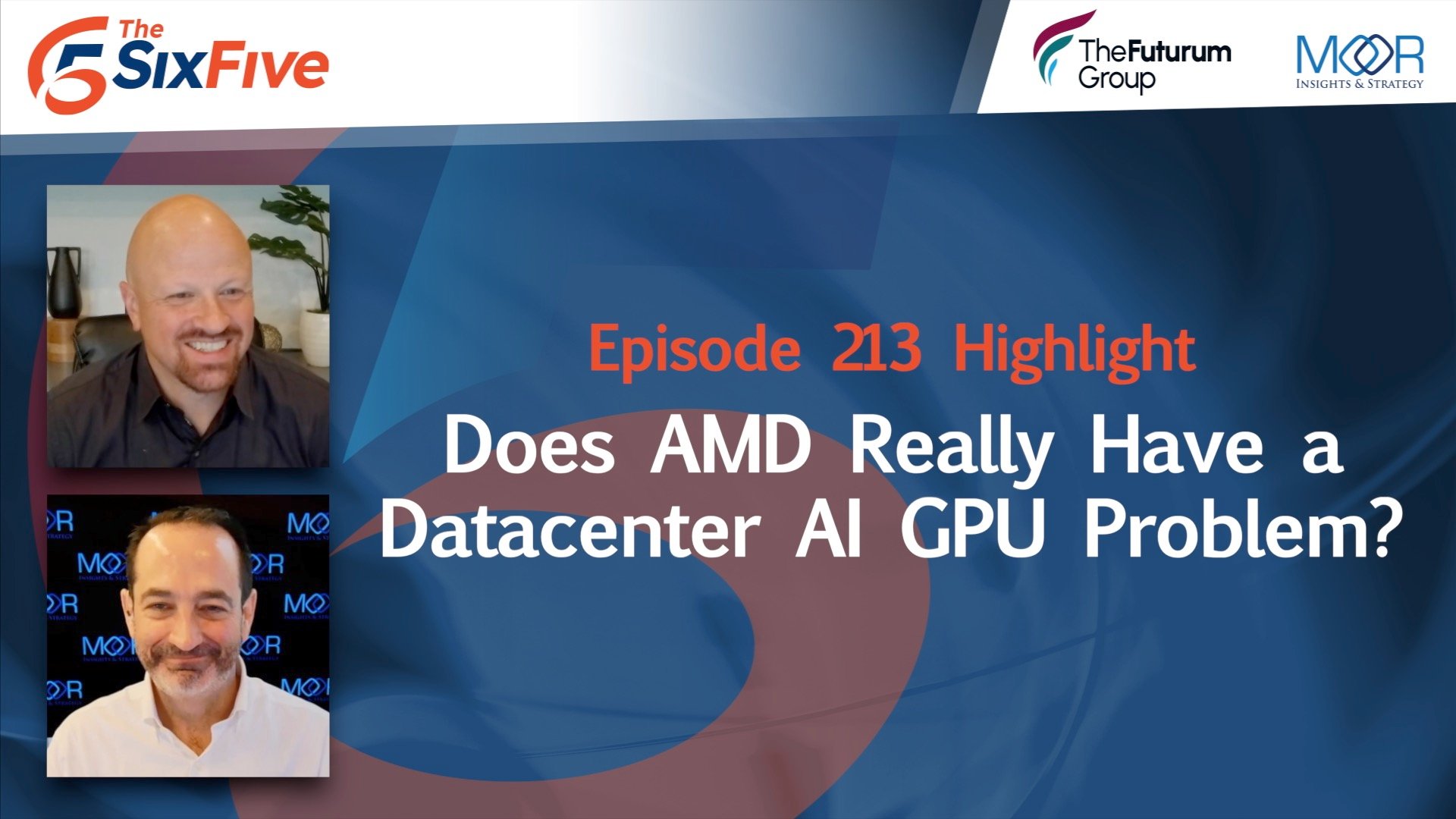
The Six Five team discusses does AMD really have a Datacenter AI GPU problem?
If you are interested in watching the full episode you can check it out here.
Disclaimer: The Six Five Webcast is for information and entertainment purposes only. Over the course of this webcast, we may talk about companies that are publicly traded and we may even reference that fact and their equity share price, but please do not take anything that we say as a recommendation about what you should do with your investment dollars. We are not investment advisors and we ask that you do not treat us as such.
Transcript:
Daniel Newman: Pat, by the way, the tweet of the week was “Hardware’s back, baby!”
Patrick Moorhead: Saw that. Dude, you totally dangled that in front of me and you knew that was red meat for me.
Daniel Newman: I put that juicy bit on there and I just laid it on the thing. I even at you, I put it out there and I added you. I just knew you were going to write something and make that blow up a little bit more. But also, look, how long were you worried that you were getting hidden in the closet? We expanded our business for years focusing more and more on software, but it wasn’t about software instead of hardware, it was software needs hardware, and it’s become symbiotic. And now having some hardware chops is actually cool again.
And Google, and Microsoft, and other companies are actually leaning in more to hardware engineers, because the fact is that if the hardware’s not right, all the software development in the world isn’t going to fix that. So anyways, sidebar, another red meat tweet that came out this week was that Google apparently has turned away from going forward with the MI300 as part of its offering, Pat. And that seemed to get buzz and create some concern and some interesting conversations on Twitter.
Patrick Moorhead: It did. And I love when I get attacked on Twitter, it’s pretty good. But so this came from a Dan Neistadt tweet, by the way, Dan, if you ever watched the show, you should get on the show. You should talk about this. Anyways, he cited the information article. Essentially, Dan, as you said, Google Cloud or/and Google are saying they’re not doing that. So a couple of things going on here.
First of all, Google didn’t say they would never use AMD MI, they just said, “We’re always looking for the best technology out there.” And for this round they’re using their own homegrown and NVIDIA. The other thing that I think was missed in the context is literally one of the largest hyperscalers with the largest data estates, Meta, was not included in the conversation, which made it incomplete. So when I step back, AMD actually has two out of the four US-based hyperscalers that are adopting it.
And by the way, I said something. I said that they’re sold out, which got a lot of people going. Let me give you the double-click of I mean what by that. What is spoken for, reserved. You can still buy an MI300 through the channel if you want. And those were reserved for the channel. But when you look at the giant volumes and the ramp that AMD had to do for its two out of four hyperscalers. No, by the way, Dell, Lenovo, and HPE, I think that the company is taking a measured approach on who it makes commitments to.
Having worked at AMD for 11 years, I saw sometimes that AMD would get into the situation where they would give a little bit of processors to a lot of different people, and that left a lot of them dissatisfied. Now in CPUs it’s easier, because the work that goes into the software isn’t zero, but it’s nothing compared to the software work you have to do to stand up a new data center, AI GPU.
So I stand by my belief that MI300, for the most part, is all reserved. You still can buy it. And I think when you look at the commitments, and I’m going to read right off the transcript from the last earnings, is they said, “From a supply standpoint, Lisa thinks that her supply chain partners can ship more than $3.5 billion.” And if we map what AMD’s commitments were, or sales for previous year were $400 million, and then that there was a forecast that went to 2 billion for this year, and then $3.5 billion I believe, when it’s all said and done, AMD will probably be around $5 billion in MI for the year. And a reminder that MI300 is the fastest ramping product to a billion in the history of AMD, pretty amazing when you look at what Opteron and Epic did. So just trying to clarify that and hey, hit me up on the comments if you think I’m completely out to lunch there.
Daniel Newman: Well, there’s a sell in, sell out, sell through aspect of all of this. And when you have channel partners that are buying and building servers based on an architecture, they want to put some on the shelf. So AMD sold them. So it’s all a technicality. But the thing about Twitter acts is that for those bullies and toxic people, it’s an absolute, it’s heaven for them. It’s heaven for toxicity. But it’s also, it can be a good debate. So that was somewhere in between. Anyways, let’s talk. Let me just add a little bit. There’s not a lot to add on this particular topic here. The long and the short of it is that AMD, by the way, you know who ramped that? Opteron? Were you around anybody? Is there anybody?
Patrick Moorhead: Well, gee, I don’t know. I hired the first product manager for Opteron in 2001 and I was there and then I ran corporate marketing when we did the announcement.
Daniel Newman: Okay, just making sure I could give you a little victory lap here.
Patrick Moorhead: Thank you.
Daniel Newman: Where I could squeeze one in. Look, AMD, there’s two, three different forces they’re fighting right now. You’re fighting the NVIDIA force, which is palpable. Everybody’s feeling the pressure. And if you’re selling your AI solutions, right now everybody’s going to get all the NVIDIA they can and they’re going to buy. AMD was the first viable merchant silicon GPU in the market right now, programmable and offering with the software, Rockham and Frameworks, and it had strong demand.
But the cloud providers are doing their own thing. The cloud providers are all building their own AI silicon. And let’s not mistake for a minute, they’re going to offer a variety, but they do have to focus. They’re making big bets, big investments now, too. AWS has been doing this for a while, but Microsoft and Google have now turned up the temperature. They are adding more. And so you got to be thinking that they’re going to put some rails up on how many things they want to offer, because you give the lowest common denominator to sales, and they may not sell the in-house stuff.
So I think there’s an impact on that. We’ll have NVIDIA because that’s what everyone’s asking for, but on the secondary offering side, if it’s going to be any other platform, if it’s not CUDA, if it’s not NVIDIA, we are building and selling our own higher margin for them. So I think that might be the bigger force. And let’s not kid, like what we’re seeing Intel pull off with the AI PCs, you can be sure they’re in the background. Intel is still very instrumental to all these cloud companies and their CPU business. And with what they’ve offered with Gaudi 3, while it’s not the same as a full on GPU, I believe there’s conversations about reserve capacity there, too.
And if you’re one of these giant cloud companies, you are thinking not just about what you’re going to offer right now, you’re also thinking about what you’re going to be supporting over the next few years to come. So they’re balancing homegrown, the demands of NVIDIA, demands, I believe, coming from Intel and having the alternative of AMD, and AMD doesn’t always have the same size to market, and to push, and to create demand as some of the other companies that have bigger marketing budgets and in NVIDIA’s case, a lot more immediate demand.
Author Information

Daniel is the CEO of The Futurum Group. Living his life at the intersection of people and technology, Daniel works with the world’s largest technology brands exploring Digital Transformation and how it is influencing the enterprise.
From the leading edge of AI to global technology policy, Daniel makes the connections between business, people and tech that are required for companies to benefit most from their technology investments. Daniel is a top 5 globally ranked industry analyst and his ideas are regularly cited or shared in television appearances by CNBC, Bloomberg, Wall Street Journal and hundreds of other sites around the world.
A 7x Best-Selling Author including his most recent book “Human/Machine.” Daniel is also a Forbes and MarketWatch (Dow Jones) contributor.
An MBA and Former Graduate Adjunct Faculty, Daniel is an Austin Texas transplant after 40 years in Chicago. His speaking takes him around the world each year as he shares his vision of the role technology will play in our future.