Don’t have VR gear to create your avatar? CommonGround wants to help out by creating a video avatar that you can take anywhere. And the $25 million they just got will help.
The News: CommonGround announced it has raised an additional $25M to help build an immersive virtual meeting experience. This brings CommonGround’stotal funding to nearly $45M, and their vision is to reimagine the future of online interactions. The company provides a platform that fosters authentic human connections as the world moves to increasingly remote, hybrid, and virtual environments. With real-life 3D representations of users far surpassing what’s possible on present-day platforms, users will finally be able to restore the deep personal connections we all crave. Read the full Press Release here.
CommonGround Raises Additional $25M to Help Build an Immersive Virtual Meeting Experience
Analyst Take: CommonGround’s raise of an additional $25M to help build an immersive virtual meeting experience is exciting news. CommonGround is an Israeli/Silicon Valley startup that has built technology for people to use their smartphones to scan their faces for responsive, real-time three-dimensional avatars that can be used in video applications. While these applications are yet to be announced, the idea suggests that users may eventually be able to use the same avatar across all their video conferencing platforms.
In a time when business buzzwords include “hybrid work,” “virtual meetings,” and the “metaverse,” the idea of having a consistent avatar across different platforms is not only novel but practical. Who would not want to have the same visual image when they dial into a Webex call, a Microsoft Teams meeting, or a zoom meeting?
The Use Case is Real
But this is not just about providing a fun feature for end users. The use case is there if you think about it.
Like many users, I often encounter situations where I may not be presentable, or my environment is not conducive for a professional video conferencing call. I may be in the car or dealing with something in the background that I don’t want to share with others on the call.
My current option is to go on video mute, which inserts a still-frame image of either my initials or my headshot in place of a live video stream. Others on the call are relegated to seeing a static image, which provides them with no visual cues or signals that I am engaged in the conversation. However, with an animated avatar, while my camera may not show my true self, it can still capture facial expressions and hand or head gestures. Others in the conference can see me blink, nod, or raise my hand if I have a question, without the distractions of whatever’ is taking place in my environment.
The Idea of Avatars is not New for Video Conferencing
The idea of avatars is not new for video conferencing. In 2022, Zoom introduced the concept of animal avatars, giving users choices such as a cute dog, fox, or even a raccoon to represent themselves in a Zoom call. While that might well be fun with friends, it’s likely not what you’d opt for on a call with the boss or with a client. At Zoom’s recent Zoomtopia’s event, the company announced the ability to use a human avatar that can be customized with choices of hair, skin tone, clothing, etc. While that’s a little more professional, I sstill see it as a cartoonish version of a person.
CommonGround Takes Avatars to the Next Level
CommonGround is taking avatars to the next level. Developed specifically to recreate YOU in the virtual world, CommonGround uses camera AI technology to capture and virtualize a user’s actual image.
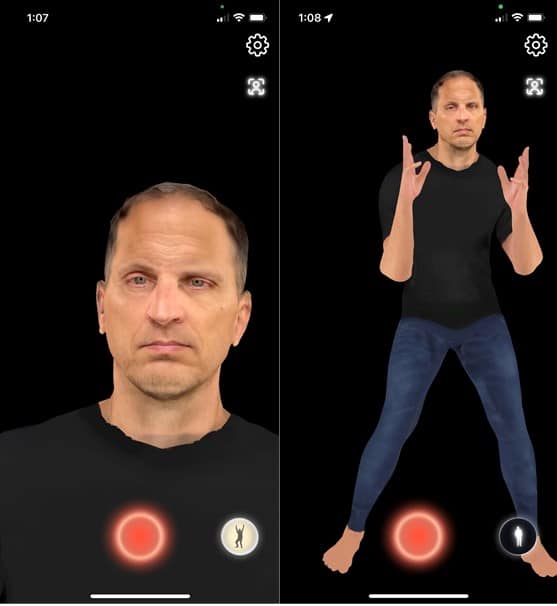
I tried it out, naturally using CommonGround’s iOS app. The process was easy, not too dissimilar from what a user goes through in setting up facial recognition and/or voice apps on a new mobile device. After moving my head side to side and speaking several phrases, the app uploaded data to CommonGround servers and eventually notified me that my avatar was ready.
Admittedly, it’s not quite to the quality level that I would say is an accurate representation of me, but nonetheless, it’s kind of cool. As you can see below, my eyes looked a bit crossed, and my hair was like a flashback to the days of Max Headroom, but this is much better than being a fox.
CommonGround’s Challenges as They Move Forward
We can conclude that the use case is there, but I am not convinced it is enough of a market for this offering from CommonGround to be a standalone company — at least not for long. In my opinion, the technology is at risk of becoming a feature within a video conferencing platform. Maybe CommonGround will be bought and integrated into another video product, or perhaps there’s a possibility they’ll be outflanked by a UC platform using its own computer vision and ML technology to create true-to-life avatars.
In order to succeed, CommonGround must integrate into platforms such as Microsoft Teams or Zoom in order to scale and broaden their adoption. But will that happen, or will this just inform these platforms what’s needed to make this into their own feature?
I am optimistic about the broader adoption of true-to-life avatars, especially for mainstream video conferencing applications. However, I suspect the same video use cases that will drive the need for their true-to-life avatars will be the number one challenge for CommonGround in the future.
Then again, they have $45M betting that they can make a go at this market and I’m looking forward to watching to see what they’re able to do.
Disclosure: Wainhouse Research, part of The Futurum Group family of companies, is a research and advisory firm that engages or has engaged in research, analysis, and advisory services with many technology companies, including those mentioned in this article. The author does not hold any equity positions with any company mentioned in this article.
Analysis and opinions expressed herein are specific to the analyst individually and data and other information that might have been provided for validation, not those of Wainhouse Research as a whole.
Other insights from Wainhouse Research:
Cisco Extends Webex Go, its Native Mobile Calling Capability, to the UK
The original version of this article was first published on Wainhouse Research.
Author Information

Craig holds a Master of Business Administration from the Texas McCombs School of Business as well as a Bachelor of Science in Business Administration from Tulane University.