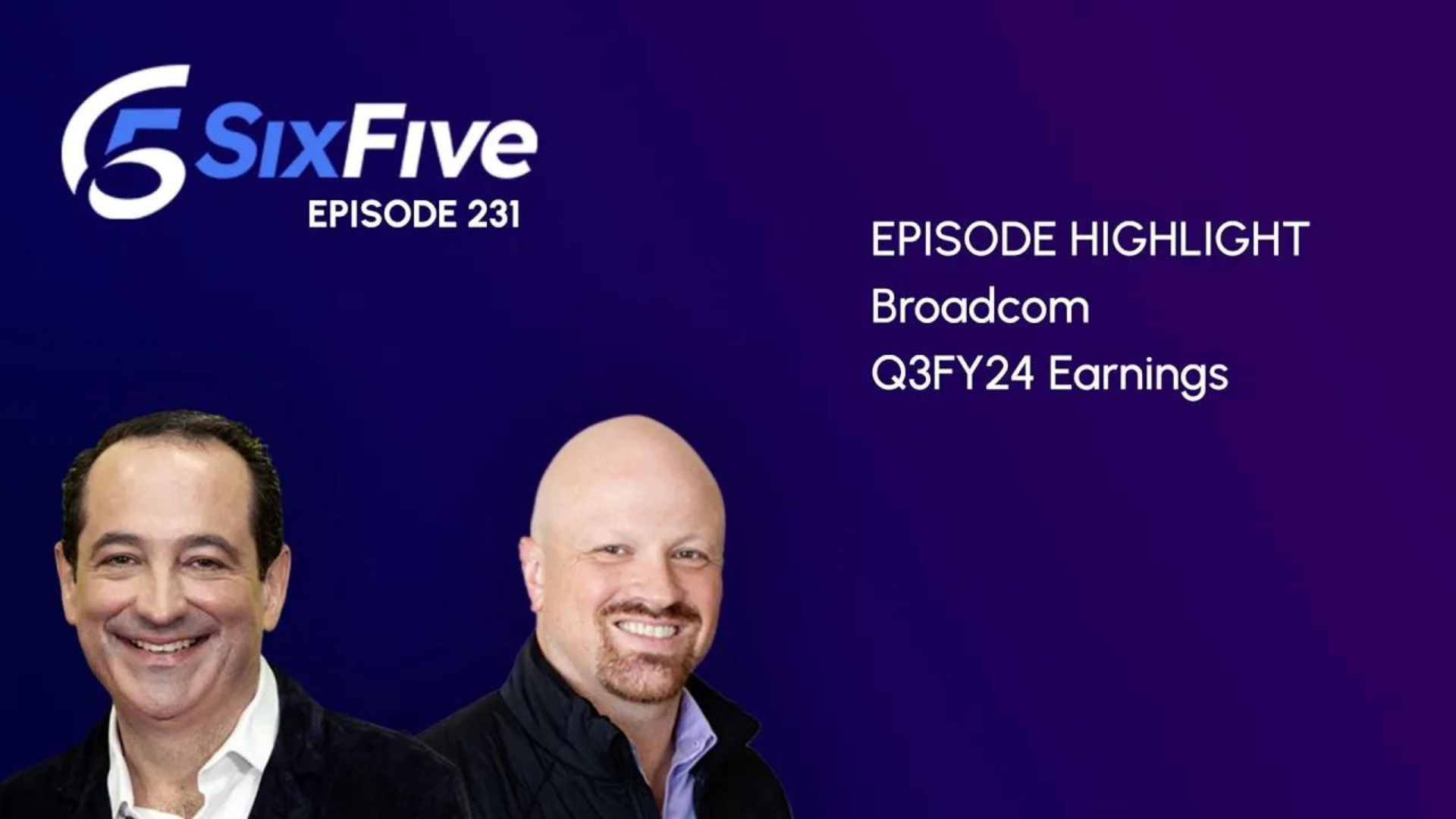
The Six Five team discusses Broadcom Q3FY24 Earnings
If you are interested in watching the full episode you can check it out here.
Disclaimer: The Six Five Webcast is for information and entertainment purposes only. Over the course of this webcast, we may talk about companies that are publicly traded and we may even reference that fact and their equity share price, but please do not take anything that we say as a recommendation about what you should do with your investment dollars. We are not investment advisors and we ask that you do not treat us as such.
Transcript:
Daniel Newman: You and I both have had a few opinions about this Broadcom. So, good result market hated it. What’s going on?
Patrick Moorhead: Yeah, so Broadcom beat on nearly everything, except the revenue guy that was off expectations by 1%. That’s $135 million on $14 billion. I digress. I just want to say CEO and CFOs, take note. This is the way to do the call. Hock Tan, it was a freaking masterpiece. Insights into the overall market, how Broadcom was playing, detail after detail, splitting the market between very crisply between AI and non-AI, Dan, the Q&A was 39 minutes. Okay, I think everybody got a whack at at least one or two questions. And Hock very patiently, sometimes they asked the same question. He didn’t get necessarily irritated. But that’s the way to do that. Okay, strong results, three factors. AI revenues continue to grow and they go strongly. Second thing, VMware bookings are accelerating. And three, non-AI semis have stabilized, which is crazy because the broadband market is still in the toilet based on the telcos and the SP. So, let’s start off with VMware.
What I loved is Hock just came right out and said, “We said pre-acquisition, we’re going to deliver 8.5 billion in EBITDA within three years of the acquisition. Where are they? Well on the path to achieving or exceeding this goal in the next fiscal ’25.” Okay, so I don’t know what is that, two years early, one year early. It’s early. Knock it out of the park. ABV analyze booking values up 32%. And yeah, I mean VMware is going well, but Dan, I think the meme was VMware is just like, “Ah, crazy. Customers are canceling their contracts and rolling their own KVM or going to Nutanix or Red Hat.”
Daniel Newman: Hypervisor, baby.
Patrick Moorhead: We want to do that. Well, it’s not in the cards right now. Listen, am I babe-ruthing this one? I mean there will be customers that will leave. I get that. Okay.
Daniel Newman: I think he’s actually ushering them out. He’s carrying their suitcases. Hock himself is like, “Let’s go.”
Patrick Moorhead: Yeah. This is something that companies like SAP should have done years ago. And by the way, VMware on its own would never have done this. Okay, let’s snap into semis. First of all, 11 plus billion forecast for AI going to 12. Two thirds of that is XPU or accelerator. And one third by the way, that’s $8 billion in XPUs. That’s almost twice as big as AMD’s data center business. So, factual it goes NVIDIA, Broadcom and AMD. And inside AI semis, custom AI accelerators grew 3.5x. Fabric ethernet switching, that’s Jericho, sorry, Tom Hock five and Jericho three AI, 4x growth. Lasers and pin diodes, 3x. PCI express switches, doubled. But hey, there’s non-AI two, which was just very eloquently up sequentially. Hock believes they hit the bottom in Q2 and Q3. Non-AI networking was up 17% sequentially even though it was down 41% year-on-year. And then bookings, demand is up 20% sequentially and all of this, even though broadband is still in the toilet. CEOs, CFOs, take note. Watch how Hock does it. Hock and Charlie show, just do what they do.
Daniel Newman: Hockonomics, baby. Hockonomics.
Patrick Moorhead: Totally.
Daniel Newman: Did I trademark that? I don’t know. Maybe someone else.
Patrick Moorhead: Are we going to debate on who? No, you said that first.
Daniel Newman: I said that first.
Patrick Moorhead: I know. I know.
Daniel Newman: I don’t get a lot of firsts, but I occasionally say so. Like I said, my historic rise to relevance isn’t all about one-liners. It’s never about death. That’s what you’re for, buddy. I’m kidding. I’m kidding. I love you all.
Patrick Moorhead: I’m so much older. I’m like 60 years old, Dan. You’re like 30.
Daniel Newman: We won’t hold that against you.
Patrick Moorhead: I’m twice your age. I never hold your inexperience against you.
Daniel Newman: Yeah, except when you do. Listen, I went on and I did an interview this morning on Yahoo Finance on this topic. I think you missed the email. I appreciate everyone for having me. Listen, first of all, Broadcom’s fine, 60x percent EBITDA top line. I mean look, only NVIDIA returns more EBITDA on revenue than Broadcom does. I mean, Hock runs an amazing business and the distribution and diversification. This isn’t some new cutting-edge future part. I mean of course those XPUs are, but he’s also selling wireless controllers, PCIe cards, and he’s still making this kind of money. That’s what Hock does. That’s why when people get all disenfranchised, I’m like, “Why? This is a great business. It just puts off tons and tons of cash.” The software, the move. I mean, look, CA performs well, the LACO-run mainframe business, the brocade side of the house, the semantic side of the house, all good. VMware’s going to be good. Pat, and I tell you, I’m being sincere when I say he’s carrying the bags of customers out the door. Any sort of deal, midterm, long-term agreements that he had that he was able to shed, he shed it. He’s okay with the 20-80 rule. He’ll take the 20, 30% biggest group of customers and then he’ll let the long tail do what the long tail does. He’ll make more money. He’s chopped up the heck out of the cost structure of that business and he will return capital to both the business and to shareholders.
That’s what he does well, Pat. The XPU part’s really interesting because sell in, sell out, the design part, how much is going in going out, it’s going out a lot faster. Meaning these companies are spending lot more on this stuff than maybe it’s being consumed. And that’s according to our data. But I think the consumption is going to start to ramp really fast as this killer inference workload starts to ramp. And XPUs are really, really in a good position, Pat, we’re showing the XPU accelerator to be like 20% faster growth than the GPU. Now having said that, I actually think it’s going to be faster than that. I think that’s a conservative outlook based upon sort of sentiment. And I don’t think the market fully appreciates the sentiment about what an ASIC, a well-designed ASIC for drug discovery recommendation engines, filtering can do in terms of lower power, performance and cost. And of course, vertical integration and control. You’ll never hear the cloud companies talk about vertical integration. They’re all going to go down the path of vertical integration.
And Broadcom’s become really astute at building these XPUs. So, they know the plan, they know the cost, they know the structure. And Hock talked ad nauseum about how this kind of market pivot is going on. Pat, I actually think this is a killer business. And then by the way, all this, we’re barely even talking about the fact that networking. Look, all these companies that don’t want to be beholden, don’t want to be locked to the NVIDIA and Finnegan in rack, out the rack and be link. Who are they going to go to? Broadcom is super well positioned in this particular space, that 12 billion number … Here’s my take on why the market kind of crapped all over it is they wanted it to be like 15. It was the same as that whole kind of whisper number with NVIDIA like, “Oh, they only are going to be by two and a half billion next quarter.” It’s like, “That’s not good enough.” Look, they’re trading at something like 26 times forward. It’s not a super high multiple or premium for a company that’s delivering 60x percent EBITDA. They’ve diversified. They’ve got different businesses. Hock always makes them profitable.
And one other thing, Pat, the whole wireless and connectivity part of the PC, the stuff they do with Apple and smart devices, the ramp on that is just starting, meaning that old kind of part of their business, they’re not really on the AI side of Apple as much in the devices, but as this ramps, it becomes what I think will be one of the most popular parts. This iPhone 16, 17, Broadcom’s got the most content out of any silicon provider to Apple. That partnership is deep and we’re not even seeing that in the numbers. That’s the part that’s lagging right now. So, all of a sudden next year with these new PCs, the new Macs, the new iPads and the new phones, Broadcom will deliver. Pat, I’m super bullish on this one.
Author Information

Daniel is the CEO of The Futurum Group. Living his life at the intersection of people and technology, Daniel works with the world’s largest technology brands exploring Digital Transformation and how it is influencing the enterprise.
From the leading edge of AI to global technology policy, Daniel makes the connections between business, people and tech that are required for companies to benefit most from their technology investments. Daniel is a top 5 globally ranked industry analyst and his ideas are regularly cited or shared in television appearances by CNBC, Bloomberg, Wall Street Journal and hundreds of other sites around the world.
A 7x Best-Selling Author including his most recent book “Human/Machine.” Daniel is also a Forbes and MarketWatch (Dow Jones) contributor.
An MBA and Former Graduate Adjunct Faculty, Daniel is an Austin Texas transplant after 40 years in Chicago. His speaking takes him around the world each year as he shares his vision of the role technology will play in our future.