Analyst(s): Olivier Blanchard
Publication Date: October 27, 2026
The Event—Major Themes & Vendor Moves: At unBoxed 2026, held September 28–30 at the Moscone Center in San Francisco, Amazon Ads announced a near-total re-architecture of how advertisers buy, measure, and show up on Amazon.
One of the most critical developments discussed at the event is the merger of the Amazon DSP and the Amazon Ads console into a single platform, Amazon Ads Agent, with a conversational AI layer that can plan media, manage campaigns, and analyze performance in natural language.
Amazon also launched a slate of AI-driven campaign types (Full-Funnel Campaigns, DVA+), new conversational ad formats for shoppers (Branded Conversations, Review Requests, Sponsored Services), and developer-facing tools for third-party agents (the Amazon Ads MCP Server and an AMC Expert Tool that writes Amazon Marketing Cloud queries).
The through-line of the event was that both sides of Amazon’s ad marketplace, the advertiser buying the media and the shopper seeing it, are moving into AI conversations at the same time.
Why It Matters Now
Amazon’s ad business is already large enough that changes to its buying stack ripple through the whole retail media and programmatic ecosystem. Every change or upgrade has to net out positively for advertisers, or everyone has a bad day. As far as I can tell, however, Amazon’s AI investments are doing exactly what they set out to do: improve systems, deliver better UX, and, most importantly, achieve positive ROI.
For reference, Amazon reported $19.8 billion in advertising services revenue for Q2 2026 (quarter ended June 30), up 26% year over year from $15.7 billion, following $17.2 billion (+24%) in Q1 2026. Some of that Q2 growth is calendar noise, since Prime Day landed in Q2 this year versus Q3 in 2025, but the trajectory is clear.
On the Q2 call, Andy Jassy said advertisers using Ads Agent targeting saw 8% lower cost per impression and 6% lower cost per acquisition – concrete evidence that Amazon’s efforts to transform its agentic layer from a feature into the platform itself are already yielding the types of results everyone was hoping to see.
What Amazon Announced
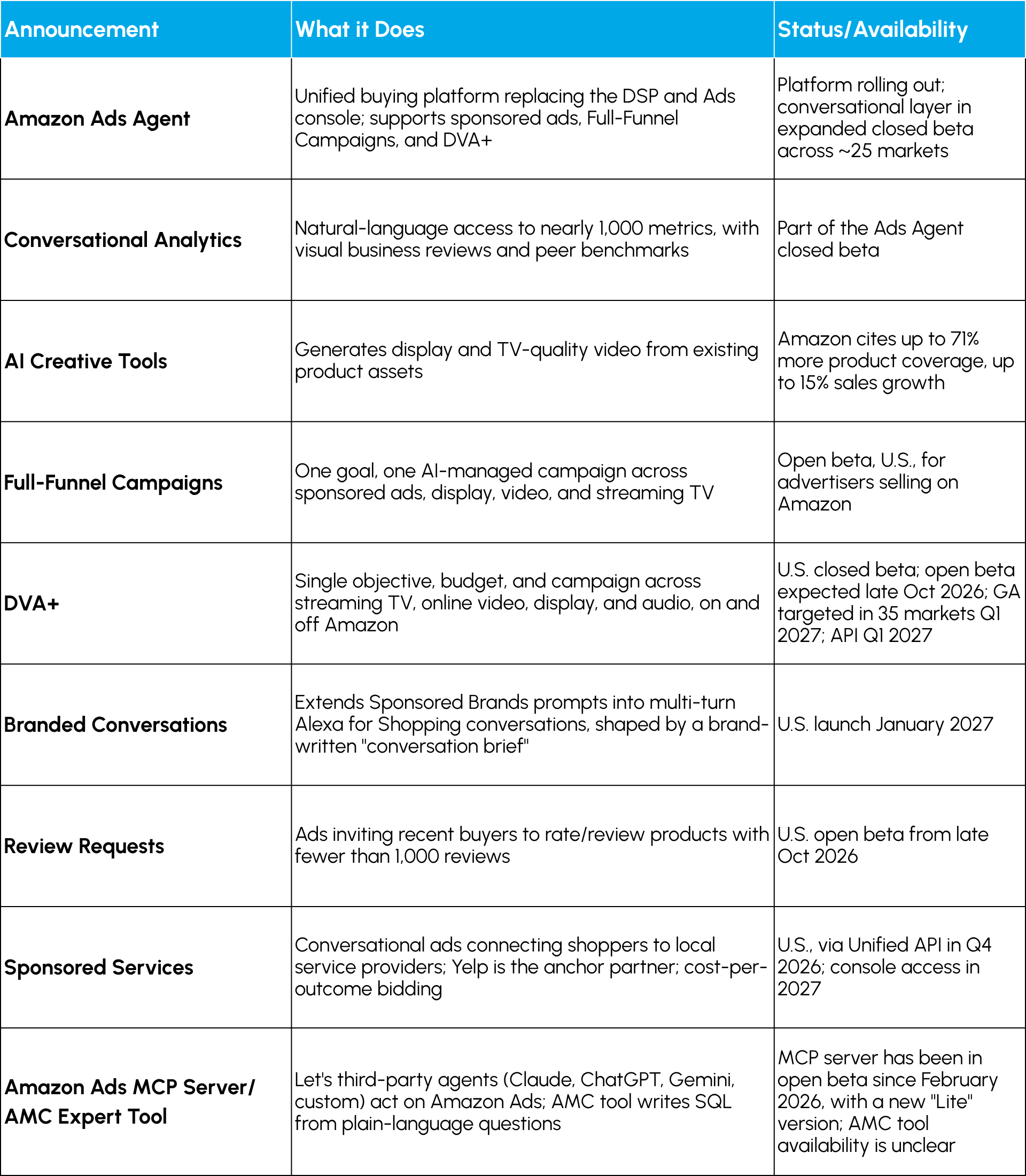
The announcements fall into four groups, with availability varying across markets, and several items still being in either closed or open beta. Generally, though, as I understand it, this is a breakdown of the announcements:
1. The Buying Stack Becomes an Agent
Amazon Ads Agent is the pivot: Folding the DSP and the self-serve console into one environment removes a long-standing seam in Amazon’s business. Sponsored ads (search-adjacent, performance-heavy, largely self-serve) and programmatic (display, video, streaming TV, often agency-managed) have historically lived in different tools with different workflows. The conversational experience sits on top. Advertisers can ask about audience sizing, reach forecasts, and budget recommendations; manage and optimize Sponsored Products campaigns; and request performance analyses delivered as charts with peer benchmarks. Paula Despins, VP of Ads Measurement, summed up the understated pitch: “It’s less time churning through data, more time actually thinking about what to do with it.” While this is more difficult to measure in terms of ROI, it isn’t hard to gauge how important it is.
For agencies and ad-tech partners, the more consequential pieces may be the developer tools. The Amazon Ads MCP Server, in open beta since February 2026, gives external agents a single integration point for creating and managing campaigns, running reports, and accessing billing. At unBoxed, Amazon added a “Lite” version that starts with three core tools and lets agents discover additional capabilities as needed, a sensible design to keep agent context windows manageable.
The AMC Expert Tool does something similar for Amazon Marketing Cloud, translating natural-language analytics requests into AMC SQL. Partner demos cited a complex AMC query dropping from roughly three hours to about 3.5 minutes, though that figure came from a tool vendor (Pacvue) rather than an independent test.
2. AI-managed Campaigns Span the Full Funnel
Full-Funnel Campaigns and DVA+ are two expressions of the same idea: give Amazon’s AI the objective and the budget, and let it allocate across formats and funnel stages. Full-Funnel Campaigns combine sponsored ads, display, video, and streaming TV into a single campaign, scored against a Long-Term Sales metric that adds the estimated 12-month value of new-to-brand customers to immediate sales. Amazon says beta testers saw a 67% higher long-term ROAS and a 29% lower cost to acquire new-to-brand customers compared with running the same formats separately. Amit Bhattacharyya, VP of Agentic Intelligence and Models, said the single campaign “shares signals in real time.”
DVA+ brings programmatic display, video, and audio to advertisers who have never used a DSP. The default mode is a four-step flow (objective, products or brand URL, AI-generated creative, budget). An advanced mode restores manual audience targeting, bid strategies, publisher lists and deals, frequency caps, and Campaign Guidance, and accepts natural-language targeting or an uploaded media plan. Kelly MacLean, VP of Engineering, Science, and Product, explained the two-mode design: “Not every advertiser is starting from the same coordinates.”
I need to share two minor caveats: 1) The performance numbers are Amazon-reported, come from self-selected beta participants, and in the Full-Funnel case are measured against a blended average rather than a holdout. 2) Long-Term Sales is partly a forecast that Amazon both generates and grades. This isn’t inherently a bad thing, but the old adage of “trust but verify” probably applies here, at least for now.
3. Ads Move Into the Shopping Conversation
On the consumer side, Amazon is building ad formats for a world where shoppers increasingly ask an assistant rather than scroll a results page. Branded Conversations, which debuted in the opening keynote, extends Sponsored Brands prompts into multi-turn conversations inside Alexa for Shopping. In Amazon’s demo, a “coffee maker” search produced a sponsored “Help me decide” prompt that led into a brand-styled experience with follow-ups like “works with capsules” and “fresh ground beans.” Brands shape these conversations through a brief that covers differentiators, product comparisons, and complementary items. Muthu Muthukrishnan, VP of Sponsored Products and Brands, put it simply: “Shopping is rarely resolved with just a single prompt.”
To make this useful and not intrusive, Amazon set some guardrails: 1) Sponsored conversations are labeled with a disclosure that brand-provided information shaped the response, and 2) brands cannot choose which reviews the AI surfaces. Asked whether brands could make favorable reviews more visible, Amazon’s Amjad Jbara answered flatly, “No.” Amazon cited early data showing nearly 20% of shoppers who engaged with a prompt continued the conversation about that brand, and Jassy has said shoppers who click a sponsored prompt convert 48% more often and spend 21% more on average, so this is a pretty good early signal that Amazon’s methodology here is sound.
Review Requests also addresses the cold-start problem for new products. The ads target recent buyers of products with fewer than 1,000 ratings and reviews, inviting a one-click star rating or written review. We note that incentives are prohibited, and campaigns pause automatically at 1,000 reviews. Even with these limits, Amazon says testing produced roughly 3x as many ratings and reviews per week. The format is billed per click, so advertisers pay whether or not a review follows and whether it is positive, which I also like. Broadly, I find Amazon’s decision to consistently bake ethical practices into its solutions both commendable and encouraging.
Sponsored Services extends Amazon’s closed loop beyond products for the first time. It connects shoppers with local service providers (plumbers after a faucet purchase, installers for products that need professional setup), with Yelp as the anchor partner for home and local services. Restaurants are also in scope at launch. The format is conversational, bid on a cost-per-outcome basis, and delivers leads to a provider’s CRM via webhook.
4. Reach Extends to Other Surfaces
Two additional announcements made around the time of the unBoxed event show Amazon pushing its ad stack beyond its own properties
The first was on September 10: Amazon Ads announced a partnership with OpenAI that lets select U.S. advertisers in a pilot extend Amazon Ads campaigns into conversational ad formats in ChatGPT. These are planned and optimized within existing full-funnel workflows.
The second came on September 22: Amazon and Best Buy expanded their Fire TV partnership. Fire TV remains the exclusive OS on Best Buy’s Insignia TVs. This matters because, starting in February 2027, Best Buy Ads will run on Amazon Ads’ programmatic technology, giving brands access to Fire TV inventory on new and existing Insignia sets.
Futurum’s Take
Amazon Ads: Right out of the gate, unBoxed 2026 delivered an immediately coherent product and ROI story for Amazon Ads. One could argue that merging the DSP and console into Amazon Ads Agent was overdue housekeeping as much as innovation, but the decision to pin this to conversation as the primary interface, and to expose the same capabilities to outside agents through MCP, was clever. It also positions Amazon well for the next phase of ad buying, where a growing share of campaign setup, optimization, and reporting will be done by software agents rather than individuals clicking through dashboards. Amazon’s advantage here is primarily structural: it owns the shopping signal, the retail conversion, and an expanding set of video and streaming surfaces, so agents can close the loop in ways that most ad platforms cannot.
Advertisers and Agencies: The trade-off is control. Full-Funnel Campaigns, DVA+, and the AI creative tools all ask advertisers to give Amazon objectives and budgets and to trust the allocation process, with Amazon also supplying the metrics that grade the outcome. While the beta results look encouraging, we note that Amazon Ads Agent only sees Amazon, so brands selling across Walmart, Target, and DTC will still need independent measurement and incrementality testing before shifting budget. The value of agencies shifts accordingly, at least within Amazon’s ecosystem: fewer campaign operations, more writing the context (brand rules, margin floors, conversation briefs) that steers agents. It also means more governance over what those agents are allowed to do. Note that migrating large accounts to new buying flows mid-Q4 might require a bit of finesse.
Shoppers and Trust: In my view, Branded Conversations might actually be the most strategically important and the most delicate announcement of the event. Amazon is right that shopping is becoming conversational, and letting brands inform the assistant feels like a natural evolution of sponsored placement. Where things get tricky is that the line between helpful guidance and paid persuasion could be harder to discern inside a chat, and the margin of error when it comes to trust and UX is razor-thin. Case in point: An April Ipsos survey found more than half of U.S. adults would trust AI recommendations less if they knew advertisers influenced them. Amazon’s disclosure labels and its refusal to let brands curate reviews are the right starting guardrails, however. How consistently it enforces them will determine whether conversational ads build or erode the trust the format depends on to be successful.
The Broader Ecosystem: The ChatGPT pilot, the Best Buy deal, and Sponsored Services all point in the same direction: Amazon wants its ad stack to be the buying layer for commerce-adjacent media wherever it runs, including surfaces that Amazon does not own. That puts it in more direct competition with Google, Meta, and the independent DSPs, and gives other retail media networks a harder choice between building their own stacks and plugging into Amazon’s (as Best Buy has just done). MCP support also signals that Amazon expects third-party agents, not just its own, to be a major channel into its platform.
What’s Next: The near-term milestones are DVA+ and Review Requests moving to open beta in late October, Sponsored Services arriving via API in Q4, Branded Conversations launching in the U.S. in January 2027, DVA+ general availability across 35 markets in Q1 2027, and Best Buy Ads moving onto Amazon’s programmatic stack in February 2027. The metric to watch is whether Amazon begins disclosing third-party-verified or holdout-based results for its AI-managed campaigns. That is what would turn this from a compelling platform pitch into a budget reallocation.
Sources
- unBoxed 2026 news and announcements, Amazon Ads
- unBoxed 2026 event page, Amazon Ads
- Conversational experience in Amazon Ads Agent, Amazon Ads
- DVA+: Display, Video, and Audio campaigns, Amazon Ads
- Get product reviews faster with Review Requests, Amazon Ads
- Sponsored Services, Amazon Ads
- Amazon Ads integration with ChatGPT, Amazon Ads, Sept. 10, 2026
- Best Buy and Amazon expand Fire TV partnership, Amazon Ads, Sept. 22, 2026
- Amazon Ads MCP Server open beta, Amazon Ads, Feb. 2, 2026
Disclosure: Futurum is a research and advisory firm that engages or has engaged in research, analysis, and advisory services with many technology companies, including those mentioned in this article. The author does not hold any equity positions with any company mentioned in this article.
Analysis and opinions expressed herein are specific to the analyst individually and data and other information that might have been provided for validation, not those of Futurum as a whole.
Other Insights From Futurum:
Amazon Q2 2026: AWS Momentum Accelerates as AI Investment Climbs
Salesforce’s Agentforce Commerce Pushes Agentic AI From Hype to Retail Revenue Reality
Is Amazon Ads AI Becoming the Center of the Advertising Stack?
Featured Image: Amazon
Author Information

Olivier Blanchard is Research Director, Intelligent Devices. He covers edge semiconductors and intelligent AI-capable devices for Futurum. In addition to having co-authored several books about digital transformation and AI with Futurum Group CEO Daniel Newman, Blanchard brings considerable experience demystifying new and emerging technologies, advising clients on how best to future-proof their organizations, and helping maximize the positive impacts of technology disruption while mitigating their potentially negative effects. Follow his extended analysis on X and LinkedIn.