Analyst(s): Olivier Blanchard
Publication Date: October 20, 2026
NVIDIA will introduce a 64GB DGX Spark configuration through six manufacturer partners on October 23, starting at $4,999. The system retains the larger model’s compute architecture and software stack, while NVIDIA Sync simplifies clustering and local model deployment. Its value depends on how buyers balance memory capacity, development requirements, and the higher prices now affecting the DGX Spark lineup.
What Is Covered in This Article:
- DGX Spark 64GB availability, pricing, and retained hardware capabilities.
- Memory capacity and the practical requirements of local AI development.
- NVIDIA Sync clustering, expansion costs, and Model Launcher.
- Software readiness, competing configurations, and AI PC silicon economics.
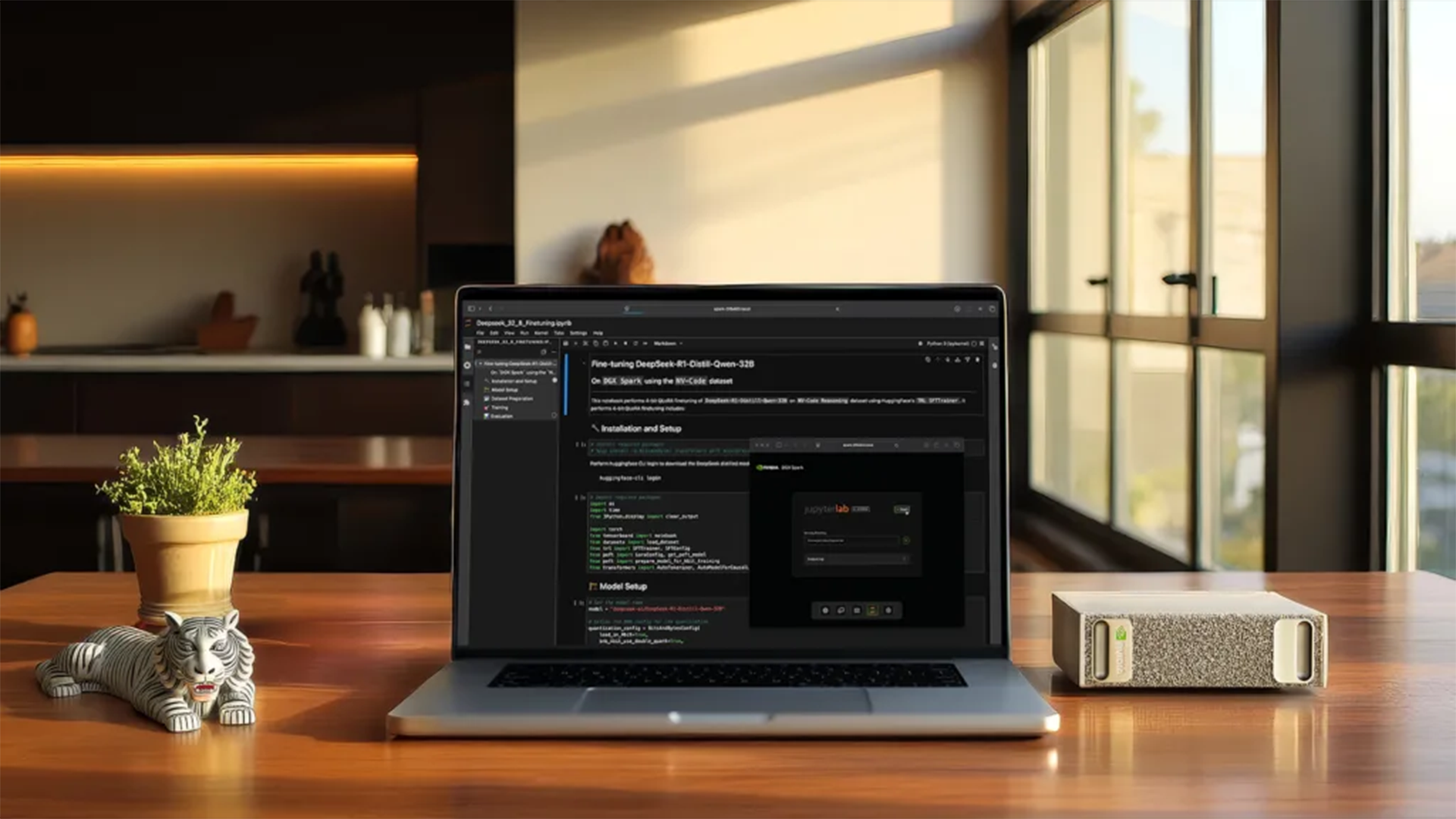
The News: NVIDIA announced a DGX Spark configuration with 64GB of unified memory, available exclusively through Acer, ASUS, Dell, Gigabyte, HP, and MSI beginning October 23 at $4,999. The system retains the GB10 Grace Blackwell Superchip, ConnectX-7 networking, DGX OS, and NVIDIA AI software stack, with support for models up to 100 billion parameters running entirely on-device.
Two 64GB systems can connect directly through a QSFP cable over a 200GbE link, pooling memory to 128GB and supporting models up to 200 billion parameters. NVIDIA Sync Cluster Assistant discovers connected systems and configures their network, while the Model Launcher, scheduled for the end of October, will launch Qwen3.8 27B on a single system or cluster and configure OpenCode for browser-based coding.
NVIDIA DGX Spark 64GB’s Low Price-Point Aims To Accelerate Local AI Inference
Analyst Take: The good news is that NVIDIA DGX Spark 64GB gives developers a lower-priced option within today’s relatively pricey DGX Spark lineup while preserving its compute architecture and development environment. The not-so-great news, however, given the platform’s pricing history, is that the new 64GB configuration, oddly, starts above the original 128GB model’s launch price, which could act as a brake to early adoption.
One might also be justified in initially worrying that if the strongest case for purchasing it primarily rests on a specific type of workload that fits its memory capacity and benefits from NVIDIA’s software stack (with clustering providing an expansion option that requires its own financial assessment), organizations might look for other – perhaps more agile – options. But upon further examination, I feel that this is the wrong perspective. A more financially accessible version of DGX Spark, albeit with more casual memory specs, could be the sweet spot that brings scale to the category’s adoption roadmap. More on that in a moment.
A Smaller Configuration Does Not Resolve the Pricing Pressure
The crux of the disconnect is this: The DGX Spark 64GB starts at $4,999, compared with the original 128GB/4TB model’s $3,999 launch price (despite its subsequent $6,950 price). To be fair, current 128GB GB10 systems range from roughly $7,000 to $9,000, which makes the new option a lower entry point into a substantially more expensive product family, but the launch price discrepancy could be enough to initially send mixed messages to risk-averse buyers about pricing fluctuations, value, and product adaptability at a time when most require certainty and consistency from their AI hardware vendors. It is a minor distraction, but a distraction all the same, which seems like an unnecessary friction point.
On the bright side, buyers can expect to retain the same 20-core Arm CPU, Blackwell GPU, and 273 GB/s shared memory bandwidth. The flip side of that, however, is that they have to accept half of the original model’s memory capacity, and that is where the real question about pricing and value begins to bump up against the comparatively high launch price, especially in an increasingly competitive environment for that type of system. Case in point: AMD Ryzen AI Halo and Ryzen AI MAX systems sell for approximately $3,500–$4,500, with a 128GB Halo configuration at $4,699 and a 192GB version around $6,500, alongside ROCm support and Windows and Linux compatibility.
This means that DGX Spark 64GB will need to justify its price through the buyer’s use of its retained compute and software capabilities, particularly when competing configurations offer more memory at similar prices. NVIDIA’s ecosystem may be worth the high price with a lower configuration for now, but I wonder what the shelf life of that thinking really is.
DGX Spark 64GB Fits a Defined Class of Local Workloads
For reference, NVIDIA specifies support for models up to 100 billion parameters, with 30–35B-class models and autonomous agents among the practical targets, and Qwen3.8-27B, Meta Muse Glimmer, and Nemotron 3.5 Lightning among the models that fit on one system. Its coherent unified memory lets the CPU and GPU share a synchronized pool, eliminating the need to duplicate data or transfer it between separate system RAM and GPU memory. The Blackwell GPU supports FP4 compressed model formats while the Grace CPU handles data preprocessing and orchestration within the same package.
On the system’s broader value proposition and relevance, workflows include the following critical applications:
- Continuous coding and research agents
- Fine-tuning models on proprietary source code
- Running inference for applications on another PC
- Preparing vision models for deployment to Jetson-powered edge devices
And because local execution keeps those workloads on the owner’s hardware, this avoids per-token cloud inference charges. If nothing else, this is, to me, the most important of the category’s value propositions. The question now is whether the smaller memory configuration is worth the lower price, or if organizations should just spring for the 128GB version. Buyers should select DGX Spark 64GB against their actual model, context, and concurrency requirements, because those requirements determine whether its memory capacity supports the intended work.
On the whole, NVIDIA providing another option to organizations seems like a net positive, particularly in a memory-constrained and cash-stressed environment. And as smaller enterprises, SMBs, and other organizations look to reduce their dependency on cloud-based token-based toll booths, the lower price point, more entry-level memory footprint, and ubiquitousness of NVIDIA’s software ecosystem could be a path to scale for this type of system. AMD’s compelling price point with more memory could challenge these assumptions, however.
Easier Clustering Strengthens Expansion but Requires a Complete Cost Comparison
NVIDIA Sync Cluster Assistant makes expansion more practical by discovering connected systems, validating their configuration, and setting up ConnectX-7 networking while retaining the same software environment across nodes. Two directly connected 64GB systems pool memory to 128GB and double aggregate memory bandwidth, while NVIDIA’s Qwen3.8 27B test indicates a performance improvement of up to 1.7×.
The benchmark’s single-system memory configuration requires clarification before buyers use that result to choose between a cluster and a larger standalone system. Four-system configurations provide 256GB with 64GB nodes or 512GB with 128GB nodes through a qualified 200GbE switch, extending capacity while adding hardware and networking requirements. Clustering gives developers a defined route to more capacity, but complete configuration pricing must guide the decision between expansion and a larger initial purchase.
Software Readiness Must Carry the Premium Hardware Case
DGX Spark 64GB ships with DGX OS and NVIDIA’s AI development environment, including CUDA-X AI libraries, Agent Toolkit, Nemotron models, and support for Ollama, vLLM, and PyTorch with CUDA. TensorRT, Jupyter, OpenShell’s policy-based controls, and NemoClaw further support development, while NVIDIA Sync enables access from Windows PCs and Macs, and the upcoming Model Launcher will configure local models for OpenCode.
Futurum’s 1H 2026 Intelligent Devices Market Sizing & Five-Year Forecast projects AI PC silicon content value rising from approximately $313 in 2025 to $401 by 2030 in the base case, a 28% increase that offsets flat consumer PC volumes and positions PCs as a premium silicon destination. As silicon content value increases, DGX Spark’s preconfigured development stack and remote inference workflows give buyers concrete capabilities to assess alongside memory capacity and purchase price. NVIDIA’s strongest case for DGX Spark 64GB rests on how effectively those capabilities will support the developer’s work, making software compatibility and deployment readiness central to the purchasing decision.
What to Watch:
- Confirm the OEM configurations available on October 23, particularly the storage capacity included at $4,999 and the corresponding prices of 128GB systems.
- Clarify the single-system baseline and test conditions behind the Qwen3.8 27B performance improvement of up to 1.7×.
- Track the end-of-October Model Launcher release, including model deployment across connected systems, access from developer laptops, and OpenCode setup.
- Compare AMD configuration prices, memory capacity, operating-system support, and ROCm compatibility with the requirements of the intended workload.
- Check availability of the announced 64GB playbooks for vLLM, OpenClaw, and distributed workloads, along with Blender’s planned downloadable installer.
- Assess the full cost and configuration requirements of larger clusters, including the qualified 200GbE switch required for four-system setups.
Read the complete blog of NVIDIA DGX Spark 64GB and its clustering capabilities on the company website.
Disclosure: Futurum is a research and advisory firm that engages or has engaged in research, analysis, and advisory services with many technology companies, including those mentioned in this article. The author does not hold any equity positions with any company mentioned in this article.
Analysis and opinions expressed herein are specific to the analyst individually and data and other information that might have been provided for validation, not those of Futurum as a whole.
Other Insights From Futurum:
The $246 Billion CPU Opportunity’s Winning Chip Has Not Been Designed Yet
NVIDIA Wants Agent Safety Enforced in Silicon
NVIDIA Q2 FY 2027: AI Infrastructure Demand Extends Into FY 2028
Featured Image: NVIDIA
Author Information

Olivier Blanchard is Research Director, Intelligent Devices. He covers edge semiconductors and intelligent AI-capable devices for Futurum. In addition to having co-authored several books about digital transformation and AI with Futurum Group CEO Daniel Newman, Blanchard brings considerable experience demystifying new and emerging technologies, advising clients on how best to future-proof their organizations, and helping maximize the positive impacts of technology disruption while mitigating their potentially negative effects. Follow his extended analysis on X and LinkedIn.