The News: Recogni announced the availability of Pegasus, a PCIe card that allows Recogni’s Scorpio, a breakthrough 1000 TOPS (Peta-Op) class inference solution for autonomous mobility, to be configured for any autonomous mobility application. Read the full Press Release on the Recogni website.
Recogni Launches Pegasus PCIe Card to Spur Autonomous Mobility Innovation
Analyst Take: Recogni debuts its Pegasus PCIe card solution aimed at advancing system architectural flexibility and swift deployment across an expanding array of autonomous mobility applications. The straightforward integration of Recogni’s Scorpio processor into any autonomous mobility application with Recogni’s new Pegasus PCIe card and Recogni’s software development kit (SDK) cues up the company to demonstrate the multi-platform versatility and readiness of its portfolio to drive ecosystem-wide compute performance, power efficiency, latency, and silicon design breakthroughs.
From my view, the Scorpio AI processor’s built-in versatility aimed at driving advanced driver assistance system (ADAS) and autonomous driving (AD) optimization stands out. For ADAS/AD applications, the topmost capabilities in demand I see include high compute performance (150-1000 trillion operations per second [TOPS]), low power efficiency (up to 40 Watt/TOPS), low processing latency (<10 milliseconds), and ultra-small silicon area (1000 TOPS/100mm2). Notably, Recogni attained full functional design for Scorpio in less than 15 months, beating the 24+ months pattern for industry design cycles and shipping its first customer system systems in early 2022. As such, Recogni enables long range 3D Object Detection (3DOD), delivering 8 megapixels (MP) detection at >300 meters. In contrast, systems that support 2 MP maximum can only attain up to 100 meters.
Further sharpening differentiation is that Scorpio’s 1000 TOPS capabilities exceed the current 600 TOPS requirement (i.e., 4 cameras x 30 FPS x 5 TOPS/frame). Such high-performance compute capabilities deliver higher resolutions that can improve road user detection in dense urban environments as well as sharpen long distance vehicle detection in highway driving environments.
I find that Scorpio’s air-cooled design enables OEMs to bypass using more costly liquid cooling system-on-chip (SoC) methods, further crystallizing Recogni’s competitive advantages against SoC alternatives, such as the Tesla HW3 (FSD) and NIO Adam. Scorpio enables significantly lower system cost due to a purpose-built architecture that delivers up to a breakthrough 40 TOPS/Watt.
Of vital importance, Scorpio increases EV driving range by incorporating traffic jam pilot mode that is a key initial application of Level 3 conditional driving automation capabilities. Accordingly, Recogni can extend electric vehicle (EV) driving range by >90 kilometers per charge at 30 kilometers per hour average speed. The high compute innovation of Recogni’s efficient Log Number System (LNS) and patented compression method results in comparable accuracy to single-precision floating-point format 32 bits (FP32) and significantly reduced compute power needs.
Recogni: Delivers Key AD Power and Range Competitive Advantages
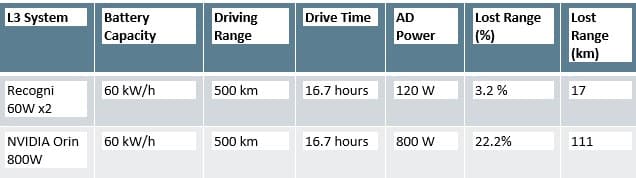
Moreover, the Recogni solution provides <10 ms of compute latency by parallelizing the pipeline from sensor input to machine learning (ML) output. This design innovation requires no buffering in external memory and provides 100% deterministic, zero-jitter execution that assures the processing of high-resolution data at the lowest latency.
Plus, the ultra-compact Recogni Scorpio silicon design is decisive in producing process-originated advantages over NVIDIA Orin across key metrics such as fourfold smaller die with a sevenfold boost in performance (based on on-sparse [dense] TOPS), and 13x more power efficiency (per MLPerf 2.0).
Key Takeaway: Recogni Advances ADAS/AD Platform Capabilities
Taken together, the Scorpio AI processor’s silicon innovations and competitive advantages underpin Recogni’s Phoenix ADAS/AD compute platform that ensures breakthrough scalable ADAS/AD platform capabilities across the 150 to 2000 TOPS range key to driving autonomous driving capabilities forward through powerful design flexibility and integration ease.
I believe Recogni’s new Pegasus PCIe card, together with the Scorpio AI processor and Recogni’s SDK, directly address the topmost AD challenges and customer needs throughout autonomous mobility environments. Now Recogni’s portfolio assures that automated driving applications use multiple high-resolution cameras and high AI processing performance essential to fulfilling OEM power and system cost targets.
Disclosure: The Futurum Group is a research and advisory firm that engages or has engaged in research, analysis, and advisory services with many technology companies, including those mentioned in this article. The author does not hold any equity positions with any company mentioned in this article.
Analysis and opinions expressed herein are specific to the analyst individually and data and other information that might have been provided for validation, not those of The Futurum Group as a whole.
Other insights from The Futurum Group:
Qualcomm’s Snapdragon Digital Chassis Will Power the 2025 Escalade IQ
Marvell Powers Automotive Ethernet Switch Technology into Global Prominence | Futurum Tech Webcast
Marvell Accelerates Automotive Zonal Architectural Cause with Brightlane Q622x Switch Debut
Author Information

Ron is an experienced, customer-focused research expert and analyst, with over 20 years of experience in the digital and IT transformation markets, working with businesses to drive consistent revenue and sales growth.
Ron holds a Master of Arts in Public Policy from University of Nevada — Las Vegas and a Bachelor of Arts in political science/government from William and Mary.