The News: Microsoft announced in a blog post that they have integrated Teams with the Hololens 2 headset to provide front-line workers with the ability to call Teams users directly, access their calendar, and fully participate in Teams meetings to include text chat, live audio and video, content sharing and screensharing. They also announced the integration of Teams with Dynamics 365 Guides to allow Hololens immersed users performing process-oriented work to rapidly connect with experts if they need help or attend meetings during the workday from the Hololens environment. The two blog posts covering these advances can be found on the Microsoft site here and here.
Analyst Take: To this point, unified communications providers have built their success on their ability to sell licenses to knowledge workers. There are an estimated 714M knowledge workers in the world, and Wainhouse estimates that they will eventually generate 570 million online meeting license holders. However, as we reach saturation in the 12 major countries that constitute 90+% of the existing base and vendors search for growth in smaller and harder-to-reach economies, the cost to turn knowledge workers into customers will increase substantially. This is the dynamic that makes the 1.5 billion front-line workers in the world incredibly attractive.
To remain buzzword-compliant, companies offering AR solutions must tie themselves to the “industrial metaverse.” In effect, the current crop of industrial metaverse offerings provide front-line workers with text and video overlays with contextual instructions for performing a task, safety warnings like an intelligent alert to put on proper gloves to protect hands, and with products like Microsoft Dynamics 365 Remote Assist, allow remote experts a direct view of what is happening and offer help.
Now with the addition of Microsoft Teams, these front-line workers are brought further into the flow of the organization’s communications and given a much richer set of collaboration tools. The Teams UI appears as a set of holographic windows that can be opened, closed, sized, and arranged in the Hololens user’s field of view. The Hololens user can hear meeting audio, see participant’s video and see shared content. They are also able to share the video captured by the Hololens with remote participants. Those participants are able to see the video and, by drawing on their desktop or laptop screen, annotate over the real world for the Hololens user.
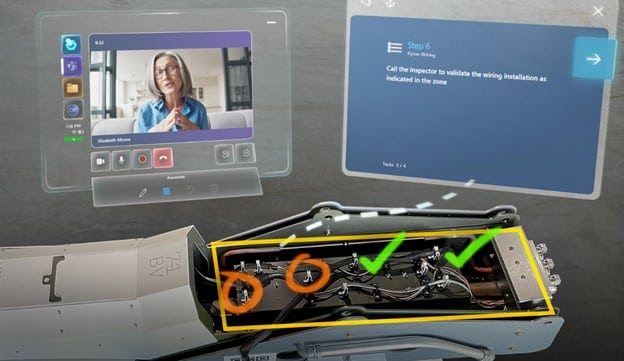
While debates rage over the precise definition of the metaverse, real-world progress is being made in the form of AR for frontline workers. Real value is created in these applications by reducing training time, improving time to resolution or shop floor productivity, and increasing first contact resolution rates among support and service teams.
What has also become clear, and increasingly possible, is that being more inclusive in the market’s approach to front-line workers pays real dividends in terms of hiring, retention, and productivity. Empowering front-line workers to communicate as richly as knowledge workers, albeit with a slightly different toolset, creates benefits for customers, businesses, and workers alike.
For Microsoft, this is another step forward for the Hololens project that, had taken some hits lately. It was reported earlier this year that the 10-year, $21.9 billion deal for Microsoft to provide the U.S. Army with its Integrated Visual Augmentation System (IVAS) hit a snag when soldiers reported becoming physically ill during testing of Hololens and similar devices.
These problems will inevitably be figured out. In the meantime, Microsoft is creating real value for companies with industrial applications for AR technologies and I look forward to hearing about more of them as we go.
Disclosure: Futurum Research is a research and advisory firm that engages or has engaged in research, analysis, and advisory services with many technology companies, including those mentioned in this article. The author does not hold any equity positions with any company mentioned in this article.
Analysis and opinions expressed herein are specific to the analyst individually and data and other information that might have been provided for validation, not those of Futurum Research as a whole.
Other insights from Wainhouse Research:
Miro’s Announcements from Distributed ‘22 – Evolution of a Digital Whiteboard to Team Content Hub
Qumu Partners With hihaho To Enable Interactive Video
CommonGround Raises Additional $25M to Help Build an Immersive Virtual Meeting Experience
The original version of this article was first published on Wainhouse Research.
Author Information

Sean is a trusted advisor to and assists industry vendors and enterprises with workplace communications and collaboration strategies, market entry and product assessment, product portfolio analysis, and sales enablement services.
Sean holds a Bachelor of Science in International Business from University of Colorado, Boulder.