Empathy Mapping for CX

If you were to create a word cloud to track the trending words in CX, “empathy” would take up some sizable real estate. The ability to understand the feelings of a customer can lead to a more personalized approach or offering, as well as better resolution to issues. CX practitioners and vendors are taking note. I recently spent 20 minutes on the phone with a customer service rep after my issue was not able to get resolved via messaging. Over the course of those 20 minutes, the rep stated that she understood me, understood the problem, and understood my frustration. The word “understood” was used 12 times during our interaction as the agent attempted to demonstrate that she saw my perspective and was sympathetic. Obviously, some empathy training had been leveraged.

Determining a customer’s underlying thoughts and feelings can be challenging, but there are many technologies that can assist with determining customer emotion, such as using text and sentiment analysis. However, these technologies are often used during or after an interaction. During my CX-PRO certification, the class explored the concept of empathy mapping. Empathy mapping is a visualization that can lay out user behaviors, attitudes, and actions in a way that allows the creator(s) to gauge customer feelings and perspective. Often used in user experience (UX), empathy mapping can also be employed by CX practitioners, marketing & sales, customer support, and product teams to do some empathy prep work that can be used to design a better experience for customers.

There are different versions of the empathy mapping template. In a simple version, there are four quadrants: says, thinks, does, and feels. Other versions include a section for “pains” and “gains.” As an example, the map below demonstrates a condensed empathy map created for a customer considering the purchase of a week-long beach hotel stay.
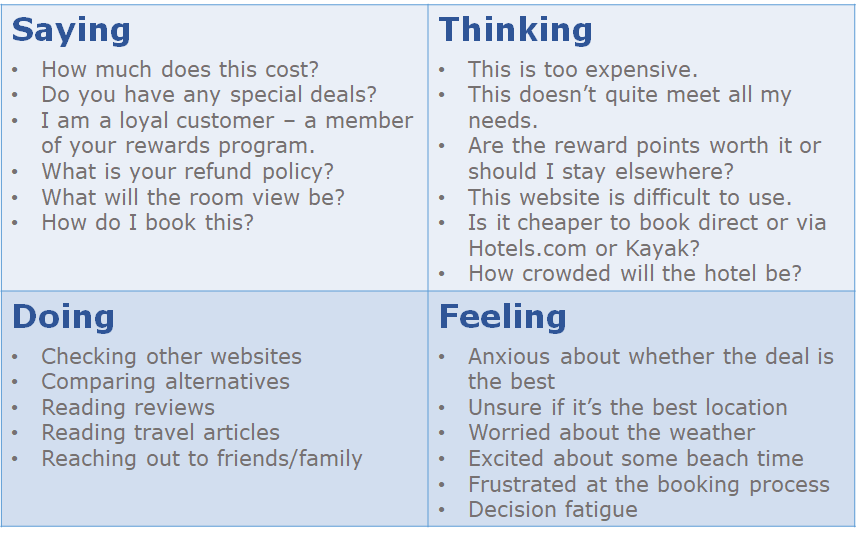
(Source: Dash Research)

A 2020 research study from Genesys reported that 48% of customers noted a lack of compassion in the way they were treated, demonstrating there is a lot of work to be done on this issue. Empathy maps allow CX practitioners to contemplate not only the outward segments (saying/doing) of a customer journey, but also the inward (thinking/feeling). This information can be used to improve upon a process or experience, identify knowledge gaps, and be proactive in the type of response so the customer feels they are understood.

Author Information

As a detail-oriented researcher, Sherril is expert at discovering, gathering and compiling industry and market data to create clear, actionable market and competitive intelligence. With deep experience in market analysis and segmentation she is a consummate collaborator with strong communication skills adept at supporting and forming relationships with cross-functional teams in all levels of organizations.

Sherril holds a Master of Business Administration in Marketing from University of Colorado, Boulder and a Bachelor of Arts in Psychology from Rutgers University.

Latest Insights:
Is AI Ready for Real Work, or Are Enterprises Still Stuck in Experimentation?
July 4, 2026

Is AI Ready for Real Work, or Are Enterprises Still Stuck in Experimentation?

Most enterprises claim advanced AI maturity, but lack governance and deployment strategies. Leading organizations are moving from experimentation to measurable AI impact....
Compliance as Code Is No Longer Optional: Why Manual Reviews Can’t Keep Up
July 4, 2026

Compliance as Code Is No Longer Optional: Why Manual Reviews Can’t Keep Up

Qodo's 'Compliance as Code' framework automates enterprise AI compliance through PR checks, solving the data privacy and security gaps that plague manual reviews at scale....
Databricks AI’s GPU Reliability Push Exposes Hidden Risks for Large-Scale Training
July 3, 2026

Databricks AI’s GPU Reliability Push Exposes Hidden Risks for Large-Scale Training

Databricks AI reveals critical GPU reliability challenges in distributed training environments. Silent slowdowns and numerical corruption pose greater risks than visible failures, threatening model quality and compute efficiency at enterprise scale....
AI Code Review Hits a Wall: Why Speed Without Trust Risks Engineering Chaos
July 3, 2026

AI Code Review Hits a Wall: Why Speed Without Trust Risks Engineering Chaos

A survey shows 94% of engineering leaders use agentic AI coding tools, but 55% struggle with reliability and hallucinations—revealing a critical gap between development speed and production quality....
Latest Research:
The Enterprise Imperative for Digital Sovereignty Architecture, Control, and Competitive Advantage
June 17, 2026
Research
Research

The Enterprise Imperative for Digital Sovereignty: Architecture, Control, and Competitive Advantage

In our latest Market Brief, The Enterprise Imperative for Digital Sovereignty: Architecture, Control, and Competitive Advantage, completed in partnership with IBM, Futurum Research explores why AI is changing the sovereignty...
Data Gravity in the Age of AI Engineering the Mission-Critical Engine for Autonomous Workloads
June 11, 2026

Data Gravity in the Age of AI: Engineering the Mission-Critical Engine for Autonomous Workloads

In our latest report, Data Gravity in the Age of AI: Engineering the Mission-Critical Engine for Autonomous Workloads, completed in partnership with Oracle, Futurum Research explores why fragmented data architectures...
The Autonomous IT Imperative
June 2, 2026
Research
Research

The Autonomous IT Imperative

In our latest Market Report, The Autonomous IT Imperative, completed in partnership with Tanium, Futurum Research examines why traditional IT operations and security models are reaching their limits—and how Autonomous...

Book a Demo

Welcome

The vision behind everything in Futurum’s Custom Research practice is this: research should show you what is happening, what comes next, and what to do about it. It should be personal to each audience, easy for people to grasp, and structured so LLMs can reason over it accurately. And it should be fast and turnkey; you want answers now, not another project to carry for quarters.

Whether you are defining business, channel, or go-to-market strategy; evaluating vendors or justifying ROI; or commissioning research to fill an emerging market need, we have your back, with a program that answers your questions with the objectivity and credibility to drive real decisions.

To do it, we bring unmatched data to bear: Futurum research, surveys, and market projections; validated market feeds; ETR’s 15 years of insight from 10,000 technology decision-makers; G2’s buyer and user data; and what our analysts hear every day. Add leading primary collection, from AI-moderated voice interviews to surveys and analyst-led interviews, all turnkey, and every project comes out credible, nuanced, and actionable.

And we don’t just drop the results in your lap. For internal work, we provide analyst-led sessions, interactive dashboards, and a range of formats. For market-facing work, Futurum delivers turnkey activation and amplification that actually gets seen, by people and by LLMs, through our media and share of voice. This is research that moves decisions and markets.

We will meet you wherever you are, from a fast-turn brief to a multi-year program, and shape the work to your goals, timeline, and budget. The right program for your moment.

If any of this is useful, I would love to talk.

Benjamin Brown, VP Custom Research, Futurum Research

Benjamin Brown

VP, Custom Research · The Futurum Group

Newsletter Sign-up Form

Get important insights straight to your inbox, receive first looks at eBooks, exclusive event invitations, custom content, and more. We promise not to spam you or sell your name to anyone. You can always unsubscribe at any time.

All fields are required


Thank you, we received your request, a member of our team will be in contact with you.