Alchemer has introduced Alchemer Workflow, a workflow feedback engine aimed at helping enterprises close the loop with customers, build engagement, and provide efficiencies across an organization.
Dash Research spoke with Vanessa Bagnato, Director Product Marketing at Alchemer, to learn more about the product launch and its applications.

“For the customer-brand relationship to be successful, customers need to feel connected to the company and heard. People don’t want to take time and energy to provide feedback and then not hear back from the company. Independent research by Alchemer found that 71% of respondents said they were having challenges with closing the loop with their customers. Some of this has to do with lack of resources and difficulty identifying feedback that needs a response. Alchemer wanted to help our customers with these issues by providing workflows that were easy to use and flexible with the ability to be set up and run on day one. We have done this with our new Alchemer Workflow,” says Bagnato.
“Alchemer has always created solutions that are easy to integrate across enterprise groups. Alchemer Workflow was not built for just one department or solely for EX and CX practitioners. It can also be used for UX research, business processes, human resources, operations, and market research. We want departments across the company to be using it in their day-to-day flow. This aligns well with our customer base who is looking to optimize spend with vendors,” she says.
Alchemer Workflow includes the following features:
- Connected Surveys, which trigger follow-on, more personalized surveys to help organizations dig into customer feedback and focus on what actions to take
- No-code process and logic arguments to quickly and easily connect feedback to systems of communication and action
- Logic branching that allows organizations to differentiate their response based on their customers’ specific feedback and preferences
- Native integrations with the most popular CRM, business intelligence, marketing, and communications systems
- Simple drag-and-drop functions, making it easy to create and launch new workflows
Bagnato highlights the advantages of connected surveys. “Surveys should be personalized to the respondent, so you can avoid survey fatigue from blanket or irrelevant questions. This is why the Connected Survey feature is so beneficial. When it comes to customer interactions, customers are continuously moving around the loop,” she says.
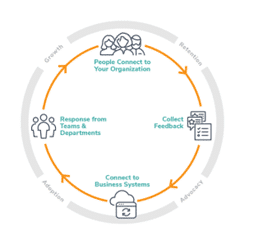
Bagnato adds, “Connected surveys allow for shorter surveys that are focused more specifically on how customers responded previously during a point on that loop. For instance, if a customer was sent a short three question survey and voiced discontent with hold time, you can follow up, thanking them for sharing the feedback on hold time and only asking for follow up on that one specific point.”
Bagnato also provides an example of surveys going out to new employees. Sending out a survey at 30, 60, or 90 days enables organizations to have more continuous interactions with their new employees. Perhaps at 30 days someone mentioned it was difficult to connect with their manager. This would trigger an alert to be sent to HR, actions could be taken and at 60 days a more personalized survey could be sent, making sure the issue was being addressed.
Having logic arguments built in makes it a robust solution, allowing for information to be routed to the right place and for tailored workflows to be created for various departments, sometimes based off of a single response. A CX feedback survey might trigger product marketing to request the person to leave a review. Product management might get feedback that could result in a product feature request. Operations might see a process that needs tweaking.
“This cross-enterprise usage helps push adoption across an organization and encourages departmental collaboration. Sometimes the workflows are completely internally focused. It really empowers data usage throughout an enterprise,” says Bagnato.
In a blog posting, Alchemer CEO David Roberts describes the company as becoming the “central management system” of experience management, routing feedback to the right part of every organization. Says Roberts, “I regularly think about an industry colleague’s comment on the CX industry, calling it ‘marshmallow fluff.’ For so many organizations, it feels good to hear feedback and to share summary results, but they don’t tackle the hard work that shows their customers and employees that they care enough to respond, engage, and take further action. Alchemer Workflow makes this hard work intuitive and easy to manage and doesn’t require specific or additional IT or CX resources.”
Related Article: Five Questions with David Roberts, CEO of Alchemer
It has been a busy year for the company, with Alchemer acquiring mobile feedback provider Apptentive, announcing integration with Microsoft Teams, broadening its partner program, and receiving a significant investment from KKR.
The development of the immediately available Alchemer Workflow is something that has been in the making for a while but was launched as companies will be continuing to seek efficiency and automation as they face budget and labor constraints. Additionally, consumer and employee expectations remain high even when companies are facing challenges.
Alchemer Workflow helps companies overcome the all-too-common challenge of taking action on feedback by enabling companies to close the feedback loop easily and effectively. Products that allow customers and employees to provide feedback, know that it was heard, and have the loop closed with focused and personalized interactions will be important as companies deepen their experience management capabilities and work to exceed customer and employee experience expectations.
Author Information

As a detail-oriented researcher, Sherril is expert at discovering, gathering and compiling industry and market data to create clear, actionable market and competitive intelligence. With deep experience in market analysis and segmentation she is a consummate collaborator with strong communication skills adept at supporting and forming relationships with cross-functional teams in all levels of organizations.
Sherril holds a Master of Business Administration in Marketing from University of Colorado, Boulder and a Bachelor of Arts in Psychology from Rutgers University.