The News: In January, the Bureau of Labor Statistics estimated that the U.S. unemployment rate was at 3.4, the lowest in a five-year timeframe. Yet, the corporate real estate industry is talking about sky-high vacancy rates. Why is there a growing disconnect between the number of people employed in the U.S. and the vacancy of office spaces — is hybrid work to blame? See the Bureau of Labor Statistics Report here.
Employment Numbers Go Up, But Real Estate Vacancies are High — is Hybrid Work to Blame?
Analyst Take: In January, the unemployment rate was at its lowest in a five-year timeframe, but the corporate real estate industry is talking about sky-high vacancy rates. Many experts point to hybrid work, the four-day workweek, and other pandemic-driven work models as factors contributing to reduced demand for corporate real estate.
While hybrid work and the four-day workweek have certainly impacted the demand for corporate real estate in the U.S., they are not the sole culprits behind the high vacancy rates. It is important to note that most of today’s vacancy woes are rooted in real estate development practices that rose in the 1990s, way before the pandemic and the advent of flexible work arrangements.
Hybrid Work and the Impact on Square Footage
Before the pandemic, it was estimated that the average employee needed about 190 square feet of office space to comfortably work in an office environment.
Post-pandemic, this number has been decreasing, with experts noting that the number is down by 10 to 15%. However, the demand for corporate real estate on a per-employee basis still ranges between 140 and 170 square feet per individual.
So it’s true that hybrid work policies are likely impacting occupancy rates (the number of people in an office), which in turn will affect the more long-term trends of vacancy rates ( the amount of real estate unleased.) But, even with this reduction, this can’t be the entire reason the U.S. is seeing such sky-high vacancy rates.
Unoccupied Real Estate in the U.S.
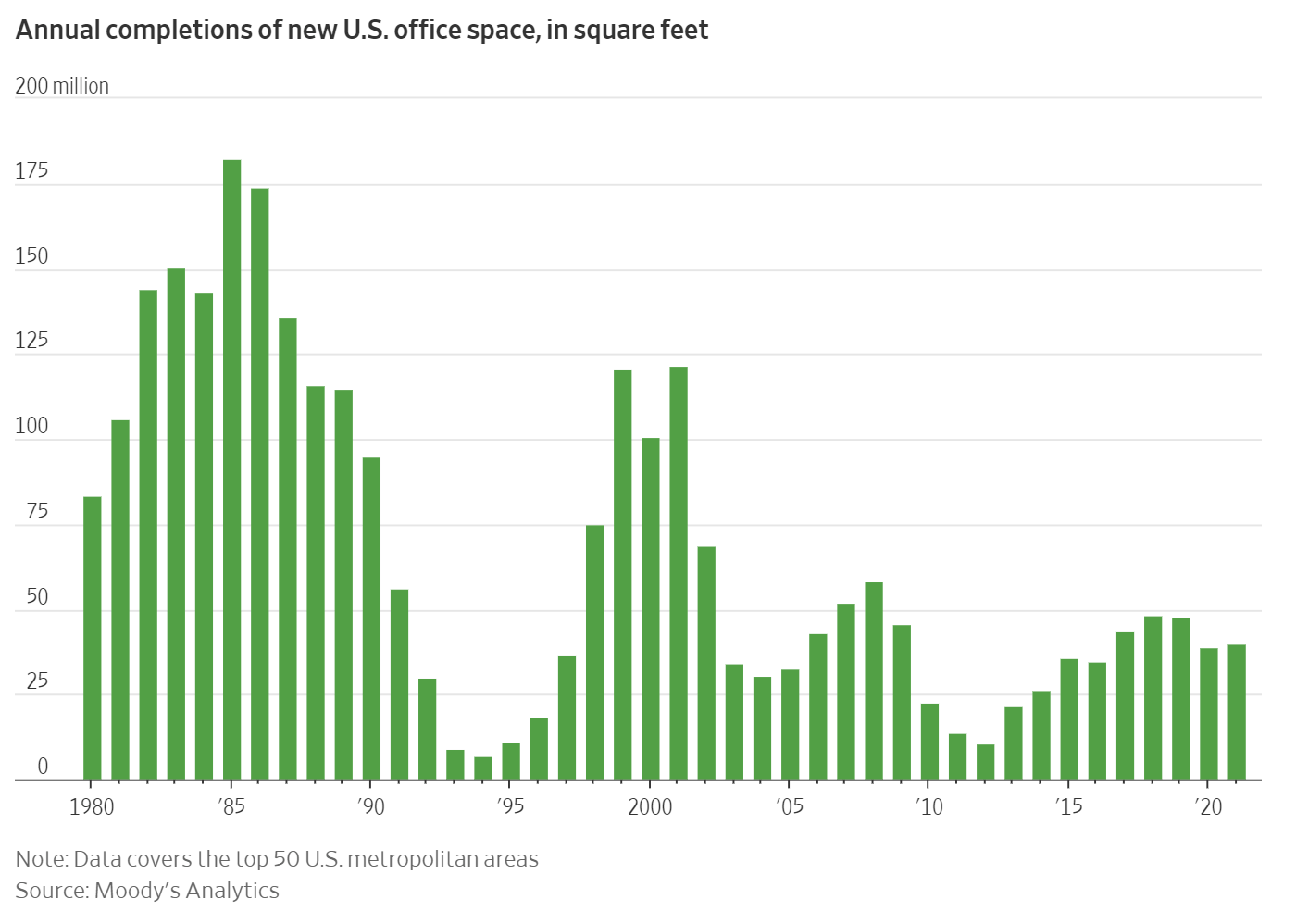
Cushman & Wakefield, an American commercial real estate services company, estimates that the U.S. will have 1.1 billion square feet of unoccupied real estate by the decade’s end. This results in a vacancy rate of 19%, compared to 14% in Europe and around 7% in the Asia-Pacific region. Cushman & Wakefield link this problem to an unnatural spike in real estate development in the 1980s and into the early 1990s. During this time, tax incentives and other favorable programs supported building corporate real estate beyond the demand.
As you can see from the graph below, new office space spiked throughout the 1980s and into the early 1990s. And the fallout is happening today, 30 years later, when the bulk of this real estate is hitting a vacancy refresh cycle.
 Distinct Segments of Real Estate
The core issue is that during this time of intense buildout, the real estate industry developed many of these properties with a narrow focus on location and square footage. Size and location won out over quality, so, properties were not designed with aesthetics in mind or room for amenities that are in favor today.
As a result, Cushman & Wakefield (along with the rest of the industry) segments the real estate available in the market into three distinct classes, ranging from Class A to Class C, and it’s the Class C segment that is causing issues. This category of properties accounts for about 25% of the current stock coming up for renewal in the next 5 to 10 years. These lower-tier properties are not attractive and are contributing significantly to the 1.1 billion square feet of unoccupied real estate predicted to take place by 2030. If this 25% segment were discarded, about 330 million square feet of unoccupied real estate would be removed, bringing the vacancy rate in the U.S. back in line with the rest of the world at around 12%.
On the other end of the spectrum are Grade A properties, which are high-quality properties driven not only by location but also by the quality of the surrounding amenities. These properties are finding demand in the market and are not suffering as badly as the lower-tier properties.
In short, it’s not a move toward hybrid work that is causing this shift, it’s the sub-par properties that are the ones suffering from consistently high vacancy rates.
The Lesson for those Implementing Hybrid Work Strategies
That’s not to say that hybrid work doesn’t play a role here. In fact, it’s likely contributing to the lower occupancy in offices. Still, it is not the only factor keeping the office vacant, especially in the U.S. If we look at the data, we can see that the commercial real estate market is in a glut, with many sub-par properties coming up for renewal. It would be easy to bridge that this vacancy issue is the same occupancy issue that is impacting many hybrid work deployments, but that’s not the reality.
We can even take this hypothesis further and ask ourselves what properties are doing well with lower-than-normal vacancy rates. That would be the Class A properties that offer not only location and space but amenities that make the office environment enjoyable and, dare I even say, more desirable for employees.
The lesson is clear: Grade A properties that meet modern employee needs can attract demand in the market and help reduce vacancy rates. It’s crucial to learn this lesson because we are no longer in a scenario where having a prime location and square footage is a strategic advantage and driver for occupancy. Companies must invest in quality properties that meet employee needs — not only from a location and amenity-rich standpoint, but also ensuring they are outfitted with technology that helps them do their work more efficiently, enjoyably, and productively, thus inspiring them to make the office an integral part of how they want to execute their own hybrid work strategy.
Disclosure: Wainhouse Research, part of The Futurum Group family of companies, is a research and advisory firm that engages or has engaged in research, analysis, and advisory services with many technology companies, including those mentioned in this article. The author does not hold any equity positions with any company mentioned in this article.
Analysis and opinions expressed herein are specific to the analyst individually and data and other information that might have been provided for validation, not those of Wainhouse Research as a whole.
Other insights from Wainhouse Research:
Author Information

Craig holds a Master of Business Administration from the Texas McCombs School of Business as well as a Bachelor of Science in Business Administration from Tulane University.