
The Transition from Passive Copilots to Autonomous Execution is Reworking the Data Intelligence Platform, Promoting Databricks, Snowflake, and Oracle, While Exposing Hyperscaler Friction
Analyst(s): Brad Shimmin
Publication Date: August 28, 2026
Document #: AIOBS202608
What You Need to Know
- Enterprise IT procurement has firmly transitioned away from generative AI systems built to summarize historical data. Organizations now demand autonomous, read-write agents capable of planning, negotiating, and safely executing state changes across live transactional systems without manual human intervention.
- To capture this operational graduation in our v2 Data Intelligence Platforms Signal report, we retired our 2025 infrastructure rubric. The new standard strictly evaluates Lake Transactional/Analytical Processing (LTAP), cryptographic per-agent identity, and embedded Token FinOps.
- This revised standard forced a decisive realignment of the competitive landscape. Platforms offering a native transactional write path – specifically Databricks, Snowflake, and Oracle – surged in our rankings. Conversely, platforms relying heavily on optimistic concurrency models or loosely coupled sidecars faced severe scoring friction under machine-speed execution loads.
Recommendations
- Enforce Copy-on-Write Sandboxing for All Agents: Never allow an autonomous process to commit directly to a live system of record. Organizations must architect a mandatory copy-on-write simulation layer where the database models the proposed state change within an isolated perimeter. Route these simulated outcomes to human data professionals for authorization before committing the final transaction using cryptographically secured, per-agent/per-task identities.
- Mandate Ontology Portability in Procurement: Immediately update all data platform Request for Proposals (RFPs) to include strict ontology portability clauses. Vendors are actively shifting their lock-in strategies from the storage layer to the intelligence layer. Demand the ability to export or, at a minimum, federate metric definitions, entity relationships, and persistent agent memory in open, vendor-neutral formats. Retaining your semantic ecosystem ensures business logic survives underlying database migrations.
- Implement a “Refuse to Guess” Toggle: Transition from standard retrieval-augmented generation architectures to curated semantic firewalls. Force platform providers to establish deterministic governance settings where an agent explicitly declines to act if a verified metric definition or policy parameter is absent from the catalog. Halting execution entirely proves vastly preferable to committing a confidently hallucinated operational write.
Analysis
The generative AI honeymoon of 2025 offered executives an appealing, low-risk demonstration: conversational dashboards capable of summarizing business realities. Today, summarizing the business represents the bare minimum. Enterprises are actively industrializing digital labor, rewiring their data architectures to support autonomous, read-write agents, that is, software explicitly designed to mutate business state. This maturation entirely redefines the core function of the Data Intelligence Platform. The platform has evolved from a passive repository for historical reporting into a deterministic trust engine for probabilistic intelligence.
The Financial Rotation and the Collapse of the Reference Divide
Enterprise leaders have stopped funding AI based on aspirational productivity promises, demanding technical proof (e.g., measurable, localized wins with defensible payback models). Funding is draining rapidly from experimental prompt-engineering pilots and pouring directly into active intelligence infrastructure. According to the 1H 2026 Data Intelligence, Analytics, & Infrastructure Market Sizing & Five-Year Forecast Report, the global Data Intelligence, Analytics, & Infrastructure (DIAI) market is projected to reach US$541.1 billion in 2026, growing at a 16.9% CAGR to surpass US$1.2 trillion by 2031. The promise of automated transaction execution and resultant margin expansion funds this massive capital rotation almost entirely.
To execute at this level, the fundamental architectural premise of the modern data stack had to fracture. In our previous evaluation cycle, the prevailing wisdom physically separated reference data (the analytical lakehouses and semantic layers an agent uses to reason) from action data (the operational systems of record where transactions actually occur). Those walls are now falling away.
Operating autonomous software across that divide introduces unacceptable latency and consistency risks. When an AI agent must consult an external knowledge graph to verify a financial policy, wait for a network response, and subsequently push an update to an operational database, the chain of trust breaks. Connecting these environments via batch pipelines creates a split-brain reality where the agent makes decisions based on stale analytical reads. To eliminate this friction, agents require a unified, governed perimeter to reason and write simultaneously.
LTAP and the Concurrency Crucible
The technical reality of our 2026 evaluation demands a converged architecture: Lake Transactional/Analytical Processing (LTAP). Platforms must provide a unified substrate in which complex semantic reasoning and serializable, ACID-compliant writes occur securely.
This requirement exposes the severe limitations of older analytical engines. Data platforms built around optimistic concurrency controls completely buckle under the bursty, high-concurrency write loads generated by machine-speed agents. When hundreds of autonomous processes simultaneously attempt to mutate overlapping records, optimistic locking creates massive contention, resulting in failed transactions and degraded performance (see Figure 1).
Figure 1: Agentic Execution Bottlenecks
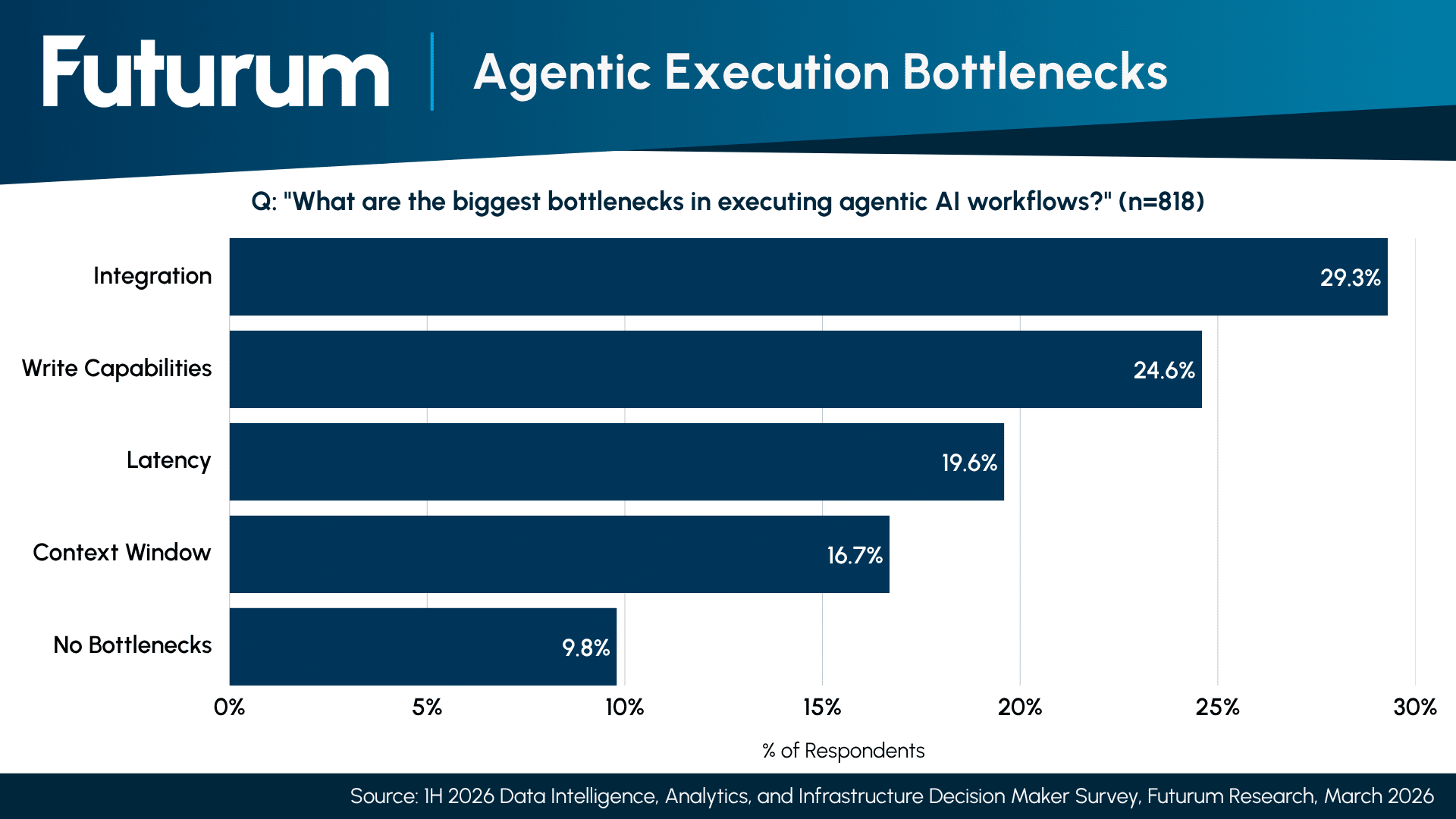
The statistical parity between hallucination fears and write-back friction proves the enterprise mandate has firmly shifted from understanding data to actively mutating it. If a platform cannot absorb machine-speed writes with instant rollback, it immediately degrades from an active operational engine to a passive context provider.
The Vendor Scoreboard: Transactional Muscle vs. The Assembly Tax
The introduction of our rigorous Signal v2 rubrics triggered a decisive realignment across the DIAI market. By scoring platforms specifically on their ability to facilitate governed, read-write agentic loops, we separated the true systems of intelligence from legacy data repositories.
The Elite Zone Arms Race
Databricks retained its absolute leadership position by tackling the write-back bottleneck head-on. Expanding far beyond its roots as an analytical lakehouse, Databricks introduced its LTAP architecture and Lakebase, heavily leveraging its strategic acquisition of the Neon storage engine. This combination gives autonomous agents the ability to perform high-concurrency, serverless Postgres-style writes directly against open lakehouse storage. Coupling this new transactional muscle with the Genie Ontology ensures that agents execute operations firmly grounded in deterministic business logic, insulating the enterprise from hallucination risks.
Snowflake executed one of the most effective strategic pivots in the sector, earning a promotion from the Leader to the Elite zone. By open-sourcing the Polaris Catalog and fully embracing Apache Iceberg, Snowflake systematically dismantled historical market objections regarding storage lock-in. Crucially, the rollout of Snowflake Postgres and Unistore Hybrid Tables provided the exact native transactional write path that our revised evaluation rubric demanded. By surrounding this converged substrate with Cortex AI and cryptographic AI Agent Identities, Snowflake transformed itself into a complete execution environment for digital labor.
The Ascent of Data Gravity and Sovereign Governance
Oracle registered the single largest score increase in our report, leaping 6.7 points to secure a commanding position in the Leader zone. For the past decade, the industry championed stateless compute decoupled from storage. Oracle took the unapologetically contrarian approach, heavily leaning into data gravity by embedding vector search and agent orchestration directly into its high-performance transaction engine via Oracle AI Database 26ai.
When an autonomous agent executes a supply chain update that requires strict serializable consistency, Oracle entirely bypasses the lock contention and latency of decoupled architectures. By offering this engine natively on Microsoft Azure, Google Cloud, and AWS, Oracle neutralized cloud-isolation concerns while preserving its core transactional supremacy.
IBM similarly earned a promotion to the Leader tier by prioritizing sovereign governance and real-time execution. Integrating Confluent’s streaming architecture and DataStax’s vector memory into the watsonx platform provided the event-driven infrastructure necessary for agentic workflows. By mapping its governance controls directly to rigid regulatory frameworks such as the EU AI Act, IBM successfully captured the highly regulated enterprise segment unwilling to risk autonomous AI on generalized public cloud infrastructure.
Friction in the Hyperscaler Ranks
While independent platforms surged forward, hyperscalers faced distinct technical and commercial friction under the new agentic requirements. Microsoft retained its Elite status due to unmatched enterprise distribution, but its technical capability score contracted. Microsoft Fabric’s reliance on optimistic concurrency models within OneLake created severe lock contention under machine-speed agent writes. Furthermore, the shared capacity billing model led to unpredictable overage charges during bursty agent workloads, highlighting a need for granular Token FinOps.
Google Cloud was demoted slightly from the Elite tier to the Leader zone. Despite achieving the highest raw product innovation score in the report with its Agentic Data Cloud and AlloyDB federation, Google has inflicted commercial damage upon itself through relentless product renamings and sales motions. Selling highly technical computing primitives rather than out-of-the-box, governed business solutions actively alienates more outcome-focused enterprise buyers.
AWS maintained its Leader position on the strength of custom silicon and open catalog interoperability, but continues to impose an integration tax on buyers. Constructing agentic architectures on AWS requires customers to manually stitch together SageMaker, Glue, Bedrock, and Lake Formation, lacking the cohesive SaaS experience of its direct competitors.
The Engine-Neutral Champion
Fivetran and dbt Labs entered the Leader zone as a combined entity by championing the engine-neutral control plane. By open-sourcing the Rust-based dbt Fusion engine and the Agents Schema, they offer a standard, portable context-delivery layer. This strategy allows organizations to maintain central semantic control across heterogeneous environments, providing reliable data contracts directly on the write path.
What to Watch
- As buyers universally mandate open table formats such as Apache Iceberg to ensure data portability, vendors are responding with a sophisticated shell game. They happily concede the storage layer while aggressively locking up the intelligence layer. Monitor vendors who attempt to capture proprietary ontologies, entity relationships, business logic, and persistent agent memory within closed orchestration frameworks. Moving parquet files means absolutely nothing if you cannot export the semantic logic that makes those files useful.
- Watch for intense buyer scrutiny around bursty, machine-generated workloads. As agents operate continuously in the background, computing costs can spiral. Furthermore, with 56.7% of enterprises actively optimizing AI inference costs, according to the 1H 2026 Data Intelligence, Analytics, and Infrastructure Decision Maker Survey Report, embedded Token FinOps has shifted from a luxury to a mandate. Platforms lacking granular Token FinOps (specifically semantic caching, dynamic model routing, and per-agent spend attribution limits) will face severe enterprise churn as automated processes silently exhaust cloud capacity budgets.
- The primary technical boundary moving into 2027 will be the latency of active governance. Watch for legacy cataloging platforms attempting to rebrand as agentic control planes. If a governance checkpoint struggles to deliver runtime policy enforcement at sub-second speeds, it will bottleneck the entire multi-agent loop, rendering the promised speed of autonomous execution impossible.
Read more in the full reports, “1H 2026 Data Intelligence, Analytics, and Infrastructure Decision Maker Survey Report,” and “Futurum Signal Report | Data Intelligence Platforms – August 3, 2026,” available to subscribers on the Futurum Intelligence Platform.
Disclosure: Futurum is a research and advisory firm that engages or has engaged in research, analysis, and advisory services with many technology companies, including those mentioned in this article. The author does not hold any equity positions with any company mentioned in this article.
Analysis and opinions expressed herein are specific to the analyst individually and data and other information that might have been provided for validation, not those of Futurum as a whole.
Other Insights from Futurum
Data Intelligence Platforms – Futurum Signal (August 3, 2026)
AWS and the End of the Naive Agent: Collapsing the Semantic Divide
Can Legacy Data Security Survive the Velocity of Autonomous AI Agents?
Author Information

Brad Shimmin is Vice President and Practice Lead, Data Intelligence, Analytics, & Infrastructure at Futurum. He provides strategic direction and market analysis to help organizations maximize their investments in data and analytics. Currently, Brad is focused on helping companies establish an AI-first data strategy.
With over 30 years of experience in enterprise IT and emerging technologies, Brad is a distinguished thought leader specializing in data, analytics, artificial intelligence, and enterprise software development. Consulting with Fortune 100 vendors, Brad specializes in industry thought leadership, worldwide market analysis, client development, and strategic advisory services.
Brad earned his Bachelor of Arts from Utah State University, where he graduated Magna Cum Laude. Brad lives in Longmeadow, MA, with his beautiful wife and far too many LEGO sets.