Analyst(s): Brad Shimmin
Publication Date: July 24, 2026
Oracle has launched Base Database Cloud@Customer X11, evolving its traditional on-premises database hardware into a fully managed hybrid cloud node. This release embeds Oracle AI Database 26ai and localized application virtual machines directly within regional and remote data centers, establishing a pragmatic path to run private, agentic AI workloads without exposing sensitive data to the public cloud.
What Is Covered in This Article:
- The technical evolution of Oracle Base Database Cloud@Customer X11, combining Oracle AI Database 26ai with full Oracle Cloud Infrastructure (OCI) management and automation.
- How the co-location of Application VMs and Database VM Clusters directly addresses latency, data gravity, and AI write-back bottlenecks.
- The strategic synergy of pairing Exadata Cloud@Customer for core workloads with Base Database Cloud@Customer for distributed regional deployments.
- Primary Futurum Research data on enterprise preferences for integrated vector databases and the reevaluation of AI workload placement due to performance hurdles.
- Forward-looking analysis on how this localized approach impacts the broader hybrid cloud and private AI competitive landscape.
The News: Oracle officially released Base Database Cloud@Customer X11, delivering a unified hybrid cloud for private AI, data, and applications directly at customer locations.
The service runs on Oracle Data Infrastructure Cloud@Customer, an 8U rack-mountable system featuring two X11 database servers powered by 5th Generation AMD EPYC processors. The hardware footprint provides 120 usable server cores, 1,320 GB of usable DDR5 memory, and scalable all-flash storage with usable capacity ranging from 11.6 TB to 47.2 TB.
Oracle Cloud Operations fully manages, monitors, and maintains the underlying physical infrastructure, hypervisors, and firmware. Customers consume the service via an operating expense-friendly database license subscription with online elastic ECPU scaling, automated patching, built-in backups, and Active Data Guard support.
The platform supports Oracle AI Database 26ai (Enterprise and Standard Editions) running in Database VM clusters alongside isolated, customer-managed Application VMs running Oracle Linux. This architectural design enables bespoke agentic workloads and applications to execute on the exact same physical infrastructure as the regulated enterprise data they interrogate.
Solving the Distributed AI Dilemma: Oracle Base Database Cloud@Customer Brings OCI Automation to Local Workloads
Analyst Take: The initial industry rush to migrate intelligence to public cloud AI services has hit a stubborn wall defined by data gravity, strict privacy compliance, latency, and an increasing aversion to market instability. Moving heavily regulated, petabyte-scale datasets to central compute environments carries immense risk and exorbitant costs. With this announcement, Oracle hopes to flip this dynamic by pushing the compute down to the data’s native resting place.
This architectural move closes an important loop for Oracle in capturing an emerging enterprise reality: organizations are pulling back from sprawling, multi-cloud data migrations in favor of highly localized private AI environments that maintain data sovereignty while retaining cloud agility. According to Futurum Research, 71% of CIOs are actively reevaluating their cloud workload placement due to AI cost structures and the realities of data gravity. The high cost of moving data and the physical limitations of latency force enterprises to adopt localized, cloud-managed infrastructure. Oracle Base Database Cloud@Customer intercepts this demand by keeping sensitive data stationary while injecting modern automation at the edge.
Closing the Loop on Agentic Write-Backs
The co-location of Application VMs on the exact same hardware as the Oracle AI Database instances represents a substantial structural advantage. Autonomous agents require low latency to function efficiently. When an AI agent lives in a public cloud environment entirely separate from the transactional system of record, network latency, cross-cloud bandwidth costs, and security perimeters can severely throttle performance.
By isolating applications in their own VMs (fully customizable with dedicated memory and storage resources) yet keeping them on the same 25 Gbps server interconnect, Oracle eliminates the network hop that can fracture agentic workflows. Our primary survey data highlights exactly why this matters for modern enterprise architectures (see Figure 1).
Figure 1: Main Agentic AI Read/Write Performance Bottlenecks
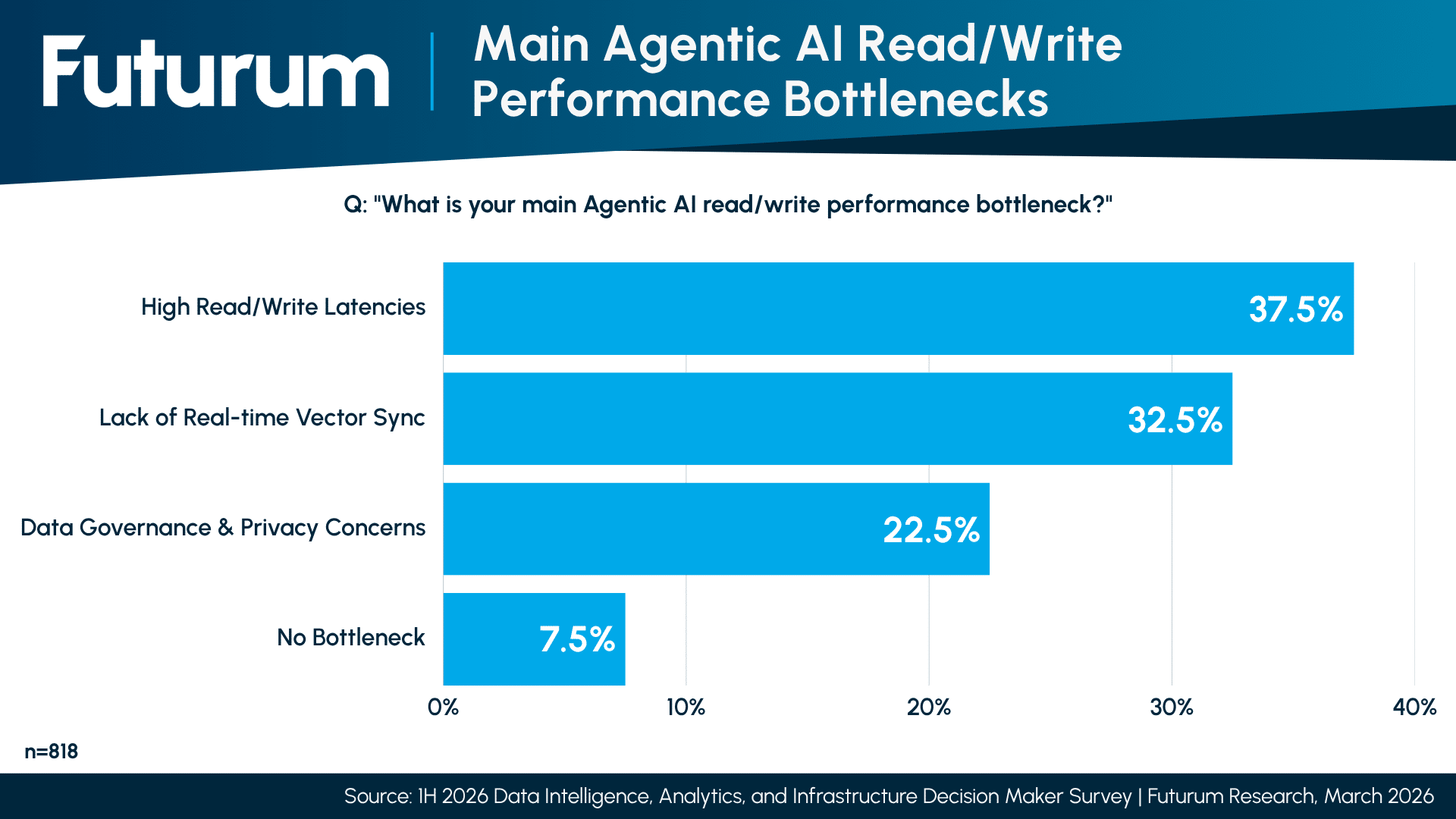
Enterprise responses indicate clear prioritization of high-value technical capabilities, demonstrating that latency and synchronization act as critical barriers to agentic AI adoption.
Furthermore, Futurum Research indicates that 24.6% of organizations identify the inability of AI agents to write back to systems of record as a top infrastructure bottleneck. Securing a localized execution environment where the agentic logic and the transactional data pool share the same hardware can cleanly accelerate this write-back loop, transforming a fragile integration into a robust, high-performance capability.
The Integrated Vector Advantage
Securing the hardware to run AI locally solves the infrastructure equation. However, an underlying database requires specialized tuning for edge-based intelligence to get the most out of this arrangement. Running Oracle AI Database 26ai natively on this infrastructure showcases the advantage of a converged, multi-model approach to this challenge.
Instead of adopting the fragmented industry standard of having IT teams bolt a specialized vector database onto a transactional system via extraction pipelines, Oracle integrates AI Vector Search directly into the core engine. This allows Retrieval-Augmented Generation (RAG) and private AI agents to operate securely behind the customer’s firewall, using up-to-the-second transactional data as working memory. At Futurum, we believe this unifying capacity will clearly separate success from failure for enterprises seeking to build agentic software at scale.
This converged methodology aligns heavily with current enterprise preferences. Recent Futurum data shows that 33.4% of organizations favor utilizing integrated database vectors within existing multi-model databases, compared to 29.3% relying on standalone, specialized vector databases. Baking these capabilities into a managed edge node reduces operational complexity and solidifies security for private AI use cases.
A Unified Estate: The Exadata and Base Database Synergy
Together, Exadata Cloud@Customer and Base Database Cloud@Customer form a formidable one-two punch for enterprise AI architectures. Enterprises can anchor their massive, tier-zero databases on Exadata Cloud@Customer at their primary headquarters, while rolling out Base Database Cloud@Customer X11 to regional offices, remote manufacturing facilities, and mid-sized departments.
Despite the physical distribution of these assets across global facilities, a single OCI control plane governs the entire estate. This centralized administration delivers a consistent developer experience, unified identity management, and simplified tracking of elastic compute usage. It provides a cohesive path forward for organizations looking to operationalize distributed private AI without ballooning their administrative overhead.
What to Watch:
- Watch how public cloud hyperscalers respond to Oracle’s database-optimized approach to edge and on-premises infrastructure. General-purpose compute is common, but local compute engineered around database architectures optimized for maximum availability and agentic AI can act as a distinct competitive wedge.
- Monitor whether organizations utilize the Application VMs for bespoke agentic workloads or default to treating the X11 box as a traditional database appliance. The success and adoption rate of the Application VM feature remain critical for proving Oracle’s private AI use case in the field.
- As companies push Oracle AI Database 26ai to localized data centers and regional branch offices, observe how IT teams manage global data governance, semantic consistency, and agent authorization across physically separate nodes.
See the complete press release on the launch of Oracle Base Database Cloud@Customer on the Oracle website.
Disclosure: Futurum is a research and advisory firm that engages or has engaged in research, analysis, and advisory services with many technology companies, including those mentioned in this article. The author does not hold any equity positions with any company mentioned in this article.
Analysis and opinions expressed herein are specific to the analyst individually and data and other information that might have been provided for validation, not those of Futurum as a whole.
Other Insights From Futurum:
From Storage to Action: Why Autonomous AI is Forcing a Database Revolution
Data Gravity in the Age of AI: Engineering the Mission-Critical Engine for Autonomous Workloads
The No-Compromise AI Foundation: Oracle Reimagines the Database for the Agentic Era
State of the Market Report: Data Intelligence, Analytics, and Infrastructure, Q2 2026
1H 2026 Data Intelligence, Analytics, & Infrastructure Market Sizing & Five-Year Forecast Report
Author Information

Brad Shimmin is Vice President and Practice Lead, Data Intelligence, Analytics, & Infrastructure at Futurum. He provides strategic direction and market analysis to help organizations maximize their investments in data and analytics. Currently, Brad is focused on helping companies establish an AI-first data strategy.
With over 30 years of experience in enterprise IT and emerging technologies, Brad is a distinguished thought leader specializing in data, analytics, artificial intelligence, and enterprise software development. Consulting with Fortune 100 vendors, Brad specializes in industry thought leadership, worldwide market analysis, client development, and strategic advisory services.
Brad earned his Bachelor of Arts from Utah State University, where he graduated Magna Cum Laude. Brad lives in Longmeadow, MA, with his beautiful wife and far too many LEGO sets.