
How Multi-Layer Ontologies, Hybrid Lakehouse Reach, & Governed Agentic Memory Position the Enterprise for Autonomous Execution
Analyst(s): Brad Shimmin
Publication Date: October 21, 2026
Document #: AIOBS202609
At GraphSummit New York, Neo4j repositioned its core graph database infrastructure as an enterprise context engine engineered to resolve the operational bottlenecks that are choking autonomous AI agents. To this end, the company is pairing a six-layer ontology architecture with zero-copy virtual graphs and native transactional block storage. The resulting platform establishes a structured knowledge layer that grounds probabilistic models in deterministic enterprise facts. Long-term enterprise success, however, will require executing through pragmatic, use-case-driven deployments that overcome historical data management inertia and innovation fatigue, all while enforcing strict write-back governance.
What You Need to Know
- Autonomous Agents Establish a New Data Consumer: Enterprise data infrastructure historically catered to two primary workloads: deterministic software applications and human analysts. Autonomous AI agents, however, represent an independent consumer class requiring contextual, interconnected data models rather than flat relational tables or isolated vector embeddings.
- The Context Engine Unifies Meaning, Reach, and Learning: Neo4j anchors its platform evolution on domain ontologies that map business semantics down to physical columns, deep multi-hop GraphRAG traversals that exceed single-hop vector retrieval, and agentic memory loops that distill runtime execution traces into reusable skills.
- Hybrid Storage to Resolve Zero-Copy Dilemmas: The vendor combines zero-copy Virtual Graphs (i.e., translating Cypher queries to push-down SQL across Snowflake, Databricks, and BigQuery) with native graph block storage Neo4j reports at sub-250ms, plus Composite Databases to balance corporate governance rules against real-time operational query latency.
- A “Lagom” Strategy Can Mitigate Enterprise MDM Fatigue: To bypass buyer resistance stemming from past Master Data Management (MDM) and academic Semantic Web failures, Neo4j advocates a balanced, use-case-led deployment model in which single business workflows incrementally pull necessary data models into production.
- Governed Agentic Memory Demands Strict Write-Back Safeguards: As enterprises increasingly rely on the Model Context Protocol (MCP) to capture execution traces and tool calls, context engines must implement fine-grained access controls, continuous memory-conflict detection, and sandboxed write-back controls to protect core enterprise systems of record.
The Context
Enterprise AI has arrived at a structural crossroads. Frontier foundation models possess extraordinary cognitive reasoning abilities, yet enterprise software leaders routinely watch internal initiatives stall during proof-of-concept testing. One of the primary constraints throttling production implementations centers on context delivery. Corporate data estates remain fractured across hundreds of disconnected relational databases, columnar warehouses, object stores, and operational applications. Feeding these unintegrated silos into probabilistic language models produces hallucinations, broken execution plans, and worse, operational blind spots.
At Neo4j’s GraphSummit in New York, CEO Emil Eifrem framed this architectural challenge around a profound shift in enterprise data consumption. For decades, database systems served two primary workloads: transactional applications executing structured create, read, update, and delete (CRUD) routines, and human analysts querying data to generate business intelligence dashboards. The emergence of autonomous AI agents introduces an entirely new third consumer to this technology stack. Agents explore corporate data estates dynamically, formulate multi-step execution plans, invoke external tools, and alter operational records.
Scaling this agentic layer introduces a significant operational challenge: coordinating a myriad of autonomous agents across fragmented enterprise repositories. In response, Neo4j is repositioning its core platform from an operational graph database into an enterprise context engine. The company asserts that graphs represent a truly native digital twin (what Emil calls an organizational world model), a necessary abstraction for translating unstructured business reality into machine-readable precision.
Neo4j is not alone in holding this premise. Major cloud and data platform providers have recently introduced context-oriented metadata layers, including Databricks Genie Ontology, Snowflake Cortex, AWS Context Service, and Microsoft Fabric IQ Graph. However, these tools primarily construct metadata abstractions and govern access over their own respective warehouse tables and Business Intelligence (BI) data models. Neo4j is positioning its platform as an independent, cross-platform knowledge substrate that spans multi-cloud and on-premises data estates alike.
Production implementations highlighted during the summit validated this strategy across diverse operational environments:
- A large business software provider uses runtime graph projections to isolate task-specific subgraphs for Agentforce, establishing dedicated operational boundaries and performance service-level agreements (SLAs).
- A leading bank deploys an ontology-based semantic layer across enterprise agents without exposing internal engineering teams to legacy Semantic Web complexities.
- A mortgage firm unifies customer interaction logs, call transcripts, loan servicing records, and CRM files into a central context store to automate personalized refinancing outreach.
- A gaming company uses zero-copy graph queries directly over Snowflake to drive natural-language business analytics across disconnected tables.
Alongside these customer milestones, Neo4j detailed significant product roadmap updates, including a preview release of Virtual Graphs, a prescriptive six-layer ontology management plane, high-scale graph sharding through InfiniGraph, cross-cluster database replication, serverless Aura Graph Analytics, high-density AuraDB instances scaling up to 2TB RAM and 5TB storage, and turnkey vertical solutions such as GraphAware Financial Crime Intelligence (FCI).
Analysis
The Third Consumer: Why Foundation Models Demand an Organizational World Model
Enterprise software has reached a point where raw algorithmic reasoning is readily commoditized. Because foundation models offer advanced cognitive capabilities off the shelf, competitive differentiation depends on the timeliness, fidelity, and governance of the context supplied to those models. Unfortunately, enterprise data estates remain fractured across disparate relational schemas, columnar warehouses, document repositories, and operational silos. Feeding these messy environments into probabilistic language models produces hallucinations, broken reasoning chains, and operational failures.
Historically, database systems served two primary consumers: deterministic software applications executing structured transactional routines and human analysts querying data to build historical business intelligence reports. Autonomous AI agents, in comparison, represent an independent third class of data consumers. Agents actively explore data estates, formulate multi-step execution plans, call external tools, and modify operational records.
Scaling this agentic layer introduces a huge operational challenge. As highlighted in the Futurum Research 2026 Key Issues & Predictions report, enterprise AI systems are evolving from passive summarizers into active systems of action capable of transacting directly against corporate records.
To govern this interaction, Neo4j positions the enterprise ontology as an organizational world model. An ontology functions as an executable type system that maps messy enterprise reality into machine-readable precision. While cloud platform providers such as Databricks, Snowflake, Amazon Web Services, and Microsoft have recently rolled out semantic context services, these offerings primarily focus on modeling the metadata of their respective platforms. Neo4j is wagering that enterprise agents require an independent, cross-platform knowledge substrate capable of spanning multi-cloud and on-premises environments alike. For this analyst, the proof will be in the pudding: how and to what extent companies subscribe to this worldview. The industry is littered with unreachable metadata aspirations – catalogs of catalogs, for example. My advice is for companies to focus on building a solid metadata estate, even if siloed and fragmented. Per Neo4j’s own advice, this will at least allow exploration of achievable projects that don’t require an all-or-nothing approach.
Deconstructing the Six-Layer Ontology Architecture: Meaning, Reach, and Learning
Neo4j structures its Context Engine around three functional capabilities: Meaning, Reach, and Learning.
Meaning establishes a deterministic semantic baseline through formal business ontologies. By defining the fundamental nouns and verbs of an enterprise, the ontology ensures that an agent calculating credit risk or evaluating customer churn applies uniform entity definitions across organizational boundaries.
Reach provides multi-hop relationship traversals across distributed systems. Basic vector search retrieves topically similar fragments of unstructured text, but it remains blind to interconnected paths across relational boundaries. Native graph traversal navigates explicit edges 10 to 100+ hops deep, powering Graph-Augmented Generation (GraphRAG) pipelines that significantly improve precision and context recall over vector-only approaches.
Learning converts transient agent interactions into permanent institutional knowledge. By capturing runtime execution traces, dialogue sessions, and observed entity facts within a graph structure, the platform distills successful paths into versioned procedural skills accessible through MCP endpoints.
To bridge high-level operational intent with low-level physical bits, Neo4j organizes the Context Engine into a six-layer ontology architecture:
- Level 1 – Business Process Layer: Encodes declarative business workflows, such as automated loan refinancing or anti-money laundering investigations. Rather than allowing an agent to guess its next step via unconstrained prompts, process-guided agents follow explicitly governed business rules.
- Level 2 – Domain Semantics (Business Ontology): Defines business entities, domain taxonomies, and entity relationships in native enterprise language, acting as the agent’s conceptual domain model.
- Level 3 – Data Products Layer: Aggregates related technical assets into curated, business-facing data products and encapsulates key organizational metrics and performance indicators.
- Level 4 – Physical Layer (Technical Ontology): Catalogs physical metadata, including schemas, tables, columns, and network locations, mapping domain properties (such as Customer.firstName) directly to physical storage locations (such as F_NAME in a legacy database).
- Level 5 – Core Capabilities and MCP Tools Layer: Exposes governed APIs, tool definitions, and MCP endpoints that agents call to perform actions in external environments.
- Level 6 – Runtime Execution Traces and Memory Layer: Records agent execution logs, intermediate tool arguments, and operational reasoning paths, supplying data pipelines that extract persistent facts and refine future agent workflows.
This architecture offers a practical path around the historical traps that doomed earlier semantic initiatives. For decades, the idea of a Semantic Web struggled under the academic weight of RDF (Resource Description Framework) and OWL (Web Ontology Language), requiring specialized knowledge and complex tooling that hindered mainstream enterprise adoption. By establishing the pragmatic Labeled Property Graph (LPG) pattern, Neo4j prioritizes developer usability and operational performance over academic purism.
Furthermore, while Palantir demonstrated the commercial value of enterprise ontologies by framing systems around accessible domain objects, its delivery model has historically required armies of expensive, forward-deployed engineers (FDEs). Neo4j also believes in the importance of FDEs, but it also aims to democratize this layer by packaging these architectural patterns directly into pre-built, software-encoded management tooling.
Storage Form Factors: Zero-Copy Virtual Graphs Versus Native Graph Block Storage
Where data lives and how it is processed remains a central architectural dilemma. Corporate mandates frequently prohibit redundant data movement due to strict governance, data gravity, and egress expenses. Neo4j addresses this operational tension through three distinct storage deployment patterns: Virtual Graphs, Native Graph Storage, and Composite Databases.
Table 1: Graph Database Roles and Workloads in the Enterprise
Virtual Graphs provide a zero-copy architecture that translates declarative Cypher queries into push-down SQL executed directly inside external warehouses such as Snowflake, Databricks, and BigQuery. Data stays at rest, preserving established role-based access controls (RBAC) and eliminating brittle ETL pipelines. A sizable game company, for example, uses Neo4j as an ontology-based semantic layer over Snowflake to support conversational business analytics, enabling users to explore interconnected data without manually authoring complex multi-table SQL joins.
However, zero-copy virtualization involves definite performance trade-offs. Columnar analytical engines excel at flat aggregations over millions of rows, but they encounter severe performance bottlenecks when processing deep, recursive multi-hop joins across dozens of entities. When an autonomous agent requires real-time graph traversal across 10 or more hops to uncover fraudulent transaction chains or assess immediate counterparty exposure, running joins across columnar relational tables generates prohibitive latency.
For operational workflows requiring sub-second execution (latencies under 250 milliseconds), native graph block storage remains indispensable. By employing index-free adjacency, where nodes store direct memory pointers to adjacent relationships, Neo4j says it navigates connected entities with constant-time complexity, bypassing relational join overhead.
The optimal operational pattern combines both approaches via Composite Databases. Here, enterprises maintain historical transaction archives virtualized in Snowflake or Databricks while materializing high-velocity operational subgraphs directly inside native Neo4j AuraDB instances. Furthermore, enterprises can deploy runtime graph projections to supply task-specific subgraphs for individual agents, ensuring isolated context boundaries, operational blast-radius control, and discrete administrative ownership (see Figure 1).
Figure 1: Agentic Execution Bottlenecks
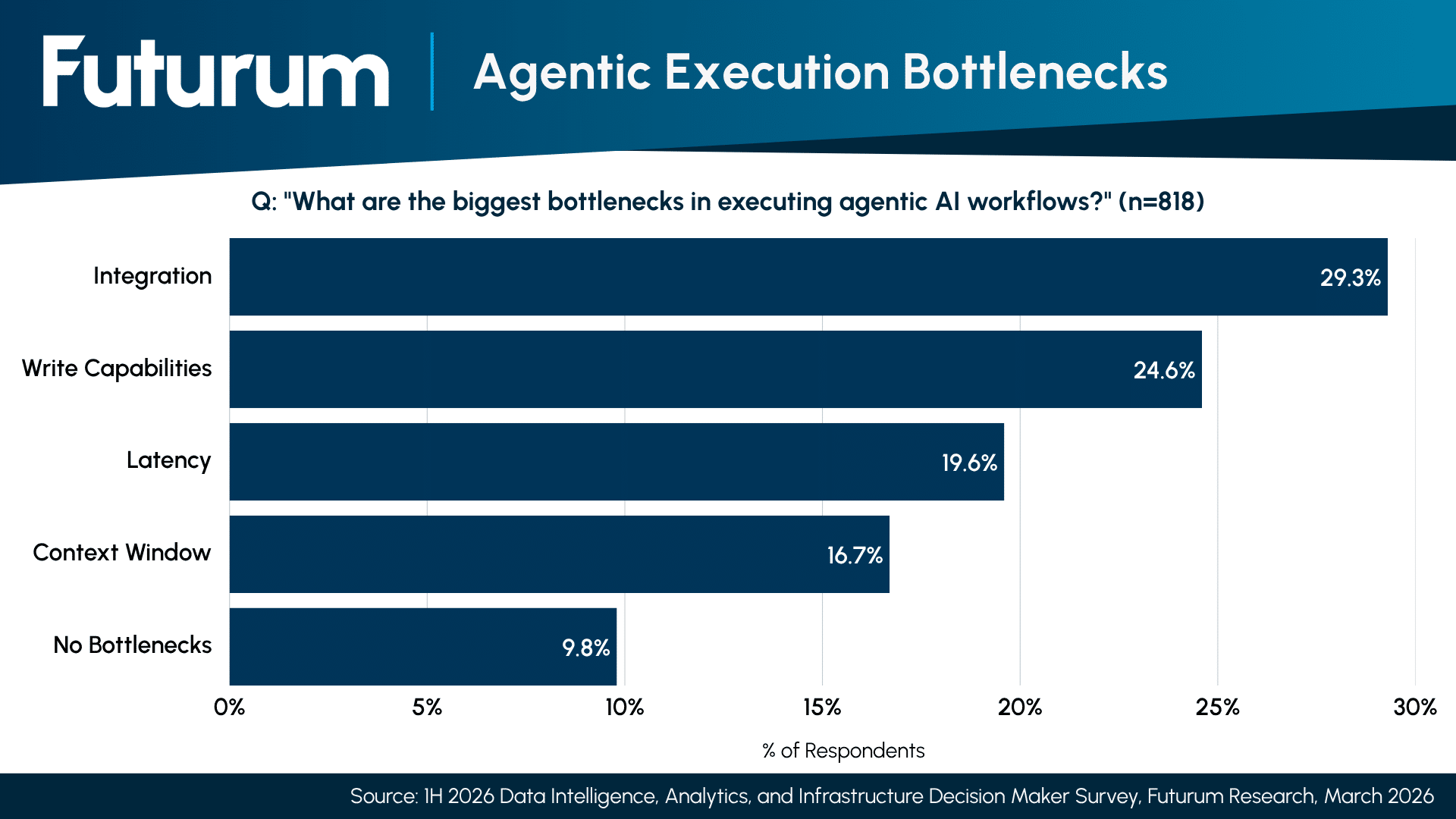
Enterprise responses demonstrate that operationalizing autonomous agents requires solving deep transactional and integration challenges, with 24.57% of decision-makers citing write-layer deficits and 19.56% reporting analytical warehouse latency bottlenecks. These findings highlight why enterprise context architectures must combine zero-copy analytical reach with low-latency transactional graph execution.
Governing the Agentic Memory Loop: Mitigating Tool Sprawl, Skill Drift, and System Write-Backs
An enterprise context engine must also actively participate in runtime agent execution rather than serving as an inert, read-only catalog. Neo4j’s agentic, self-improving memory loop intends to unify short-term session workspaces, episodic event logs, long-term semantic knowledge graphs, and procedural execution rules. When an agent navigates a complex operational task, its execution traces are parsed, distilled into structured procedural knowledge, and exposed as versioned MCP endpoints.
This loop enables systems to learn from past executions and sounds very straightforward. However, scaling this sort of action in production surfaces several operational hurdles:
- Tool Sprawl and Semantic Collisions: Exposing dozens of uncoordinated MCP endpoints directly to foundation models causes confusion. When separate business units expose competing customer endpoints without a unifying domain model, models struggle to select the appropriate tool. Grounding MCP definitions within Level 5 of the ontology ensures agents call tools governed by clear semantic boundaries.
- Skill Drift and Memory Contradiction: Corporate realities shift constantly. As agents record new execution traces, newly extracted facts inevitably conflict with historical data. Without automated conflict resolution, distilled skills drift and generate contradictory actions. Neo4j addresses this challenge by embedding structural back-links from distilled skills to the underlying memory graph. When base entity facts change, the platform flags downstream skills for human-in-the-loop review before updated behaviors are promoted back to production.
- PII Governance and Permission Inheritance: Agents querying memory graphs must strictly inherit user-level security contexts. Conversational traces frequently capture personally identifiable information (PII) and internal operational details that lack pre-existing security classifications. Context engines must apply automated entity masking and dynamically enforce fine-grained access policies at the graph level, verifying whether an agent possesses the authority to inspect specific subgraphs.
- Governed System-of-Record Write-Backs: As shown in Figure 1, 24.57% of enterprise leaders report the lack of an operational transactional write layer as their top architectural bottleneck. Autonomous agents that can only read data generate passive recommendations, leaving human operators to manually re-enter findings into operational software. Overcoming this bottleneck safely demands strict isolation between execution traces and core transactional tables. System write-backs must route through audited, copy-on-write sandboxes and governed APIs that require human-in-the-loop authorization before committing mutations to live production environments.
The “Lagom” Adoption Imperative: Healing the Scars of Failed Data Modeling Initiatives
Neo4j’s vision must overcome not only these kinds of operational hurdles but also dispel buyer skepticism and overall fatigue. Enterprise architecture teams carry deep organizational scars from past MDM and corporate data catalog initiatives that collapsed under their own weight. Organizations spent millions of dollars and multi-year rollout cycles attempting to construct universal, top-down enterprise data models, only to produce obsolete schemas that business units abandoned.
Worse, mentioning academic terms such as “ontologies” often triggers resistance, conjuring memories of costly consulting engagements that failed to deliver operational value. Emil Eifrem candidly acknowledged this dynamic, noting that he avoided using the term for two decades to steer clear of the academic stagnation associated with early Semantic Web projects.
Bridging the gap between a comprehensive six-layer architectural framework and immediate operational demands requires what Eifrem terms a lagom approach – the Swedish concept meaning “just right” or balanced. IT leaders facing mandates to deploy working agents cannot afford an 18-month data modeling moratorium. Instead of attempting to map the entire corporate estate upfront, teams should target a single, moderately valuable operational workflow, such as connecting call transcripts, SMS logs, and loan servicing records to automate refinancing outreach.
In comparison, focusing on a bounded, practical problem allows the immediate operational use case to pull the necessary ontologies, schema mappings, and data pipelines into place incrementally. This use-case-led delivery model avoids the failure modes of legacy MDM, delivering clear business impact within weeks while steadily building out the enterprise knowledge layer.
What to Watch:
- Production Convergence of the Semantic Layer: According to findings from our 1H 2026 Data Intelligence, Analytics, and Infrastructure Decision Maker Survey Report, 25.43% of organizations prioritize semantic layers for AI context, and 47.80% anticipate AI-augmented agentic analytics will dominate enterprise spending. Watch whether Neo4j’s prescriptive management plane captures developer mindshare before cloud data warehouse providers commoditize basic catalog metadata.
- Virtual Graph Latency on Open Lakehouse Formats: Monitor performance metrics as Neo4j Virtual Graphs reach General Availability in the coming months. Specifically observe query response times when Cypher-to-SQL push-down executions run deep multi-hop traversals over Apache Iceberg and Delta Lake storage compared to native AuraDB block storage.
- Standardization of Model Context Protocol Tool Registries: Track whether Anthropic’s MCP standard solidifies across enterprise platforms, and observe how effectively graph platforms incorporate native MCP registries, dynamic tool filtering, and procedural memory versioning directly into operational databases.
- Independent Context Engines Versus Cloud Ecosystem Encroachment: Observe whether enterprises favor independent, cross-cloud context engines or proprietary metadata layers tied to specific cloud ecosystems. Neo4j’s multi-cloud neutrality and specialized graph performance provide distinct advantages, provided the vendor maintains seamless integration with existing data warehouse investments.
Disclosure: Futurum is a research and advisory firm that engages or has engaged in research, analysis, and advisory services with many technology companies, including those mentioned in this article. The author does not hold any equity positions with any company mentioned in this article.
Analysis and opinions expressed herein are specific to the analyst individually and data and other information that might have been provided for validation, not those of Futurum as a whole.
Other Insights From Futurum:
Teradata Bridges the Enterprise AI Agent Execution Gap
Salesforce Bets on Silicon Synergy and Metadata to Make Business AI Practical
AWS and the End of the Naive Agent: Collapsing the Semantic Divide
Author Information

Brad Shimmin is Vice President and Practice Lead, Data Intelligence, Analytics, & Infrastructure at Futurum. He provides strategic direction and market analysis to help organizations maximize their investments in data and analytics. Currently, Brad is focused on helping companies establish an AI-first data strategy.
With over 30 years of experience in enterprise IT and emerging technologies, Brad is a distinguished thought leader specializing in data, analytics, artificial intelligence, and enterprise software development. Consulting with Fortune 100 vendors, Brad specializes in industry thought leadership, worldwide market analysis, client development, and strategic advisory services.
Brad earned his Bachelor of Arts from Utah State University, where he graduated Magna Cum Laude. Brad lives in Longmeadow, MA, with his beautiful wife and far too many LEGO sets.