
Navigating AI-Driven DIY Pressures and Strategic Consolidation in the Partner Technology Stack
Analyst(s): Alex Smith
Publication Date: November 10, 2026
Document #: AIOAS202610
What You Need to Know
- Standalone Partner Relationship Management (PRM) remains a fragmented micro-category compared to its enterprise software cousins such as CRM and ERP, leaving vendors vulnerable to software stack compression.
- Large enterprises are forced into SI-led in-house builds because commercial PRMs lack deep integration with core CRM/ERP/Finance platforms, while mid-market organizations treat PRM as a lightweight “orbiting” administrative utility vulnerable to AI displacement.
- Survival in the partner technology space hinges on Private Equity-driven rollups that unify core PRM infrastructure, multi-route cloud marketplace go-to-market (GTM) capabilities, and channel incentive suites into single-pane-of-glass platforms.
The Futurum View: Make or Break Time for PRM Market
At a recent briefing with a major tech company, a somewhat surprising claim was proudly shared: the fact that it built one of the largest and most successful PRM systems in the world. This is a platform that is internally developed and operated, supporting thousands of partners and (self-claimed) millions of users across its vast partner network. It is not uncommon for a company to self-develop parts of its operational tech stack, particularly when it comes to the partner tech stack. Yet it is rare (though not unheard of) for a company to self-develop its own CRM platform (this same company uses Salesforce). The build-vs-buy question is far more active in the world of PRM and partner-oriented technologies than it is in core sales and marketing.
It is not a lack of off-the-shelf solutions that causes this. The PRM category has a number of competing companies offering commercial software (around 70–75 vendors exist in the G2 database for PRM, and around 200 overall in partner tech). Yet despite the importance of partnering as a GTM discipline, the solution category has never risen to anywhere near the heights of fellow software categories in terms of global spend. CRM is a $96 billion market; ERP is a $69 billion market; PRM hovers between $1 billion and $2 billion. The market has signaled that companies are willing to spend a fraction of the amount on software to manage partners as they will to manage customers and suppliers. Alternatively, companies will simply build the tooling themselves.
Two fates now await the PRM market. First, “Do-It-Yourself” (DIY) approaches will rise, buoyed by AI-enabled developer teams and the architecture of Model Context Protocol (MCP) servers. Second, aggressive consolidation of existing partner technology stacks will accelerate, spearheaded by private equity. The hopeful outcome of the latter is that a true household PRM name finally emerges.
Enterprise Integration Gaps vs. Mid-Market “Orbiting” Portals
The largest of technology companies see partnering as a core discipline, but in those companies we rarely (if ever) see a PRM vendor scale to be an enterprise-class solution that is treated as a first-class citizen the way that CRM, ERP, or martech is. A large enterprise partner program can be incredibly complex, featuring intricate tiering structures, multi-tiered attribution logic, complex co-sell rules, and global rebate matrices. Partner-oriented workflows cannot operate in a vacuum. They require deep, bidirectional integration across core enterprise tech stacks, spanning CRM, ERP, marketing, and core financial/commission systems. Most PRM companies seemingly have not risen to meet that challenge; consequently, enterprise leaders bypass off-the-shelf PRMs and engage in custom DIY builds (frequently in partnership with Systems Integrators (SIs) and IT consultancies), adding custom partner systems directly on top of their core systems of record. The PRM companies are either not in the biggest partner operations, or playing a narrow functional role in those environments.
The result is that PRM has largely become a mid-market product. The top five most reviewed PRM products on G2 reflect a user base dominated by mid-market (46%) and small business (37%) segments, with only 16% enterprise participation. Furthermore, 60% of reporting customers maintain annual contract values under $1,000, and 54% operate on non-binding or month-to-month terms. This indicates that off-the-shelf PRMs in the mid-market are purchased as lightweight utilities rather than deeply embedded platforms.
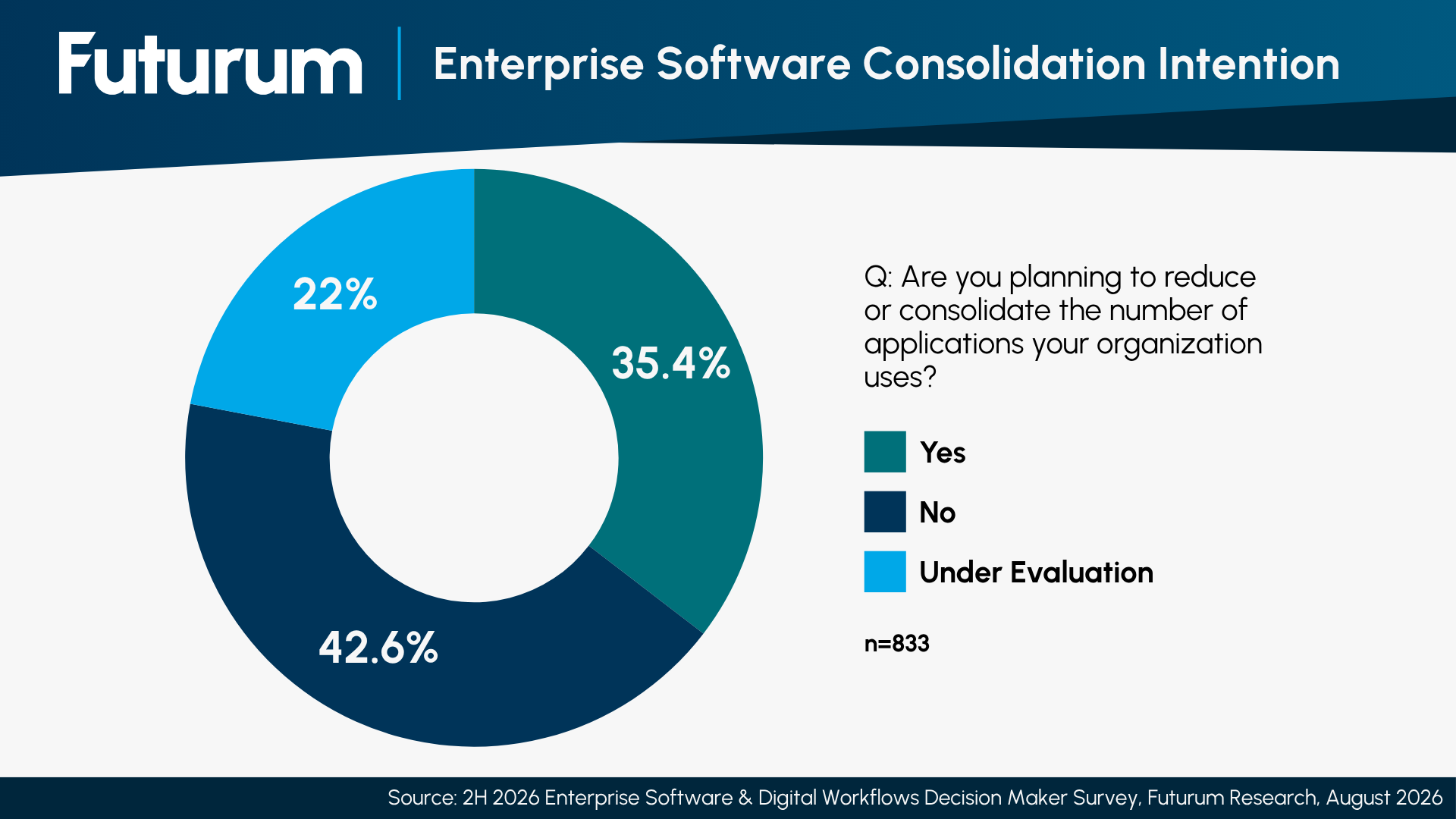
These commercial PRMs deployments show the characteristics of a peripheral or “orbiting” application. In these scenarios, we can see PRM functioning as a lightweight administrative portal for deal registration forms, document distribution, and partner onboarding checklists. When IT departments conduct software rationalization exercises, orbiting applications with low switching barriers face immediate scrutiny. And with over 57% of organizations actively consolidating or evaluating application consolidation, pure-play PRM point solutions face roadblocks at both ends of the market: avoided by the largest enterprises for lack of deep integration depth, and rationalized by mid-market buyers seeking suite convergence.
Figure 1: Enterprise Software Consolidation Intention
Why DIY Will Rise: AI Agents, MCP Servers, and Developer Autonomy
It won’t just be larger enterprises that lean into the DIY approach. Generative AI and modern integration standards have fundamentally tipped the cost-benefit equation in favor of internal development for workflow portals.
Historically, building an in-house partner portal required dedicated engineering pods, continuous UI maintenance, custom database schemas, and complex integration pipelines to mirror lead routing rules into the CRM. Going forward, agentic software engineering and LLM-assisted coding frameworks will increasingly allow internal IT teams and SI partners to assemble partner-facing applications in a fraction of the time.
Simultaneously, the emergence of MCP servers represents a technical tipping point for partner technology. MCP standardizes how AI applications interact with underlying enterprise data sources safely and securely. In a traditional PRM model, a vendor must grant partner organizations access to a closed, third-party portal. MCP-enabled architectures provide a fundamentally different model for software engagement:
- Decentralized Interoperability: An enterprise can expose specific, secure APIs and database contexts (e.g., deal registration schemas or co-sell account queries) directly to an AI agent framework.
- Zero-Portal Workflows: Partners no longer need to navigate a proprietary, separate vendor portal to log a lead or retrieve marketing collateral. Instead, partner-side AI agents communicate directly with vendor-side MCP servers using standardized interfaces. MCP itself does not handle cross-organizational authentication, identity, or trust between a vendor and its partners; the protocol leaves that to the participating organizations to build and govern. That gap is a role PRM vendors are well positioned to fill, acting as the trusted layer that manages partner identity, entitlements, and data-sharing rules across organizational boundaries.
- Reduced Operational Overhead: Internal developer teams can deploy custom front-end interfaces (or simple conversational interfaces built inside Slack, Microsoft Teams, or custom web portals) backed by native CRM business logic.
When G2 implementation data shows commercial PRM software can be deployed in a matter of weeks using internal resources, enterprise IT leaders will naturally conclude that custom agentic workflows built directly on top of their existing CRM platform and other first-class data lakes will offer a superior, lower-cost alternative to subscribing to an isolated SaaS vendor with a narrow focus.
That conclusion comes with caveats. Custom builds carry their own long-term costs: ongoing maintenance, technical debt that accumulates as partner programs and tiering rules change, exposure to staff turnover when the engineers who built the system move on, and SI fees for both the initial build and continued upkeep. These costs are easy to underestimate at the decision point, and they give commercial PRM vendors their strongest counterargument to the DIY case.
PRM companies leveraging this counterargument may have the attention of loyal functional partner leaders, but does their reach extend deeper (and higher) into the operational machinery?
Consolidation Is Underway, and Will Continue
If the threat of DIY represents the push factor driving vendors away from pure-play PRM, Private Equity (PE) consolidation represents the pull factor reshaping the vendor landscape. The sheer fragmentation of the current market, where around 70 vendors (according to G2 data) compete for a modest $1B–$2B total addressable market, means no individual off-the-shelf vendor possesses sufficient “gravity” or brand power to define the category independently. Beyond PRM, another 120+ companies are competing in adjacent categories such as incentive management and through-channel marketing.
To survive, the partner tech stack must undergo aggressive M&A rollups. Private Equity sponsors have recognized that while standalone PRM portals are vulnerable, a converged, end-to-end Partner Management Platform (PMP) creates immense value for enterprise buyers who manage complex, multi-route indirect GTM strategies. This is where the earlier-mentioned data point around application convergence can serve as a tailwind for the category.
We are already witnessing the rollout of this consolidation playbook across several key market participants:
- AppDirect: Expanded its reach beyond traditional commerce by incorporating affiliate/partner network engine PartnerStack alongside cloud marketplace automation platform Tackle.io, creating a comprehensive platform bridging core PRM, cloud GTM, and ecosystem monetization.
- Channelscaler: Formed through the strategic merger of Allbound (front-end PRM experience) and Channel Mechanics (back-end incentive and program compliance automation), combining portal UX with complex enterprise financial engines.
- Crossbeam: Merged with Reveal in a major ecosystem deal, pooling data networks across more than 25,000 connected companies to establish data gravity for partner account mapping.
- Impartner: Backed by private equity growth capital, Impartner has executed a rollup strategy, acquiring players such as TIE Kinetix (through-channel marketing) and Amplifinity (referral automation) to broaden its enterprise suite.
- Unifyr: Formerly operating as Zift Solutions, the company rebranded and re-architected its core software engine to unify channel marketing automation with broader channel management workflows.
These strategic maneuvers illustrate that pure-play point solutions are being systematically acquired or re-platformed. The goal of this rollup wave is to build a platform capable of handling traditional VARs, cloud marketplaces, strategic alliances, and referral networks under a single architectural pane of glass.
The Quest for a Household Name
At its core, the primary challenge facing PMP companies is not merely architectural or functional; it is a challenge of narrative and reputation. While there is a deeply committed base of partner management professionals who actively advocate for their preferred partner technologies across various roles and organizations, this enthusiasm rarely permeates the higher echelons of corporate leadership. The positive reputation built among functional power users consistently fails to extend to the C-suite or inform core business strategy.
For PMP to escape its positioning as a secondary administrative utility and achieve category status akin to CRM or ERP, vendors must fundamentally elevate their narrative. They must transition from selling functional feature sets to demonstrating direct, strategic business value at the executive level. Until PMP platforms can clearly articulate their impact on enterprise revenue growth, ecosystem-led pipeline velocity, and holistic customer retention directly to CFOs and CEOs, partner technology will remain vulnerable to budget rationalization rather than being recognized as an indispensable, first-class software stack.
What to Watch:
- Vendor Native Partner Portals: Watch for large tech companies to launch deeper, native co-selling and partner portal tools directly within their seller consoles, further encroaching on standalone PRM functionality.
- Expansion of MCP Server Frameworks: Monitor the adoption of MCP standards among enterprise software platforms, which could allow partners to co-sell and register deals directly from their own CRMs without ever logging into a vendor portal.
- Private Equity Exit Timelines: Track upcoming exit cycles for PE-backed rollups such as AppDirect, Impartner, and Channelscaler. Their ability to achieve premium enterprise valuations will signal whether the consolidated “Partner Management Platform” category has successfully established market gravity.
- Major PRM Vendor Enterprise Expansion: Monitor whether any leading PRM vendors successfully achieve enterprise-scale expansion by securing and scaling within one or two flagship enterprise accounts, potentially signaling a shift away from mid-market utility positioning.
Disclosure: Futurum is a research and advisory firm that engages or has engaged in research, analysis, and advisory services with many technology companies, including those mentioned in this article. The author does not hold any equity positions with any company mentioned in this article.
Analysis and opinions expressed herein are specific to the analyst individually and data and other information that might have been provided for validation, not those of Futurum as a whole.
Other Insights From Futurum:
Salesforce’s Real Moat Behind Koa Is Its CRM Training Data
AIforce Turns Salesforce Into an Everywhere Intelligence Layer
AWS Marketplace Evolving to Support All Stages of the Sales Cycle
Author Information

Alex is Vice President & Practice Lead, Ecosystems, Channels, & Marketplaces at the Futurum Group. He is responsible for establishing and maintaining the Channels Research program as part of the overall Futurum GTM and Channels Practice. This includes overseeing the channel data rollout in the Futurum Intelligence Platform, primary research activities such as research boards and surveys, delivering thought-leading research reports, and advising clients on their indirect go-to-market strategies. Alex also supports the overall operations of the Futurum Research Business Unit, including P&L segmentation, sales and marketing alignment, and budget planning.
Prior to joining Futurum, Alex was VP of Channels & Enterprise Research at Canalys where he led a multi-million dollar research organization with more than 20 analysts. He played an integral role in helping the Canalys research organization migrate into Omdia after having been acquired in 2023. He is an accomplished research leader, as well as an expert in indirect go-to-market strategies. He has delivered numerous keynotes at partner-facing conferences.
Alex is based in Portland, Oregon, but has lived in numerous places, including California, Canada, Saudi Arabia, Thailand, and the UK. He has a Bachelor in Commerce and Finance Major from Dalhousie University, Halifax Canada.