At OCP Global Summit 2026, Arm is releasing an ecosystem white paper proposing a methodology for measuring CPU performance in agentic AI systems, alongside a Signal65 benchmark study that credits the Arm AGI CPU with 1.99x the modeled work per rack of AMD’s EPYC 9755 across seven workloads. The disclosures move the agentic CPU debate from architecture claims to measured workloads, and they put a stake in the ground on how the industry should assess agentic performance.
What Is Covered in This Article:
- Arm’s OCP 2026 disclosures including a benchmarking methodology white paper and a Signal65 performance study of AGI CPU
- The 1.99x average modeled rack-performance result versus AMD’s 128-core EPYC 9755, with per-workload results from 1.43x to 3.19x
- Rack density as the dominant driver, 21 to 23 AGI CPU servers per 24 kW rack against 13 EPYC 9755 servers
- The white paper’s framework of five agentic workload archetypes and two complementary measurement methods
- Arm’s ‘agentic work per rack’ metric as a counter to agents-per-rack marketing
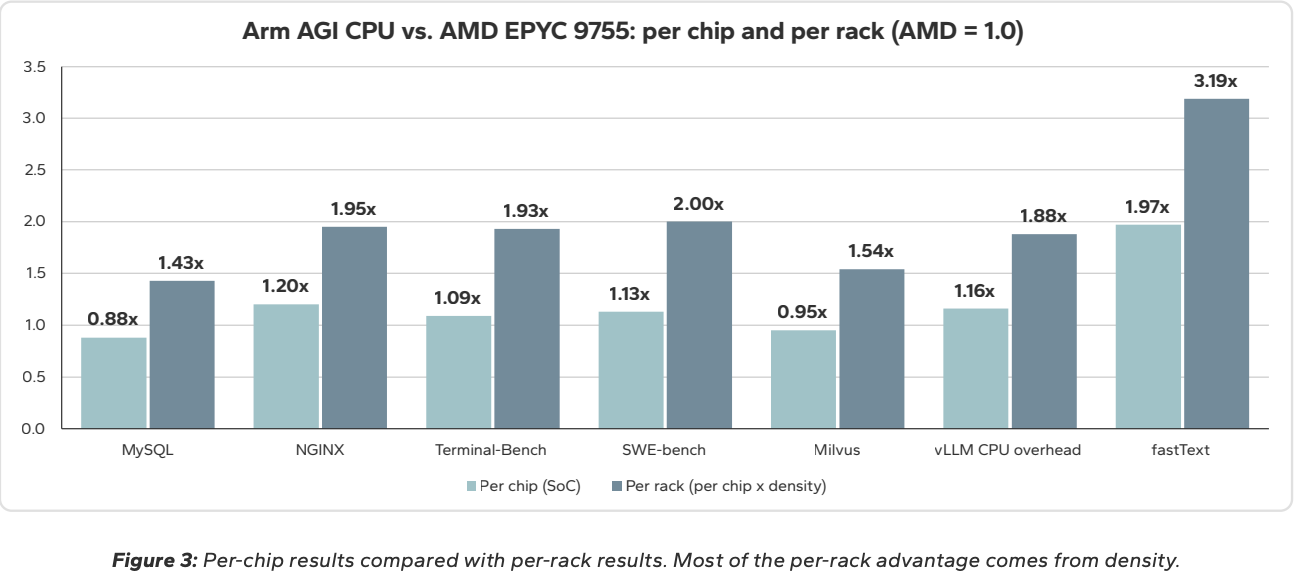
The News: At OCP Global Summit 2026 in San Jose, Arm made two disclosures on agentic CPU performance. The first is a white paper, developed with ecosystem partners, that proposes a use-case-driven methodology for measuring the CPU’s contribution to agentic AI systems. It defines five representative workload archetypes, software engineering, enterprise operations, financial and scientific research, personal assistants, and robotics, and pairs component-level benchmarking with end-to-end task measurement built on replayable agent trajectories. The second is a Signal65 Lab Insight study, “Scaling Agentic AI with Arm AGI CPU,” authored by Russ Fellows, VP, Labs at Signal65, applying that framing to the merchant silicon Arm launched in March 2026. Across seven workloads spanning tooling (MySQL, NGINX), agentic workflows (Terminal-Bench 2, SWE-bench replay), and reasoning and planning support (Milvus vector search, vLLM CPU overhead, fastText), the study credits AGI CPU with an average of 1.99x the modeled performance per 24 kW rack of a system built on AMD’s 128-core EPYC 9755, with individual workloads ranging from 1.43x to 3.19x.
By Arm’s pillar framing, that is 1.7x for tooling, 2.0x for end-to-end agentic workflows, and 2.2x for reasoning and planning. A separate Sandbench comparison against a two-socket AMD EPYC 9965 found AGI CPU creating agent sandboxes with 45% less time for cold starts, 27% less for warm starts, and 41% less in the worst case under 4x oversubscription across runc, Firecracker, and gVisor runtimes. Arm’s booth will also showcase the expanded AGI CPU hardware ecosystem, including its own reference design, commercial servers from Supermicro, Lenovo, and ASRock, a 5U Supermicro head-node configuration for accelerator cards, and compute racks that scale from air to liquid cooling.
Arm AGI CPU Posts 2x the Agentic Work Per Rack of AMD’s EPYC 9755 at OCP 2026
Analyst Take: Arm is attempting something harder than a benchmark win at OCP Global Summit 2026. It is trying to define the test. The agentic CPU benchmarking white paper argues that no existing benchmark family measures what agentic AI actually asks of a processor, since traditional CPU suites miss the agent loop and AI benchmarks measure the model rather than the system around it. The Signal65 study then runs Arm’s own silicon through the proposed lens and finds 1.99x the agentic work per modeled rack of AMD’s EPYC 9755. Both halves deserve attention yet deserve different levels of trust. The methodology is a credible contribution to a measurement problem Futurum has flagged all year: agentic workflows route intent parsing, tool execution, retrieval, orchestration, and policy checks through the CPU, and the industry has been pricing that shift with marketing numbers rather than measurements. The performance claim compares against a competitor’s current part rather than its next one. If the methodology gains adoption, every vendor’s agentic claims become testable, including Arm’s.
The 2x Is a Density Result
The appendix tells a more precise story than the headline. Per chip, AGI CPU averages 1.20x the EPYC 9755 across the seven workloads, and AMD wins two of them outright: MySQL at 0.88x and Milvus at 0.95x favor the x86 part at the socket level. The 1.99x emerges from Arm’s rated server-power model, which places 21 to 23 AGI CPU servers in a 24 kW rack against 13 EPYC 9755 servers, 5,712 to 5,888 physical cores against 3,328, because an AGI CPU server draws a rated 950 W to 1,050 W against 1,700 W for a two-socket EPYC system. Multiply per-chip results by that 1.62x to 1.77x density factor and the rack numbers follow. The report’s own sensitivity analysis deserves quoting: memory is sized at 4 GB per hardware thread, which hands the SMT-enabled EPYC rack roughly 2 TB of memory per server against 1 TB for AGI CPU, and sizing per physical core instead would cut the seven-workload average from 1.99x to about 1.81x. Signal65 also notes the rack results are modeled rather than measured, the per-chip results come from early AGI CPU systems, and the tests make no attribution to SMT, cache, or instruction set. That transparency is the strongest part of the study, and it points buyers to the real question: whether Arm’s rated power figures and the 4 GB-per-thread memory assumption match their own deployment math. Enterprises should rerun the rack model with their own power budgets before the 2x reshapes a procurement decision.
Agentic Work Per Rack Reframes a Metric the Industry Was Getting Wrong
The most consequential idea in the disclosure is a rejection of agents per rack as a unit of value. Jeff Defilippi, Senior Director of Product Management for Cloud AI at Arm, made the case directly in Futurum’s pre-briefing: a rack can host 50,000 nominal agents that accomplish nothing because they contend for the same cores, cache, and memory bandwidth. Arm proposes agentic work per rack instead, completed tasks under service-level guarantees, with tail latency in a loaded system as the binding constraint. That framing aligns with how Arm built the AGI CPU, which allocates a dedicated core, dedicated cache, and dedicated memory bandwidth per worker and omits simultaneous multithreading to avoid the contention and tail-latency expansion SMT introduces on x86.
It also functions as a competitive wedge. Intel has leaned on agent-density messaging, and density is exactly the metric Arm’s framework declares meaningless without a completion-time denominator. The Sandbench results give the argument teeth, since sandbox creation is the recurring tax every tool-using agent pays, and 45% faster cold starts against a two-socket EPYC 9965 compound across thousands of agent tasks. Futurum sees the correction as directionally right. The agentic era prices outcomes, tokens processed, tasks completed, SLAs met, and a per-rack work metric connects silicon choices to the “AI factory” economics that already govern accelerator purchasing. The open question is whether a vendor whose architecture happens to excel at the proposed metric can convince the industry to adopt it, a question SPEC and MLPerf have answered slowly in every prior cycle.
The White Paper Is a Taxonomy the Agentic Benchmark Vacuum Has Been Waiting For
The methodology paper is more rigorous than vendor benchmark literature tends to be. It separates CPU-visible agentic work into common framework functions, orchestration, routing, state, guardrails, and telemetry, and use-case-specific tool workloads such as compilation, databases, and simulation. Five workload archetypes span deployment venues from cloud developer infrastructure to embedded robotics, each with a distinct CPU stress signature. Two measurement approaches are held in deliberate tension: component benchmarking for reproducibility and attribution, end-to-end benchmarking for task realism. The paper’s most useful technical contribution is the replayable agent trajectory, a captured sequence of tool calls that can be re-executed to isolate CPU work from model nondeterminism, which the source experiments found can swing run-to-run results by one to two orders of magnitude for the same task.
The Signal65 study applies exactly that method, replaying 259 SWE-bench tasks and running 72 agent task types in sandboxed containers on Terminal-Bench 2, where AGI CPU posts its most meaningful wins: 2.00x and 1.93x modeled per rack on the two emerging agentic benchmarks, from per-chip advantages of 1.13x and 1.09x. The authors of the white paper also decline to publish a composite score, arguing that defensible workload weights do not yet exist. That restraint cuts both ways. It is honest methodology, and it leaves the 1.99x headline resting on an arithmetic average of seven workloads whose selection Arm shaped. Enterprises evaluating agentic infrastructure should treat the archetype taxonomy as immediately useful for mapping their own workloads and treat any single figure of merit, from any vendor, as premature by the white paper’s own logic.
A 2x Claim Against Zen 5 Sets Up a Harder Fight Against Venice and Vera
The benchmark targets deserve scrutiny before the number reshapes procurement. Signal65 measured against the EPYC 9755, AMD’s 128-core, Turin-family Zen 5 flagship, which is competitive context for systems shipping today but not for systems a buyer will rack in late 2027, when AMD’s Zen 6 EPYC Venice, Intel’s Xeon 6+, and NVIDIA’s Vera will contest the same sockets. Futurum raised the Venice gap in our briefing, and Arm did not dispute it. The result is a statement about the current market, not the next one.
The benchmark composition tells its own story. The strongest result is fastText at 3.19x per rack and 1.97x per chip, conventional CPU data processing of the kind a host node performs, and vLLM CPU overhead at 1.88x quantifies the serving work that keeps an accelerator saturated, precisely the role where AGI CPU is gaining early traction with customers pairing it against in-house accelerators. The 1.43x MySQL result is the most contestable, since x86 tuning on mature server workloads is a 30-year moat and AMD holds the per-chip win there. The competitive field also includes Arm’s own architecture: the report itself frames AGI CPU as building on AWS Graviton, Google Axion, Microsoft Cobalt, and NVIDIA Vera, Arm-based designs that generate royalties without buying Arm’s merchant silicon, so every AGI CPU benchmark win doubles as a sales pitch against Arm’s largest licensees. The agentic reframing is Arm’s argument for why merchant silicon deserves a growing share of it.
The Head Node Opening Is the Nearest Revenue and the Rack Is the Larger Prize
The hardware ecosystem on display at OCP maps the two deployment paths AGI CPU can take. The Supermicro 5U head-node configuration, AGI CPUs in front of slots for GPUs or fixed-function accelerator cards, addresses the most immediate commercial opening: custom accelerator programs need a host CPU, Arm confirmed that accelerator builders evaluating AGI CPU for the host role are reporting strong results, and the fastText, vLLM, and Sandbench numbers quantify why a contention-free CPU matters when its job is keeping an accelerator saturated. NVIDIA validated the coupled-CPU model with Grace, and AGI CPU offers that pattern to everyone building silicon that is non-NVIDIA silicon. Rack-scale configurations, scaling from air to liquid cooling, chase neoclouds already plumbing for liquid cooling and buying compute at rack granularity to run agentic services alongside accelerator racks. Supermicro, Lenovo, and ASRock carrying commercial systems extend the go-to-market Futurum covered at OCP EMEA, where Supermicro and Verda brought the first AGI CPU systems to market.
The sequencing matters for Arm’s model transformation from IP licensor to silicon vendor. Head node wins inside other companies’ accelerator programs produce revenue without challenging hyperscaler custom CPU programs directly, while rack-scale agentic compute puts Arm in open competition with its own licensees’ designs. Arm’s Q1 FY 2027 results showed data center royalties strengthening as AGI CPU gained traction, evidence the two paths are compounding rather than cannibalizing so far.
What to Watch:
- Whether Signal65’s planned follow-on testing on final production AGI CPU hardware, including PINNACLE CPU-centric benchmarks and broader competitive comparisons, confirms the early-system results
- Whether AMD responds with Venice-generation agentic benchmarks or a methodology counterproposal
- Whether cloud providers, benchmark bodies, or rival silicon vendors adopt the white paper’s archetypes and trajectory-replay method
- Whether named AGI CPU head node design wins with custom accelerator programs surface in the coming quarters
- Whether neocloud rack-scale AGI CPU deployments move from evaluation to production commitments
Read the full announcement on agentic CPU performance in the Arm newsroom.
Sources
- AI agents are changing what CPU performance means, ARM, October 2026
Declaration of generative AI and AI-assisted technologies in the writing process: This content has been generated with the support of artificial intelligence technologies. Due to the fast pace of content creation and the continuous evolution of data and information, The Futurum Group and its analysts strive to ensure the accuracy and factual integrity of the information presented. However, the opinions and interpretations expressed in this content reflect those of the individual author/analyst. The Futurum Group makes no guarantees regarding the completeness, accuracy, or reliability of any information contained herein. Readers are encouraged to verify facts independently and consult relevant sources for further clarification.
Disclosure: Futurum is a research and advisory firm that engages or has engaged in research, analysis, and advisory services with many technology companies, including those mentioned in this article. The author does not hold any equity positions with any company mentioned in this article.
Analysis and opinions expressed herein are specific to the analyst individually and data and other information that might have been provided for validation, not those of Futurum as a whole.
Read the full Futurum Group Disclosure.
Other Insights From Futurum:
The $246 Billion CPU Opportunity’s Winning Chip Has Not Been Designed Yet
Arm’s Agentic Moat Widens With CSS for Mobile 2, CSS N4, and Physical AI
Can the IBM/Arm Dual Architecture Processor Align the Mainframe With the Agentic CPU Market?
Author Information

Brendan is Research Director, Semiconductors, Supply Chain, and Emerging Tech. He advises clients on strategic initiatives and leads the Futurum Semiconductors Practice. He is an experienced tech industry analyst who has guided tech leaders in identifying market opportunities spanning edge processors, generative AI applications, and hyperscale data centers.
Before joining Futurum, Brendan consulted with global AI leaders and served as a Senior Analyst in Emerging Technology Research at PitchBook. At PitchBook, he developed market intelligence tools for AI, highlighted by one of the industry’s most comprehensive AI semiconductor market landscapes encompassing both public and private companies. He has advised Fortune 100 tech giants, growth-stage innovators, global investors, and leading market research firms. Before PitchBook, he led research teams in tech investment banking and market research.
Brendan is based in Seattle, Washington. He has a Bachelor of Arts Degree from Amherst College.