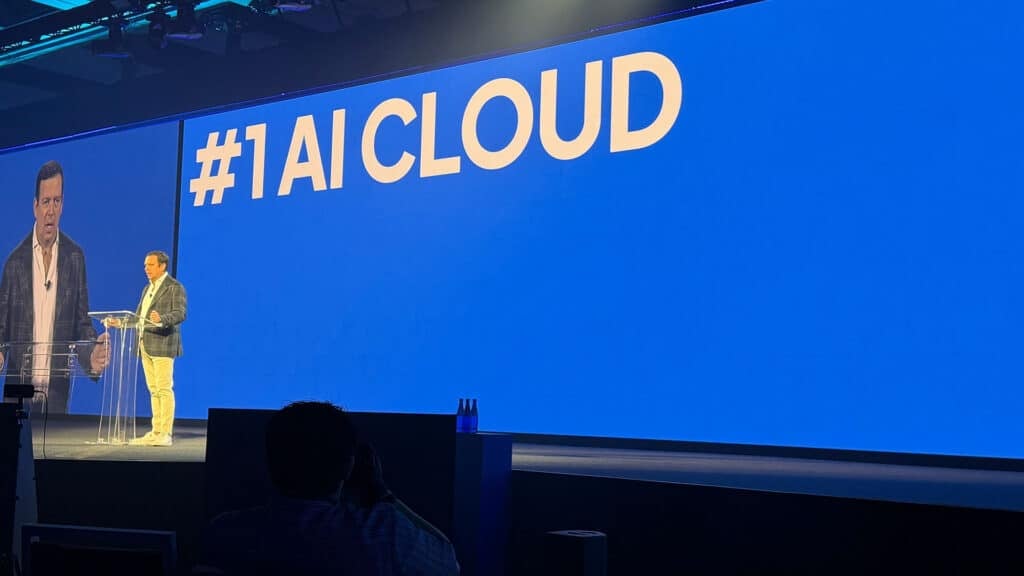
SAP unveiled its Autonomous Enterprise initiative at SAP Connect in Las Vegas, launching Joule Work and Joule Assistants on the SAP Business AI Platform. Internal deployment to 110,000 SAP employees has produced 20% productivity gains in finance, HR, and procurement, giving SAP a defensible proof point before broad customer rollout. With the enterprise applications market forecast at $664.3B in 2026 (Base case) and a 10.9% CAGR through 2031, SAP’s leading positions in ERP (15.83% share, $9.55B) and supply chain (18.01% share, $3.82B) place it to capture a disproportionate share of AI-driven growth.
What Is Covered in This Article:
- Joule Work and Joule Assistants launch at SAP Connect
- 20% internal productivity gains validating the platform
- Early enterprise adopter deployments across Nestlé, PwC, and others
- Open platform strategy: 70+ AI models and ISO/IEC 42001 governance
- Agentic AI demand from 73.1% of enterprise decision makers
- Enterprise applications market forecast at $664.3B in 2026
- Competitive landscape: SAP Joule vs. Salesforce Agentforce, Microsoft Copilot, ServiceNow, and Oracle [2][2]
The News: SAP announced its Autonomous Enterprise initiative at SAP Connect on October 6, 2026 in Las Vegas, unveiling Joule Work and Joule Assistants built on the SAP Business AI Platform. Joule Work is already live with 110,000 SAP employees, delivering 20% productivity gains across finance, HR, and procurement. The SAP Knowledge Graph underpins the platform by mapping more than 7 million data fields for reliable business context. Early enterprise adopters include Nestlé, whose Accounts Receivable Assistant automates collections prioritization across 140 countries, and PwC, deploying a Billing Assistant to reduce billing errors. SAP also announced a new partnership with Moody’s to embed supplier risk data into SAP Ariba and expanded its collaboration with ORO Labs for procurement orchestration.
SAP’s Autonomous Enterprise: Is Joule the ERP Endgame?
Analyst Take: SAP’s Autonomous Enterprise launch is designed to convert its installed-base dominance into an AI revenue engine. By deploying Joule Work internally first and publishing concrete productivity metrics, SAP did something most enterprise vendors skip: it put measurable results on the table before asking customers to buy. That internal validation, combined with early adopter results, directly reduces perceived risk for the next wave of enterprise buyers.
Internal Deployment as a Market Signal
Rolling out Joule Work to 110,000 employees before general availability is a credibility play. The 20% productivity gains in finance, HR, and procurement give SAP’s sales teams a defensible benchmark — an operational result from a complex, multi-function enterprise, not a vendor projection. Maschinenfabrik Reinhausen reinforces the point: tasks that previously required up to an hour of manual effort across SAP S/4HANA are now handled in seconds through natural language. The SAP Knowledge Graph, mapping more than 7 million data fields, grounds Joule in trusted business context rather than generic large-language-model outputs. For enterprise buyers who cite faster time-to-value as a top budget-allocation driver (47.9% of decision makers, n=833), this architecture addresses the most common objection to AI adoption head-on.
Cross-Functional Adoption Shows Platform Depth
The early adopter roster spans industries and use cases in ways that demonstrate platform depth, not point-solution capability. Nestlé’s Accounts Receivable Assistant automates collections prioritization across 140 countries, showing that Joule operates at global scale within a single, complex S/4HANA transformation. The International Trade Assistant cuts trade classification effort by up to 50% — a concrete gain in a compliance-heavy workflow where errors carry real financial consequences. PwC’s Billing Assistant targets error reduction in professional services billing, a high-frequency, high-stakes process. These deployments speak directly to the 47.9% of enterprise buyers (n=833) who rank improved integration capabilities among their top budget-allocation confidence drivers, because each assistant operates across SAP and third-party data without requiring custom integration work.
Open Platform Strategy Meets Agentic AI Demand
SAP’s decision to support more than 70 AI models via Joule Studio, from no-code to pro-code workflows, positions the Business AI Platform as infrastructure rather than a closed product. This matters because 73.1% of enterprise technology decision makers (n=833) now rank agentic AI among their top technology priorities, and that demand is not uniform: different organizations want different models, governance frameworks, and integration patterns. SAP’s ISO/IEC 42001-certified AI governance architecture addresses the regulatory and auditability requirements that increasingly gate enterprise AI procurement. New partnerships with Moody’s for continuous supplier risk monitoring in SAP Ariba and ORO Labs for procurement orchestration extend the platform’s data and workflow reach without requiring SAP to build everything internally. Supply chain management ranked among the top projected agentic AI deployment areas in Futurum’s 2H 2026 enterprise survey (33.9%, n=833), and SAP’s 18.01% supply chain market share makes the Moody’s integration well-timed to capture that demand.
Competitive Landscape: Joule vs. the Field
SAP is not the only major vendor building an agentic AI platform, and the competitive dynamics here matter as much as the product itself. Futurum’s Signal Report on Agentic AI Platforms for Enterprise (June 2026) [2] identifies Salesforce, Microsoft, ServiceNow, Oracle, AWS, and Google as the primary competitors in this race. Each takes a fundamentally different approach.
Salesforce has moved aggressively with Agentforce, expanding beyond front-office CRM into back-office workflows like compliance and data verification through Agentforce Operations (launched April 2026) [2]. Salesforce reported Agentforce ARR grew 169% year-over-year in its fiscal 2026 results, demonstrating real commercial traction [2]. Its ‘Headless 360’ architecture, which exposes CRM capabilities through APIs and Model Context Protocol tools, is designed to position Salesforce as a horizontal agent orchestration layer [2]. The risk: Salesforce’s data model is CRM-centric, and extending it to ERP-grade workflows like procurement and manufacturing requires data integration work that SAP’s native position avoids.
Microsoft approaches the market from an infrastructure angle. Copilot Studio allows enterprises to build custom agents on top of Azure AI, leveraging Microsoft’s dominant position in productivity (Teams, Office 365) and cloud infrastructure. In Futurum’s 1H 2026 enterprise decision maker survey, 38.8% of buyers said they expect GenAI to be delivered via task-specific agents, while 27.6% still expect copilot-style, prompt-driven integration. Microsoft spans both modes but concentrates its strength in the productivity layer, not the ERP and operational layer where SAP dominates.
ServiceNow has built its AI agent strategy around IT operations and workflow automation, where it has deep domain data and a large installed base [2]. Its approach is narrower than SAP’s or Salesforce’s but deeper in IT service management, and it benefits from strong enterprise trust in regulated industries.
Oracle has integrated AI agents into Fusion Cloud Applications across finance, HR, and supply chain. Oracle’s advantage is a full-stack model (infrastructure through application), but its enterprise applications market share in ERP (11.01%, $6.64B) trails SAP’s, and its agent capabilities are less prominent in Futurum’s Signal assessments to date [2].
SAP’s differentiation is structural: Joule is embedded in the systems where the majority of large-enterprise operational workflows already run [2]. That means no new platform evaluation, no data migration, and no integration project for existing SAP customers. Whether that installed-base advantage translates into AI monetization at the pace SAP needs will depend on customer adoption velocity through 2027.
Market Position and the AI Monetization Question
SAP holds 15.83% ERP market share ($9.55B in CY2025 revenue) and 18.01% supply chain share ($3.82B), leading both segments. The enterprise applications market is forecast to reach $664.3B in 2026 (Base case) and grow at a 10.9% CAGR through 2031. Meanwhile, 43.6% of enterprise buyers (n=833) now cite generative AI capabilities as their top criterion for future software purchases, with agentic AI close behind at 39.4%. SAP’s embedded AI approach turns that buying criterion into a retention and expansion lever across its installed base. The open question is whether SAP can translate internal productivity gains into measurable customer outcomes fast enough to justify the premium pricing that AI monetization requires.
What to Watch:
- Customer adoption velocity: which enterprise segments beyond early adopters deploy Joule Work in Q4 2026 and Q1 2027, and at what scale
- Productivity benchmark replication: whether external customers report productivity gains comparable to SAP’s internal 20% figure across finance, HR, and procurement
- Competitive platform response: how Salesforce (Agentforce Operations), Oracle (Fusion AI Agents), Microsoft (Copilot Studio), and ServiceNow reprice or repackage their embedded AI offerings over the next two quarters [2][2]
- Moody’s and ORO Labs integration depth: whether the new partnerships deliver measurable supplier risk reduction outcomes that SAP can publish as customer proof points
- Regulatory catalyst: how evolving EU AI Act implementation timelines affect enterprise procurement of ISO/IEC 42001-certified AI platforms
- SAP Pay market traction: whether SAP’s embedded payments capability, integrating payment processing directly into SAP Cloud ERP via Tereina, gains customer adoption within the existing installed base through H1 2027
Read the full announcement about the Autonomous Enterprise on SAP’s website.
Sources
- SAP Puts the Autonomous Enterprise to Work, SAP
- 2H 2026 Enterprise Applications Market Sizing & Five-Year Forecast, Futurum Research, August 2026
Declaration of generative AI and AI-assisted technologies in the writing process: This content has been generated with the support of artificial intelligence technologies. Due to the fast pace of content creation and the continuous evolution of data and information, The Futurum Group and its analysts strive to ensure the accuracy and factual integrity of the information presented. However, the opinions and interpretations expressed in this content reflect those of the individual author/analyst. The Futurum Group makes no guarantees regarding the completeness, accuracy, or reliability of any information contained herein. Readers are encouraged to verify facts independently and consult relevant sources for further clarification.
Disclosure: Futurum is a research and advisory firm that engages or has engaged in research, analysis, and advisory services with many technology companies, including those mentioned in this article. The author does not hold any equity positions with any company mentioned in this article.
Analysis and opinions expressed herein are specific to the analyst individually and data and other information that might have been provided for validation, not those of Futurum as a whole.
Read the full Futurum Group Disclosure.
Other Insights From Futurum:
SAP Closes the Feedback Loop With AI-Powered Customer Influence Relaunch
SAP Links AI Agents to Business Processes and Oversight
Will Usage-Based Pricing Broaden Agentic ABAP Development?
Author Information

Keith Kirkpatrick is VP & Research Director, Enterprise Software & Digital Workflows for The Futurum Group. Keith has over 25 years of experience in research, marketing, and consulting-based fields.
He has authored in-depth reports and market forecast studies covering artificial intelligence, biometrics, data analytics, robotics, high performance computing, and quantum computing, with a specific focus on the use of these technologies within large enterprise organizations and SMBs. He has also established strong working relationships with the international technology vendor community and is a frequent speaker at industry conferences and events.
In his career as a financial and technology journalist he has written for national and trade publications, including BusinessWeek, CNBC.com, Investment Dealers’ Digest, The Red Herring, The Communications of the ACM, and Mobile Computing & Communications, among others.
He is a member of the Association of Independent Information Professionals (AIIP).
Keith holds dual Bachelor of Arts degrees in Magazine Journalism and Sociology from Syracuse University.