Analyst(s): Ron Westfall
Publication Date: April 17, 2025
What is Covered in this Article:
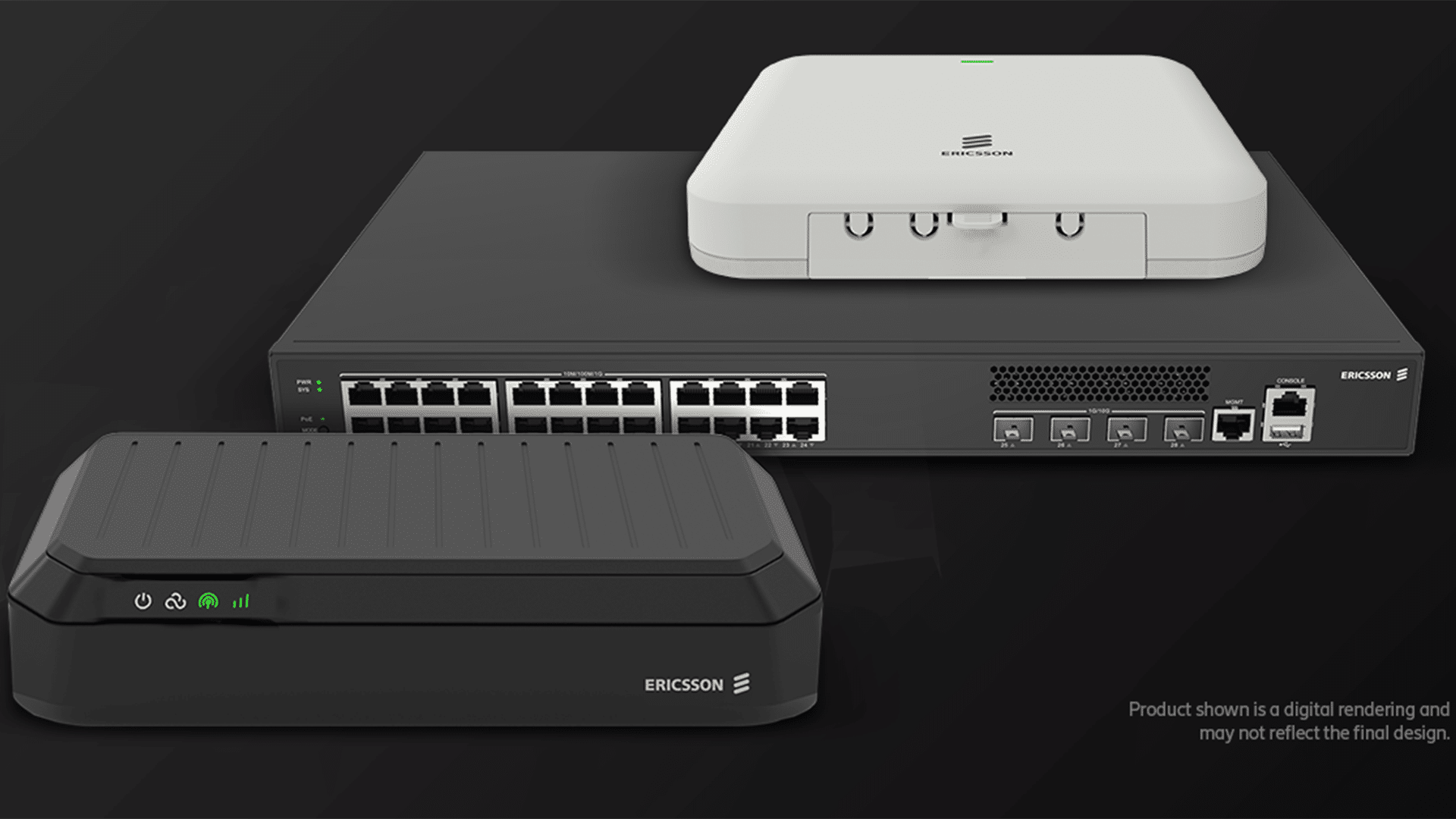
- The new architecture is anchored by the Ericsson Cradlepoint E400, positioned as the first enterprise appliance to combine 3GPP Release 17 5G, Wi-Fi 7, and embedded eSIM/dual-SIM.
- New Ericsson LAN switches and Wi-Fi 6 access points designed to extend small and medium office LAN capacity without complexity under unified management.
- Ericsson NetCloud Manager enables AI-driven operations, centralized eSIM provisioning, SD-WAN, zero-trust security, and access to 5G Advanced network slices.
The News: Ericsson announced the launch of its new wireless-first architecture that aims to bring agility and scale to branch networking. Designed to support higher-bandwidth, business-critical, AI-powered operations, it combines diverse WAN connectivity, LAN switching, network slicing, and zero-trust through unified management to deliver scalable and secure high-performance branch networking.
Ericsson Goes Wireless-First for AI Enterprises
Analyst Take: Ericsson debuted its wireless-first branch architecture that combines the Cradlepoint E400, new LAN switches and access points, and NetCloud Manager to provide enterprises with a future-ready connectivity foundation to unlock the full potential of AI-driven innovation. With 5G’s faster speeds and lower latency, enterprise businesses are viewing it as a compelling alternative to wired connections and a catalyst for innovation and transformation. Ericsson aims to simplify LAN architecture, security, cellular management, and multi-WAN optimization by delivering an integrated solution managed through a unified platform.
From my view, Ericsson’s new offering closely aligns with the topmost enterprise priorities in the adoption of AI capabilities, fully aligning with the key takeaways from the Futurum Research CIO Insights Survey for Q1 2025. Futurum Research surveyed 119 CIOs from Fortune 500 and Global 2000 organizations across the planet to understand their strategies, challenges, and priorities for AI adoption, IT investment, cloud workloads, cybersecurity, and digital transformation. One valuable insight is that the primary goals of AI adoption include automation (96%), productivity improvements (77%), and enhancing customer experiences (69%). However, data security risks (80%) and lack of explainability (67%) remain significant concerns.
As a result, I expect Ericsson’s Wireless-first branch architecture and new E400 will resonate with the enterprise decision makers tasked with optimizing branch office connectivity and taking full advantage of AI capabilities and innovation. This will prove instrumental in the ability of enterprise branch offices to optimize 5G Advanced adoption, IoT proliferation, and increased reliance on wireless-first implementations.
Ericsson Wireless-First Branch Architecture and E400: Agility is the Difference Maker
I believe combining 3GPP Release 17 5G, Wi-Fi 7, and embedded eSIM/dual-SIM capabilities in the Ericsson Cradlepoint E400 is critical for enterprise connectivity, as it fulfills a key set of enterprise connectivity requirements. For instance, 3GPP Release 17 5G offers advanced features like enhanced network slicing, ultra-low latency, and higher throughput, enabling predictable performance for bandwidth-intensive applications such as AI, AR/VR, and real-time analytics. It supports mission-critical enterprise use cases with improved reliability and efficiency. Wi-Fi 7 provides multi-gigabit speeds, lower latency, and greater capacity than previous Wi-Fi standards. It supports dense device environments, ensuring seamless connectivity for IoT, employee devices, and high-density branch locations.
Embedded eSIM/dual-SIM capabilities allow enterprises to switch carriers remotely without physical SIM changes, simplifying deployment across regions and ensuring optimal network coverage. Dual-SIM functionality enhances redundancy by enabling failover between carriers, which is critical for maintaining uptime in distributed or remote sites. The combination enables multi-WAN flexibility, integrating 5G, Wi-Fi, and other WANs (e.g., satellite), providing scalable connectivity for diverse enterprise needs, from temporary pop-up sites to permanent branches.
Release 17 5G’s enhanced reliability features, paired with dual-SIM failover, ensure continuous connectivity even during network disruptions or carrier outages. This is vital for healthcare, retail, or public safety industries, where downtime can have significant consequences. Wi-Fi 7’s improved spectrum efficiency and interference management enhance reliability in crowded environments, complementing 5G’s robust cellular connectivity.
The high throughput and low latency of 5G Release 17 and Wi-Fi 7 enable real-time processing of AI-driven applications, such as computer vision, predictive analytics, and generative AI. Network slicing in 5G further prioritizes traffic for AI workloads, ensuring consistent performance. These capabilities meet the growing enterprise demand for AI-ready networks, as organizations increasingly adopt data-intensive technologies.
eSIM/dual-SIM reduces operational overhead by allowing remote carrier management and eliminating physical SIM logistics. This streamlines network setup and maintenance, especially for distributed enterprises. The integrated 5G and Wi-Fi 7 solution reduces reliance on wired infrastructure, lowering deployment costs and enabling rapid setup in locations where wired connectivity is impractical.
Ericsson Intelligent Bonding uses flow duplication, sending mission-critical application traffic across one WAN link and duplicating it across a secondary link. The first flows to arrive at the destination are accepted, ensuring no disruption if one link experiences congestion or failure. As such, this is well-suited for branch office scenarios, such as healthcare facilities and public safety environments, where uninterrupted connectivity is critical, including roaming between wireless providers and using satellite networks. Ericsson’s flow duplication provides real-time redundancy for mission-critical applications.
Combining these capabilities can help ensure that the new Ericsson’s wireless-first architecture and the E400 are prepared for emerging enterprise trends, such as 5G Advanced, IoT proliferation, and increased reliance on wireless-first implementations. This can help future-proof enterprise networks for evolving connectivity demands. This combination is positioned to deliver breakthrough agility across enterprise connectivity by delivering unparalleled speed, reliability, flexibility, and scalability, empowering enterprises to support AI-driven innovation, maintain operational continuity, and simplify network management in a wireless-first world.
Looking Ahead
Overall, I believe the new wireless-first branch architecture and E400 proposition can enable Ericsson to demonstrate competitive advantages against a crowded, impressive array of enterprise branch connectivity competitors in solution and architecture agility. These competitive offerings include Cisco’s range of cellular gateways and routers (i.e., Cisco Catalyst Cellular Gateways and Meraki MG series), Palo Alto’s Prisma SD-WAN paired with its SASE offerings, Fortinet’s FortiGate appliances (i.e., FortiGate 60F/80F series), and Sierra Wireless/Semtech AirLink XR80.
Ericsson’s partnerships with Juniper Networks and Extreme Networks provide a critical channel mindshare boost, enabling Ericsson to deliver full-stack networking solutions for large enterprise and campus environments. Both Juniper (i.e., AP/EX/QFX series combined with Mist AI) and Extreme (i.e., Universal Broadband Portfolio/ExtremeCloudIQ, 4000/5000/7000/V Series) offer a broad portfolio of switches and access points that are needed to address diverse enterprise use cases and requirements.
Moreover, each solution is integrated and tested with Ericsson NetCloud so that customers can deploy easily and confidently. Ericsson should also consider highlighting the business value of its solution in relation to branch office priorities such as AI assistants and computer vision (i.e., boosting shopper experience and inventory management).
What to Watch:
- Enterprise branch office environments will increasingly prioritize unified networking and security solutions such as Ericsson E400 that simplify operations, embed intelligence to reduce workload, enhance efficiency, and support proactive management.
- Key rivals such as Cisco, Fortinet, Palo Alto, and Sierra Wireless will need to directly respond to Ericsson’s wireless-first branch office and E400 capabilities, such as platform agility and intelligent bonding, to reduce competitive advantages.
- Enterprise branch offices will put more emphasis on providing the intelligent overlay key to bring enterprise characteristics to best-effort LEO satellite connections.
You can read the full press release at Ericsson’s website.
Disclosure: The Futurum Group is a research and advisory firm that engages or has engaged in research, analysis, and advisory services with many technology companies, including those mentioned in this article. The author does not hold any equity positions with any company mentioned in this article.
Analysis and opinions expressed herein are specific to the analyst individually and data and other information that might have been provided for validation, not those of The Futurum Group as a whole.
Other insights from The Futurum Group:
Ericsson Open RAN, Apple C1 & Telstra Open Programmable 5G Advanced Moves – Six Five Webcast
The View From Davos with Ericsson’s Åsa Tamsons
Image Credit: Ericsson
Author Information

Ron is an experienced, customer-focused research expert and analyst, with over 20 years of experience in the digital and IT transformation markets, working with businesses to drive consistent revenue and sales growth.
Ron holds a Master of Arts in Public Policy from University of Nevada — Las Vegas and a Bachelor of Arts in political science/government from William and Mary.