The News: Oracle announced that it is developing an artificial intelligence (AI) companion designed to enable developers to build applications more quickly by leveraging Oracle’s areas of expertise combined with the power of generative AI (GenAI). This initiative highlights how AI-powered software development is revolutionizing the way code is created, tested, and managed. Read the press release here.
The GenAI Revolution in Software Development: Oracle Enters the Fray
Analyst Take: The world of software development is undergoing a seismic shift thanks to the advent of GenAI. This technology is not just enhancing existing processes; it is revolutionizing the speed and efficiency with which developers can create applications. By harnessing AI-driven tools such as copilots and assistants, developers are witnessing productivity gains of 30%-50% according to consensus estimates. These tools, which understand and generate code, can dramatically reduce the time spent on coding, debugging, and testing.
Several tech giants have already introduced their versions of AI copilots, signaling a broader industry transformation. Amazon has introduced CodeWhisperer as part of its AWS suite, designed to help developers by providing code recommendations directly within the IDE. Microsoft’s GitHub Copilot goes a step further by suggesting whole lines or blocks of code, learning from the billions of lines of code available on GitHub. Google, meanwhile, has integrated GenAI features into its cloud services, offering AI tools that assist with code completion, bug fixing, and more. These innovations illustrate a clear trend: the future of coding is collaborative, with human ingenuity augmented by AI’s capabilities.
In addition, complexity is also being driven up by the move to cloud-native and containerized applications, which require enterprises to manage a mix of conventional and re-factored or containerized applications. A side effect of the increase in complexity is a surge in demand for a range of IT skills that, as a result, are now in short supply and more expensive to hire. The resulting skills gap is forcing enterprises to increase their reliance on IT generalists to manage increasingly complex IT environments, while demanding that IT departments accelerate the pace of innovation.
What Was Announced
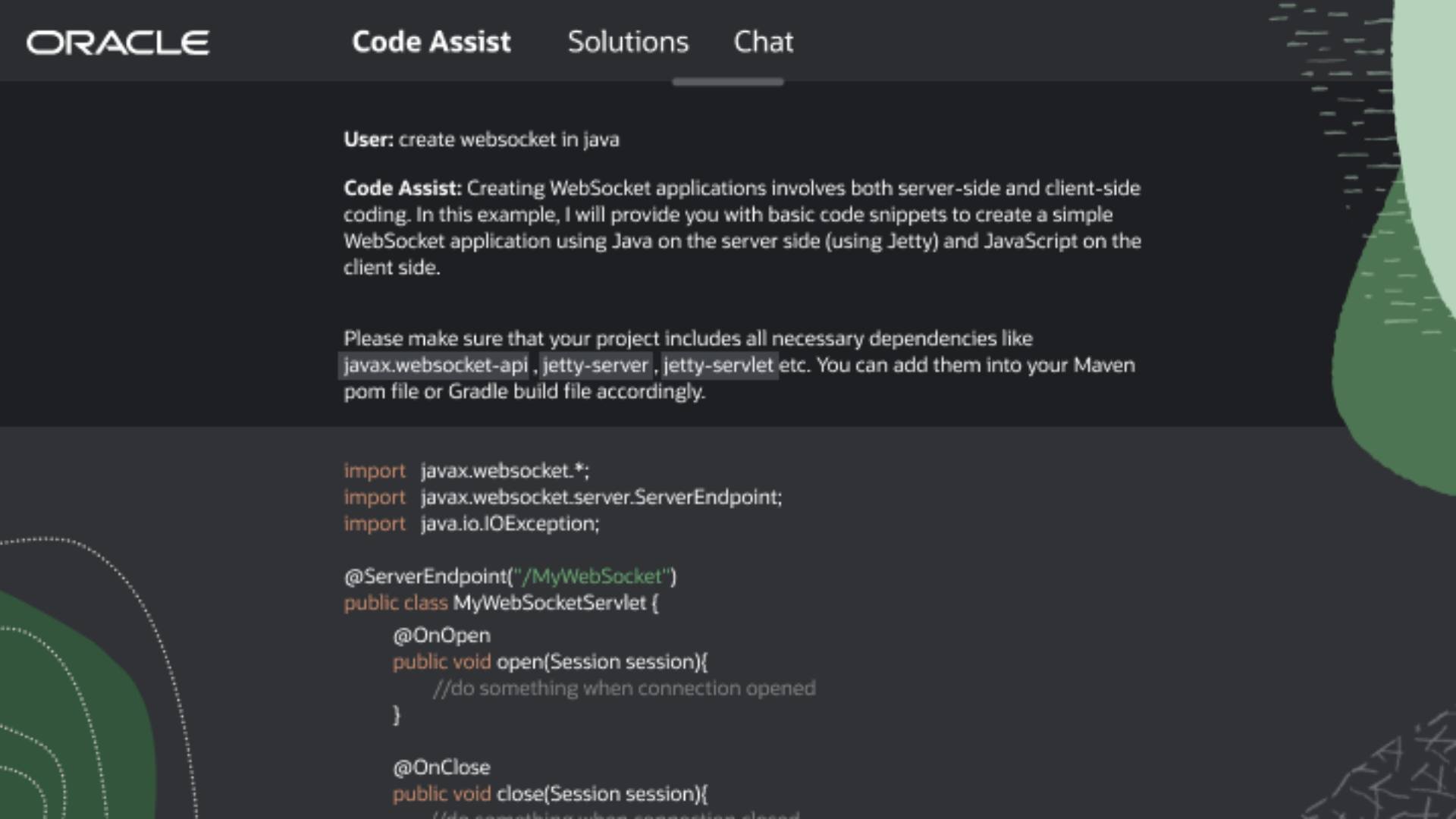
Oracle, recognizing the transformative impact of AI on software development, has announced the upcoming launch of Oracle Code Assist. This new tool is an AI-powered code companion designed to boost developer velocity and enhance code consistency. Leveraging large language models (LLMs) that run on Oracle Cloud Infrastructure (OCI), Oracle Code Assist is tailored specifically for Java, SQL, and OCI-based application development.
The core of Oracle Code Assist lies in its ability to provide context-specific coding suggestions, which can be aligned with an organization’s best practices and unique codebases. This is achieved by training the AI on a broad repository of software, fine-tuning it with OCI’s service APIs, and incorporating coding patterns and best practices from Oracle’s vast experience.
Oracle Code Assist will be available as a plugin for popular development environments such as JetBrains IntelliJ IDEA and Microsoft Visual Studio Code. It promises to transform the software development lifecycle by offering features such as:
- Code Generation: Automatically generates complete class files, methods, or lines of code based on learned context and patterns.
- Code Annotation: Produces API documentation or comments, facilitating easier maintenance and understanding of the code.
- Code Explainability: Offers plain language summaries of code, aiding in faster comprehension and review.
- Faster Code Reviews: Enhances code quality by suggesting improvements during the review process based on performance and style guidelines.
- Test Coverage Generation: Creates detailed tests to ensure comprehensive coverage, enhancing the quality and reliability of software.
These features are not just about speeding up development but are aimed at making the code more robust, maintainable, and aligned with the latest coding standards.
Looking Ahead
Oracle’s introduction of Code Assist is not happening in a vacuum. It is part of a broader strategy to cement its role as a leader in the enterprise software market, especially in areas where it has historical strength. Oracle’s deep roots in Java and SQL are particularly significant, given these technologies’ widespread use across the enterprise spectrum. By focusing on these languages, Oracle is not just playing to its strengths but also addressing the specific needs of its large existing customer base.
The emphasis on Java and SQL gives Oracle “brand permission” to lead in this space, leveraging its extensive track record to provide tools that are deeply integrated with its core technologies. This strategic focus ensures that Oracle can offer more than just generic coding assistance; it can provide finely tuned support that understands the intricacies of Java and SQL development.
As we look to the future, the landscape of software development will continue to evolve with AI as a critical driver. Oracle’s move to introduce Code Assist is a clear indication that it intends to be at the forefront of this evolution. The tool is not merely a new feature in Oracle’s suite but a fundamental part of its commitment to enhancing developer productivity and software quality through innovative technology.
In summary, Oracle Code Assist represents a significant step forward in the fusion of AI and software development. It underscores Oracle’s commitment to innovation and its readiness to empower developers with tools that not only enhance their productivity but also improve the quality and consistency of their output. This development is a key part of the broader trend towards AI-enhanced software development, promising to reshape how applications are built in the Oracle ecosystem and beyond.
Disclosure: The Futurum Group is a research and advisory firm that engages or has engaged in research, analysis, and advisory services with many technology companies, including those mentioned in this article. The author does not hold any equity positions with any company mentioned in this article.
Analysis and opinions expressed herein are specific to the analyst individually and data and other information that might have been provided for validation, not those of The Futurum Group as a whole.
Other Insights from The Futurum Group:
ServiceNow Q4 2023 Earnings Exceed Guidance, Driven by Generative AI
Rising Observability Adoption in DevOps with Futurum Research’s Paul Nashawaty
Amazon Q Unveiled: Additional Productivity with AI
Image Credit: Oracle
Author Information

With over 25 years of experience, Paul has a proven track record in implementing effective go-to-market strategies, including the identification of new market channels, the growth and cultivation of partner ecosystems, and the successful execution of strategic plans resulting in positive business outcomes for his clients.

Steven engages with the world’s largest technology brands to explore new operating models and how they drive innovation and competitive edge.