Analyst(s): Brad Shimmin
Publication Date: October 14, 2026
What Is Covered in This Article:
- The strategic expansion of Microsoft Fabric and Azure Databases was unveiled at FabCon and SQLCon Europe 2026 in Barcelona.
- The elevation of Power BI semantic models and domain ontologies to an authoritative business-context tier for autonomous agents.
- Architectural bridging between analytical insights and transactional write-back via Fabric Apps and the Rayfin framework.
- Multi-cloud semantic interoperability efforts across the Model Context Protocol and Apache Ossie.
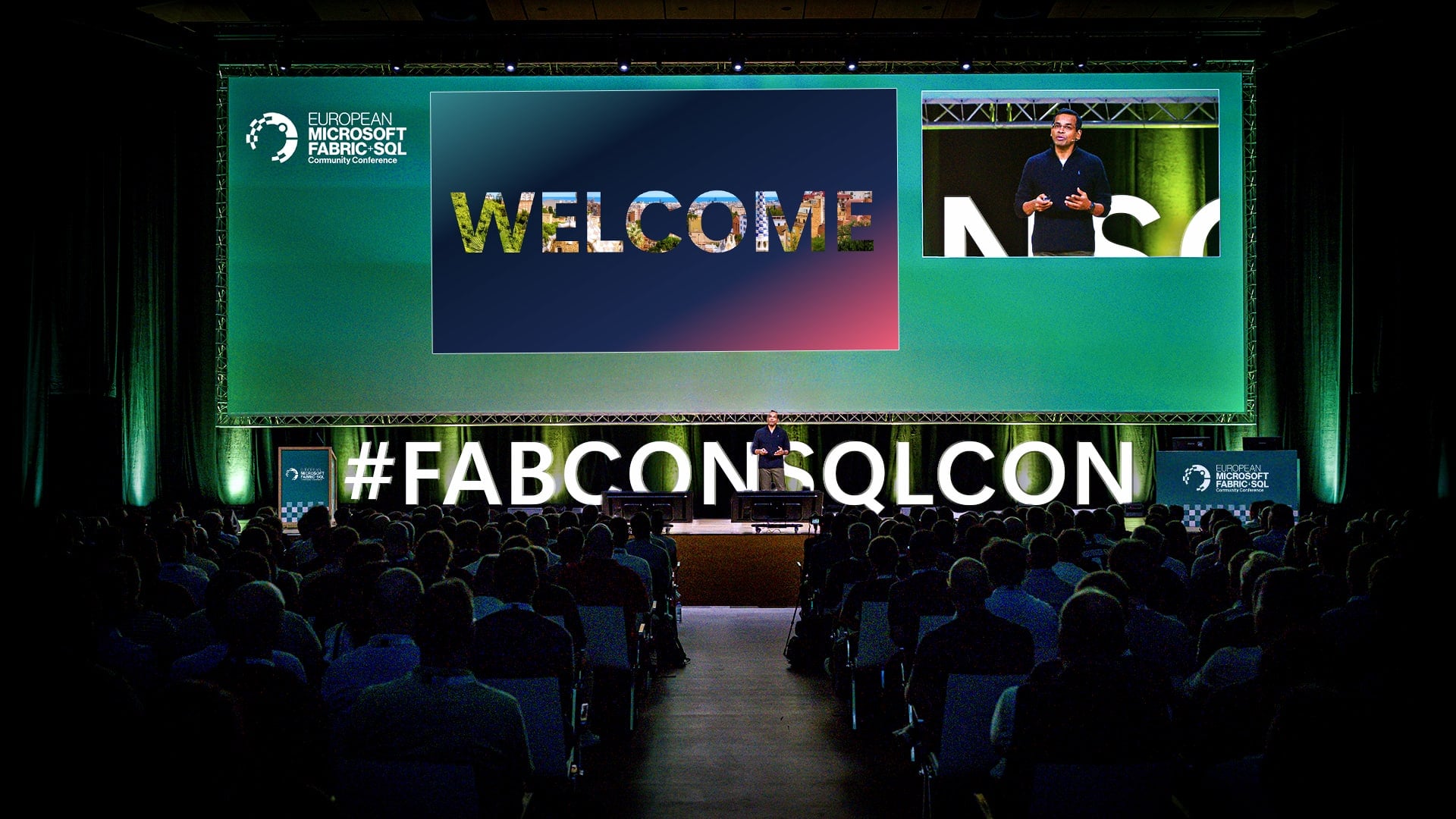
The Event—Major Themes & Vendor Moves: At FabCon and SQLCon Europe 2026, nearly 5,000 data professionals gathered at the CCIB in Barcelona, Spain, to evaluate Microsoft’s expanded data portfolio. Microsoft framed its roadmap around Frontier Transformation, moving Microsoft Fabric beyond a consolidated analytics suite into an integrated operational nervous system for enterprise AI. One of the most impactful announcements was the general availability of Fabric IQ inside Microsoft 365 Copilot Chat and Cowork. Fabric IQ grounds enterprise AI interactions directly in certified Power BI semantic models, metrics, and ontologies without duplicating storage or incurring incremental token fees.
Microsoft augmented this intelligence tier with execution engines and platform governance tools. The vendor introduced Project Osmos as an autonomous Spark Data Engineering Agent in preview, launched Database Hub in public preview as a centralized management plane across SQL and NoSQL engines, and expanded Fabric Apps via the open-source Rayfin framework. To counter platform isolation concerns, Microsoft introduced IQ Sharing in preview alongside native Model Context Protocol (MCP) endpoints and affirmed its commitment to the open Apache Ossie semantic standard alongside ecosystem partners such as Snowflake.
Microsoft FabCon And SQLCon Europe: Elevating Semantic Models to an Enterprise AI Control Plane
Analyst Take—The Microsoft Fabric Semantic Layer Captures Platform Gravity: Autonomous agents rarely fail because an underlying system lacks database rows. They fail when operating without an accurate, timely, and operational business context. By elevating Power BI semantic models into foundational enterprise ontologies, Microsoft is executing a very astute maneuver in leveraging its architectural might. Enterprises have spent years curating Data Analysis Expressions (DAX) calculations, entity relationships, and operational metrics across more than 22 million Power BI semantic models. (Note that Microsoft claimed only 20 million models just a few months ago and 15 million just last year.) Feeding that growing groundswell of definitions directly into ontologies can turn passive dashboard plumbing into an enforceable contract governing autonomous agent reasoning.
This technical alignment directly targets enterprise adoption bottlenecks. According to the Futurum Intelligence 1H 2026 Artificial Intelligence Platforms Decision Maker Survey, 55.37% of enterprise decision-makers cite AI agent reliability and hallucination management in production as their primary barrier to generative AI adoption. Grounding autonomous reasoning in certified business metrics and semantic views addresses this reliability gap at the root.
Furthermore, open table formats like Delta Lake and Apache Iceberg have commoditized storage persistence across cloud providers. As raw storage becomes interchangeable, platform gravity steadily relocates to the metadata tier. Capturing enterprise business logic within the Microsoft Fabric semantic layer secures workload stickiness far more effectively than proprietary file storage ever could. Whichever vendor controls the operational definitions dictating how an organization functions will command downstream agent execution across the enterprise.
Bridging Read-Only Analytics and Transactional Action
Traditional business intelligence served as a terminal read-only destination where dashboards visualized historical transactions. Autonomous systems require closed-loop execution that connects insight directly to operational workflows. Pairing Fabric IQ with Fabric Apps and the open-source Rayfin development framework elegantly bridges this divide. Allowing developers and Power BI creators to build state-preserving, interactive applications backed by transactional Fabric SQL and PostgreSQL stores is important, as it aligns flexible analytical discovery with agentic production requirements at scale.
These efforts are important as they embed natural-language business rules directly into ontology entities. This, in turn, establishes deterministic boundaries for probabilistic models. When an autonomous agent evaluates supply chain metrics or schedules inventory allocations, it operates within declared operational guardrails rather than loose system prompts. Exposing these structured domain graphs through the Model Context Protocol endpoint ensures external developer tooling can consume governed business context without forcing teams into an isolated software silo. By keeping OneLake as the central operational hub and in supporting open standards, Microsoft has quickly established a defensible runtime for enterprise AI that doesn’t lock customers into a single agentic tool value chain.
What to Watch:
- Adoption Velocity of the Fabric IQ MCP Interface: Observe how readily external developer frameworks, including Claude Code, OpenAI Codex, and Google Antigravity, facilitate the use of Fabric IQ’s Model Context Protocol endpoint to ground external agents in OneLake context.
- Apache Ossie Implementation Milestones: Track concrete contributions and cross-platform metadata translation benchmarks between Microsoft, Snowflake, and other lakehouse vendors to evaluate semantic layer portability.
- Application Creation Velocity in Power BI Desktop: Monitor how business analysts actually adopt agentic app creation to transition from visual reporting canvases to interactive write-back workflows. Will they seek to automate existing tasks or break ground on new opportunities?
- Governance Discipline Around Automated Ontologies: Evaluate how effectively enterprise data teams implement human review workflows to validate AI-proposed ontologies before deploying them to production agents. More pointedly, consider how companies like Microsoft intend to support the governance of these “bottom-up” ontologies over time.
You can watch the keynote and read more on the announcements made at Microsoft FabCon & SQLCon in Barcelona on the company’s website.
Disclosure: Futurum is a research and advisory firm that engages or has engaged in research, analysis, and advisory services with many technology companies, including those mentioned in this article. The author does not hold any equity positions with any company mentioned in this article.
Analysis and opinions expressed herein are specific to the analyst individually and data and other information that might have been provided for validation, not those of Futurum as a whole.
Other Insights From Futurum:
AWS Embeds DuckDB in Aurora to Collapse Operational and Lakehouse Silos
Beyond Retrieval: CData Connect AI Gateway Tackles Transactional Agents
The Context Bottleneck: Where AI Buyers Struggle, the Market Accelerates
Featured Image: Microsoft
Author Information

Brad Shimmin is Vice President and Practice Lead, Data Intelligence, Analytics, & Infrastructure at Futurum. He provides strategic direction and market analysis to help organizations maximize their investments in data and analytics. Currently, Brad is focused on helping companies establish an AI-first data strategy.
With over 30 years of experience in enterprise IT and emerging technologies, Brad is a distinguished thought leader specializing in data, analytics, artificial intelligence, and enterprise software development. Consulting with Fortune 100 vendors, Brad specializes in industry thought leadership, worldwide market analysis, client development, and strategic advisory services.
Brad earned his Bachelor of Arts from Utah State University, where he graduated Magna Cum Laude. Brad lives in Longmeadow, MA, with his beautiful wife and far too many LEGO sets.