Partially due to remote working trends and partially due to heightened employee expectations, there is a need for companies to review their employees’ day-to-day digital experiences and the technologies that may be causing them friction, which ultimately is leading employers toward adopting new digital technologies that can help improve their employees’ journeys.
Statistics show that the employee-technology interaction is an important factor:
- Nexthink research states 89% of employees believe Digital Employee Experience (DEX) is an extremely or very important part of the overall employee experience (EX). In fact, 28% of employees aged 25-34 years old noted that they would consider leaving a job because of a poor IT experience.
- Employees who say that their technology is enabling productivity are 158% more engaged and have 61% higher intent-to-stay beyond three years, compared to those who do not feel technology is enabling their productivity. (Qualtrics)
- 64% of office workers, IT professionals, and C-Suite executives surveyed by Ivanti report the way they interact with technology directly impacts morale.
- In a survey of IT decision-makers and knowledge workers, 81% agree that those companies that do not make DEX a board-level priority will fall behind their competitors. (1E)
Employees now expect their interactions with work technology to be as good as their interactions with consumer technology and consumer support channels. Many people are working from home without access to in-house support. If the technology does not work as intended – if it is slow, hard to use, lacking important capabilities and does not allow for automation – it can result in decreased productivity and employee dissatisfaction. Unlike the way customers interact with company websites and support channels, employees are not doing a “one and done” with technology. They are interacting with work systems all day long, for multiple days a week.
Digital employee experience is an area that is still maturing in terms of adoption, but those in the market are seeing strong traction. Additionally, the nature of work that IT groups is doing is shifting and expanding. Dash Research reached out DEX provider Nexthink to chat about current trends in the market. According to Nexthink:
“We have seen clear growth across the board for DEX adoption with the roles and responsibilities of IT professionals evolving from setting employees up with IT equipment to providing solutions which promote employee collaboration and productivity – a change brought on with the COVID-19 pandemic.”
When asked about the current challenges in EX, Nexthink spoke about the obstacles in combining data to offer a comprehensive employee journey view:
“The challenge for a customer is to avoid a silo approach, where a vendor offers visibility and insight into one aspect of an employee’s experience but does not provide a holistic view across the entire experience. Successful DEX delivery requires seamless integration of workplace analytics, insight-driven automation, and contextual employee engagement, and companies should ensure that a vendor can provide a platform that delivers these capabilities seamlessly – supporting longer term strategic DEX goals while addressing urgent operational issues in the shorter-term.”
Nexthink approaches EX with a goal similar to that of technology providers who are supporting customer experience (CX) – to create an ideal experience for users. Solutions such as Persona Insight, Remote Worker Experience, and Nexthink Analyze help to measure, monitor, and create a more detailed and personalized understanding of the challenges workers, both remote and in-office, are facing. Analysis can help merge employee sentiment with a digital experience score to quantify the complete employee journey.
Artificial intelligence (AI) and automation capabilities are becoming more important to the employee experience. AI has long been used in EX to sift through employee feedback and listening data, and tie together the various incoming information flows. However, there is an increased need for automation and technologies like AI, chatbots, and self-service to help with employee touchpoints that might not need an initial human contact. Many companies are short-staffed on the human resources or information technology fronts, and are maintaining lean departments. These technologies can help ease HR and IT workloads, as well as provide employees with the ability to solve their problems faster.
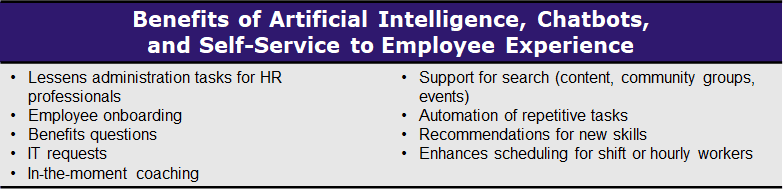
Digital experience and all the supporting technologies employees interact with are no longer an afterthought, or at the bottom of the extensive list of employees needs and desires. They now count as reasons for staying with an employer or leaving, and attention to this issue must be woven into all EX efforts.
Related Article: Smaller Companies Look for Ways to Support Positive Employee Experience
Author Information

As a detail-oriented researcher, Sherril is expert at discovering, gathering and compiling industry and market data to create clear, actionable market and competitive intelligence. With deep experience in market analysis and segmentation she is a consummate collaborator with strong communication skills adept at supporting and forming relationships with cross-functional teams in all levels of organizations.
Sherril holds a Master of Business Administration in Marketing from University of Colorado, Boulder and a Bachelor of Arts in Psychology from Rutgers University.