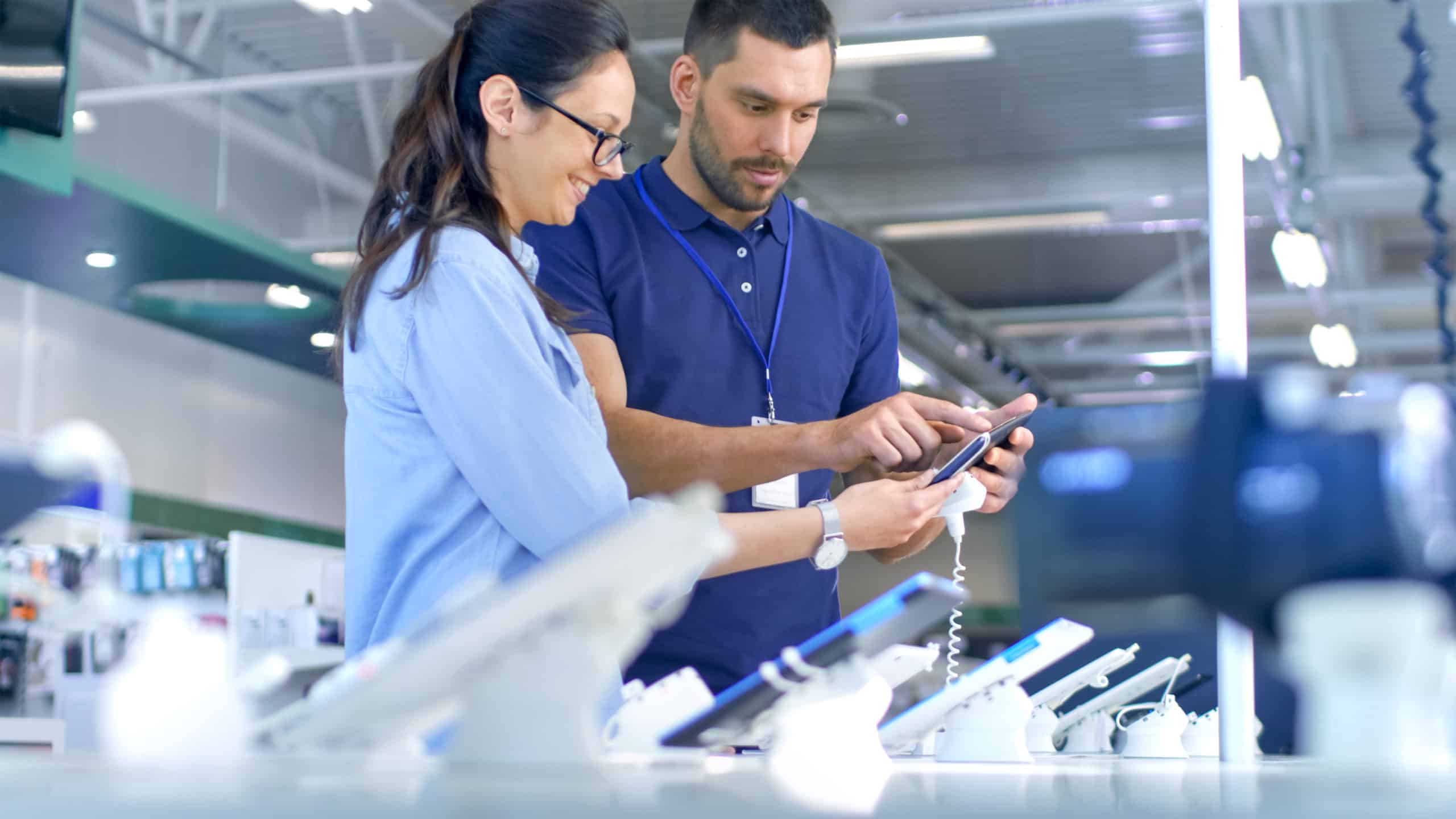
The COVID-19 pandemic accelerated the speed at which telecom operators shifted toward online customer service tools and e-commerce retail sales. And even with telecom retail stores fully open across the country today, it is expected that consumers will continue to pivot their buying experiences to online.
That trend, coupled with the surge in remote working and the increased demand for in-home broadband, is making telecom operators become more reliant on cloud-based customer care platforms that cater to remote customer service workers. In addition, many telecom providers are also investing in different forms of automation and artificial intelligence (AI)-based CX platforms.
Dash Research estimates that the global market for CX and customer engagement (CE) software and services in the telecom industry will reach $16.4 billion by 2026. And Dash believes that North America will account for $9.2 billion of that amount by 2026.
Verizon goes touchless
Verizon is one example of a telecom operator that changed its retail experience because of the COVID-19 pandemic. The operator has more than 1,500 corporate retail stores in the US and because it was designated an “essential” business, it could keep its stores open during the early days of the pandemic. But at the same time, demand for telecom services was surging as people tried to stay connected while working and learning from home.
To accommodate the in-store traffic and keep its workers and customers safe, Verizon launched a touchless retail platform that let customers set up appointments online or through their My Verizon app. This helped Verizon limit the number of people that were in a store at the same time. In addition, the My Verizon app helped customers determine if their issue could be resolved through the website or app, or if it required a store visit. Verizon’s Touchless Retail allowed customers to pay using touchless payments and sign contracts electronically.
Today, the company estimates that more than 87% of its transactions incorporate the Touchless Retail technology.
“I think we’ve evolved the future of retail in a way that we have an immersive retail experience, that’s a lower-touch experience. That’s giving people confidence to return to the retail environment,” said Ronan Dunne, executive vice president and CEO of Verizon’s Consumer Group, speaking during a Bank of America investor conference held in September.
“We’ve seen strong activity in the online environment,” Dunne said, noting that he thinks people feel more comfortable participating online, which is good for the industry in terms of distribution opportunities.
Comcast goes virtual
But Verizon is not alone. Comcast also saw a need to invest in digital platforms and found that, during the pandemic, customers became reliant on the company’s Xfinity Assistant to answer questions and troubleshoot issues. If the Xfinity Assistant cannot answer a question, it refers the customer to an agent who can answer the question or it will let the customer schedule a virtual “call back” so they avoid long hold times.
Tom Karinshak, chief customer experience officer at Comcast, said that during the COVID-19 pandemic, use of the Xfinity Assistant increased 445%. “We saw an increase in usage in something that already had significant usage,” Karinshak said in a video post. “But we’ve also seen satisfaction go higher.”
Karinshak added that, during this period, Comcast also unveiled a new customer service program, the Virtual Technician, which is powered by Twilio, a cloud-based communications platform. The company said its developers designed, prototyped, and piloted the virtual experience in just 30 days. There was some urgency to this. According to Karinshak, the company needed a way to keep its employees and customers safe, while still completing necessary work inside a customer’s home.
The Virtual Technician allows a technician to visit a home and do all the necessary work outside it, but then connect with the customer virtually to walk them through any inside work. “We’ve had great success with it,” Karinshak said, adding that the company is planning to expand its services and will keep the Virtual Technician even when the pandemic is over. “We think it’s great to give the customer that option,” he said.
Comcast is seeing its CX improvements pay off. During the company’s second quarter earnings call with investors, Dave Watson, president and CEO of Comcast Cable, said that the digital experience improvements attributed to a 10% decrease in agent calls and a 22% reduction in truck rolls. “Over the past five years, we’ve constantly made progress,” he said. Telecom providers like Comcast and Verizon are seeing their investments in CX, whether via an app or a virtual assistant, pay off in terms of keeping customers connected during a pandemic, in addition to helping reduce truck rolls and customer service calls.
Author Information

Sue is a Denver-based freelance technology journalist, editor and analyst with expertise writing about topics like 5G communications, cloud-native networking, edge computing, and more. She can cut through industry jargon and explain complex technology concepts to both non-engineers and business decision makers.
Previously she had served as the editor-in-chief at SDxCentral, covering news and information related to the software defined networking market. Before that, she served as the editor-in-chief of FierceWireless, which covers cellular, satellite and other telecommunications technologies and markets.
As an expert in her covered areas, Sue is a frequent speaker at technology industry events and has moderated panels for the Consumer Electronics Show, the Competitive Carriers’ Show, The Wireless Infrastructure Show, 5G North America, DC 5G, Interop, and more.
Sue Holds a Bachelor of Science in Journalism from University of Colorado, Boulder.