
Most customers only think about their electricity, water, or gas service providers at two times: when their bill comes, and when there is an interruption or problem with the service. However, given the increased use of Internet of Things (IoT)-based smart meters, smart appliances, and energy profiling technology, many utilities have steadily shifted to a more customer-centric model over the past decade.
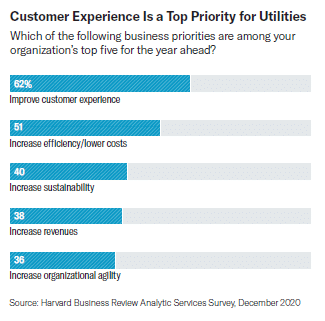
Smart meters and IoT devices served as the catalysts for the utility data revolution, resulting in power and utility companies leveraging this data to change the nature of customer relationships. Today, granular usage data, smart metering data, and two-way communication about how utility providers and customers can work together to reduce and optimize resource usage is driving a more customer-centric culture. According to a 2021 Harvard Business Review study of 73 utility industry executives, improving CX is a key business priority.
Largely due to the use of dashboards and analytics in other facets of their lives, end customers have been seeking more personalized information about their usage so they can adjust it for monetary savings, as well as lessening the impact on the environment. These customers are looking to utilities to mine through their usage data and habits, so they can reduce their energy use and costs by making behavioral changes.
However, the first steps in ensuring a good CX begins with basic communication and customer enablement features, such as providing real-time or near-real-time updates to outages via the channel or app of the customer’s choosing. Further, there should be a self-service portal or tool allowing customers to report outages or service problems, start or resume service, and quickly access all relevant service and billing history data. The goal, wherever possible, is to allow customers to handle tasks quickly, efficiently, and on their own time, rather than force them to contact a call center.
Another key element in providing solid CX is ensuring that all communications and data relayed to a customer is personalized. While it requires the capture and analysis of personal use data, it will permit a deeper understanding of a customer’s needs, behavior, and journey.
For example, utilities can provide specific insights by linking personalized energy consumption data with specific load profiles, such as identifying when heating, ventilation, and air conditioning (HVAC) equipment is drawing power versus lighting, appliance, and other power draws. Illustrating which types of devices and activities are contributing to a household or business’ energy usage can spur the customer to reduce energy use by taking specific, targeted actions, such as running the dishwasher less frequently, or shutting off lights when not in use.
Utilities can also improve the customer’s experience while generating incremental revenue by linking this data with specific product or service offers. For example, a utility can partner with service providers or manufacturers to suggest specific services or products that can help customers reduce their energy use. Partnerships can generate incremental revenue streams that require little effort or changes in the way a utility’s core services and products are delivered.
For example, a utility can track and provide customers with historical, year-over-year water consumption data. If a spike in consumption is detected in the data, it could be a sign of a small or large leak in a pipe, an indication that a washer or dryer is malfunctioning, or some other condition that requires inspection. By highlighting this type of anomaly, a provider could then suggest an on-site inspection with an affiliated plumber, or suggest purchasing newer (and more energy-efficient) appliances through a partner.
By linking an offer to data, a utility company not only provides a useful service for a customer who may not be aware of a problem, but also demonstrates a commitment to only providing truly relevant offers to a customer, rather than simply offering random products or services that may not be needed or wanted. Further, by encouraging customers to replace old or malfunctioning equipment, it can simultaneously save them money on recurring utility charges, and, in many cases, reduce energy loads via the use of more efficient equipment. The key driver of providing better CX, even in highly monopolistic areas, is the demonstration that a utility is shifting from simply being a provider of energy, water, or gas, and is focused on the customer and their needs. By understanding a customer’s needs, profile, and use, a utility provider can better align its services to each customer, developing a reputation as a trusted brand for other ancillary or additional services, such as renewable energy equipment (e.g., solar panels), add-on products in the home (including appliances or energy audits), or specific energy-efficiency programs (e.g., time-of-use billing programs). Providing excellent CX is about anticipating customers’ needs, and then presenting relevant services and products that provide benefits to both the customer and the utility.
Author Information

Keith Kirkpatrick is VP & Research Director, Enterprise Software & Digital Workflows for The Futurum Group. Keith has over 25 years of experience in research, marketing, and consulting-based fields.
He has authored in-depth reports and market forecast studies covering artificial intelligence, biometrics, data analytics, robotics, high performance computing, and quantum computing, with a specific focus on the use of these technologies within large enterprise organizations and SMBs. He has also established strong working relationships with the international technology vendor community and is a frequent speaker at industry conferences and events.
In his career as a financial and technology journalist he has written for national and trade publications, including BusinessWeek, CNBC.com, Investment Dealers’ Digest, The Red Herring, The Communications of the ACM, and Mobile Computing & Communications, among others.
He is a member of the Association of Independent Information Professionals (AIIP).
Keith holds dual Bachelor of Arts degrees in Magazine Journalism and Sociology from Syracuse University.