Contact centers have long played a passive role in delivering customer service, usually handling inbound inquiries related to administrative customer inquiries, technical questions or issues, or general questions about the company, its products and services, and its policies. However, to remain competitive, today’s business-to-consumer (B2C) and business-to-business (B2B) organizations must transform their contact centers into customer engagement centers, which are designed to take a more active role in delivering great CX across a variety of functions.
The catalysts for change reside in three distinct domains: personnel, policies, and platforms. Each of these functional areas can drastically impact the way CX is delivered via a traditional live-agent service model, albeit with several changes.
To support the shift from a call center agent to an engagement center agent, organizations need to implement policies and procedures that support a customer-centric, relationship-focused approach to each interaction. Instead of focusing solely on key performance indicators (KPIs), such as average call handle time, first call resolution percentage, or other metrics designed to quickly resolve issues, organizations need to focus on CX measures, such as customer satisfaction, customer success, and customer effort scores.
A second component is an increased focus on agent training. Customer-facing agents must be trained to build empathy with the customer, as opposed to simply treating each call as a transactional process. They also need to be trained in the skill of active listening to understand the true intent of the inquiry, the current sentiment of the customer, and the decision-making authority to resolve the issue, or quickly escalate the matter to a qualified superior.
Agents must also be provided with the proper technology tools to ensure that relevant product or service knowledge is automatically delivered to the agent, based on the context of their interaction with the customer, to ensure the agent can provide immediate assistance. The agent customer care platform should also support the following elements:
- Comprehensive customer data, including customer journey information, is available to the agent, allowing the agent to fully understand the customer’s situation and provide empathy.
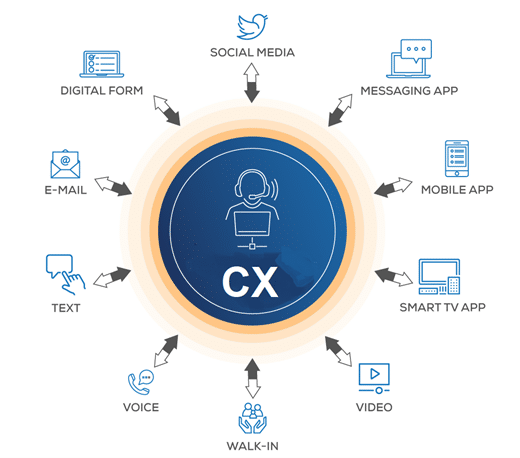
- Omnichannel communication tools (chat, SMS, mobile, social, etc.) that are incorporated into the platform, including seamless handoff between channels, based on the customer’s preferences and availability.
Omnichannel Customer Engagement
- Support for self-service or automated responses, to reduce agents’ workloads with repetitive and lower-value tasks.
- All technology tools and applications are unified so that agents can easily view and access the information they need to support the customer efficiently.
The most important aspect of transforming a contact center to an engagement center that can deliver excellent CX is ensuring that the policies and procedures that have been established are adhered to throughout every interaction, with every customer. Today’s customers will not tolerate being transferred to different agents or systems when they contact the company. Agents are expected to own the customer relationship across all lines of business, while handling a wider variety of issues across multiple communication channels.
In addition, both customers and agents should be able to easily submit or capture feedback that can be used to ensure a continuous CX improvement loop that responds to customer changes, product or service changes, or external conditions. Empowering agents by implementing an intelligent, unified, and customer-centric platform will help ensure that today’s telecommunications providers can truly embrace and thrive using a customer-centric, relationship-based CX approach, driving customer satisfaction, success, and long-term loyalty.
Author Information

Keith Kirkpatrick is VP & Research Director, Enterprise Software & Digital Workflows for The Futurum Group. Keith has over 25 years of experience in research, marketing, and consulting-based fields.
He has authored in-depth reports and market forecast studies covering artificial intelligence, biometrics, data analytics, robotics, high performance computing, and quantum computing, with a specific focus on the use of these technologies within large enterprise organizations and SMBs. He has also established strong working relationships with the international technology vendor community and is a frequent speaker at industry conferences and events.
In his career as a financial and technology journalist he has written for national and trade publications, including BusinessWeek, CNBC.com, Investment Dealers’ Digest, The Red Herring, The Communications of the ACM, and Mobile Computing & Communications, among others.
He is a member of the Association of Independent Information Professionals (AIIP).
Keith holds dual Bachelor of Arts degrees in Magazine Journalism and Sociology from Syracuse University.