The aftermath of the pandemic has left many employees feeling disconnected from the companies they work for. With some employees being remote or hybrid, there is less opportunity for connection, belonging, and the impromptu social and collaborative moments that add to an employee’s experience. The use of employee community tools is one way to provide support in this area, and an important one to focus on, as a sense of belonging is strongly tied to employee engagement and retention.
Additionally, employees are often an untapped resource of knowledge and ideas for CX that the use of communities can bring to light.
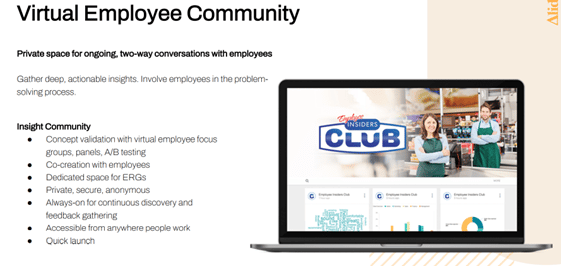
Dash Research spoke with experience management software provider Alida during interviews for Dash’s Employee Experience report. Alida has had success leveraging community building technology for both CX and EX purposes, building connection and bringing in another source of data. According to Senior Product Manager, Lattika Sachdeva, “When we think of employee experience, our framework includes both listening and co-creation. Voice of the Employee programs need to enable companies to solve problems with their employees, not for their employees. It must be an ongoing process.”
Becca Mayers, VP of product marketing at Alida, says there were some great use cases of employee communities being used to both improve EX and potentially improve business outcomes. “Giving employees a safe space to share concerns and ideas helps to build empathy and trust. Furthermore, empowering employees to solve problems can lead to opportunities for innovation.” Mayers adds, “Employee resource groups (ERGs) are a great community use case for Diversity, Equity & Inclusion (DE&I) efforts where we see companies being able to leverage the data they have coming in about a particular concern, that is important to a particular group of people who have raised their voices. People are saying – this is a problem; this isn’t working for me. Helping them form a community where they can have deep and ongoing conversations on specific pain points helps with the whole co-creation of a workplace goal, which is a positive for both employees and companies.”
In CX, communities can be used for product and process development and improvement, and feedback from communities can be an important data source. Tying in employee feedback provides a more holistic picture of possible process and product improvements.
According to Alida, 90% of employees have suggested CX improvements, but less than one-third think it is a priority for their employers. Building communities to problem solve and gather insights can help companies take faster and more targeted action for both internal and external challenges.
Alida pointed to a healthcare system that was facing employee burnout and high turnover of nursing staff. The provider worked with Alida to build an insights community that gathered in-the-moment feedback from the nursing team that was used to improve EX. Specific items were identified and the program resulted in reduced turnover and improved nurse experience. In an example of leveraging employee communities to improve CX, Telstra partnered with Alida to engage with their employees via an online community, Telstra Catalyst. Employees were able to share their product knowledge, as well as customer feedback that they had been receiving. This data helped to shape Telstra’s messaging and offering development, which resulted in 50% fewer modem returns per year, an 18% decrease in order cancellations and a 30-point increase in customer advocacy within 30 days.
Starbucks has been taking the idea of co-creation seriously as the company works toward improving its in-store partner (employee) experience. During a Q4 earnings call, Frank Britt, Executive VP, Chief Strategy and Transformation Officer said, “Partners who proudly wear the Green Apron have bravely shared their stories and their ideas in our co-creation sessions, and we have concentrated our efforts to jointly create solutions with our partners and for our partners.”
Starbucks also launched a pilot of a new partner app for its 270,000 US and Canadian workers that will create one digital community. According to Britt, the platform will evolve to “allow partners to stay connected on what matters to them most, including their schedules, their benefits, and continuing to use their voice to drive the co-creation of Starbucks.”
Allowing employees to have ongoing opportunity to both voice concerns, as well as share ideas for innovation or improvement, is important for both CX and EX. The use of tools such as feedback, crowdsourcing, and community groups can help avoid the expectation gap that often arises between employers and employees by gathering and acting on the “inside-out” view employees can provide.
Author Information

As a detail-oriented researcher, Sherril is expert at discovering, gathering and compiling industry and market data to create clear, actionable market and competitive intelligence. With deep experience in market analysis and segmentation she is a consummate collaborator with strong communication skills adept at supporting and forming relationships with cross-functional teams in all levels of organizations.
Sherril holds a Master of Business Administration in Marketing from University of Colorado, Boulder and a Bachelor of Arts in Psychology from Rutgers University.