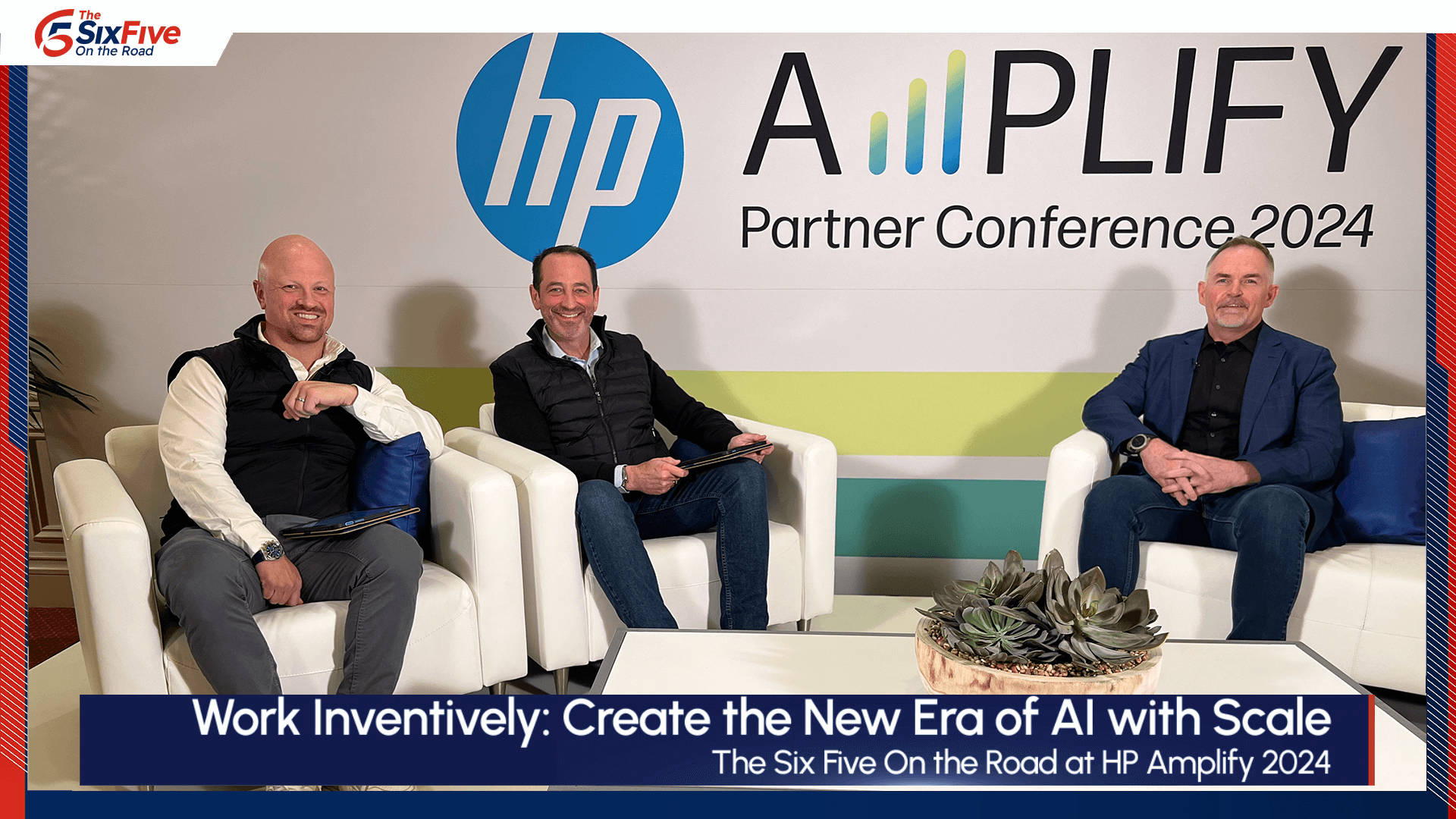
On this episode of The Six Five – On The Road, hosts Patrick Moorhead and Daniel Newman are joined by HP‘s Jim Nottingham, Senior Vice President and Division President. Jim shares thoughtful insights on how HP is gearing up to revolutionize artificial intelligence (AI) accessibility and innovation through its new Z by HP products and solutions. The discussion delves into HP’s commitment to fostering the new era of AI at scale, emphasizing the democratization of AI, the progress of the Z by HP AI Studio, and the integration of AI in various industries through high-performance Z workstations.
The discussion covers:
- The importance of HP’s announcements at HP Imagine and the new developments presented at APC for making AI more accessible and democratizing AI.
- The early-stage development of Z by HP AI Studio, its expected broader availability, and the feedback received from the AI Studio Lighthouse Account Program.
- The pivotal role of AI in industries like media and entertainment, product development and manufacturing, and architecture, engineering, and construction, through the utilization of Z workstations.
Learn more at HP.
Watch the video below, and be sure to subscribe to our YouTube channel, so you never miss an episode.
Or listen to the audio here:





Disclaimer: The Six Five webcast is for information and entertainment purposes only. Over the course of this webcast, we may talk about companies that are publicly traded and we may even reference that fact and their equity share price, but please do not take anything that we say as a recommendation about what you should do with your investment dollars. We are not investment advisors and we ask that you do not treat us as such.
Transcript:
Patrick Moorhead: The Six Five is on the road at HP Amplify 2024 here in Las Vegas, our second home. It’s been an incredible show so far. It’s really been the combination of making hybrid work better with AI.
Daniel Newman: Yeah, it has. And I don’t know about you, Pat, but Vegas feels like a second home, but not sure I’m prepared to make that commitment just yet. But yeah, it’s been a very positive day here at Amplify. We’ve heard from some of the world’s most prolific tech companies and their CEOs, and we’re hearing a lot about, of course, the AIPC, but we’re hearing a lot about the future of work, hybrid work, sustainability. It’s been a mix. It’s been a really good event so far.
Patrick Moorhead: Yeah, we’ve had a lot of great conversations around AI in printing, around AI in, I’ll call them standard AIPC notebooks, but hey, what about the developers out there and the developer ecosystem, the people who are actually building these incredible innovations that we see today. It’s not just done in the cloud, they’re done on very high performance advanced compute solutions, AI workstations for short, and to have this conversation and do the double click on it, we have Jim Nottingham. Great to see you, Jim.
Jim Nottingham: Good to see you. Thanks for having me.
Patrick Moorhead: It’s great. Twice in two days, we had dinner together, had a great conversation. You’re working on some great stuff. It’s super exciting.
Jim Nottingham: Yes, sir. I think I have the best job in HP. It’s super fun. Mostly because of our customers.
Patrick Moorhead: I had to think about that a little bit. It’s a great job.
Daniel Newman: We had a Enrique on earlier and he said he has the best job at HP.
Patrick Moorhead: I think that’s a good thing to have. As long as-
Daniel Newman: I think if everyone that works here thinks it’s the best job.
Patrick Moorhead: It seems it works out well.
Daniel Newman: So Jim, you made a couple of announcements about AI accessibility going back to last year in October. Tell us a little bit about what’s new here. How was that process going of making AI more accessible and democratizing AI for everyone?
Jim Nottingham: Yeah, great question. So we did make some announcements. The AI workstation that uses the new GPUs that are really targeted at helping people create their own private models, fine-tuning, the Retrieval Augmentation, a great product. And also the AI Studio, which is a development platform that really lets teams of developers, AI developers, and data scientists work on a common platform across any infrastructure, local workstation client, in the data center cluster, in the cloud, or even the super cloud. And what we’re announcing this week is we’ve really completed a full integration of all the NVIDIA’s NGC tool suite, their pre-trained models, the NEMO framework, and that’s really significantly streamlines the AI creation workflows.
And then we’re also announcing, really we’re bringing all these together. So we’ve announced in the AI Creation Center, which takes our AI workstation with the AI studio platform and all the NVIDIA tools, and we’re adding to it other third party tools that lets our customers select, manage, and very importantly validate their LLMs, their foundational models that they use for training. So this AI creation center is really a turnkey solution that is very affordable and it really enables teams to very quickly deploy and start to create their own models.
Patrick Moorhead: This is super exciting and it really hits on a couple key industry trends. So first of all, customers are not looking for something more than just a bag of parts. They show up and, “Hey, you figure out the rest, you figure out the software, you figure out the process.” And I feel like HP is really going a step further in pulling all that together. And the other part is fine-tuning of models that quite frankly, when it comes to enterprise use is exactly… it’s really a trade-off between, “Hey, do I fine tune a bigger model? Do I create my own smaller model? And then how do I infuse it with data that’s on-prem, maybe through RAG?” That’s one way you could do that.
Jim Nottingham: Exactly right.
Patrick Moorhead: So super exciting. Z by HP AI Studio still developing that. I’m curious, what’s been the feedback so far here at the show?
Jim Nottingham: So well in the early access program, the reason we’re doing the early access program is to get a lot of that feedback and definitely the feedback from the show has been very positive. I’ve been getting bombarded with a lot of follow-up questions because people are-
Patrick Moorhead: I’m not surprised.
Jim Nottingham: They have a vested interest in creating these capabilities within their companies to really streamline their business operations and transform their business operations. So very positive here. In the early access program, I would say the results have been excellent, and I’ll start with really the top two. First, the integration and the co-engineering we did with NVIDIA, that’s been a big hit.
Everybody just says right away, “Whoa, having this integrated, it really streamlines the process. That is a great add.” And number two, the collaboration capability and the ability to work from different locations on different platforms on a shared project is saying, “Hey, that’s very compelling.” Now, on the bad, I would say the good news is the bad is what we expected and why we did the program, which is it’s really more of the tactical stuff like, “Hey, is this really working the way it should? Hey, it was missing this file.” And so it’s very positive in that we’re getting the feedback to really polish it before we go GA.
Patrick Moorhead: You have to do that. You can’t just crank some beta product out there when you’re working on important stuff like this. Big resource investment of course on your side, but also your customer’s side, so that’s the smart approach here. For sure.
Jim Nottingham: And to your comment, I think your comment was spot on about it’s easy to sell a bag of parts, or a toolbox, say, “Hey, here’s the best toolbox, knock yourself out.” Fortunately, with all the work we’ve done in data science for several years, we’ve been working with data scientists and we started creating solutions because in data science, as much as we love our products, it’s not about the products because our customers need more than specs. It’s about the solutions. And so we’re learning from those solutions that we can really streamline, and that’s what led to these other things we’re doing. Of course, we love our workstations, we’re going to continue to make them great, but it’s really broader in terms of the value that you need to deliver.
Patrick Moorhead: I’d like to add, just ask a follow-up on this. So a perfect architecture is where things that are done on the client side are done on the client side. Things that are done either in the big data center, or the big cloud, or done there, and that work is synced so you can get the right work done in the right place. Can you talk a little bit about how AI Studio works together through the combination of that?
Jim Nottingham: Yes, absolutely. It’s all about data management. And as you know with the growth of data, data is massive and it’s accelerating. It’s all about getting compute closer to the data and having the right compute, with the right data, at the right place, at the right time. So AI Studio really consolidates or gives you a common shared hub for how you manage that, and it gives you the options to use different compute with the data, but still use the same project without having to reconfigure your project. That’s been part of the collaboration feedback that we got. It’s been very positively received.
Patrick Moorhead: That’s great.
Daniel Newman: So with what you’re doing with Studio Lighthouse, it’s clearly democratizing AI. Now, the Z workstations, whether it’s media, whether it’s architecture, engineering, these have been the workhorses, and of course with all of the AI that’s coming, how is AI coupling up with these big workhorses to revolutionize some of these industries?
Jim Nottingham: That is an excellent question. So I’m going to answer that with four big trends or challenges that we see across all of our traditional segments. And by the way, AI doesn’t replace those. So number one I already mentioned, it’s the explosion of data. Every segment, every customer, they’re working with massive data. Even just now on our breakout, like when Anthony was uploading the file just for our presentation, 800 megabytes. So they’re working with huge data and then the data, the type of data, it’s moving all unstructured, which drives huge complexity into the workflow. So workflows are getting more complex. Not only the unstructured data, but all of our customers are like the world’s change makers. They’re like the most creative people on the planet, and they want to push the edge. And so their workflows are just getting crazy complex. And then last, and this was true when you were designing and selling PCs just like it is today, everybody wants to accelerate their outcomes.
They want their products faster, they want more insights from the data faster. They want their movies to be created faster, their game, more games, et cetera, et cetera. Now, those are the three big trends that apply to every category. Certainly they apply to AI. AI is the other trend, and it’s super important because A, it amplifies all of those other three and B, because it is being used in all those other three. All of our customers are rushing, just like companies are rushing to, “How do I use AI to streamline my operations?” All these creative people are saying, “Oh wow, this is a cool, amazing tool.” And they’re figuring out how do I incorporate that into my workflows, which drives the complexity, drives the data, and so we’re focused on all of those. And the solutions we’re delivering today focused on data science and AI, they’re going to enable us, and we’ve got some amazing cool things in our pipeline. They’re going to enable us to translate those capabilities to other segments.
Patrick Moorhead: So are these, oh, sorry, we going to…
Daniel Newman: No, no. Jim is so compelling that I just want to make sure because rumor has it, he’s in pretty high demand. So let’s hit him with one more, but I think I just want to make sure Jim gets off to where he is trying to go.
Patrick Moorhead: So just to maybe bring this to life, maybe some people who don’t know exactly what to do with a workstation, what are some of the verticals that people should be considering if they’re in product development, manufacturing, architecture, construction? Is it classic like 2D, 3D, plus entertainment? Are these the sweet spots here?
Jim Nottingham: For sure. The ones you just listed, those are a large part of our market. Game developers, movie makers. It’s also true in healthcare. It’s also true in the space company, SpaceX, NASA. Really all of the segments where people are really pushing the boundaries, they’re changing the game, they’re changing either the way you live, or the way you work, or the way you’re entertained. They’ve got the complex workflows and it is all about the workflow. And wherever they’ve got the complex workflows where they want that dedicated one-on-one compute, super valuable. And in no case that I can think of, do customers only work on workstations? So it is a hybrid compute world. They’re working on workstations, they’re working in the data center, they’re working in the cloud, and our goal is to really make that more seamless. And we’ve got a lot of cool stuff that’s going to help customers make that more seamless.
Patrick Moorhead: You know what’s funny as Jim’s going through that, I can’t help but to think, I think we’ve gotten a little lazy in the industry and calling something pro. I feel like your stuff is pro. And I’m not saying that other stuff is unprofessional or un-pro, but it really feels like hardcore. My son’s a developer. He needs to be using this. He is basically creating chatbots, bringing incredible amount of data in. And it’s funny, a lot of students are using these gaming PCs to do this, but they’re inadequate when you get into an enterprise, they have no manageability. You don’t really have to work together or it’s on a Git repository in the university somewhere. But yeah, just had that fleeting thought. What you do is pro.
Jim Nottingham: Yes, for sure. It’s pro. And what’s interesting is the line of what pro is shifting because of these trends. They’re pushing the needs, demands for compute. So for example, between our consumer business, we have a lot of prosumers, we have influencers. These influencers are getting pretty sophisticated. They’re making a lot of money, and they’re using pretty sophisticated tools. So they’re moving up, they’re moving up the stack, and we want to enable them just like all of our pro customers are becoming pro-pro.
Patrick Moorhead: I love it.
Daniel Newman: Yeah, we saw democratize with software. The hardware’s enabled that. We stream like a television show every week from our desktops or our PCs without a workstation. 10 years ago, you needed an Avid system or a major, you know what I mean? We’re broadcasting each and every day off our phone. So it’s crazy how far it’s come. Jim, it’s been great talking. Clearly. We need more time.
Jim Nottingham: I would love to talk with you guys anytime. I feel flattered that you had me here. Thank you.
Patrick Moorhead: Aw, same, back at you.
Jim Nottingham: You guys are my heroes and I really appreciate you asking me to be here.
Patrick Moorhead: Thank you.
Jim Nottingham: Let’s do it again soon.
Patrick Moorhead: Yeah, let’s do that.
Daniel Newman: All right, everyone hit that subscribe button. Join Patrick and I for all of our coverage here at HP Amplify 2024. It’s been a great day talking about hybrid work, AI, sustainability, workstations, and so much more. But for this episode, we got to say goodbye. We’ll see you all later.
Author Information

Daniel is the CEO of The Futurum Group. Living his life at the intersection of people and technology, Daniel works with the world’s largest technology brands exploring Digital Transformation and how it is influencing the enterprise.
From the leading edge of AI to global technology policy, Daniel makes the connections between business, people and tech that are required for companies to benefit most from their technology investments. Daniel is a top 5 globally ranked industry analyst and his ideas are regularly cited or shared in television appearances by CNBC, Bloomberg, Wall Street Journal and hundreds of other sites around the world.
A 7x Best-Selling Author including his most recent book “Human/Machine.” Daniel is also a Forbes and MarketWatch (Dow Jones) contributor.
An MBA and Former Graduate Adjunct Faculty, Daniel is an Austin Texas transplant after 40 years in Chicago. His speaking takes him around the world each year as he shares his vision of the role technology will play in our future.