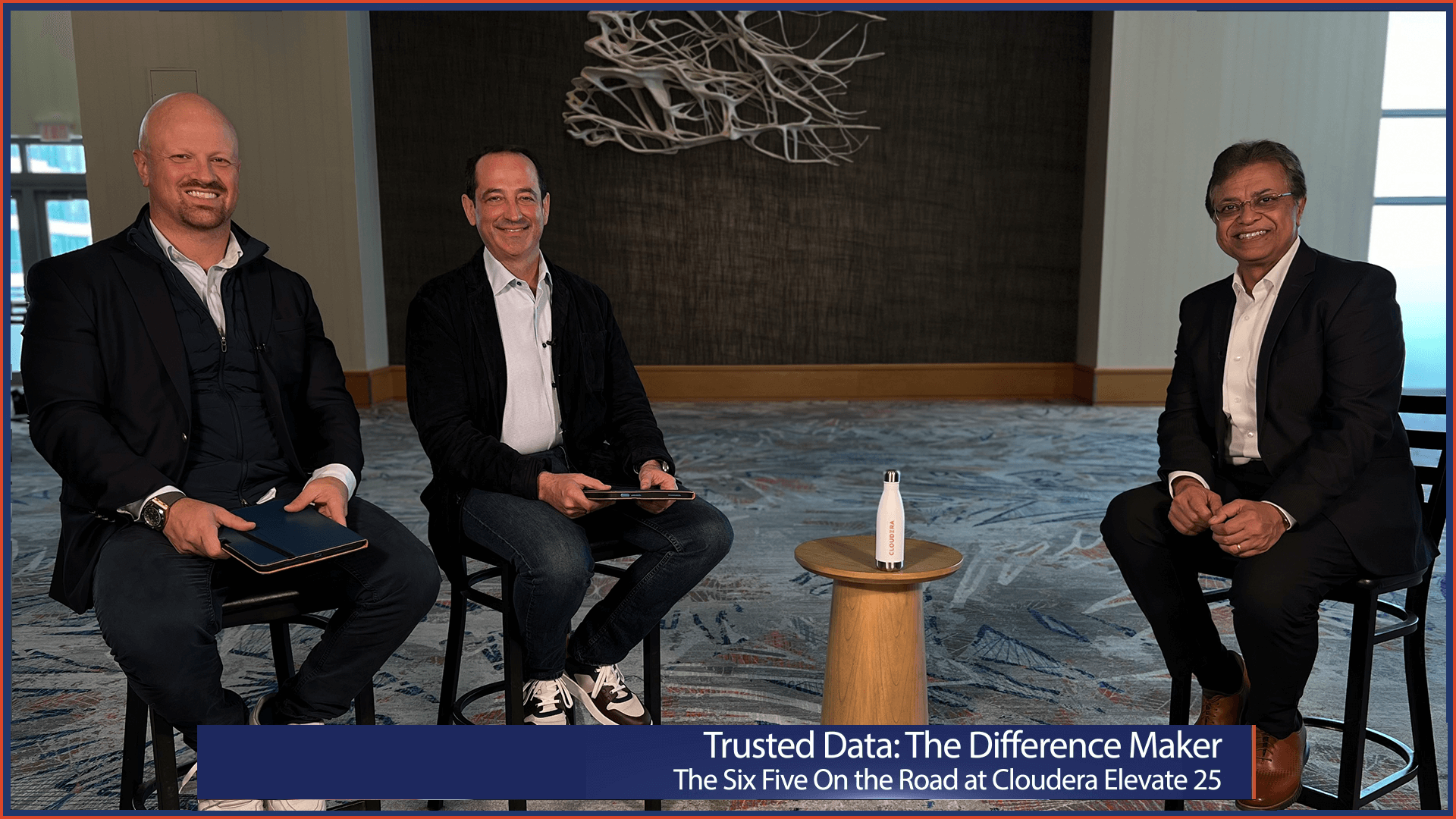
On this episode of The Six Five On the Road, hosts Daniel Newman and Patrick Moorhead welcome Dipto Chakravarty, Chief Product Officer at Cloudera for a conversation on Cloudera’s growth and product-led innovations and their position as AI continues to disrupt compute infrastructure at Cloudera Elevate 25.
Their discussion covers:
- An overview of Cloudera’s growth strategy and specific product-led innovations Cloudera has planned
- Cloudera’s “nexus of trusted data” and how this makes their cloud platform unique
- How Cloudera positions themselves as AI usage trends continue and how Cloudera’s trusted data will make a difference for customers
Be sure to subscribe to The Six Five Webcast, so you never miss an episode.
Watch the video here:
Or Listen to the full audio here:





Disclaimer: The Six Five Webcast is for information and entertainment purposes only. Over the course of this webcast, we may talk about companies that are publicly traded and we may even reference that fact and their equity share price, but please do not take anything that we say as a recommendation about what you should do with your investment dollars. We are not investment advisors and we ask that you do not treat us as such.
Transcript:
Patrick Moorhead: The Six Five is back and we’re on the road in Miami, Florida here at Cloudera sales kickoff, elevate ’25, that’s fiscal year ’25. Dan, it’s been a great show so far. You and I were on stage. We’ve heard some incredible product testimonials or customer testimonials and what they’ve done with this amazing technology.
Daniel Newman: Yeah, there’s some top secret customer testimonials.
Patrick Moorhead: One we can’t even use their name.
Daniel Newman: They weren’t here, but as analysts, one of the things we do love to see is product fit, product market fit. And of course every company right now has got this kind of AI story. Everyone’s got a, “We are the AI company.” And there’s a lot of his-story that needs to go into building a product that’s actually ready for the AI opportunity of today. And so while we’ve spent a lot of time talking to CEO Charles Stansberry and I hope everyone out there goes and checks out that video. Pat, I know something you and I love to talk about.
Patrick Moorhead: Listen, I mean, okay, I’m an ex product guy, so I like products and it’s great to get right from the head of products. Dipto, welcome to the Six Five. Thanks for coming on.
Dipto Chakravarty: It’s great to be here.
Patrick Moorhead: Yeah, absolutely.
Daniel Newman: It’s your first time on the show. I think we met at EVolve in New York, but you were like five minutes into the role.
Dipto Chakravarty: That’s actually accurate. Literally that long in the role EVolve was the best way of getting to know our … Not just new hire orientation but meeting the customers, not just the employees.
Daniel Newman: Exactly. So it’s good to see you settling in. We spent some time talking with Charles about his sort of investment led growth and kind of where he sees taking the product, but we’d love to get your angle now. You’re taking it a layer deeper. You’re really figuring out how to innovate on the products, meet that market fit that we spoke about. Where are you at with that? Talk a little bit about your planning. Talk a little bit about your strategy, talk about where you’re at, expand upon what Charles was talking about.
Dipto Chakravarty: The product strategies sound, we have to execute on these in a way that it adds differentiating value beyond the competitor landscape and really adding value that is durable for our customers. We are focusing on three different themes. We have four pillars of investments. We are going to have to modernize our lakehouse, which already is industry leading solution.We are going to be adding data mesh capabilities and also a data fabric you’ll be hearing and that’ll co-exist. That’ll be the first area of investment.
We are also investing in AI significantly because I joined Cloudera from Amazon where the AI was really the lingua franca, just about adding the AI into everything. This market is primed for growth because data management is only 30-years-old, but what’s making it really new is data has gravity. It will have to stay where it is. So when you have petabytes and data under management, it’s the compute that has to be brought closer to it and people are scrambling to figure out how to execute on that strategy because our customers with petabytes and exabytes under management, they’re looking at us to do the forklift for them so that it’s easy lift for the users.
That’s the second area you’re going to see with your AI, particularly generative AI, but also broader AI coming into play. We also have the modernization and exploration of the cloud solutions where we will have a hybrid cloud for just about all our mature customers who have already gone to the journey on the cloud. It’s not like they’re learning, they’re on that journey. On that journey, the most important option that looking for from us is to how do they make these workloads hybrid?
How do they use cloud as an operating model beyond using it as a compute model or a finance or a CAPEX OPEX model? They’re looking at how to use cloud to run their business. Sometimes it makes sense to have the workload in a public cloud. Sometimes it makes sense to have it on-premise and the businesses are making those decisions. Our job as their partner is to make it flexible for them.
Patrick Moorhead: I love that. I love the talk about the hybrid cloud. You’re definitely making moves under the goal that you want to be the vendor of choice for their cloud data platforms. And I think I heard a phraseology, I don’t know if you used it or not, let me make sure I get this right. The nexus of trusted data that’s under your control and how that sets you apart. So how do those two come together, right? Because right now you’re the nexus of data on-prem. You want to be the customer choice in the cloud. How do those two work together?
Dipto Chakravarty: This nexus is really, I call this the trifecta. This nexus of these things coming together creates such a unique opportunity for us because the workloads that are mature workloads, they already have a known pattern of how they get spawned off and executed. The new workloads that are getting added is creating a strain on the IT departments because very few IT department’s budgets are increasing, it’s really their workloads are increasing. Complexity is increasing, their budgets are most cases the same or decreasing.
So how do we provide our customers efficiency and effectiveness? Those are two different things. Efficiencies, how do you do the things that you do well? And then effectiveness is how do you do the right things? And that’s why I’ve told the team that we have to slow down to go fast and make sure that we offer customers choices so that some of their workloads can be by default on-prem, spike it to the cloud. Other workloads will be by default on the cloud, occasionally brought on-prem to run an LLM like compute test job. And the third kind of workload, which is even more interesting and Cloudera will be the company that gives its customers the choice, is when you want to have storage on-prem, compute off-prem or vice versa, storage off-prem, compute on-prem, those workload characteristics are going to drive the economic value for our customers because we want to create value for them. I want our customers to know Cloudera as the most flexible data concierge service that they can rely on to run their workloads without having to worry about the forklift and the left shifts and those are the things that the customer shouldn’t have to do. It shouldn’t have to have an army of people moving workloads on the cloud or from the cloud on-prem or even in the worst case scenario from one kind of public cloud to another public cloud.
Patrick Moorhead: Yeah, I think you nailed it. I mean, I set up on stage, Dan started off the cloud’s 15-years-old. It’s a teenager, right? And in the end, today here in 2024, what enterprises want is they want software capabilities that are cross cloud, okay? And whether that’s a sovereign cloud, a private cloud, on-prem for mainframes, as Charles has talked about a few times, public cloud and also the ability to get SaaS data. And it’s even more important here in the age of generative AI, for sure.
Daniel Newman: Speaking of AI, I mean, I think we would be missing an opportunity if we didn’t talk on every single show ever about. But seriously, one of the biggest, most prolific and important trends that’s going to transform every business immediately. And it’s all about driving productivity. It’s about driving efficiency. But I’ll be candid, seven, eight months ago, nobody at Cloudera was really using AI as a term, it was like almost there was this resistance to really go down the path.
And despite big data and the important shift it was making it towards AI, it’s this new team that’s coming in, yourself included, that’s really kind of grabbing the ball and saying, “We want to be differentiated. We want to be part of an AI conversation.” But I still think there’s an opportunity to tell people what that means. Tell us a little bit about how you are seeing through product and through the innovation you’re developing, Cloudera becoming a real player, being one of the first off the tongue when it comes to company’s AI strategy.
Dipto Chakravarty: Great question. I love talking about this because really it’s going to happen at three different layers at Cloudera. It’s already happening. First of all is automation. AI drives automation beyond the DevOps lifecycle. We have started using what we call the AI Ops, which actually orchestrates workload. It actually automates testing and it really gives the team a productivity boost. Anything that is cryptable, anything that you can have a playbook for can be automated.
And we showed some examples on the stage, live products that are generating code for you, generating test cases for you, giving you the productivity boost, making it easier for us to get started. Automation is the first level. The second one is accuracy. If you apply AI to any software development or any other manufacturing, it’s not just the speed, it’s also the precision that you’re able to overachieve. And that’s what AI is capable of doing right now. It gives you a better precision, it gives you better outcomes.
And the third area is really making the separation between machine learning and AI. Machine learning is we already have been doing and we are going to do more of, it’s all about training the data, training the computer to interact with you rather than interacting with a computer yourself. If you train it well enough, one machine will interact with the other. And at this very moment our watch talks to our phone, phone talks to the email server.
That’s a closed loop system, but you can go fairly pervasive in that and having multiple devices talk to each other. And this is where the line becomes very blurry between man machine interaction and we want to be the company that’s known for automating software infrastructure for our customers, not only for their software but also about their hardware on-prem and off-prem as well.
Patrick Moorhead: So can we do a double click on this and maybe connect the dots between the data and AI? I mean, just try to be as black and white as possible here. How does your platform make AI better?
Dipto Chakravarty: Because it starts with AI foundation is data quality, data completeness, data accuracy, data freshness. So we have to get the data strategy in place first. That’s the journey phase number one. Next phase is picking a model that best suits you from whether we are offering customers choices of whether they can use an open source model or closed source model. What we are seeing is you almost, unless you have a lot of ton of budget to handpick and create a model from scratch, it gets very expensive because you have to train the model on billions and billions of … That’s B with a billion parameters.
You’re better off starting with a model that is close enough and then you start from there to fine tune it. Once you fine tune the model and you’ve gotten it to be good enough for your needs, if you start interrogating the model, you start training the model, it becomes your proprietary IP. At that point, you own that and you can then put it behind your air gap systems. Most of our large customers who are already on the AI journey, they are looking at starting with an open source, iteratively training and taking it to the closed source.
And given our open source heritage, I see us doing this better than any other company that we start with open source community and we build a community of really set of models that are shared assets and to the point where that’s your customers are really our customer’s proprietary model. And they use that as their differentiator of, one would say, that once the proprietary models are ready, they wouldn’t want to share that with anyone and not even our vendor. And I want to have that separation between models that they have created using Cloudera as a platform versus using models that are available in the open source community.
Daniel Newman: Yeah Dipto, I appreciate you going that deep. I’ll tell you something. We went on stage and the first slide was something along the lines of the more things change, the more things stay the same. And what I’m hearing from you is sort of a reiteration of the fact that the complexity of getting your data right is only being amplified in the era. And whether it’s trying to build a foundational model, a small model, a large model, it’s all about having your data compliant, governed, available.
And so this is where Cloudera has such an opportunity to shine is that companies can’t do the cool stuff without doing the hygiene. And so if anything, this whole AI trend is only amplified substantially, increase the need exponentially for the tools that you’ve built and offered for the hybrid multi-cloud era. So it seems like you’re very well set. Of course, now you got to execute.
Dipto Chakravarty: We are excited to get on it. I’ve been seeing some awesome results because some of these models that we demonstrated yesterday, the amount of effort to really bring it from inception to delivery, we are talking days or weeks, no more than that. And I think speed will be the number one differentiator. And I go back on this thesis of making things simple is hard and we are doing that heavy lift for our customers and making things easy for them so that keeping things simple will be hard and making things complicated will be very, very easy.
In our business where our typical customer profiles, they have multiple cloud providers, they have multiple public cloud providers, they have multiple storage suppliers. So dealing with a very complex ecosystem and us making that investment and being their preferred vendor, that who knows how to deal with complexity, that gives them a whole carousel of choices. And if they rely on Cloudera Product Suite, we will be in a winning place that I want to be that tool of choice that they use us to lift and shift and also run their business.
Daniel Newman: And making things easy is hard, making things hard is easy. Dipto, I want to thank you so much for joining us here on the Six Five.
Dipto Chakravarty: Yes, delighted to be here. Thank you for spending time with me.
Daniel Newman: Thank you. I got an easy one for all of you. Hit that subscribe button. We would love to have you as part of the Six Five community. And, of course, watch all of our coverage here at Elevate 25, north of Miami, south of Fort Lauderdale, here at the SKO. Yes, that is fiscal year ’25. We appreciate everybody tuning in, but we got to say goodbye for now. See you later.
Author Information

Daniel is the CEO of The Futurum Group. Living his life at the intersection of people and technology, Daniel works with the world’s largest technology brands exploring Digital Transformation and how it is influencing the enterprise.
From the leading edge of AI to global technology policy, Daniel makes the connections between business, people and tech that are required for companies to benefit most from their technology investments. Daniel is a top 5 globally ranked industry analyst and his ideas are regularly cited or shared in television appearances by CNBC, Bloomberg, Wall Street Journal and hundreds of other sites around the world.
A 7x Best-Selling Author including his most recent book “Human/Machine.” Daniel is also a Forbes and MarketWatch (Dow Jones) contributor.
An MBA and Former Graduate Adjunct Faculty, Daniel is an Austin Texas transplant after 40 years in Chicago. His speaking takes him around the world each year as he shares his vision of the role technology will play in our future.