
The $5 billion Sunnyvale facility rests on the claim that parallel development doubles the speed of chip commercialization, with TSMC, Intel, Samsung, SK hynix, and Micron as founding partners and 2030 targets of 54% gross margin and 40% operating margin as the payoff
What Is Covered in This Article:
- The $5 billion EPIC Center unveiling in Sunnyvale with TSMC, Intel, Samsung, SK hynix, and Micron as founding partners
- Founding partner fireside chats on the memory wall, logic-memory integration, and co-located R&D
- A fabless systems panel with Broadcom, NVIDIA, and Qualcomm on memory energy, interconnect reach, and thermal limits
- Investor breakfast data on agentic AI wafer demand, process control growth, and AIx connected services
- New 2030 targets of 2 points of WFE share gain, 54% non-GAAP gross margin, 40% non-GAAP operating margin, and more than $12 billion in services revenue
The News: Applied Materials staged a two-day sequence around SEMICON West 2026, held October 13-15 at the Moscone Center in San Francisco. On October 12, the company unveiled the EPIC Center on its Sunnyvale campus, a $5 billion, 600,000-square-foot R&D facility with nearly 4 acres of cleanroom, built in 26 months from groundbreaking to first tool move-in. EPIC stands for Equipment and Process Innovation and Commercialization. The unveiling drew the R&D leadership of the industry’s five largest chipmakers as founding partners, with TSMC, Intel, Samsung, SK hynix, and Micron on stage, Broadcom, Advantest, SCREEN, KIOXIA, and Besi as innovation partners, and Stanford, UC Berkeley, UCLA, Arizona State University, and RPI anchoring a university program. Futurum attended both days in person, and Futurum CEO Daniel Newman moderated the founding partner conversations.
The next morning, Applied hosted its traditional technology breakfast at SEMICON West with an expanded lineup. CEO Gary Dickerson framed the state of the industry, Semiconductor Products Group President Prabu Raja detailed segment share gains, Keith Wells presented the process control business for the first time, Tim Deane covered AI-enabled services, and CFO Brice Hill broke quiet-period custom to deliver new 2030 financial targets.
One theme ran through both days. Demand now exceeds supply across leading-edge logic, DRAM, and advanced packaging, so the race has moved from performance alone to yield and output, and Applied has positioned the EPIC Center, its e-beam metrology franchise, and its AIx service platform as the tools that convert yield into a durable equipment and services annuity.
Applied Materials’ EPIC Center Ties 2x Faster Innovation to a 2% WFE Share Gain by 2030
Analyst Take: The Applied Materials EPIC Center converts a decade of co-innovation rhetoric into physical infrastructure, and the investor breakfast that followed put a number on the expected return. 2x faster chip innovation is the mechanism behind the more than 2 points of WFE share Applied targets by 2030. The company committed $5 billion to a model that runs university research, materials discovery, equipment development, and module integration in parallel inside one Sunnyvale facility, claiming the journey from idea to commercial chip can compress from 10 to 15 years to as little as half that, with earlier design-in across customer roadmaps as the channel that converts speed into share.
The founding partners supplied the demand signal. SK hynix is moving engineers to work alongside Applied’s in Silicon Valley, Intel is linking its Oregon R&D campus to the facility, and Micron President and Chief Technology and Products Officer Scott DeBoer described the objective as co-investing so that “technology that maybe would have come out six years from now or seven years from now” arrives “two years from now.”
The bull case is that early design-in across transistors, wiring, and packaging extends Applied’s lead in the three fastest-growing WFE segments, where the company claims the number one position in each. The bear case is that the model asks fierce competitors to innovate within shared walls, and the 2x compression claim rests on early internal proof points rather than a commercialized technology that traveled the full EPIC path. Futurum’s view is the Applied Materials EPIC Center and the new 2030 targets reset the equipment industry’s role in the AI buildout.
Agentic AI Wafer Demand Turns Yield Into the Binding Constraint
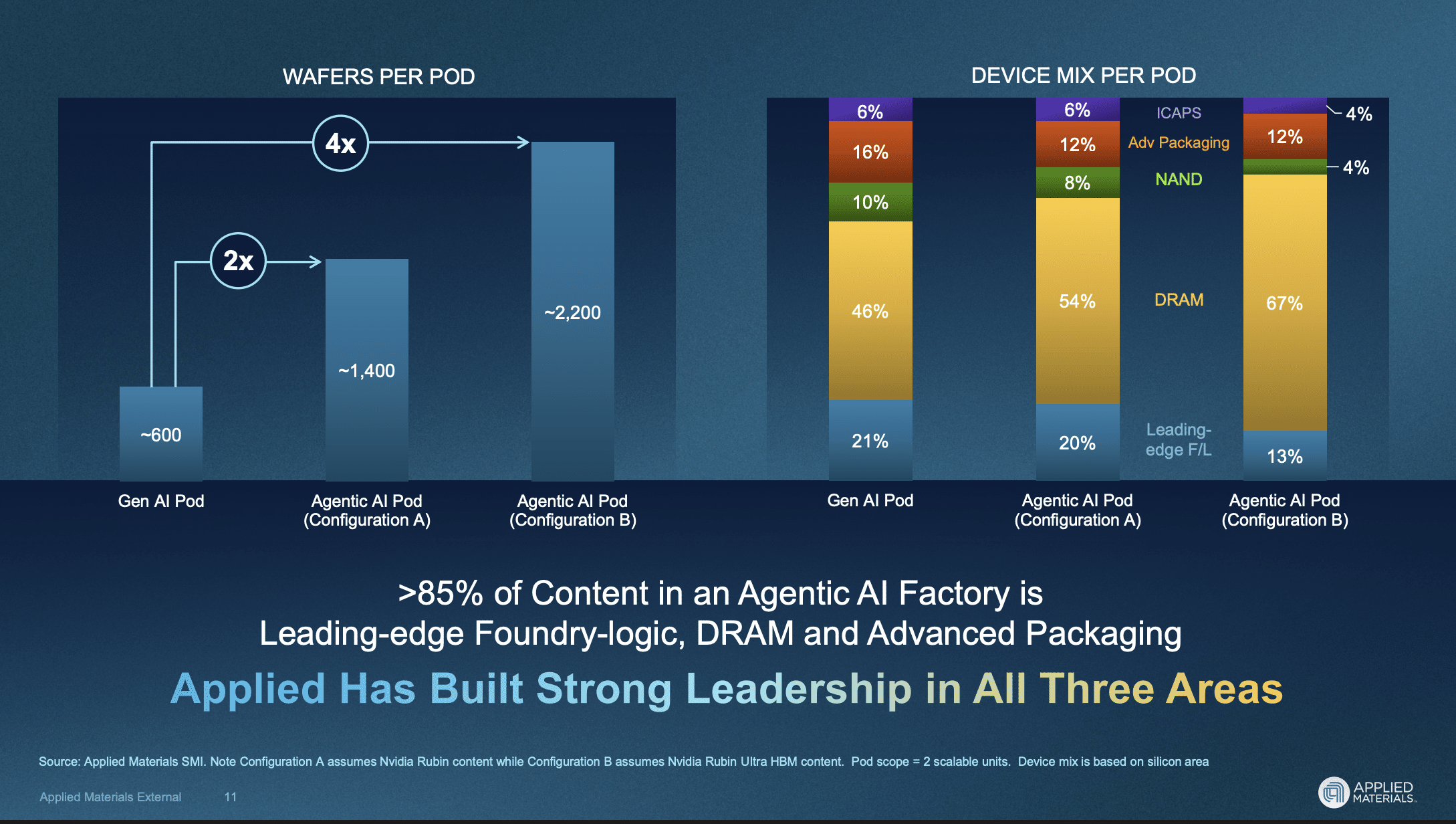
Dickerson told investors he has never seen stronger customer pull for yield and output innovation in his career and the breakfast supplied the arithmetic behind the claim. Applied presented an AI factory pod analysis showing agentic AI configurations consume 2x to 4x more wafers than generative AI pods, with 85% of agentic pod wafer starts falling in leading-edge logic, DRAM, and advanced packaging. Data center demand has crossed over mobile as the dominant driver of leading-edge wafer starts in both logic and DRAM, and Applied said it raised its wafer fab equipment forecasts for calendar 2026 on agentic compute growth, while withholding a specific WFE number during its quiet period.
The segment math favors the company’s mix. Roughly 75% to 80% of incremental WFE growth through 2030 sits in the three segments where Applied claims leadership, and Raja detailed served market expansion from $12 billion at 3nm to $15 billion at 1.4nm in leading-edge logic, a more than 40% served market increase in the 6F² to 4F² DRAM transition, and an advanced packaging business expected to exceed $5 billion within a few years. Futurum’s Semiconductors market model sizes total WFE at $120 billion in 2025 rising to $162.2 billion in 2026 in its high case, with AI-related demand at $67.6 billion of the 2026 total, a trajectory consistent with the demand acceleration Applied described.
The EPIC Model Asks for Trust in Exchange for Speed
The structural argument for the Applied Materials EPIC Center came from Raja, who described the traditional sequential path from university research to high-volume manufacturing as too slow for product cycles that now turn annually. EPIC runs the phases in parallel, offering partners dedicated space, more than 100 test vehicles, customer reticles, and early access to equipment that has not reached the market. Samsung Device Solutions CTO Jaihyuk Song gave the partner rationale its sharpest form, saying the discipline the model demands is to “integrate early and fail early and learn early.” SK hynix CEO Noh-Jung Kwak pushed standardization and data sharing as the ecosystem’s two unlocks while acknowledging that data remains “very sensitive for each companies,” and Intel EVP and Chief Technology and Operations Officer Naga Chandrasekaran committed Intel to joint work on transistors, interconnects, and advanced packaging with equipment “still in the minds of Applied engineers.”
The tension was visible on stage: Chandrasekaran said there “will definitely be challenges in what we can share, what we can do together,” and Kwak conceded that the data AI development requires remains sensitive for every company even as he argued the industry must find a way to share it. Dickerson’s answer, repeated across both days, is that trust built over decades of co-innovation makes the model workable, and the partner roster suggests the customers accept those terms for now. The risk is measurable either way. If founding partners staff the facility and co-developed technologies reach pilot lines years early, EPIC becomes the industry’s default development model. If IP concerns hollow out participation, Applied will have built the world’s most expensive showroom.
The Fabless Panel Located the Bottleneck in Memory Power Delivery
The systems panel gave the facility its demand-side justification. Bill Dally, Chief Scientist and SVP of Research at NVIDIA, said the decode phase of inference “is memory bandwidth limited, and we have to get that bandwidth up by an order of magnitude, the energy per bit down by an order of magnitude,” tracing how a bit read from HBM costs a few hundred femtojoules at the array but 4 to 5 picojoules by the time it crosses the interposer to the GPU. His priorities for early collaboration were system-on-wafer integration and co-packaged optics, where comb laser supply and modulator stability remain unsolved materials problems. Chidi Chidambaram, SVP and Fellow at Qualcomm, answered with measured data from the company’s high bandwidth compute program, reporting DRAM-on-logic samples delivering memory access at “0.2 to 0.3 picojoules per bit” against roughly 4 picojoules for HBM3, a 10x improvement that feeds the AI250 product Qualcomm has announced for next year. He also named the open problem: edge devices must run prefill and decode on one chip at 1 to 2 watts per square millimeter while DRAM sitting on top stays below roughly 95 degrees Celsius, a thermal materials challenge he assigned directly to the EPIC ecosystem. Frank Ostojic, SVP and GM of Broadcom’s ASIC Products Division, argued the industry has exhausted its headroom, with dies and packages at their size limits, and said breaking even one of the five or six constraints facing architects would extend scaling significantly. The convergence matters for Applied’s thesis. Memory stacked on logic, wafer-scale packaging, and co-packaged optics all shift value toward materials engineering, deposition, bonding, and inspection steps where Applied claims its strongest positions, including more than 60% share of HBM packaging today.
The 2030 Targets Price Applied as an AI Growth Company
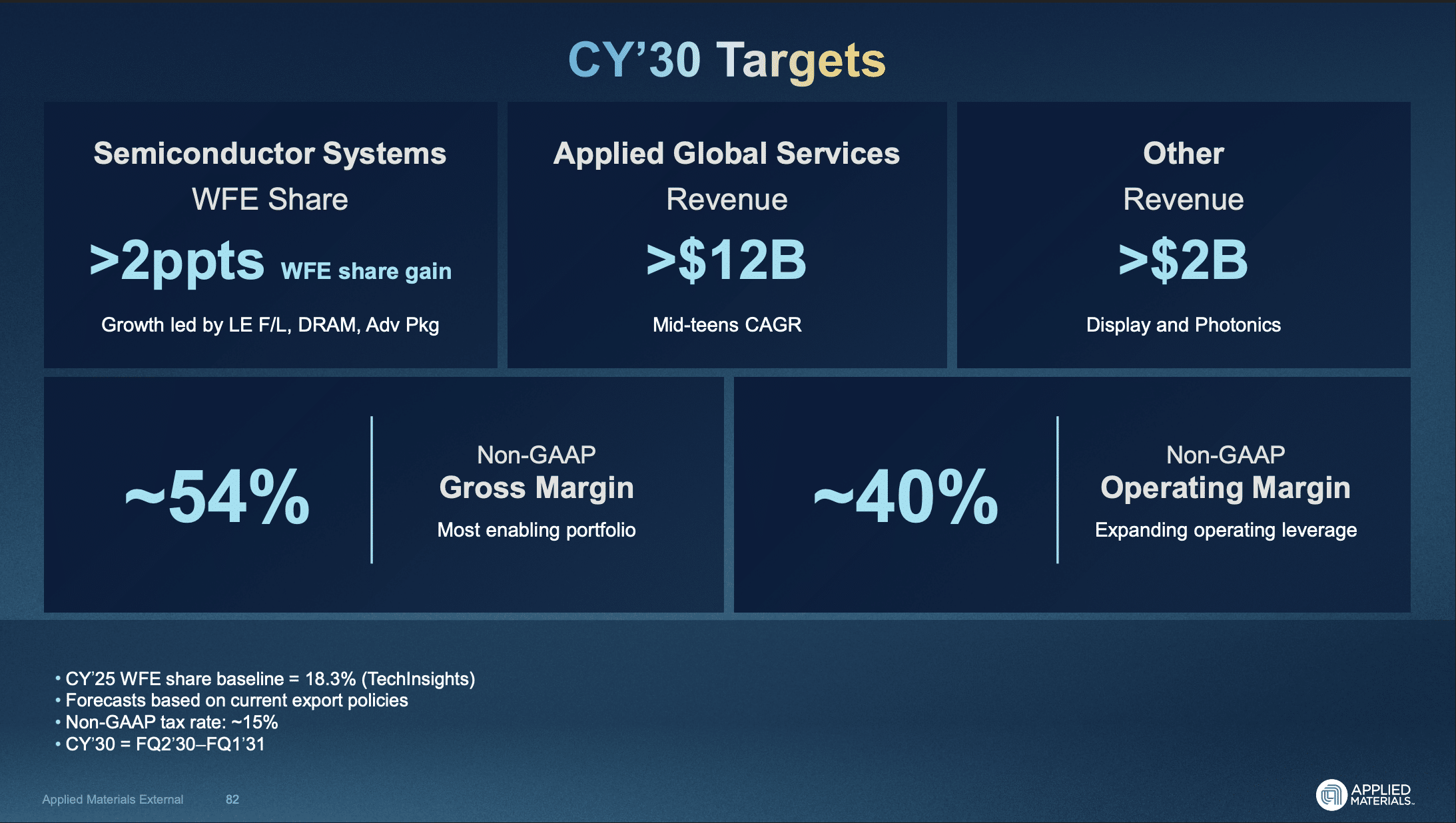
CFO Brice Hill’s first SEMICON West breakfast appearance delivered the quantitative frame. Applied closed its 10-year record with revenue of $34.3 billion, a 12.2% CAGR, non-GAAP gross margin of 50%, up 680 basis points over the decade, and a 22% EPS CAGR. The 2030 targets extend the trajectory: more than 2 points of WFE share gain, 54% non-GAAP gross margin, 40% non-GAAP operating margin, services revenue above $12 billion on a mid-teens CAGR, display and photonics businesses above $2 billion combined, and a commitment to return 80% to 100% of free cash flow while doubling lab and manufacturing capacity.
The services model supplies the recurring revenue case. Applied has 37,000 chambers connected to its AIx platform, expects more than 90,000 by 2030, targets 20% growth in revenue per tool, and presented 18 quarters of data showing 30% faster service resolution on connected tools, with predictive models now calling electrostatic chuck failures 30 days in advance at better than 90% accuracy. Wells supplied the growth kicker, with both optical inspection and e-beam revenue growing roughly 50% this calendar year, a $3 billion metrology and inspection business in 2026, and a declared product roadmap into the roughly $7 billion of optical inspection TAM that Applied does not serve today, a direct move on KLA’s franchise.
The bear case got a fair hearing from investment analysts. Applied lost WFE share in 2025 as China access fell from roughly 90% to 70% of that market, so a 2-point gain by 2030 partly recovers lost ground, and management’s response, that share is rising where it can compete, assumes trade rules stay frozen. The margin path also requires roughly 100 basis points of expansion per year against rare earth, logistics, and infrastructure cost headwinds the company acknowledged. Vendor-supplied forecasts at this scale deserve the standard caveat and the November earnings call will be the first test of whether the raised agentic demand outlook converts to guidance.
What to Watch:
- Whether founding partners publicly staff co-located engineering teams at the EPIC Center through 2027
- Whether EPIC programs pull technologies planned for 6 or 7 years out into the 2-year window DeBoer described
- Whether Applied’s November earnings call converts the raised agentic AI demand outlook into guidance
- Whether optical inspection and e-beam sustain 50% growth into calendar 2027 as KLA responds
- Whether China trade rules stay fixed, the stated assumption beneath the 2-point WFE share gain target
Read more details on the Applied Materials website.
Sources
- AGENTIC AI FACTORY POD CONSUMES, Applied Materials
- Applied Materials Investor Breakfast 2026 Presentation, Applied Materials
Declaration of generative AI and AI-assisted technologies in the writing process: This content has been generated with the support of artificial intelligence technologies. Due to the fast pace of content creation and the continuous evolution of data and information, The Futurum Group and its analysts strive to ensure the accuracy and factual integrity of the information presented. However, the opinions and interpretations expressed in this content reflect those of the individual author/analyst. The Futurum Group makes no guarantees regarding the completeness, accuracy, or reliability of any information contained herein. Readers are encouraged to verify facts independently and consult relevant sources for further clarification.
Disclosure: Futurum is a research and advisory firm that engages or has engaged in research, analysis, and advisory services with many technology companies, including those mentioned in this article. The author does not hold any equity positions with any company mentioned in this article.
Analysis and opinions expressed herein are specific to the analyst individually and data and other information that might have been provided for validation, not those of Futurum as a whole.
Read the full Futurum Group Disclosure.
Other Insights From Futurum:
Micron Research Labs: Can $1 Billion a Year Out-Research Samsung and SK hynix?
Applied Materials Q3 FY 2026: Advanced Packaging and DRAM Accelerate Growth
Applied Materials’ Master Class Schools Memory Makers on Logic-Class Fabrication
Author Information

Brendan is Research Director, Semiconductors, Supply Chain, and Emerging Tech. He advises clients on strategic initiatives and leads the Futurum Semiconductors Practice. He is an experienced tech industry analyst who has guided tech leaders in identifying market opportunities spanning edge processors, generative AI applications, and hyperscale data centers.
Before joining Futurum, Brendan consulted with global AI leaders and served as a Senior Analyst in Emerging Technology Research at PitchBook. At PitchBook, he developed market intelligence tools for AI, highlighted by one of the industry’s most comprehensive AI semiconductor market landscapes encompassing both public and private companies. He has advised Fortune 100 tech giants, growth-stage innovators, global investors, and leading market research firms. Before PitchBook, he led research teams in tech investment banking and market research.
Brendan is based in Seattle, Washington. He has a Bachelor of Arts Degree from Amherst College.