
Analyst(s): Brendan Burke
Publication Date: September 28, 2026
Synopsys announced AgentEngineer, a portfolio of seven domain-specific long-horizon agents spanning verification, implementation, analog, manufacturing, meshing, combustion, and EMC analysis, built on the new Synopsys Autopilot Platform. Synopsys reports engagement results of up to 50x faster verification closure, 20% higher coverage, and 2x better token efficiency. Futurum’s view is that this is the industry’s furthest advance toward lifecycle agents that let a single team design across every stage, and the integration pressure falls on point-tool rivals and internal agent programs alike.
What is Covered in this Article
- Seven Synopsys AgentEngineer long-horizon agents plus an open lane for customer agents, with general availability planned for the end of 2026
- The Synopsys Autopilot Platform with context intelligence, persistent memory, privileged tool APIs, governance, and compute and LLM optionality
- Vendor-reported results of up to 50x faster verification closure, 20% higher coverage, a 10% to 30% RTL productivity boost at Fujitsu, and 2x better token efficiency
- Endorsements from Intel, NVIDIA, Samsung, MediaTek, Fujitsu, and AheadComputing across more than 30 engagements
- Futurum’s view on lifecycle-agent consolidation, the NVIDIA OpenShell relationship, and the consumption economics Synopsys previewed on its Q3 FY2026 earnings call
The News: Synopsys (Nasdaq: SNPS) announced on September 28 the Synopsys AgentEngineer solutions, a portfolio of domain-specific long-horizon agents that reason, plan, and execute complete engineering workflows across verification, system validation, implementation, analog and mixed-signal design, manufacturing, and simulation and analysis. The portfolio comprises seven agents across coverage closure, PPA closure, analog design, mask synthesis, and FEA, CFD, and EM coding agents, with an eighth lane reserved for customer-built agents in an open ecosystem.
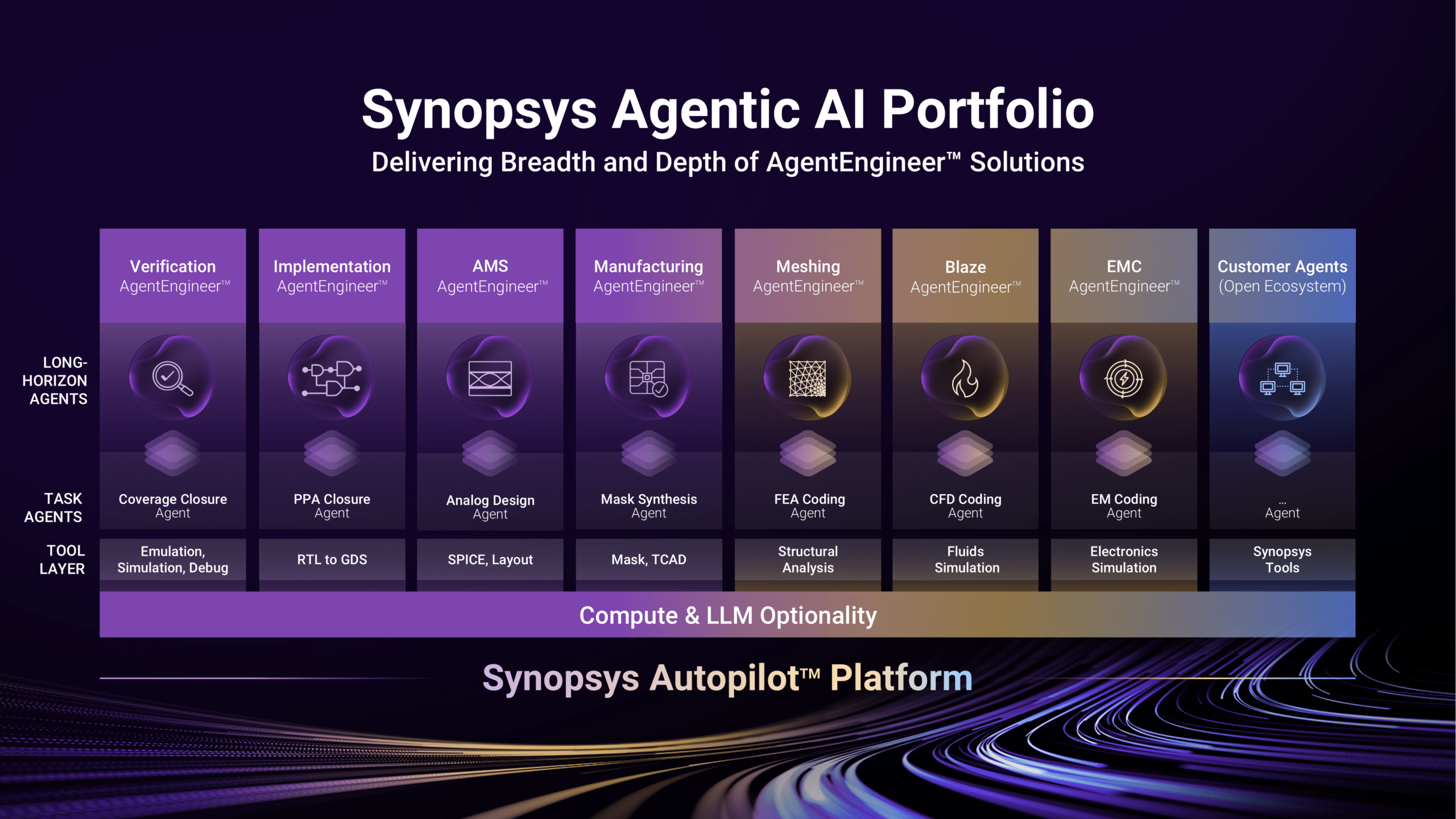
All of them run on the new Synopsys Autopilot Platform, an open foundation that supplies context intelligence, persistent memory, telemetry, security, and governance, and connects agents to Synopsys EDA and simulation ground-truth engines. Synopsys reports demonstrated engagement results of up to 50x faster verification closure, 20% higher coverage, a 30% productivity boost, and 2x better token efficiency, with more than 30 customer engagements underway and general availability planned for the end of 2026.
“Our customers are re-engineering their engineering workflows across semiconductor and systems products to keep pace with increasing system complexity and tight market windows,” said Ravi Subramanian, Chief Product Management Officer at Synopsys. “Synopsys’ portfolio of AgentEngineers and the Autopilot Platform enable customers to accelerate their shift from AI-assisted design to autonomous engineering, built on trusted EDA and simulation and analysis engines.”
The full announcement is available in the Synopsys press release.
Synopsys Autopilot Aims to Consolidate Chip Design Around One Stack
Analyst Take: Synopsys Autopilot is the furthest any vendor has gone toward agents that cover the full chip design lifecycle. Eight portfolio columns run from verification through implementation, analog, and manufacturing into the physics domains that arrived with Ansys, and each one stacks a long-horizon agent above task agents above a ground-truth engine. This is the architecture for a vision Synopsys has been selling since the Ansys close, where a single small team designs a chip across every stage from RTL to system-level physics. If customers adopt that vision, procurement consolidates around whichever stack the agents live in, and Synopsys just claimed the widest footprint in the category. The bet is expensive to counter because Cadence would need comparable multiphysics breadth to match it column for column.
The Long-Term Goal Is a Faster Design Start
Synopsys described the destination two weeks before the launch. “The silos will go away. There will just be a chip design engineer,” said Thomas Andersen, Vice President of AI and Machine Learning at Synopsys, in a Six Five on the Road conversation with Futurum at AI Infra Summit 2026. In the end state Andersen sketched, the tools humans operate today become engines, the engineer writes the specification and keeps the creative decisions, and agents launch the tools, fix the errors, and close the timing, congestion, and verification issues behind the scenes. He expects that shift to produce a faster design cadence and a proliferation of custom silicon, because a creative engineer without a large team can go from good idea to silicon faster and cheaper.
His timeline was disciplined, with mostly automated spec-to-product judged doable and the next 6 to 12 months ruled out, on a path that seeds agents with expert knowledge and lets them become self-learning. Meta’s accelerator team put fully automated chip design 2 to 3 years out at the same event. Futurum has argued that agentic EDA is collapsing the cost of a design start, and a rising design-start count multiplies the value of the EDA stack. A design organization whose plans, skills, and persistent memory accumulate inside Autopilot’s context intelligence faces a platform migration to leave. Each new start will deepen the dependence.
Long-Horizon Agents Take Over Handoffs
What is new here is the removal of the human trigger between workflow stages. Agentic offerings to date have automated bounded tasks, with an engineer initiating each stage and reviewing the handoff. An AgentEngineer instead pursues one objective across hundreds or thousands of reasoning steps and revises its own plan when an intermediate result falls short. Synopsys distinguishes these long-horizon agents from long-running ones that perform a single activity for hours, such as monitoring nightly regressions.
The Implementation AgentEngineer shows the difference in practice with an autonomous PPA and design closure workflow. It takes the tech file, RTL, SDC constraints, and a PPA goal, builds a cognitive model of the design as its knowledge foundation, and plans its own path through design exploration. It then drives implementation while collecting live design data, works through congestion, DRC, and IR-drop closure, including the dirty data that those runs produce, and finishes signoff PPA closure and ECO closure on its own, monitoring execution throughout and feeding results back into its plan.
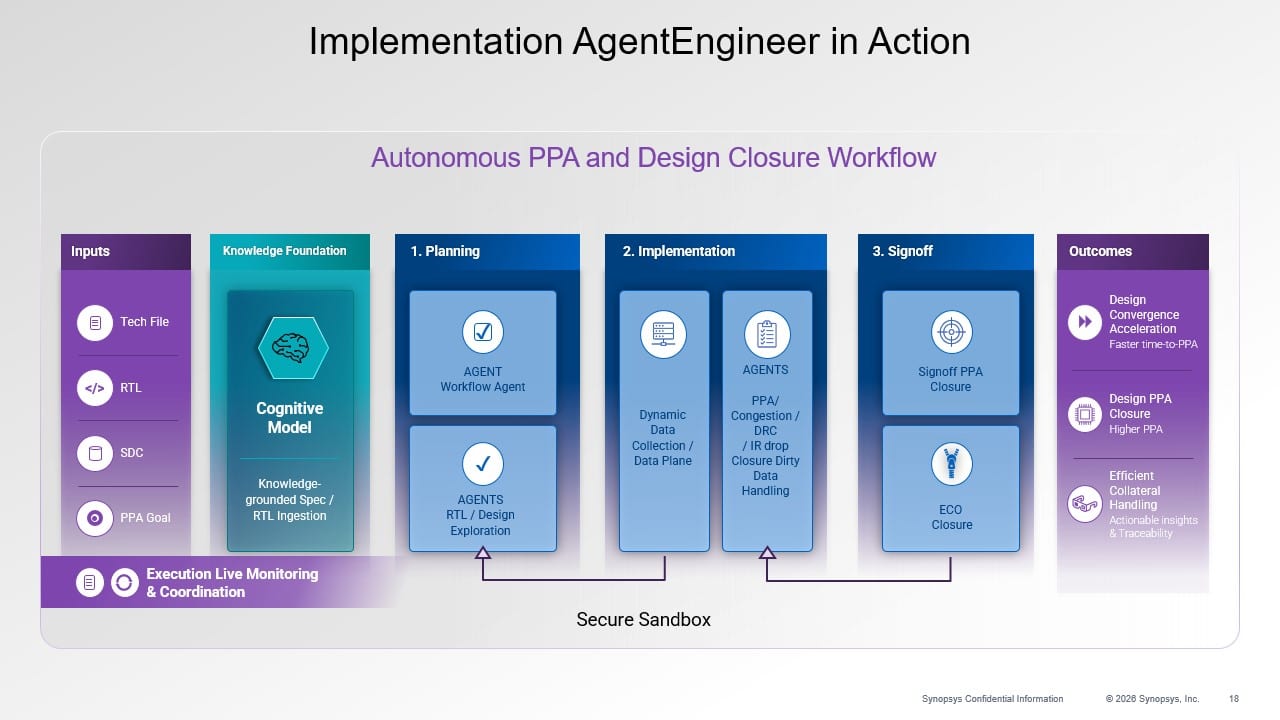
This is the first commercial claim of closure automation that reaches through sign-off. AI already operates in this stage, since Synopsys DSO.ai and Cadence Cerebrus have tuned implementation parameters with reinforcement learning for years, but those optimizers work inside runs that engineers still set up and shepherd, and the closure grind of triaging violations and cycling ECOs stays human. AheadComputing’s endorsement describes the new span in production terms, with reduced manual effort and accelerated design convergence from RTL handoff through implementation, ECO, and signoff.
Synopsys confirmed that these agents run on leading commercial and open-source LLMs rather than a proprietary reasoning model. The differentiation, therefore, concentrates on context intelligence and on privileged APIs that let agents run Synopsys engines more efficiently than public interfaces allow, which is where the 2x token efficiency claim comes from. Multiple customers independently arrived at that efficiency gain, showing the new priority for agent harnesses.
Checkpoint Density Will Measure How Fast Level 5 Autonomy Arrives
Synopsys’ autonomy framework defines Level 5 as full autonomous execution, an agent that reasons, plans, adapts, and completes the objective on its own. AgentEngineer meets that definition of capability. Futurum’s view is that the framework now needs a second axis. Capability level describes what the agent can do, while operating level describes how much of that autonomy a customer permits, and the two will diverge for years.
The observable variable is checkpoint density, the frequency with which engineering teams pause the agent to inspect and redirect. Teams may begin with frequent review and reduce intervention as confidence grows. Futurum expects verification to cross the trust threshold first, because its ground-truth engines score every intermediate result and make agent errors cheap to detect. Analog and manufacturing will lag, since a bad layout or mask decision surfaces expensively and late. Design organizations are already split between teams that check on agents hourly and teams that let them run for days, and the second group became possible only in the past year as frontier models learned to sustain multi-day autonomous runs. Autopilot productizes that model capability, and checkpoint density in production deployments will show how fast customers convert it into operating autonomy.
Autopilot Builds the Domain Layer on Top of NVIDIA’s Security Runtime
Tim Costa’s endorsement names NVIDIA Nemotron models, the NVIDIA Agent Toolkit, and the NVIDIA OpenShell secure runtime as ingredients in the collaboration. OpenShell, released by NVIDIA in early preview in March 2026, is an open-source runtime that isolates autonomous agents in sandboxes and enforces policy at the infrastructure layer, evaluating each agent action before it reaches the host environment. Its deployments to date center on coding agents and enterprise workflows through integrations with SAP and ServiceNow and security partnerships with Cisco and CrowdStrike. Autopilot makes Synopsys the most prominent engineering-domain application of that runtime. NVIDIA supplies sandboxed execution and accelerated computing, while Synopsys keeps context intelligence, IP protection, and workflow governance in its own name. The layer where EDA procurement decisions get made now belongs to Synopsys rather than to the infrastructure beneath it.
The Agentic Revenue Model Remains in Preview
The financial logic surfaced a month before the announcement. On the Q3 FY2026 earnings call, Sassine Ghazi previewed the same 50x faster time to validated RTL and 20% coverage gain, cited a 40% reduction in debug cycle time from autonomous EDA workflows on Microsoft Discovery, and told investors that agents taking on more engineering work orchestrate the underlying EDA tools at a significantly higher rate, which management framed as an incremental growth opportunity. An agent iterating to coverage closure runs simulation, emulation, and formal engines at a duty cycle no human team sustains, and every additional design start compounds the effect. The record hardware-assisted verification quarter, with 12 new and 66 repeat customer wins in Q3, shows the compute pull-through pattern agents would amplify.
Timing tempers the enthusiasm. Synopsys expects no 2026 revenue contribution from its integrated AI solutions, Multiphysics Fusion contributes to growth beginning in 2027, and AgentEngineer reaches general availability at the end of 2026, so agentic revenue is an FY2027 story at the earliest, and the monetization model itself remains in development.
Pre-GA Metrics, Customer Competition, and the Cadence Counter Set the Bar
The demonstrated results will be scrutinized by customers. The 50x closure figure, the 20% coverage gain, and Fujitsu’s 10% to 30% RTL productivity boost are vendor-published engagement results from a pre-GA product. Intel’s endorsement is scoped to the promise of agentic debug rather than deployed closure.
The buy-versus-build contest is live. Hyperscaler silicon teams have been bootstrapping agent loops on frontier models, and Futurum has heard of a major design lab that ran up a seven-figure token bill on internal agents before bringing in outside help to restructure the spend. Autopilot’s token efficiency and privileged APIs are the argument against repeating that experiment, though the platform’s own openness leaves the door ajar for sophisticated teams to adopt the APIs and keep the rest in-house.
Cadence has already answered at the front end. Four days before this launch, Cadence added an RTL Generation Agent to its ChipStack AI Super Agent, converting natural language specs into PPA-optimized RTL with a claimed 24% area and 18% power improvement over foundation model code generation and early access planned for Q4 2026. ChipStack runs the same architecture of super agents orchestrating task agents over trusted engines, so the contest is now about breadth rather than concept. Cadence’s agentic footprint today concentrates on spec-to-RTL, and Synopsys claims the span from there through signoff and system physics. The capability is demonstrated on both sides of the duopoly. The economics remain a thesis until customers publish them.
What to Watch
- Whether AgentEngineer and Autopilot reach general availability across all seven domains by the end of 2026
- Whether Synopsys discloses an agentic monetization model and quantifies consumption uplift in FY2027 guidance
- Whether checkpoint density falls in production deployments, the observable signal of operating autonomy approaching Level 5
- Whether hyperscaler custom silicon teams adopt Autopilot in place of internally built agent stacks
- Whether Cadence answers with a lifecycle-spanning agent platform of its own this year
Disclosure: Futurum is a research and advisory firm that engages or has engaged in research, analysis, and advisory services with many technology companies, including those mentioned in this article. The author does not hold any equity positions with any company mentioned in this article.
Analysis and opinions expressed herein are specific to the analyst individually and data and other information that might have been provided for validation, not those of Futurum as a whole.
Read the full Futurum Group Disclosure.
Other Insights from Futurum:
Synopsys, Cadence, and Siemens Take Agentic Chip Design Autonomous at DAC
AMD Advancing AI 2026: Does AMD Now Build the World’s Best CPUs and GPUs?
Arm’s $15 Billion CPU Opportunity Hinges on Agentic Data Center Design
Author Information

Brendan is Research Director, Semiconductors, Supply Chain, and Emerging Tech. He advises clients on strategic initiatives and leads the Futurum Semiconductors Practice. He is an experienced tech industry analyst who has guided tech leaders in identifying market opportunities spanning edge processors, generative AI applications, and hyperscale data centers.
Before joining Futurum, Brendan consulted with global AI leaders and served as a Senior Analyst in Emerging Technology Research at PitchBook. At PitchBook, he developed market intelligence tools for AI, highlighted by one of the industry’s most comprehensive AI semiconductor market landscapes encompassing both public and private companies. He has advised Fortune 100 tech giants, growth-stage innovators, global investors, and leading market research firms. Before PitchBook, he led research teams in tech investment banking and market research.
Brendan is based in Seattle, Washington. He has a Bachelor of Arts Degree from Amherst College.