RingCentral expanded AIR Pro to deliver agentic AI capabilities across its customer engagement portfolio, including automated outbound calling, live screen monitoring, and AI-powered analytics [1]. This marks a shift from isolated AI pilots to integrated, workflow-centric automation. Futurum Group’s 1H 2026 AI Platforms Decision Maker Survey finds that support and customer experience is the number-one GenAI use case (56% of respondents), reflecting broad enterprise demand for AI-driven CX. Meanwhile, Futurum’s 1H 2026 Enterprise Software Decision Maker Survey shows 38.8% of buyers expect GenAI to be delivered via agents that automate specific tasks, validating RingCentral’s product direction.
What Is Covered in This Article:
- RingCentral’s AIR Pro expansion and new agentic AI features
- The shift from isolated AI pilots to integrated, workflow-driven automation
- Enterprise buyer demand for agentic AI in customer engagement
- Competitive implications for NICE, Genesys, and Five9
- Risks and realities in deploying agentic AI at scale in CX
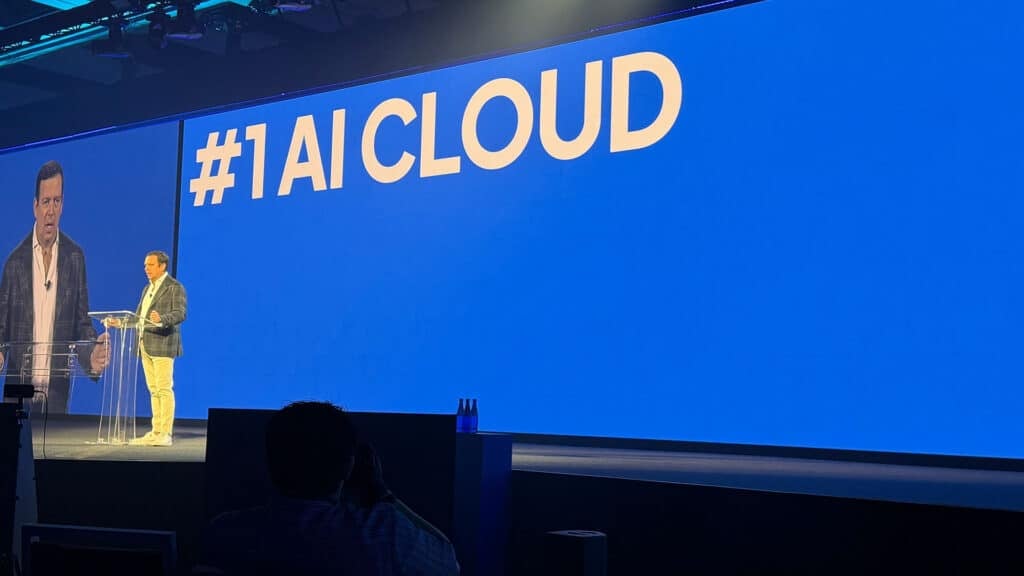
The News: At CCW Las Vegas 2026, RingCentral announced a major expansion of AIR Pro, embedding agentic AI capabilities throughout its customer engagement portfolio [1]. New features include automated outbound calling where AI agents initiate and complete customer interactions, real-time supervisor dashboards with live screen monitoring, and conversational analytics that let supervisors query performance data using plain language. The update also integrates WhatsApp Voice, enabling smooth escalation from text to voice without losing context, and launches RingWEM, a workforce management suite built directly into RingCX. These features are in beta now, with general availability expected in the second half of 2026 [1]. The move signals RingCentral’s intent to consolidate contact center functions and automate both agent and supervisor workflows.
RingCentral’s AIR Pro Bet: Can Agentic AI Redefine the Contact Center Stack?
Analyst Take: RingCentral’s AIR Pro expansion is a clear signal that agentic AI is moving from hype to operational reality in the contact center. By embedding automation into outbound, analytics, and workforce management, RingCentral is betting that enterprises want fewer point solutions and more integrated, AI-driven workflows. The data supports this bet: Futurum Group’s 1H 2026 Enterprise Software Decision Maker Survey shows that 41% of enterprise buyers are actively planning to consolidate their application stacks, with improving workflow and reducing IT cost the top consolidation drivers. The competitive stakes are rising for legacy CCaaS vendors and AI-native entrants alike.
Why Integrated Agentic AI Is the New Table Stakes
Contact center buyers are no longer satisfied with isolated AI pilots or chatbot add-ons. They want automation that spans outbound calling, real-time supervision, and analytics in a unified platform. Futurum Group’s 1H 2026 AI Platforms Decision Maker Survey confirms that support and customer experience is the top GenAI use case at 56% of respondents, ahead of knowledge management (52%) and operations/workflow automation (51%).
Separately, the 1H 2026 Enterprise Software Decision Maker Survey finds that customer engagement ranks as a top-three agentic AI deployment area (44% of respondents), alongside cybersecurity (59%) and sales/marketing (51%). RingCentral’s move to embed agentic AI into RingCX and RingWEM aligns with this convergence of demand. But consolidation brings new risks: if the AI fails at handoff or context retention, customer trust erodes quickly. Competitors such as NICE, Genesys, and Five9 are also racing to deliver integrated agentic workflows, but few have shown credible real-time supervision at scale.
Automation Is Only as Good as Its Governance
Agentic AI promises to reduce manual work, but reliability and data privacy remain the top adoption hurdles. Futurum Group’s 1H 2026 AI Platforms Decision Maker Survey shows that reliability and hallucination management is the leading challenge at 55% of respondents, followed closely by privacy and security concerns at 53%. When asked specifically about agentic AI, security and data privacy vulnerabilities rank as the single biggest concern (24%), with loss of human control (16%) and integration complexity (16%) close behind. RingCentral’s real-time supervision and live screen monitoring could help address compliance and trust issues, especially in regulated sectors.
However, the risk is that increased automation without strong governance will trigger new audit and oversight requirements. The Enterprise Software Decision Maker Survey reinforces this: among organizations consolidating applications, improving governance is a ranked driver, underscoring that buyers expect platform vendors to deliver compliance safeguards alongside automation. Enterprises must scrutinize how well RingCentral’s AI agents handle edge cases, escalation, and compliance in live production, not just in controlled demos.
The Real Battle: Platform Consolidation Versus Best-of-Breed Flexibility
RingCentral is pitching a consolidated stack that includes AI agents, workforce management, analytics, and omnichannel routing all in one. This appeals to organizations seeking to simplify vendor management and reduce integration headaches. Futurum Group’s 1H 2026 Enterprise Software Decision Maker Survey provides direct evidence: 41% of buyers plan to consolidate their application stacks, with the most common strategy being elimination of 1 to 4 applications and replacement with a suite or platform (25% of consolidators). The top consolidation drivers are reducing IT cost (19%), improving workflow (15%), and reducing IT complexity (15%).
Meanwhile, the 1H 2026 AI Platforms Decision Maker Survey shows that 35% of organizations rate their AI capabilities as on par with competitors, while 31% say they are somewhat ahead, leaving a wide middle market open for disruption. If RingCentral can deliver faster time to value and measurable productivity gains, it will pressure rivals to match its breadth. But if customers find the stack inflexible or the AI unreliable, best-of-breed vendors with deeper vertical expertise could regain ground. Notably, Futurum’s Enterprise Software data shows that among those not consolidating (59%), flexibility and specialized capabilities remain the implicit priority.
What to Watch:
- Agentic AI Reliability: Will RingCentral’s handoff and context retention work at scale in production, given that 55% of enterprises cite reliability/hallucinations as their top GenAI challenge?
- Governance Gaps: Can RingCentral address compliance and privacy risks as automation expands, especially as 24% of enterprises rank security/privacy as their biggest agentic AI concern?
- Competitive Response: How quickly will NICE, Genesys, and Five9 match real-time supervision and analytics?
- Platform Consolidation Momentum: With 41% of enterprise buyers planning to consolidate applications, will RingCentral capture consolidation budgets or will best-of-breed flexibility win?
Read more about the announcement on RingCentral’s website.
Sources
Declaration of generative AI and AI-assisted technologies in the writing process: This content has been generated with the support of artificial intelligence technologies. Due to the fast pace of content creation and the continuous evolution of data and information, The Futurum Group and its analysts strive to ensure the accuracy and factual integrity of the information presented. However, the opinions and interpretations expressed in this content reflect those of the individual author/analyst. The Futurum Group makes no guarantees regarding the completeness, accuracy, or reliability of any information contained herein. Readers are encouraged to verify facts independently and consult relevant sources for further clarification.
Disclosure: Futurum is a research and advisory firm that engages or has engaged in research, analysis, and advisory services with many technology companies, including those mentioned in this article. The author does not hold any equity positions with any company mentioned in this article.
Analysis and opinions expressed herein are specific to the analyst individually and data and other information that might have been provided for validation, not those of Futurum as a whole.
Read the full Futurum Group Disclosure.
Other Insights From Futurum:
Will Samsara’s AI-Driven Safety Stack Redefine Fleet Risk Management?
Can HPE’s Unified Agentic IT Operations Cut Through AI Infrastructure Complexity?
Salesforce’s Agentforce Commerce Pushes Agentic AI From Hype to Retail Revenue Reality
Author Information

Keith Kirkpatrick is VP & Research Director, Enterprise Software & Digital Workflows for The Futurum Group. Keith has over 25 years of experience in research, marketing, and consulting-based fields.
He has authored in-depth reports and market forecast studies covering artificial intelligence, biometrics, data analytics, robotics, high performance computing, and quantum computing, with a specific focus on the use of these technologies within large enterprise organizations and SMBs. He has also established strong working relationships with the international technology vendor community and is a frequent speaker at industry conferences and events.
In his career as a financial and technology journalist he has written for national and trade publications, including BusinessWeek, CNBC.com, Investment Dealers’ Digest, The Red Herring, The Communications of the ACM, and Mobile Computing & Communications, among others.
He is a member of the Association of Independent Information Professionals (AIIP).
Keith holds dual Bachelor of Arts degrees in Magazine Journalism and Sociology from Syracuse University.