The News: Dynamic Yield by Mastercard has introduced a shopping assistant that uses generative AI to help consumers find products in an extensive digital product catalog. Providing a more personalized experience, Shopping Muse can act as a personal shopper, helping customers find just the right item, even if they cannot describe it specifically. More information on this new personal retail assistant can be found on the Mastercard website.
Personal Retail Assistant Launched by Dynamic Yield by Mastercard
Analyst Take: Sometimes you walk into a store and know exactly what you want, down to brand name, color, size, etc. Sometimes you kind of know what you want, but you may not know what it is called. Maybe you can just describe it as a certain style or have some general ideas. In a physical retail location, you can hash this out with a sales associate who can direct you. End result? You get what you need with minimal effort. But if you are online, this process can be more difficult. Faced with a long online digital product catalog, you must hope the search filters are good and, at a minimum, will likely end up paging through lots of content. Dynamic Yield by Mastercard has introduced a new generative AI-driven tool that hopes to mimic the in-person human experience of finding what you are looking for, with a personal assistant named Shopping Muse.
Shopping Muse Leverages AI for a Personalized Digital Shopping Experience
Similar to other AI assistants, Shopping Muse can help you find products by phrases or detailed descriptions and produce personalized product recommendations along with suggestions for other items that you might want to purchase. Shopping Muse tries to take that experience up a few notches by offering an experience that might feel like talking with a friend about something you are looking for or walking into a store and speaking with a sales associate. According to Dynamic Yield, this personalized digital customer experience uses machine learning (ML) models and incorporates natural language processing (NLP), image recognition, and personalization algorithms to deepen a tailored customer experience.
Shopping Muse uses Affinity ML for profiling, which can provide a guess about your customer’s next purchase. This guess can be based on session browser history or past purchases. VisualML uses image recognition for customers to upload pictures of what they want and can create suggestions just as a human personal shopper would do. Shopping Muse can also take into account contextual information, such as weather in the user’s location.
If You Cannot Find the Right Words …
One of the more interesting capabilities of Shopping Muse is the ability to take informal language or just a general idea and turn it into recommendations that make sense. The company points to an example of, “show me outfits that look similar to my favorite celebrity” and it will understand it and churn it into a tailored list of recommendations. Similarly, you might be able to type in something like the dreaded combinations of “festive professional” or “beach formal.” The solution can combine these non-commonplace search terms with the consumer’s profile, intent, and affinity for a very personalized (and time-saving) experience.
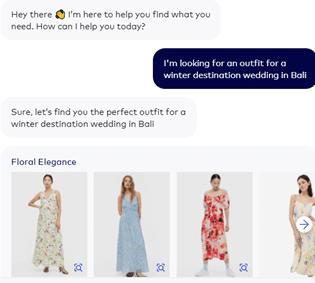
The solution is well-suited for large, diverse digital product catalogs, and the company says that fashion and furniture brands have been getting a lot of value out of Shopping Muse and conversational commerce. Shopping Muse is plug and play and easy to set up with the ability to match brand tone of voice, look and feel, and style. The solution is now available via an early access program.
Personalization is one of the key must haves in developing CX and a relationship with a brand that will be more than a one-off interaction. Removing potential friction points involved in spending too much time digitally searching for the right item or getting an on-target recommendation for something that the customer is not sure how to describe will keep people returning to that experience, for their own personal shopping, as well as shopping for others.
Disclosure: The Futurum Group is a research and advisory firm that engages or has engaged in research, analysis, and advisory services with many technology companies, including those mentioned in this article. The author does not hold any equity positions with any company mentioned in this article.
Analysis and opinions expressed herein are specific to the analyst individually and data and other information that might have been provided for validation, not those of The Futurum Group as a whole.
Other insights from The Futurum Group:
Salesforce’s Connected Shopper Report: Digital, Physical & Service Crucial
Data Flexibility Drives Customer Targeting, Insights for The Washington Post
Booking a Trip? The Digital Experience Matters
Author Information

As a detail-oriented researcher, Sherril is expert at discovering, gathering and compiling industry and market data to create clear, actionable market and competitive intelligence. With deep experience in market analysis and segmentation she is a consummate collaborator with strong communication skills adept at supporting and forming relationships with cross-functional teams in all levels of organizations.
Sherril holds a Master of Business Administration in Marketing from University of Colorado, Boulder and a Bachelor of Arts in Psychology from Rutgers University.