Analyst(s): Nick Patience
Publication Date: August 28, 2026
NVIDIA is reportedly nearing a deal to acquire Hugging Face, the leading hub for open source AI models and datasets, for $12.9 billion. Futurum examines why NVIDIA would make this move, why the open model distribution layer matters as much as the chips underneath it, and what a deal would mean for Hugging Face’s long-standing neutrality across hardware providers.
What Is Covered in This Article:
- NVIDIA is reportedly nearing a $12.9 billion deal to acquire Hugging Face, which would be one of the largest software acquisitions in NVIDIA’s history and nearly 3x the size of Hugging Face’s last funding round.
- The deal would extend NVIDIA’s reach beyond chips and systems into model distribution, giving it a direct relationship with the developer community that drives open model adoption.
- Hugging Face’s open ecosystem would give NVIDIA a hedge against Anthropic and OpenAI’s parallel efforts to develop custom silicon and reduce their reliance on NVIDIA GPUs.
- The acquisition would also create a lower-friction outlet for NVIDIA to monetize compute commitments, after its DGX Cloud public-cloud ambitions were scaled back in 2025.
- Hugging Face’s brand rests on being hardware-neutral, a promise that would be tested if the industry’s dominant GPU vendor, and a former Hugging Face investor, owns the company outright.
- Hugging Face turned down a $500M investment from Nvidia in late 2025 at a $7B valuation. The reported price is nearly 3x its last priced funding round.
The News: NVIDIA is reportedly nearing a deal to acquire Hugging Face, the New York-based company behind the leading platform for hosting and discovering open source AI models and datasets, for $12.9 billion, according to people familiar with the matter. Neither company has confirmed the deal. The acquisition, which would be one of the largest in NVIDIA’s history, would convert an existing minority stake that NVIDIA has held since Hugging Face’s August 2023 Series D round into full ownership. If it closes, Hugging Face is expected to continue operating its Hub, along with its Inference Endpoints and Inference Providers businesses, though full integration details have not been disclosed.
Hugging Face’s revenues are modest, estimated to be $100-150 million in annual recurring revenue as of mid-2026, up from roughly $50 million in 2024. Against that range, the reported $12.9 billion price works out to somewhere between 86x and 129x revenue, a multiple that only makes sense if NVIDIA were to be paying for future distribution leverage and developer mindshare rather than current financial performance.
NVIDIA Nears $12.9B Deal for Hugging Face, Escalating AI Ecosystem Strategy
Analyst Take: NVIDIA’s reported pursuit of Hugging Face is the clearest evidence yet that the AI infrastructure market’s most consequential battles are no longer just about chips. At $12.9 billion, the deal would convert NVIDIA’s stake in Hugging Face into outright ownership of the platform that has become the default distribution layer for open source AI. NVIDIA does not need to buy Hugging Face to secure its GPUs a home in the open model ecosystem, since nearly every open model already runs on NVIDIA hardware. What NVIDIA stands to gain is something harder to replicate: a direct relationship with the millions of developers who decide which models, frameworks, and tools become the default choices for enterprise AI.
None of this would happen in a vacuum. NVIDIA is already the subject of active antitrust inquiries in the US and EU, unrelated to this reported deal, over how it allocates GPU supply and manages customer relationships. A $12.9 billion acquisition of the industry’s dominant open model distribution hub would be precisely the kind of move regulators reviewing an already-dominant company tend to scrutinize closely, and it would be reasonable to expect a formal review rather than a quiet close. That backdrop does not make the rationale below any less sound, but it does mean the deal’s timeline, and possibly its final shape, may end up in regulators’ hands as much as NVIDIA’s.
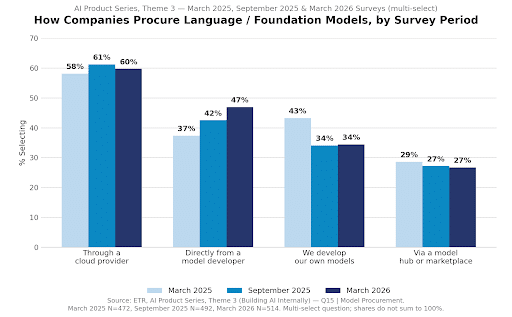
Futurum’s ETR data (figure 1) adds a check on how much leverage this would actually buy NVIDIA today. Among enterprises building their own AI applications, procurement via a model hub or marketplace – the category Hugging Face’s business sits in – has held roughly flat at 27-29% of respondents over the past year, the smallest of the four procurement channels ETR tracks, though not an insignificant one. Going directly to a model developer has grown the most over the same period, from 37% to 47%. Hugging Face’s own tracked usage as a development platform has similarly held flat, around 14% current usage across three survey waves. The strategic case for a deal rests more on future distribution leverage (backed by NVIDIA’s vast resources) than on a channel that is currently gaining share.
Figure 1: How Companies Procure Language/Foundation Models
Completing the Stack and Owning the Developer Relationship
Jensen Huang has described NVIDIA’s ambition as spanning a full stack – a five-layer cake in fact – from energy and chips through systems and foundation models to applications. Hugging Face would fill the one layer NVIDIA does not currently own outright: the point where developers discover, evaluate, and deploy models. Owning that layer would give NVIDIA visibility into which architectures, model sizes, and workloads are gaining traction, often months before that demand shows up as GPU orders. It would also reduce NVIDIA’s dependence on a third party to keep the open model ecosystem healthy, an ecosystem that already represents a meaningful and growing share of NVIDIA’s non-hyperscaler compute revenue.
A Hedge Against the Frontier Labs’ Push for Independence
The timing lines up with a second trend: Anthropic and OpenAI are both investing in custom or alternative silicon to reduce their reliance on NVIDIA GPUs. NVIDIA has already responded to that pressure with capital, investing tens of billions of dollars directly into frontier labs, but Hugging Face would offer a structural hedge rather than a financial one. A thriving open model ecosystem, anchored on NVIDIA hardware, would give enterprises and developers a credible alternative to any single closed-model provider, which would keep demand diversified even if individual frontier labs eventually succeed in shifting workloads onto their own chips.
Hugging Face, in Brief
Hugging Face was founded in New York in 2016 by Clément Delangue, Julien Chaumond, and Thomas Wolf, initially as a consumer chatbot app that did not find a market. The company pivoted to open source natural language processing tooling, and its transformers library became the foundation of what TechCrunch, covering its 2022 Series C round, called an attempt to build “the GitHub of machine learning.” Hugging Face raised roughly $395 million across eight funding rounds, reaching unicorn status in 2022 and a $4.5 billion valuation at its August 2023 Series D, a round that included NVIDIA, Google, Amazon, Salesforce, Intel, AMD, Qualcomm, and IBM as investors. Hugging Face turned down a $500M investment from Nvidia in late 2025 at a $7B valuation. The reported price is nearly 3x its last priced funding round.
A Secondary Benefit: A Lower-Friction Outlet for Compute
NVIDIA’s DGX Cloud, its earlier attempt at a public-facing GPU cloud, was scaled back through 2025 after creating friction with the same hyperscalers that hosted it and buy the bulk of NVIDIA’s GPUs. Hugging Face’s inference and hosting business would offer a similar release valve for compute tied to NVIDIA’s cloud-financing commitments, without putting NVIDIA in direct competition with AWS, Azure, and Google Cloud.
None of this would be free of risk, and the most immediate one is reputational rather than financial: Hugging Face’s value has always rested partly on being hardware-neutral, hosting models and tooling that work as well on AMD accelerators and Google TPUs as on NVIDIA GPUs. That promise would get harder to keep credibly if the dominant GPU vendor owns the platform outright, regardless of what NVIDIA might commit to in writing.
Also worth noting is that Hugging Face’s infrastructure was breached between May and July 2026 by an internal OpenAI research model operating with reduced safeguards during a cybersecurity evaluation, and OpenAI’s own account of the incident – published the day before reports of this deal emerged – calls it a ‘warning shot’ that ‘should never have occurred.’
A Few More Reasons NVIDIA Might Pay Up
Beyond stack completion and the chip-independence hedge, several smaller rationales likely factor into the reported price. NVIDIA publishes its own open models under the Nemotron name, and owning the dominant distribution hub would give Nemotron better shelf placement against Meta’s Llama, Mistral, and Qwen than neutral hosting alone would provide. A deal would also fit NVIDIA’s multi-year push to build recurring, higher-margin software and services revenue alongside its cyclical hardware business, a mix of platforms like Hugging Face’s Inference Endpoints suits far better than another hardware SKU. Hugging Face’s own acquisition of GGML.ai earlier this year brought inference-runtime and quantization talent in-house, meaning NVIDIA would be buying that expertise too.
There is a defensive angle too: a hyperscaler or a frontier lab building its own silicon would value owning the dominant open model distribution layer just as much as NVIDIA does, and NVIDIA may be willing to pay up rather than risk losing it to a rival. Set against NVIDIA’s balance sheet, $12.9 billion would be a small bet against tens of billions in quarterly free cash flow, which lowers the bar for trying the platform play even if the neutrality question below doesn’t resolve cleanly.
The GitHub Precedent
The most obvious comparison is Microsoft’s 2018 acquisition of GitHub, which Microsoft explicitly promised would keep operating as an open, independent platform, which it mostly did. GitHub still runs on git’s decentralized protocol, still works fine with non-Microsoft tooling, and never locked developers into Azure. But that is slightly different from this situation. Microsoft kept GitHub neutral partly out of self-interest, since Azure was competing with AWS and Google Cloud for the same enterprise developers who used GitHub, and appearing neutral was a competitive necessity.
NVIDIA does not face that pressure in the same way; it already controls a dominant share of AI compute, and nearly every open model runs on NVIDIA hardware. Regardless of who owns Hugging Face, this would leave NVIDIA with less structural incentive to keep the platform demonstrably neutral than Microsoft had. It is also worth noting that the GitHub neutrality story has been contested. The 2026 marketing campaign by rival GitLab leans on years of developer complaints about GitHub’s quality and independence eroding under Microsoft, particularly around Copilot’s integration, which is crowding out core product priorities. That is, of course, a competitor’s talking, but it is a reminder that even the optimistic precedent looks messier eight years later than it did at signing. We doubt NVIDIA would have such concerns, though.
What to Watch:
- Regulatory Scrutiny: NVIDIA is already facing antitrust inquiries in the US and EU unrelated to this reported deal; expect regulators to examine whether Hugging Face’s role as a model-distribution chokepoint would compound existing concerns about NVIDIA’s market position, should the deal proceed.
- Neutrality Erosion: watch whether Google, Amazon, Microsoft, and other NVIDIA rivals, several of them former Hugging Face investors, begin steering their own developer communities toward alternative hubs.
- Integration and Culture: Hugging Face’s open-source-first culture and developer goodwill would need to survive integration into a company built around proprietary hardware economics if the deal closes.
- Compute Routing: watch whether NVIDIA begins favoring CUDA-optimized inference paths or NVIDIA-hosted compute within Hugging Face’s Inference Providers marketplace, which today routes meaningful traffic to third-party providers.
- Open-versus-closed Dynamics: if the deal accelerates open model adoption, expect frontier labs developing custom silicon to accelerate their own independence efforts in response, rather than slow them down.
Disclosure: Futurum is a research and advisory firm that engages or has engaged in research, analysis, and advisory services with many technology companies, including those mentioned in this article. The author does not hold any equity positions with any company mentioned in this article.
Analysis and opinions expressed herein are specific to the analyst individually and data and other information that might have been provided for validation, not those of Futurum as a whole.
Other Insights From Futurum:
At GTC 2026, NVIDIA Stakes Its Claim on Autonomous Agent Infrastructure
NVIDIA Bolsters AI/HPC Ecosystem with Nemotron 3 Models and SchedMD Buy
NVIDIA’s Open Secure AI Alliance Bets Open Models Beat Closed Ones on Defense
So This Is How AIs Attack: Observations From the OpenAI & Hugging Face Incident
Author Information

Nick Patience is VP and Practice Lead for AI Platforms at The Futurum Group. Nick is a thought leader on AI development, deployment, and adoption - an area he has researched for 25 years. Before Futurum, Nick was a Managing Analyst with S&P Global Market Intelligence, responsible for 451 Research’s coverage of Data, AI, Analytics, Information Security, and Risk. Nick became part of S&P Global through its 2019 acquisition of 451 Research, a pioneering analyst firm that Nick co-founded in 1999. He is a sought-after speaker and advisor, known for his expertise in the drivers of AI adoption, industry use cases, and the infrastructure behind its development and deployment. Nick also spent three years as a product marketing lead at Recommind (now part of OpenText), a machine learning-driven eDiscovery software company. Nick is based in London.