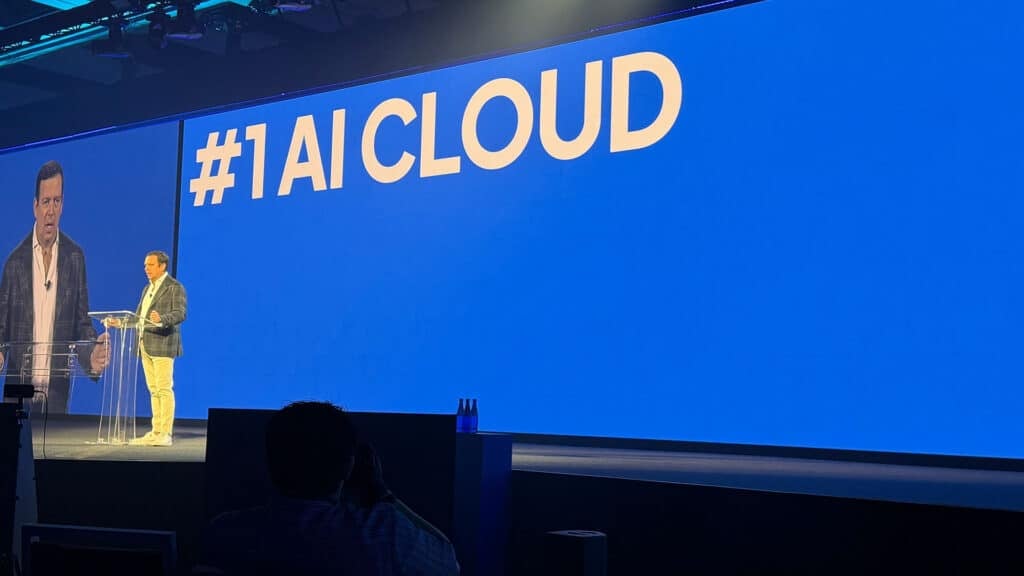
The Six Five team discusses Is SaaS Over + AgentForce 2.0 Launch
If you are interested in watching the full episode you can check it out here.
Disclaimer: The Six Five Webcast is for information and entertainment purposes only. Over the course of this webcast, we may talk about companies that are publicly traded and we may even reference that fact and their equity share price, but please do not take anything that we say as a recommendation about what you should do with your investment dollars. We are not investment advisors and we ask that you do not treat us as such.
Transcript:
Daniel Newman: There was kind of a big week this week right before the holiday. Salesforce brought together a lot of press media, a handful of analysts. I know we were invited. I just couldn’t get another trip out of me. My legs were done. But I did watch from afar, our team did, and I’m sure your team did as well as Agentforce 2.0 was launched. And then Satya Nadella also went on the record this week kind of making some comments about CRUD databases being used to build software and are we heading towards the end of SaaS? Which is something I think a really thoughtful, provocative analyst has been saying for some time.
Patrick Moorhead: Said it in April.
Daniel Newman: Yeah, I wasn’t talking about you. But anyways.
Patrick Moorhead: It’s always about you, Dan.
Daniel Newman: Well, I mean it’s not about me, but well, it might be about me. But the fact is that we have hit this seminal moment, Pat. We are at this massive pivot right now to agents. It’s just happening. And so we saw this major move that Marc Benioff made, you saw all of a sudden he kind of went all in. First of all, very interestingly, he went all in on this attack on Microsoft and his whole attack vector there is that this kind of Copilot everywhere thing is creating a lot of data risk. His thing is that, well, Salesforce is trusted, all the data’s in compliance, and there is no risk. I think there’s some assessment to be done there and our team’s actually doing some of that, and I’ll have to come back to a little bit more about that right now. But then the second question that’s really, are we coming to the end of SaaS as we know it? Are most of these applications that we’re using going to become deprecated databases? Is this where most of the AI is going to be consumed? Who are going to be the winners and losers in this case? And I think it’s a really interesting case. Kind of going back to what we just talked about with Gemini, Pat, and Google is, does the biggest install database, sorry, install user base end up winning in the long term because they already have the customers on the platform? And I think that’s the bet that Salesforce is making.
Look, we’re going to make a big pivot and we use Salesforce. And what I’m saying is moving to an agent-based platform that can have pre-built workflows for use cases that are high volume, that can be built right into the existing platform to lower costs, increase productivity, increase efficiency, can this be brought to scale to help? And can it be done using pretty simple reasoning, RAG techniques? And then can it be affordably implemented into the existing platform? So, Benioff went on to really talk about, I think having a thousand sales in the last quarter, really strong demand. They did go on and actually start doing customer stories, which I think is really important. And I think they’re talking about the fact that they really believe that they are the leader right now in agentic AI. I will say, Pat, kind of a couple of quick things on this one, I think there’s going to be two sort of major motions and there’s going to be a consolidation. The first major motion is companies have spent a lot of time, energy, and money on what platform they’re going to run their business on, whether it’s NetSuite, Salesforce, Dynamics, SAP, all these different platforms. Change is going to be hard here. So, I do think every one of these companies has a chance to sell agentic and generative AI capabilities right on top of their existing platform.
The second thing is going to be is, how is this monetized, Pat? Is it all about a sticky factor? Meaning adding agentic and AI capabilities in to keep customers on the platform and keep them over without really incrementally charging, which by the way, Wall Street’s going to hate? Or is this about a new incremental revenue stream for these customers that’s going to be in addition to the money that they’re spending? Second layer is going to be about simplicity and ease of use is, how much do companies need to know? If you’re a really, really large enterprise, you can put a ton of resources towards AI processes, workflows, automations, agentic. Most companies though, these platforms are where they’re looking to consume. They want to actually have a SaaS-based, SaaS-like experience. They want to have their systems of record and they want to be able to put AI on top of it to build revenue related workflows, operations workflows, projects, supply chain workflows, all these workflows. Again, and the agent, the idea is having tens or hundreds or even thousands of application-specific workers. Think of them like an ASIC, they’re like an ASIC for our chip friends out there for a specific use. And you can have thousands of these deployed for specific use cases, and then knowledge workers with deep expertise can focus on solving harder problems. This has always been the story of automation. So, long story-
Patrick Moorhead: Yeah. I know you’ve got to go to a meeting, but I want my time. If you-
Daniel Newman: You’re going to get your time, don’t worry.
Patrick Moorhead: Okay.
Daniel Newman: I’m just going to hang up. I’m going to walk out of the room. And you can just go ahead and finish the show.
Patrick Moorhead: So I think this is going to be one of the biggest conversations probably for the next two years in the enterprise. And I kind of put it up here, Daniel, with the death of the mainframe, the death of on premises infrastructure, and the death of PCs. Okay? Nothing ever dies in tech. Well, a little bit does, consolidation plays, right? We don’t have MP3 players, they got integrated into our smartphones. But very simply, the thesis says, I have a database. I put an agent around it. I give it the right authentication and identity management. And I can just query it. And you’re going to have multiple types of data in one place, either logically or physically. That can be CRM, ERP, PLM, HRM, HCM, things like that. So by the way, I love the thesis. I have talked to no less than 50 CIOs, CDOs, and systems integrators, and here is what they’re telling me. What they’re telling me is this data management problem is almost insurmountable in their mind.
Some examples they gave me said, “Hey, even if you only have one instance consolidation of SAP, the way the data is laid out in places like HANA, it is very difficult to get at that data. And then think of the identity one, we always like to use this example which says, I have a spreadsheet of how much the senior management gets paid. Not the public stuff on the case, but the non-public stuff. How do you get authentication across data and be able to query it without doing that? That is a hard thing. I asked a CIO of a technology company, how many years do you think it’ll take to pull all of the important data and put it in one place? He’s like five to six years probably. So, I love the thesis. It makes so much sense just on the practicality and the years it might take to get there-
Daniel Newman: Can AI, Pat, solve some of the data management?
Patrick Moorhead: That’s where I was going, man. Like with AWS on Q Developer, mainframe migration going from COBOL to JavaScript. But the most impressive to me was on VMware, which it’s not just moving code, right? It’s NSX environments, it’s the 800 switches that you have in VMware and AWS Q Developer can actually, and you and I grilled the VP and GM of this, not grill, but asked some very hard questions on the reality of this. And while he said, “It’s not single push button yet, but man, we see line of sight to be able to do that.” And it seems to me, and isn’t it weird, Dan, that we don’t have this AI data management cleanup stuff with agentic AI that knows the rules, that knows the corner cases? That has to be an opportunity. And wouldn’t you expect a company like Databricks or Snowflake or a Cloudera or somebody to be able to do that? Short answer is yes. So, net net, I love the thesis of it. I think at the end of the day, you’re going to see a lot more agentic AI coming through the SaaS companies than we are homegrown. And if we do, it’s going to be at the very largest of companies with the budgets to work with GSIs to pull all this stuff together. Or the magic tool comes out, generative AI, that’s like, “Here’s a push button to clean up all this SAP mess. Here’s a push button to take all of your CRM data out of Salesforce and to be able to put Copilot around that or Google agent.” So, I love this topic. I love this topic. Yeah.
Daniel Newman: Yeah, it’s a great one, Pat. And I think the companies you’ve mentioned, we’ve mentioned, I mean there’s a number of different winners potentially in this. There’s winners in the SaaS layer. We talked about the Salesforce and Microsoft, the ServiceNow, SAP, Oracle, all have a good chance to win. Then there’s the infrastructure and platform players. You talked a little about the cloud, what gets built in the cloud as a platform and then gets deployed and what gets built and consumed in the ISV’s applications? And that’s going to be a big tug of war to where application, and by the way, utilization grows because the silicon story only continues, everybody, into the future if the consumption starts to go up a lot. And this is a big part of where that consumption happens.
Author Information

Daniel is the CEO of The Futurum Group. Living his life at the intersection of people and technology, Daniel works with the world’s largest technology brands exploring Digital Transformation and how it is influencing the enterprise.
From the leading edge of AI to global technology policy, Daniel makes the connections between business, people and tech that are required for companies to benefit most from their technology investments. Daniel is a top 5 globally ranked industry analyst and his ideas are regularly cited or shared in television appearances by CNBC, Bloomberg, Wall Street Journal and hundreds of other sites around the world.
A 7x Best-Selling Author including his most recent book “Human/Machine.” Daniel is also a Forbes and MarketWatch (Dow Jones) contributor.
An MBA and Former Graduate Adjunct Faculty, Daniel is an Austin Texas transplant after 40 years in Chicago. His speaking takes him around the world each year as he shares his vision of the role technology will play in our future.