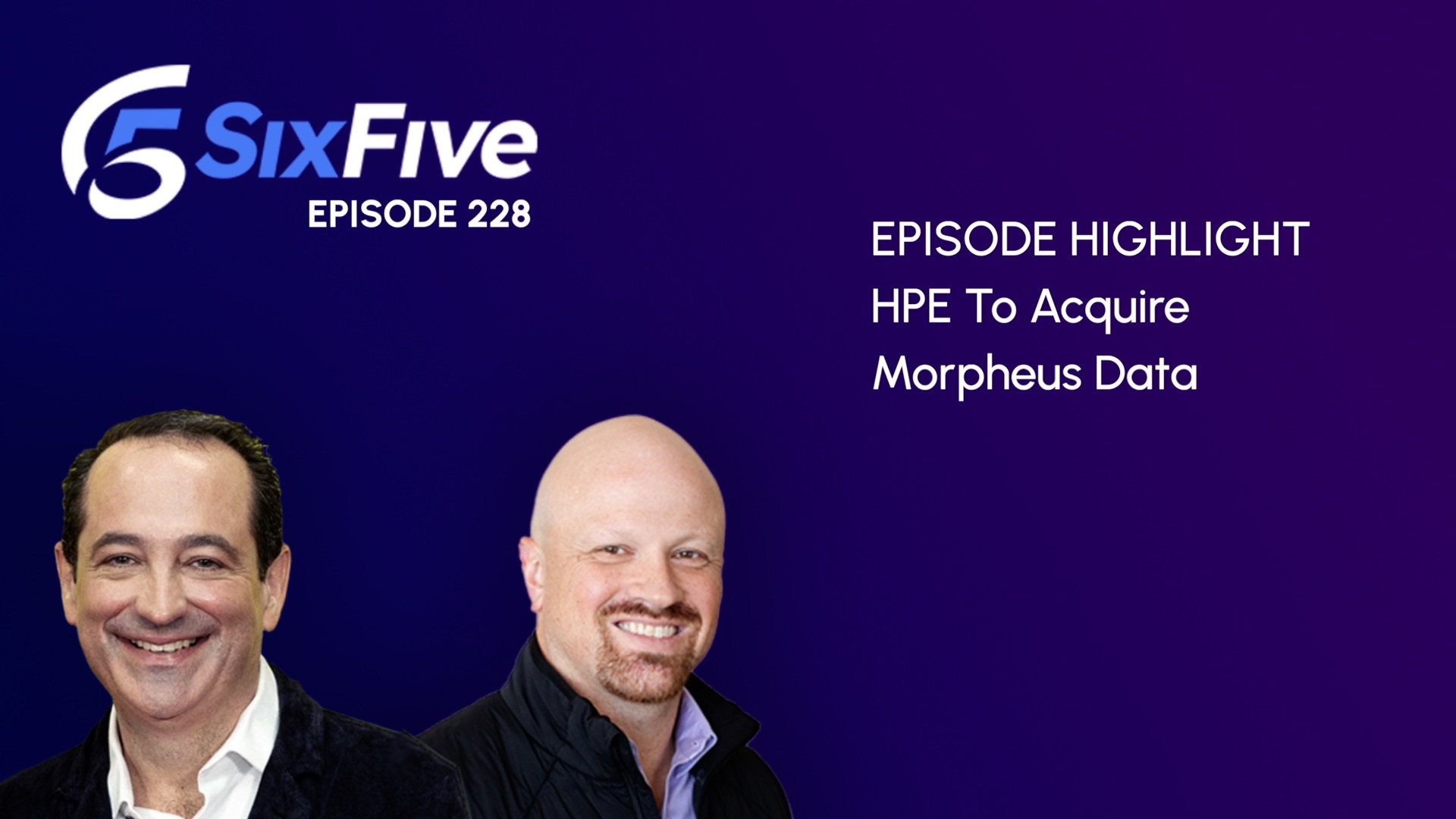
The Six Five team discusses HPE To Acquire Morpheus Data
If you are interested in watching the full episode you can check it out here.
Disclaimer: The Six Five Webcast is for information and entertainment purposes only. Over the course of this webcast, we may talk about companies that are publicly traded and we may even reference that fact and their equity share price, but please do not take anything that we say as a recommendation about what you should do with your investment dollars. We are not investment advisors and we ask that you do not treat us as such.
Transcript:
Patrick Moorhead: There’s even more acquisition news, and this happened later last week.
Daniel Newman: Feels like the matrix. Morpheus.
Patrick Moorhead: Morpheus. No, no, I think that’s super cool. And I guess they didn’t get sued for that. But listen, you all know that I have been an unabashed lover of hybrid multi-cloud solutions. And essentially, this is the capability to standardize on a certain set of capabilities and vendors that you can use on-prem, private cloud, sovereign cloud, AWS, Google Cloud, Azure and Oracle Cloud. And so, your infrastructure and your capabilities aren’t silo dependent. They can be transported based upon what you are trying to accomplish as an enterprise. I like this tuck-in acquisition. And why do I call it a tuck-in? It’s a couple hundred employees. And one, I would say criticism critique that HPE has deservedly received is hey, all of your services aren’t hybrid multi-cloud fabrics. Now, storage, for instance, are connected to hyperscalers like AWS and Azure, but this extends all of their capabilities to AWS, Azure and Google. The company also did a really good job talking about how some other acquisitions they made like OpsRamp and Zerto, how they plug into Morpheus’ hybrid cloud management platform.
So like I said, my article on AMD’s acquisition, the degree of success comes down to increased revenue, customer delight and how they can do this. And I would say the biggest part is how enterprises and governments perceive HPE as a full stack service and software provider. Now, I want to footnote that saying that HPE does do mix and match. If you want to plug in Red Hat, you want to plug in VMware, you want to plug in Nutanix, and other types of stacks, you can do this. But strategically, and where you just know HPE makes a lot more money is when they go in with the full stack.
Daniel Newman: Yeah, absolutely, Pat. First of all, some good coverage there. Our team put a number of pieces out. We dove deep into this one, Pat. It’s a $6 billion estimated market for intelligent cloud ops by 2027. So there’s some big spend there, Pat. You and I have talked a lot about hybrid multi-cloud. 25%, 30% of the enterprise workloads are in the public cloud, and the rest are still OnPrem. And by the way, those numbers vary somewhat considerably, depending on the organization itself. This is, like you said, a tuck-in. It gives additional capacity and capabilities for the company to head down the journey it has been on. Its journey has been ARR. Does this sound familiar, everybody? ARR subscription helping demystify the complexities of multi-cloud and the fact that most enterprises are on multi-cloud. The push-pull is that the OEMs, the HPEs, Lenovos Dells and everyone else are trying to build subscription based services that that, extend the prem to the cloud.
On the other side, all the hyperscalers are trying to simplify the process of taking those on-prem workloads to the public cloud. And everyone wants the same, but in the end, the customer, we learned a lot about this in the CrowdStrike instance. A lot of these kinds of architectures, you can do these things differently. And depending on how you do them, all the way from cloud to the edge to the device, can have really, really meaningful impacts as to how your business functions and runs. So multi-cloud needs orchestration, needs automation, needs spin ops management, which workload, which place, what’s the best cost? And so, of course, the last piece is trying to unify that. What control plane does the average cloud environment manager, IT manager utilize, Pat, if they’re running AWS, running Google, running Microsoft? And let’s face it, the average growing company that’s going to grow through organic and inorganic means, large enterprises that tend to grow both ways consistently, have a lot of technical debt. They continue to acquire technical complexity in debt.
Because when they bring new companies in, they tend to have different ecosystems and hardware. We’ve talked about multiple acquisitions just here today. And that happens every single day in these companies. And then of course, companies need to be able to do all this with the future of AI in mind. So this is helpful. It moves things in the right direction for HPE. It’s a very competitive landscape. HPE is taking it head on. They were very early in this space. I think both you and I have been covering this in depth. And this will be one to watch if the company can explain that it added meaningful growth. That would be really encouraging for both the investor and customer base.
Author Information

Daniel is the CEO of The Futurum Group. Living his life at the intersection of people and technology, Daniel works with the world’s largest technology brands exploring Digital Transformation and how it is influencing the enterprise.
From the leading edge of AI to global technology policy, Daniel makes the connections between business, people and tech that are required for companies to benefit most from their technology investments. Daniel is a top 5 globally ranked industry analyst and his ideas are regularly cited or shared in television appearances by CNBC, Bloomberg, Wall Street Journal and hundreds of other sites around the world.
A 7x Best-Selling Author including his most recent book “Human/Machine.” Daniel is also a Forbes and MarketWatch (Dow Jones) contributor.
An MBA and Former Graduate Adjunct Faculty, Daniel is an Austin Texas transplant after 40 years in Chicago. His speaking takes him around the world each year as he shares his vision of the role technology will play in our future.