Analyst(s): Tiffani Bova
Publication Date: July 29, 2026
Document #: AIOTB202607
Key Points
- The vendor channel program built for resell, Managed Services, and integration services is ill-prepared to add value in the AI conversion work that agentic-first operating models now require.
- Infrastructure vendors are racing into the intelligence layer in their own products, but they are banking on enterprises adopting through internal talent or global systems integrators (GSIs) rather than investing in the partner programs and skills their channel would need to deliver it.
- Most channel partner organizations have little to no client-grade capability in the AI conversion work, orchestrating models, standing up agentic systems, and wiring them into enterprise workflows, and that gap sits exactly where the next decade of service revenue and profitability is forming.
- Infrastructure and intelligence are not collapsing into one thing. Infrastructure spending will not slow, but the mix of partner revenue must shift toward the AI conversion work, and the channel program must support both the infrastructure and the intelligence layers.
- A vendor can only certify a partner in a competency it possesses. Infrastructure vendor services are scoped to the product, so what the channel can be taught is the product, not the conversion work above it, where the margin has moved.
Recommendations
- Recruit for the AI-native bench, not the badge. The scarce capability is model-orchestration and agentic-delivery depth, and the AI companies and GSIs are already competing for it. Build a partner motion that recruits and rewards that capability directly, before it is locked into someone else’s ecosystem.
- Build a commercial model that lets partners keep the IP and with which to build their business. Volume rebates and certification tiers will not attract an outcome-priced firm with its own agentic frameworks. Let the delivery IP and the margin stay with the partner, so the conversion work becomes a reason to build on you rather than around you.
- Replace certify-and-sell with co-build. Putting a Frontier Partner through a resell or Managed Services program is a category mismatch. Make your infrastructure a dependable component of the partner’s delivery, and run the high-touch, joint motion you already run with GSIs one tier down, for the AI-native partner.
Analysis: The Gap Beginning to Form
A new kind of firm is winning enterprise AI work. It is AI-native, built on proprietary IP and outcome-priced contracts, with a PhD-dense bench, and it operates as a Model Orchestrator across the several models an enterprise now runs (A Shift from Technology to Intelligence: The Rise of the Frontier Partner, February 2026).
The GSIs moved first. Accenture announced its acquisition of Faculty in January 2026 and has since raised its full-year acquisition budget to roughly $9 billion; Capgemini bought WNS for $3.3 billion to build an agentic operations business. They are buying the AI-native bench they cannot hire or train fast enough, because that bench is where enterprise AI work is now being won. That scramble is the visible edge of a gap now running the length of an IT supply chain organized around AI and the growth it is expected to bring.
For the infrastructure vendors positioning themselves as the best infrastructure option for the biggest technology shift in decades, it raises a hard question: if the capability that turns infrastructure into outcomes is being bought elsewhere in the value chain, what is their partner ecosystem built to deliver, and do they have the programs to capture the spend forming around AI? Futurum puts the AI platforms market above $100 billion today, on track for roughly half a trillion by 2030. But the fastest-growing piece is the operations-and-workflow layer, the conversion point where agentic intent becomes real spend, scaling toward $92 billion at a 43 percent CAGR (Patience, 1H 2026 AI Platforms Market Sizing and Five-Year Forecast). And the buyer for that work has moved too: Futurum’s CIO research finds most AI purchasing authority now sits outside the CTO/CIO office (Ashley, AI Implementation Is the New Account Control Point, July 2026), so the conversion work and the budget for it are forming in the same place, above the infrastructure layer.
One distinction matters. Vendors already engage the GSIs through high-touch strategic alliance and joint go-to-market programs, not the transactional channel, and that is how the upper end of the market gets served. What they lack is any equivalent motion for the AI-native partner, or for the conversion work below the Global 2000. The gap is not that vendors cannot run a sophisticated joint motion; they do it every day at the top. It is the motion that stops where the Global 2000 does.
The Stack Is Collapsing Inward
Every layer of the technology stack is now competing for the same enterprise AI budget, and the major players no longer stay in one layer; Google, Microsoft, and NVIDIA each now span several. The latest round of vendor announcements matters less than the direction of travel: every one of those moves shortens the distance to the enterprise buyer, and more of that distance can now be closed without the channel in the transaction at all. That is the exposure. It is not one competitor in an adjacent box. It is the whole stack collapsing inward, and the infrastructure layer is where the squeeze is sharpest right now, and the channel business is the largest.
Figure 1: The AI Stack is Integrating Vertically
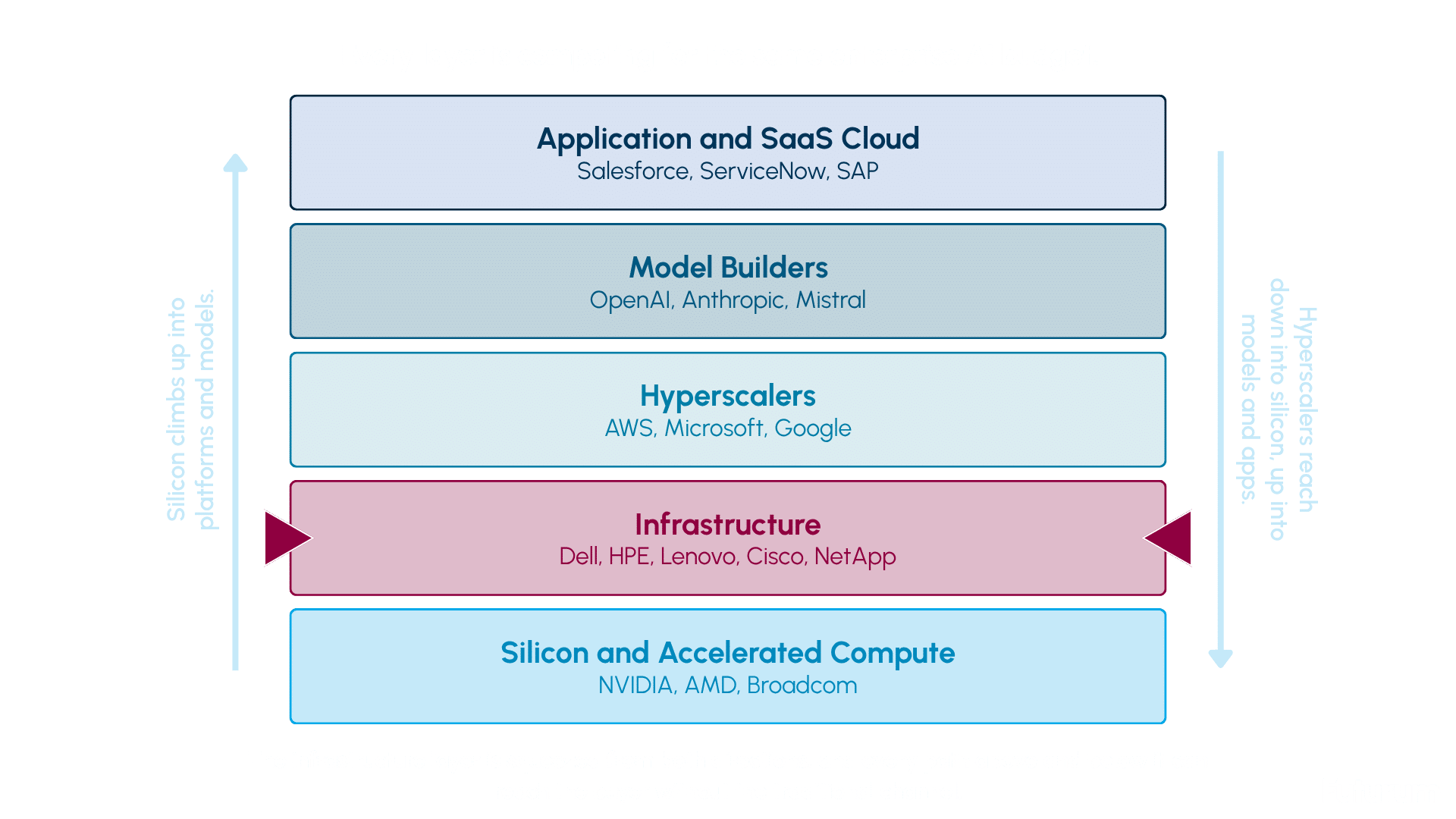
Figure 1 is the go-to-market view of the stack, who sells and delivers at each layer, a channel projection of the fuller reference model in Mitch Ashley’s The AI Stack (Ashley, July 2026), not a competing framework.
The infrastructure vendors are responding by developing AI-first solutions and partnering directly with the model builders, racing to climb into the data and intelligence layer. That is the right work at the technology level. But they are banking on enterprises adopting through their own internal talent or their existing GSI relationships, rather than on building the partner capability their channel would need to deliver it. Futurum projects the application development market to reach $344 billion by 2028, and most of that growth sits with the firms that can build and govern these architectures, not with the hardware beneath them.
The channel has seen a version of this before. When Cloud arrived, a Born in the Cloud partner emerged, and the traditional partners that repositioned in time went on to thrive while the ones that waited either struggled to remain relevant or absorbed deal and margin compression. The difference now is speed and compression. That on-premises-to-cloud transition played out over years; this one is compressing into quarters. It is also concentrated, for the moment, at the enterprise level, which is why the GSIs are racing to buy talent, train their people, and invest ahead of demand. As the same investment moves down into the mid-market, the dynamics will shift, but the lesson from the cloud era holds: the ones that move early gain revenue and brand momentum and set the bar for the ones that wait.
Services Reveal What a Vendor Is Built to Do
The same earnings disclosures that make the AI infrastructure boom look unstoppable reveal something those infrastructure numbers obscure. Meeting demand for infrastructure is one business. Building the services and intelligence layer on top of it is another. At most of these vendors the services organization, while a profitable annuity, exists to support the product through implementation, integration, and ongoing recurring maintenance, a different capability from the one that turns that infrastructure into a measurable business outcome.
The disclosures tell the story (company earnings disclosures, Q1 and Q2 FY2026). Dell does not break services out as a segment at all. Cisco’s services revenue was roughly flat even as product grew sharply. HPE’s advisory and professional services are not a reportable segment; it sits inside a “Corporate Investments and Other” bucket, running a negative operating margin. NetApp’s support annuity earns a 93 percent gross margin while its professional-services line earns roughly a third of that at a sixth of the size. Only Lenovo runs services as a headline business, its Solutions and Services Group crossing $10 billion at a roughly 22 percent operating margin, and it took five years of deliberate investment to build. The pattern holds across four of the five: services revenue is overwhelmingly ongoing support and maintenance, recurring and attached to the product, while professional and advisory work is a fraction of it and, in some cases, shrinking.
Where a company treats services as a strategic business unit, it reports them as a segment, with revenue, margin, and growth disclosed. Where it does not, they are embedded, bundled, or absent. IBM is a useful benchmark here, the only company in this analysis that is a technology vendor, full systems integrator, and channel operator at once. That structure is why its services are a strategic business rather than a product-attached annuity: it invests in the bench, the methodology, and the delivery IP because it sells all three. The difference between IBM and the infrastructure vendors is stark, and it is a difference in corporate strategy, not capability. The infrastructure vendors are not built that way, and for most, becoming so is not the strategy they have chosen (or one they have veered away from).
The partner and channel data point in the same direction. In Futurum’s channel survey, AI software is the top category partners sell, at 71 percent, and AI consulting is the second service, at 62 percent, yet fewer than half of even the confident cohort, 48 percent, report a robust AI business generating significant revenue. Partners are selling AI. What is missing is the vendor’s hand in helping them build the capability that would deliver value above the product.
The buyer side confirms it. In Futurum’s SLE decision-maker survey, nearly 45 percent of software lifecycle spend already flows through third-party partners, yet buyers value those partners primarily for pricing, support services, and customer support (Ashley, 2H 2026 Software Lifecycle Engineering Decision Maker Survey, N=839). The money already moves through the channel. The value basis has not moved with it. The product roadmaps confirm the same gap from the vendor side: HPE’s GreenLake Intelligence framework is coherent, but the monetization path for partners is not; NetApp’s data-intelligence layer is real and sits above the product, but it ships as software, and no product certification creates the data-science bench that makes it useful.
Mitch Ashley’s reading of the AI stack names the problem exactly: presence is not completeness (Ashley, The AI Stack, July 2026). A company can occupy a layer, announce the products, and still be unable to deliver them. That space between presence and completeness is the completeness gap, and it runs on both sides. The infrastructure vendors are present in the intelligence layer but not complete in it: they have the products, not the bench. The partners are present in AI, most of them selling it, but not completely: fewer than half have a business that actually delivers it.
Why the Vendor Cannot Close the Gap
Two constraints most partner programs have never had to confront now sit in the way. The first is on the vendor side. A vendor can only certify a partner in a competency it possesses. A services organization scoped to its own product cannot train a partner to build and run agentic systems it does not operate itself. It is a description of what a certify-and-train program can and cannot transfer, and it explains why partners have stopped asking for training. In Futurum’s channel survey, training and certification support fell 14.7 points in six months to the bottom of partner priorities, the sharpest drop of any category. Vendor training teaches the product, and the product is not where the margin moved.
The second constraint sits on the partner side. Building an AI orchestration and agentic-delivery practice means hiring talent that competes with the AI companies and the GSIs for the same scarce people. The large partner can absorb those costs and invest ahead of demand; the smaller VAR cannot fund a bench it cannot immediately utilize. Underneath both constraints is an incentive problem: a partner that builds a thriving AI practice earns margin the vendor captures no share of, so funding that build has never won the executive argument, and for most vendors it never will. A channel leader may see the opportunity clearly, but the C-suite rarely green-lights investment that grows the partner’s revenue and margin rather than its own. The constraint is as much about corporate priority as about capability.
The partners that can absorb these investments are not waiting. SHI, one of the largest privately held solution providers, stood up its own AI and Cyber Labs and invested in the AI-engineering firm NStarX to build out its orchestration services; Insight Enterprises acquired the AI consultancy Inspire11 and set an ambition to become a leading AI solutions integrator; CDW, at $22.4 billion in net sales, partnered its way in, standing up an agentic-workflow practice around Moveworks after running it across its own workforce first. Acquire, build, or partner; the mechanism varies, but the result is the same: the capability now lives inside the partner, and that path is open mainly to those with the balance sheet to fund it.
None of this is new. Microsoft was transferring internally proven services IP to its partners nearly two decades ago, and the discipline of proving a practice on yourself before selling it is older still. What AI changes is the stakes. When the product was hardware or a license, internal adoption was a good practice; in the conversion layer, where a buyer is purchasing judgment and delivery capability rather than a SKU, it becomes the credential. The proof points are lining up: CDW ran Moveworks across its own workforce before building the offering; IBM built Consulting Advantage to deliver its own consulting, then productized it as Enterprise Advantage; Microsoft deployed Copilot internally as its own first customer and now tells partners to do the same. And the buy-the-bench move is not new either: McKinsey acquired the AI firm Iguazio in 2023, folding a 70-person team into QuantumBlack to close the gap between AI in the lab and AI in production, the same gap the GSIs are paying to close now, at scale.
The Race to Own the Conversion Layer
Four pathways are emerging to close the completeness gap. In the distribution pathway, a distributor stands up the practice, and partners white-label it. In the vendor-built pathway, the vendor stands up the practice and partners white-label it. In the direct pathway, the vendor delivers the conversion work itself. In the partner-built pathway, the partner builds the capability on its own, by training talent internally, allying with a small Frontier Partner, or acquiring a boutique small enough that the GSIs have not already taken it.
No one is building the model that actually closes the gap. IBM is running the direct pathway. The hyperscalers are moving further, Microsoft furthest of all, though each is building within its own stack. A cross-stack version, vendor-built or partner-built, remains mostly aspiration, which is where the opening sits for a vendor willing to move first.
The hyperscalers are already moving, each playing to the base it starts with. Microsoft has gone the furthest. Beyond its Frontier Distributor designations for Ingram Micro and Redington, it has introduced a Frontier Partner specialization and a Frontier Engineer skilling path that credential partners to build and operate production-ready agents, and it has formalized a Customer Zero motion that rewards partners for proving the practice on themselves first. That is not distribution; it is Microsoft building agentic-delivery capability inside its partners. Google is going a different way, cultivating a smaller set of high-capability partners it co-engineers with directly on Gemini Enterprise, and AWS sits between them, building AWS-credentialed delivery teams inside partners through a reusable harness that compounds with every engagement. Both are funding embedded engineering that lives inside the partner’s delivery, not the vendor’s.
This matters, and it has a limit. Microsoft’s motion is the most advanced in the market, and the shape of it, credential real delivery capability, skill the bench inside the partner, and reward proving it internally first, is a credible template for what moving partners up the stack can look like. But like Google’s and AWS’s, it is built for the vendor’s own stack: it credentials partners to build and deliver Microsoft’s agents. That is good for Microsoft’s ecosystem and for Microsoft’s customers. It is not, on its own, enough for the enterprise that runs several models at once, which Futurum’s research shows is now the norm. A partner skilled only in one vendor’s stack still cannot orchestrate across the models a real engagement demands, which leaves the gap open on both sides: the customer still needs cross-model delivery that no single-stack program provides, and the partner still cannot win the multi-model business on single-stack skills alone. The motion exists; the cross-stack conversion work this note describes is not what it builds. And no infrastructure vendor yet runs even a single-stack version of it.
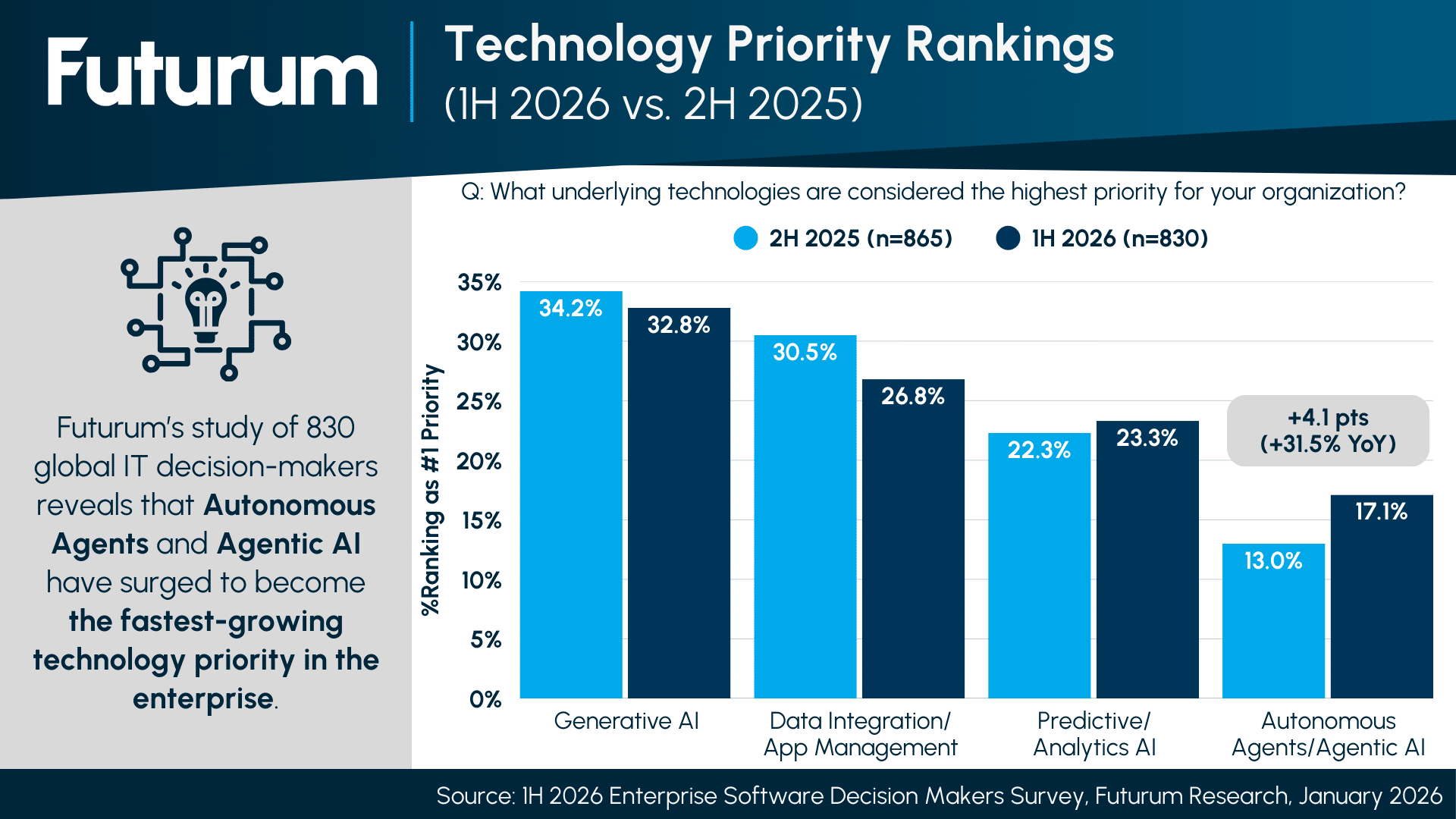
The buyer is forcing the pace. Futurum’s enterprise software buyer survey shows buyer priorities changing: autonomous agents and agentic AI are the sharpest-rising priority, up 4.1 points, while generative AI and data integration cool. Buyers are moving past features toward end-to-end workflow automation.
Figure 2: Technology Priority Rankings – The Agentic Shift
Enterprises now run an average of 3.8 AI models, and the organizations that rate themselves behind their peers are set apart by two gaps: workforce adaptation (up 12.4 points) and legacy system integration (up 13.1 points), both above the infrastructure layer rather than within it. The governance data sharpens the point. Three-quarters of organizations experienced a production incident in the last 12 months where AI-generated code or agent actions were a contributing factor, yet fewer than half mandate human review of AI-generated code, and AI agent governance ranks as the least-mature practice in the software lifecycle, with 28 percent of organizations not yet started (Ashley, 2H 2026 SLE Decision Maker Survey, N=839). Enterprises cannot close that gap with internal talent alone. That is the demand signal for the conversion bench. The partners most exposed as this shift runs its course are the ones whose advisory work is the old kind, positioning and reselling around infrastructure, with no data, orchestration, or agentic delivery underneath it.
The sequence is already observable. As enterprises move their AI budget, it tends to land at the infrastructure layer first, and even to rotate among infrastructure vendors, before it climbs into the conversion work above. The 2026 signals bear this out: softness at IBM, as its mainframe cycle turned, showed up as strength at Dell and HPE, while Accenture, which had invested most aggressively in acquiring an AI-native bench, was growing its AI transformation business. The money enters the infrastructure and climbs, and the partners who have built the conversion bench are positioned to capture it as it does. One signal runs the other way and is worth watching: large AI deals are taking longer to close, a sign the climb may be slower than the enthusiasm suggests. Whether that is a pause or a slower ascent is unsettled, but the direction is clear: infrastructure first, conversion work next.
The Program Decisions That Follow
Three program design decisions follow from what is in the market today, and each addresses a different piece of the gap. None of them is a certify-and-sell program with a new badge.
- Recruit against the AI companies and the GSIs for the same partner. Frontier Partners are being recruited directly by the AI companies and acquired by the GSIs. The AI companies are formalizing it: OpenAI launched its Partner Network in June 2026 with a $150 million commitment and a tiered structure that rewards deployment and co-sell, a direct bid for the same conversion partners the infrastructure vendors need. The capability to recruit for is model-orchestration and agentic-delivery depth, not product certifications.
- Accommodate outcome pricing and partner-owned IP. Volume incentives and product-training cascades will not recruit a firm that is outcome-priced and operating with proprietary agentic frameworks. The commercial model has to let the delivery IP and the compounding advantage stay with the partner, which is what turns the work above the infrastructure into a margin layer for the channel rather than a service wrap on a shrinking commodity.
- Replace certify-and-sell with co-build. Putting a Frontier Partner into a resell or Managed Services program is a category mismatch. The enablement motion has to run the other way: not training the partner on the vendor’s product, but making the vendor’s infrastructure a reliable component of the partner’s agentic delivery stack. The partner is not working for the vendor; the vendor and the partner are working together for the enterprise outcome.
This is not a reversal of who leads. Partners have resold the hardware and owned the services close to the box for decades, and the largest have long run their own engagements on their own paper. What is new is where the value is forming, and it is not the kind of above-the-product services a partner already delivers around a CRM or an ERP. It is the AI conversion layer itself: orchestrating multiple models so each task runs on the best one, standing up agentic systems, and wiring them into the workflows where enterprise decisions get made. That is a bench most infrastructure vendors neither build nor staff. Vendors already run a high-touch, co-sell and co-delivery motion at the top of the market through their strategic alliance programs with the GSIs; what they lack is an equivalent for the Frontier Partner and for the work beneath the enterprise tier.
The question shifts from how the vendor leverages its partners to how the vendor makes itself worth leveraging in AI work it does not own. That is a different program, a different incentive plan, and a different definition of a win.
The commercial model that delivers this is not a more sophisticated one-to-one channel program. It is a co-build ecosystem, four motions working together, co-sell, co-build, co-innovate, and co-develop, that the most commercially advanced vendors already run with their highest-capability partners. Partners have made the shift clear: in Futurum’s channel survey, co-sell support surged 14.6 points in six months to become their number-one priority, the mirror image of the training collapse. Vendor programs still weighted toward training and certification are answering yesterday’s question.
Channel conflict is a real consideration in the AI era. Direct sales, indirect channel partners, hyperscaler, distributor, AI company, and Frontier Partner motions can all show up in the same enterprise deal. The vendor that coordinates its go-to-market (GTM) across the entire value chain wins partner mindshare and brand loyalty; the vendor that does not delivers a weaker customer experience and cedes AI opportunities to the vendors that get it right. The vendor that builds a co-build or co-develop play with at least one Frontier Partner, at least one hyperscaler or model builder, and at least one major channel partner over the next twelve to eighteen months takes the pole position. The vendor that waits hands it to the one that did the hard work to invest in a more coordinated go-to-market model.
What is not yet settled is who owns the conversion layer, which of the four models wins, and whether the vendors or their partners capture the work above the infrastructure. AI is moving faster than the channel models built to sell it, which is why the answer is still open. That is not a reason to wait. The vendors that will matter in eighteen months are deciding now which model to build, and with whom. The question is not whether this shift happens. It is whether you shape it or inherit it.
The winners are the first movers who make the investments to win.
What to Watch
- Whether the pause is real. Large AI deals are taking longer to close. Watch whether that is a temporary slowdown as budgets rotate through the infrastructure layer, or a genuine stall in conversion-layer spend. The buyer surveys and the GSIs’ book-to-bill through the next two quarters will tell which.
- Which of the four models gets built. The vendor-built and partner-built models remain mostly aspirational. Watch whether any infrastructure vendor stands one up rather than defaulting to distribution or their existing GSI alliances, and which vendor moves first. The first to commit sets the template that the others react to.
- The recruiting race. The AI companies are formalizing partner networks, and the GSIs are acquiring the bench. Watch whether they pull the Frontier Partners into exclusive orbits before the infrastructure vendors build a competing motion, because the supply of independent AI-native partners is finite and closing.
- Whether the completeness gap closes on either side. Watch for the two signals that would close it: infrastructure vendors beginning to fund and staff a real delivery bench, or partners crossing from present to complete, from selling AI to running a business that delivers it. Movement on either side is the leading indicator that the gap is being resolved rather than widening.
Disclosure: Futurum is a research and advisory firm that engages or has engaged in research, analysis, and advisory services with many technology companies, including those mentioned in this article. The author does not hold any equity positions with any company mentioned in this article.
Analysis and opinions expressed herein are specific to the analyst individually and data and other information that might have been provided for validation, not those of Futurum as a whole.
Other Insights from Futurum
Futurum Research, A Shift from Technology to Intelligence: The Rise of the Frontier Partner (Bova, Smith, February 2026). Referenced for: Frontier Partner definition, Model Orchestrator framing, the shift from technology to intelligence, and application development market sizing ($344 billion by 2028).
Futurum Research, The AI Stack: How Vendors Are Composing AI Strategy (Ashley, July 2026). Doc ID AIOMA202606. Referenced for: the presence-is-not-completeness framing and the eight-layer reference stack model.
Futurum Research, The Orchestration Era: Why Your GSI Program Is Already Behind (Bova, Smith, April 2026). Doc ID AIOTBAS202604. Referenced for: GSI acquisition pattern (Accenture–Faculty, Capgemini–WNS, McKinsey–Iguazio).
Futurum Research, 1H 2026 Ecosystems, Channels & Marketplaces Global Enterprise Decision Maker Survey (Smith, March 2026). Doc ID 1H26DMECMAS202603. N=400 channel partner decision-makers, fielded January to February 2026. Cited in text as “Futurum’s channel survey.” Referenced for: AI software (71 percent) and AI consulting (62 percent) against robust-AI-business (48 percent) among confident partners; co-sell support surge of 14.6 points and training-program collapse of 14.7 points.
Futurum Research, 1H 2026 Enterprise Software Decision Maker Survey (January 2026). N=830 enterprise software decision-makers with purchase authority (2H 2025 baseline N=865). Cited in text as “Futurum’s enterprise software buyer survey.” Referenced for: technology priority rankings and the Agentic Shift (Figure 2).
Futurum Research, 1H 2026 AI Platforms Decision Maker Survey (Patience, published March 2026, fielded February 2026). Doc ID 1H26DMAIFNP202603. N=820 enterprise AI decision-makers with budget authority. Referenced for: multi-model deployment (average 3.8 models) and the workforce-adaptation and legacy-integration gaps.
Futurum Research, 1H 2026 AI Platforms Market Sizing and Five-Year Forecast (Patience). Referenced for: AI platforms market size and the operations-and-workflow conversion-point figure (scaling toward $92 billion by 2030 at a 43 percent CAGR).
Q1/Q2 2026 Vendor Earnings Disclosures. Dell Technologies Q1 FY27, HPE Q1 FY26 and Q2 FY26, Cisco Q3 FY26, NetApp Q4 FY26, Lenovo Q4 FY26. Referenced for: services segment reporting, margins, and growth. Also, IBM’s preliminary Q2 2026 (July 14, 2026), Dell and HPE’s Q2 2026 infrastructure results, and Accenture FY2026 results, are referenced directionally for the infrastructure-first spending sequence.
Vendor and partner disclosures, 2026. Dell AI Factory and AI Ecosystem Program; HPE GreenLake Intelligence and Unleash AI; NetApp AI Data Engine and Informatica integration; IBM Enterprise Advantage and Consulting Advantage (Think 2026); Microsoft Frontier Distributor designations (Ingram Micro, Redington) and Copilot partner specializations; Google Gemini Enterprise transformation program (Google Cloud press release, April 22, 2026); AWS Partner-Led Forward Deployed Engineering Motion; OpenAI Partner Network (June 14, 2026); CDW–Moveworks partnership (May 6, 2026) and CDW FY2025 net sales of $22.4 billion; Accenture–Faculty (January 2026), Capgemini–WNS ($3.3 billion, July 2025), and McKinsey–Iguazio (2023) acquisitions.
Author Information

Tiffani Bova is Chief Strategy and Research Officer at The Futurum Group.
Ranked for the last six years in the Top 50 Business Thinkers in the world by Thinkers50, Tiffani Bova is a thought leader who Forbes says “reshapes our perception of growth.”
As both a practitioner and academic she offers a unique perspective and has helped lead the tech industry through several evolutions over her nearly 30-year career as Salesforce’s former Growth and Innovation Evangelist, and previously as a Distinguished Analyst and Research Fellow at Gartner and a sales, marketing and customer service executive for start-ups and Fortune 500 companies. She is the author of two Wall Street Journal bestsellers: GrowthIQ and The Experience Mindset.