
Microsoft, Google, and Amazon Reorganize Around Distributed AI Buying Centers and a Changing CIO Role
Analyst(s): Mitch Ashley
Publication Date: August 20, 2026
Document #: AINMA202608
What You Need to Know
- Microsoft is embedding 6,000 employees behind a $2.5 billion commitment, AWS funded a $1 billion forward-deployed engineering organization, and Google committed $750 million to partners, all since April 2026. The competition moved from model capability to deployment capacity inside enterprises.
- The hyperscalers are chasing a buyer who left the IT department. Nearly two-thirds of AI purchasing authority lies outside the CTO/CIO office, spread among business, data, and R&D leaders.
- The CIO’s job is changing shape. The new mandate is enabling builders of systems that produce work, and the near-tripling of AI adoption in R&D across CY25 shows where those builders sit.
- The binding constraint is absorption. Three-quarters of CIOs hold thorough AI deployment plans, yet talent and technology pace rank as co-equal top CIO challenges for 2026.
Owning the implementation layer is the new account control point. Embedded vendor engineers raise the same governance questions as the agents they deploy.
Recommendations
For vendors, this reduces to one question. Who owns AI implementation when the buying authority is distributed?
- Map Coverage to Buying Authority, Not the Org Chart: With nearly two-thirds of AI purchasing decisions made outside the CTO/CIO office, a CIO-only sales motion misses most of the buyer. Account plans need named coverage of business, data, and R&D leaders.
- Choose a Deployment-Layer Position Deliberately: Microsoft internalized it at $2.5 billion, AWS at $1 billion, and Google funded partners. Each carries channel and margin consequences worth modeling now.
- CIOs – Treat embedded vendor engineers as a governance decision first: Access scope, reporting lines, and audit rights matter more than the productivity pitch. Set those terms before the engineers arrive.
Analysis
The vendor that owns the implementation layer will own the account. The hyperscalers have put $4.25 billion behind AI implementation since April. AWS committed $1 billion to forward-deployed engineering, Microsoft staked $2.5 billion and 6,000 embedded employees on its Frontier Company, and Google routed $750 million through partners in April. AWS moved on June 30, Microsoft on July 2, and Amazon cut AGI staff on July 22 to fund its side of the shift.
Every one of these is a commitment. None has produced a delivered outcome yet, and that is the point. Three competitors funded the same bet inside 90 days, before any of them could prove it works.
AI Implementation Follows the Buying Center
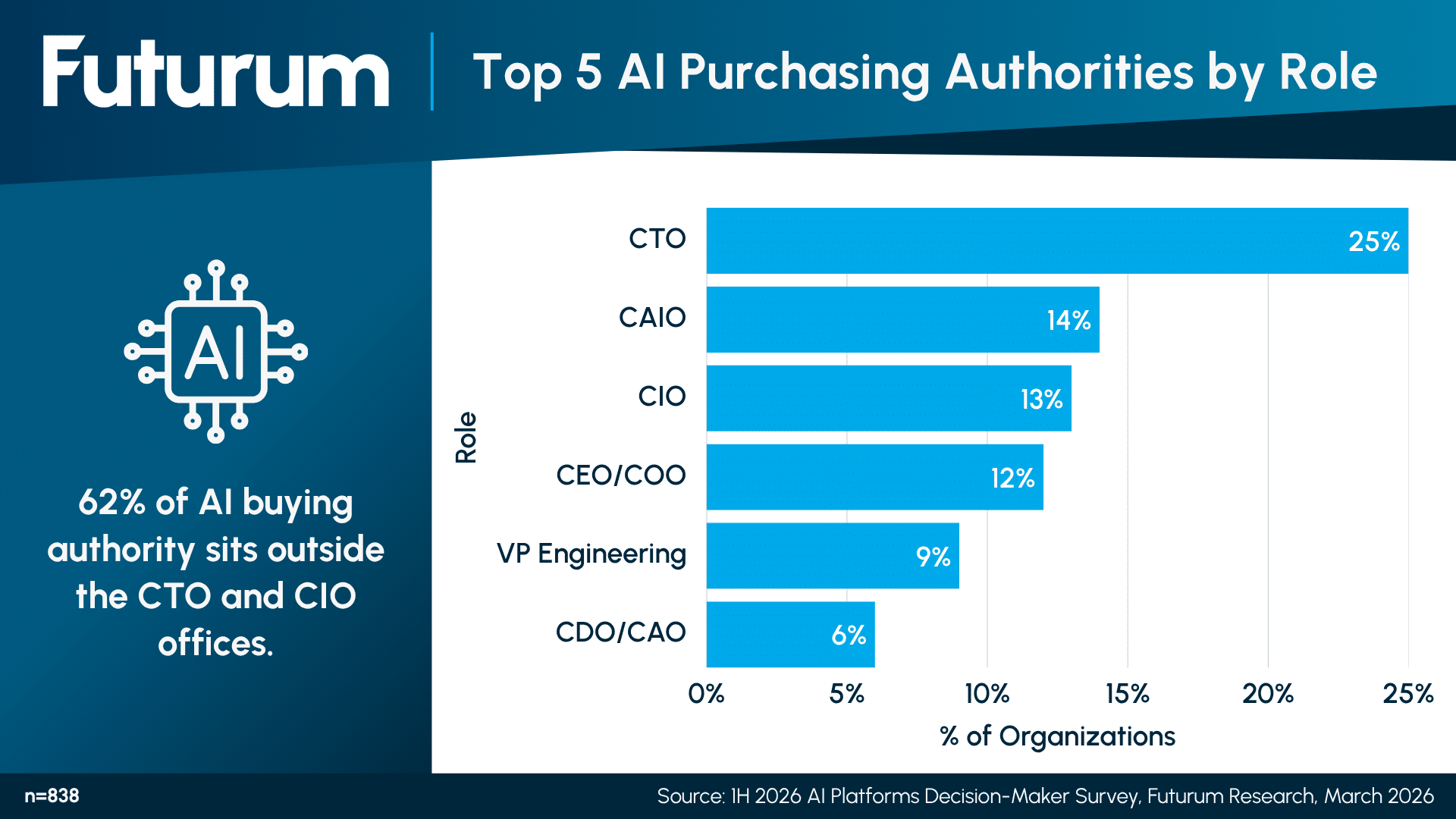
Account control used to mean owning the CIO relationship. That buyer no longer controls the budget alone. Futurum’s 1H 2026 Platforms Decision Maker Survey (N=838) put primary AI purchasing authority with CTO at 25%, the CAIO at 14%, and CIO at just 13% of organizations, just above the CEO at 12% and VP Engineering at 9%. Additionally, primary authority is spread amongst other parts of the organization, including the CDO at 6%, and the CISO and CFO at 5% of organizations.
Figure 1: Top 5 AI Purchasing Authorities by Role
Microsoft’s 6,000 embedded employees are the control mechanism for that distributed account. An account team calls on the CIO. An embedded engineer sits with the supply chain lead, the underwriting team, and the product group, where the budget decisions now happen, and stays after the deal closes. Google buys the same presence through Accenture, Deloitte, Capgemini, and other partners, plus its own forward-deployed engineers funded by the $750 million.
Absorption Capacity Is the Leverage
Implementation buys control because enterprises cannot absorb what they bought. Futurum’s 1H 2026 CIO & Tech Buyers Survey shows pilot-stage adoption collapsed 31.2 points as 74.2% of CIOs locked in thorough deployment plans, with talent and technology pace as co-equal top challenges. The plans exist. That capacity is what the hyperscalers now sell, and whoever supplies it sets the pace downstream.
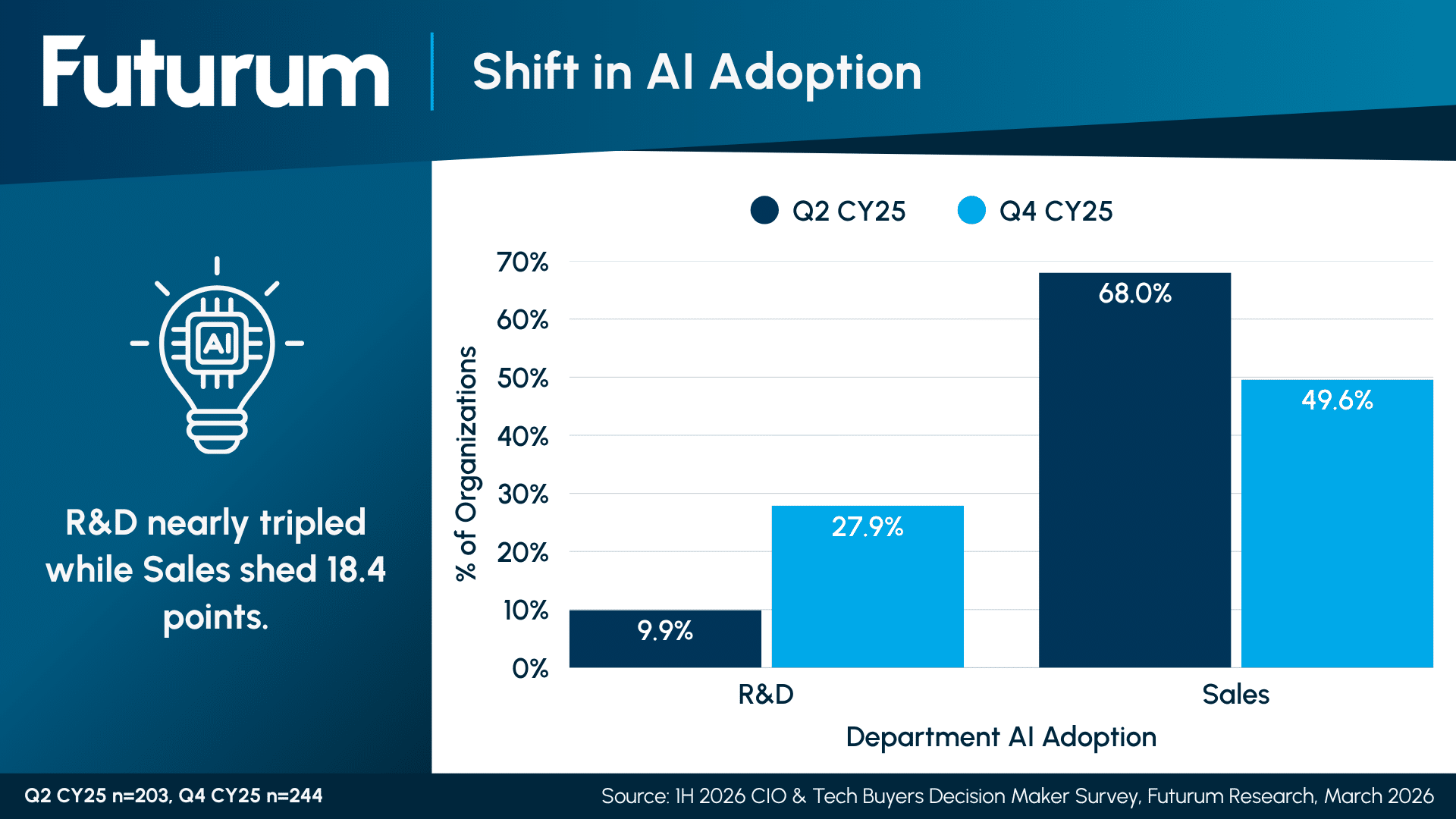
The CIO’s role is shifting from equipping workers who produce units of work to enabling builders of systems that produce units of work, and the vendors just moved into that gap. R&D AI adoption nearly tripled across CY25, from 9.9% to 27.9%, while AI use in Sales fell 18.4 points. The builders moved upstream, and the embedded engineers followed them there. A CIO who does not provision that capacity will watch a vendor do it.
Figure 2: Shift in AI Adoption
The absorption gap runs the length of the supply chain. In Futurum’s channel survey, 71% of partners sell AI software, and 62% sell AI consulting, yet fewer than half run an AI business generating significant revenue (Bova, From Technology to Intelligence, July 2026). Partner priorities flipped to match: co-sell support surged 14.6 points, while training fell 14.7 points to the bottom. The channel is asking vendors for exactly what the hyperscalers just built.
Why the Hyperscalers Are Doing It Anyway
These are margin-dilutive services businesses the hyperscalers spent a decade avoiding, and building them anyway is the tell. Nobody commits $4.25 billion to embedded headcount for the services revenue. They are buying the operations-and-workflow layer, on track for $92 billion at a 43% CAGR (Patience, 1H 2026 AI Platforms Market Sizing & Five-Year Forecast). Enterprise AI budgets enter at infrastructure and climb; the embedded teams sit where the climb happens (Bova, From Technology to Intelligence, July 2026).
Microsoft is betting that owned implementation locks the account before models commoditize. Google is betting the partner channel scales faster. Amazon is running both sides of the trade: AWS builds a $1 billion embedded organization while the AGI unit sheds frontier staff.
The delivery models are not equivalent. Futurum’s 2H 2026 Software Lifecycle Engineering survey found nearly 45% of tooling spend already flows through third-party partners, favoring Google’s route to buyers it does not own. The embedded model Microsoft and AWS chose trades that reach for single-threaded accountability. That wins where governance is the binding constraint.
Every one of these bets shares a ceiling. Enterprises now run an average of 3.8 models, and one-stack delivery capacity cannot orchestrate the multi-model engagement a real account demands (Bova, From Technology to Intelligence, July 2026). Microsoft claims its Frontier Company runs model-diverse by design. No vendor has shown that at a 6,000-person scale, and none can until the first wave of engagements closes. Whoever proves cross-model delivery first owns the layer outright. The others hold a share.
The Governance Debt Lands on the CIO
The governance debt lands on the CIO who ignores this layer. Embedded engineers acting inside enterprise systems raise the same control questions as the agents they deploy; access scope, audit trails, and approval gates apply to both. Enabling builders is concrete work: provisioning agent platforms as shared infrastructure, setting policy for systems that act, and governing the vendor staff inside them. A CIO who cannot say who governs that embedded presence has outsourced control.
One vendor ran this play before the hyperscalers did. Entire, former GitHub CEO Thomas Dohmke’s agent-provenance startup, launched what looked like a developer tool and pulled the purchase up to the CIO’s signature two weeks before the hyperscaler moves (Selling Agent Provenance to the CIO: Entire Changes Who Signs, Futurum, July 2026). Entire is in the preview stage. It signals direction, and it does not prove volume.
Entire escalated one purchase. The hyperscalers just industrialized the pattern. Watch the account reviews 18 months from now: the vendor in the building will hold them. The buying center was distributed; accountability was not.
What to Watch
- The SI Counterattack: Watch for exclusivity picks. Microsoft competes with them, and Google pays them.
- Whether the Climb Stalls: Large AI deals are taking longer to close, a pause or a slower ascent. Watch GSI book-to-bill over the next two quarters, and watch whether hyperscalers start reporting deployment velocity the way they once reported benchmarks. If the money stops climbing past infrastructure, the implementation bet re-prices.
- Embedded-Engineer Governance: Enterprises will need access policies, audit logging, and approval gates for vendor personnel working inside their systems. The first incident touching customer data resets the terms for everyone.
- Copycat Embedded Motions: ServiceNow and Salesforce sit closest to the workflows where agents act. If application vendors follow, this edge dies early.
For more information, see the announcements from AWS, Microsoft, and Google.
Disclosure: Futurum is a research and advisory firm that engages or has engaged in research, analysis, and advisory services with many technology companies, including those mentioned in this article. The author does not hold any equity positions with any company mentioned in this article.
Analysis and opinions expressed herein are specific to the analyst individually and data and other information that might have been provided for validation, not those of Futurum as a whole.
Other Insights from Futurum
Selling Agent Provenance to the CIO: Entire Changes Who Signs
The AI Stack: How Vendors Are Composing AI Strategy
Narrowing the AI Production Gap: Red Hat’s Focus on AI-Assisted Engineering
Author Information

Mitch Ashley is VP and Practice Lead for the CIO & Technology Buyers and Software Lifecycle Engineering practices at The Futurum Group. A multi-time CIO and CTO with 30+ years leading technical organizations, Mitch built and operated production systems spanning cybersecurity for the U.S. Department of Defense, PKI services for the broadband and 5G industries, SaaS platforms, large-scale telecom and banking systems, and a national broadband network. His work with AI began early, developing expert systems that diagnosed and repaired complex mainframe environments. That operator foundation grounds his analysis in operational consequence, covering the technology buyer's world of software engineering, cybersecurity, DevOps, cloud, and AI.