Intel told investors that a shortage of advanced organic substrates is limiting server CPU output and that the industry will stay supply-constrained into 2028. Futurum’s CPU Supply Chain market map traces more than 70 companies across design, manufacturing, and end markets to show where agentic CPU demand meets a supply chain sized for the chatbot era, and which suppliers gain from the squeeze.
What is Covered in this Article
- Intel’s Q3 2026 warning on substrate supply for EMIB packaging
- Futurum’s ~$250 billion server CPU forecast for 2030
- Substrate, materials, packaging, and test suppliers positioned to gain
- RISC-V and SiFive entering the agentic CPU market
- Share shifts driven by supply allocation and custom CPU design
The News: Intel reported third quarter 2026 revenue of $16.5 billion on October 29, with Data Center and AI revenue of $7.3 billion, up 17% sequentially and nearly 80% year over year. Management named substrates as a core constraint alongside Intel 3 yields and a Fab 28 shutdown in Israel. “Even as our Intel 3 wafer outputs ramps quickly, an industry-wide shortage of advanced organic substrates for our EMIB packaging is also impacting our ability to scale output,” said Lip-Bu Tan, CEO of Intel. CFO Dave Zinsner said Intel has secured 40% more substrate capacity, most of it arriving in the second half of 2027. “We expect the industry to remain supply constrained throughout 2027 and into 2028,” said Zinsner, who projected industry server CPU units will grow more than 30% in both 2026 and 2027.
Intel’s Substrate Shortage Moves the CPU Supply Chain Bottleneck Into the Package
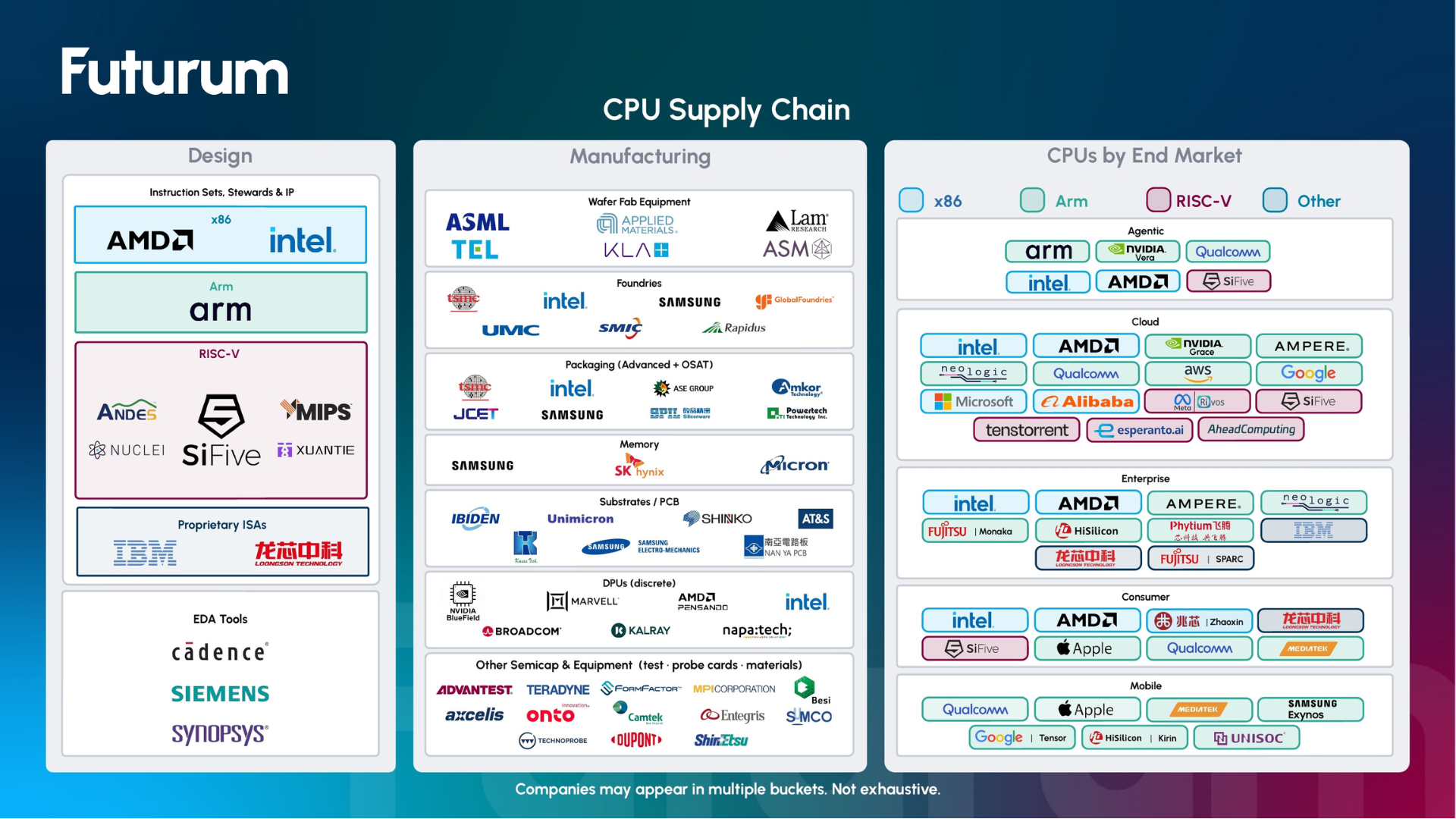
Analyst Take: The binding constraint on the CPU recovery now sits below the wafer. Intel’s wafer output beat plan this quarter, and laminate from Japan and Taiwan still kept server shipments short. Futurum’s CPU Supply Chain market map traces the problem from design through manufacturing to the chips themselves. Every layer was sized for one host CPU per four to eight GPUs, and Futurum’s channel checks find agentic deployments specifying from 1:2 up to 100:1 CPUs per GPU as sandboxes and tool runners multiply. Futurum’s AI Supply Chain Market Model puts the server CPU market at $245.9 billion in 2030, roughly 6x the $40 billion Tan cites as today’s market, with standalone AI CPUs growing from $23.7 billion in 2026 to $164.7 billion, per The $246 Billion CPU Opportunity’s Winning Chip Has Not Been Designed Yet. The consequence of this supply shortage is that market share through 2027 will be determined by who has control of the slowest layer on the map. As foundry capacity expands, custom Arm and RISC-V designs will influence who owns the socket after that.
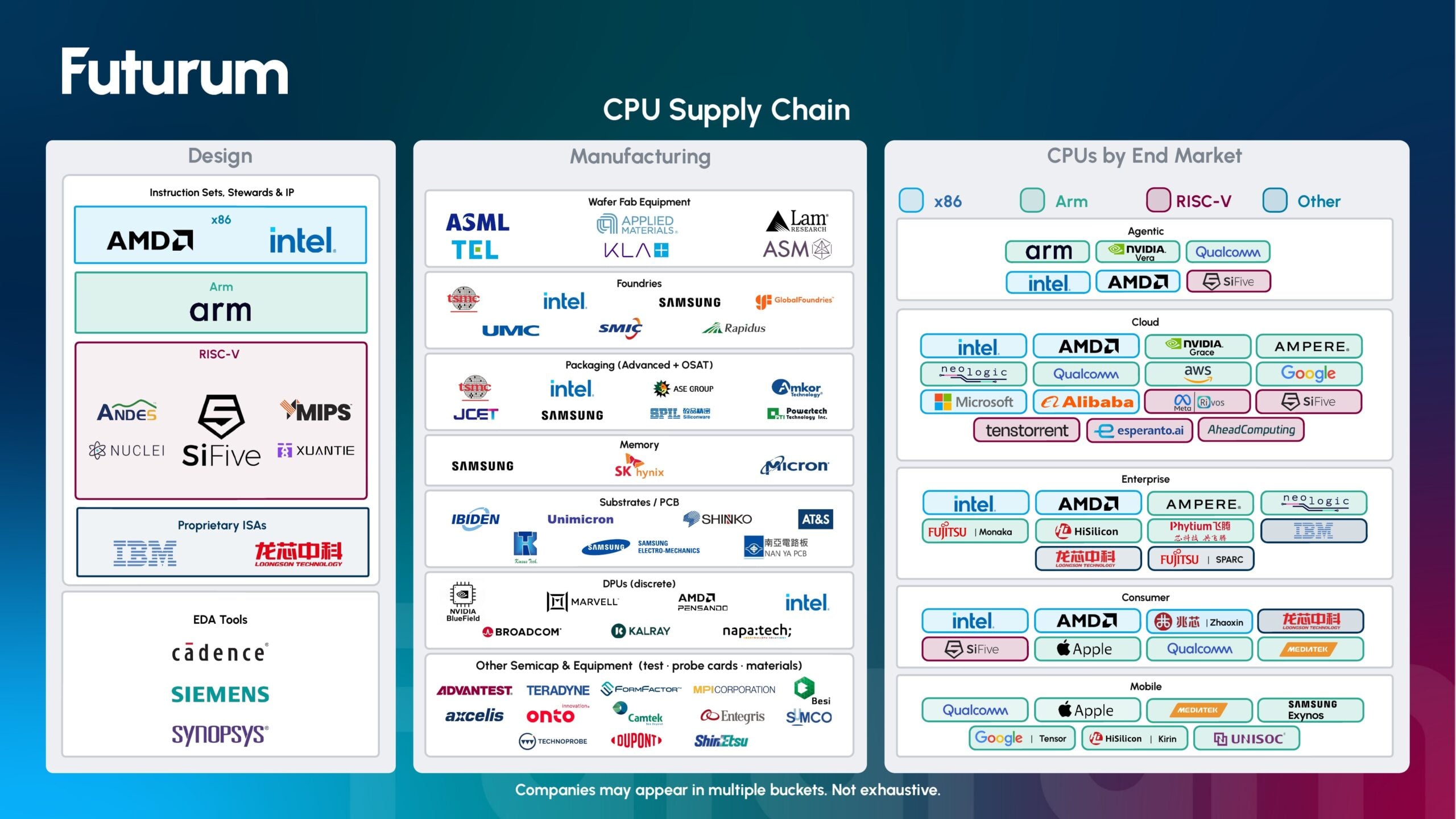
RISC-V and Multi-Die Design Reshape the Design Layer
The design column of our market map is where the instruction set duopoly opens up. AMD and Intel steward x86 and now jointly coordinate the ISA’s extensions, while Arm licenses the dominant alternative under royalty pressure. RISC-V removes the license fee and SiFive leads it into the agentic tier on Futurum’s map, so a hyperscaler or AI lab can license SiFive cores and build an orchestration CPU sized to its own agents. SiFive raised $400 million at a $3.65 billion valuation in April with NVIDIA among its investors, and in January it became the first RISC-V vendor to adopt NVLink Fusion. Most of its more than 10 billion shipped cores still serve embedded and accelerator control roles, and no SiFive-based server CPU ships in volume yet. Chiplets also make CPU design a multi-die physics problem, which pulls Cadence, Siemens EDA, and Synopsys thermal and power analysis earlier into every program.
Wafer Demand Outgrows CPU Units at the Foundry and Equipment Layers
Flagship data center CPUs have grown from 300 to 400 sq mm of silicon to about 1,600 sq mm as multi-die packages. Futurum estimates CPU wafer consumption has grown roughly 10% per year faster than units over 10 years. Gate-all-around transistors and backside power on Intel 18A-P and TSMC N2 add process steps per wafer, which raises equipment intensity for ASML, Applied Materials, Lam Research, KLA, and Tokyo Electron. Intel said firm purchase orders to equipment suppliers rose nearly 40% sequentially. TSMC builds most merchant and hyperscaler CPU silicon, with Samsung and Rapidus as further leading-edge options. Tan’s offer to build CPUs of any instruction set makes Intel Foundry a second source for rivals constrained at TSMC.
Substrates Become the Tightest Layer in the Chain
More tiles need larger ABF substrates with more build-up layers, and Intel’s EMIB bridges sit inside that substrate, which exposes Granite Rapids and Clearwater Forest directly. Analyses compiled by Tom’s Hardware project an ABF supply shortfall of about 21% in 2027 and possibly more than 40% by 2028, with GPU and custom accelerator packages drawing on the same pool. Ajinomoto supplies more than 95% of ABF film and raised prices about 30% in the third quarter of 2026. Ibiden is spending $3.1 billion over fiscal 2026 to 2028 to reach 2.8x its 2024 AI substrate capacity and plans EMIB-T substrate production by its fiscal year ending March 2028. Unimicron raised 2026 capex to a record $1.07 billion, and Shinko, Kinsus, Nan Ya PCB, AT&S, and Samsung Electro-Mechanics round out the base. CPU vendors now negotiate for supply and substrate makers write the terms.
Packaging, Memory, and Test Suppliers Collect a Toll on Every Added Chiplet
Advanced packaging makes the 1,600 sq mm dimension possible. Intel is adding capacity in New Mexico and Malaysia and its EMIB-T flow is drawing external customers seeking a second source to TSMC’s CoWoS, while ASE with SPIL and Amkor expand OSAT capacity. Memory forms a second bottleneck, since server CPUs ship with 12-channel DDR5 and growing MRDIMM attach while Samsung, SK hynix, and Micron steer the same DRAM wafers toward HBM. DPUs from NVIDIA BlueField, built on Arm IP, AMD, Marvell, and Broadcom offload networking and storage, freeing cores for agents. One defective chiplet can scrap a whole package. That raises test intensity for Advantest and Teradyne and multiplies probe card touchdowns for FormFactor, Technoprobe, and MPI.
Supply and Custom CPU Design Will Decide Share Across End Markets
The map’s chip column shows Arm and RISC-V entries in every segment from agentic to mobile. Futurum’s 1H 2026 Data Center Semiconductors Market Sizing & Five-Year Forecast put Intel at 45.3% of Q4 CY2025 data center CPU revenue, AMD at 29.7%, and an Arm-based cohort at 25.0%. In agentic and cloud, AMD builds EPYC Venice at TSMC with its own substrate allocations, so every quarter Intel cannot ship is one EPYC can fill, and NVIDIA Vera and Arm’s AGI CPU compete for the same TSMC capacity. AWS Graviton, Google Axion, and Microsoft Cobalt let hyperscalers fit the CPU to their own agents and negotiate allocation directly, and Meta’s Rivos purchase points that custom model at RISC-V. Enterprise moves slower, with IBM Power and Fujitsu Monaka serving mission-critical niches and Phytium and Loongson anchoring China’s substitution push. In consumer and mobile, memory prices are cutting PC units about 12% in 2026, which frees Intel 18A wafers for data center parts. Merchant x86 share will erode fastest in segments where buyers can design their own CPUs and secure their own supply.
The bear case comes from the 2021 to 2022 ABF shortage, which ended in a 2023 glut once PC demand fell. If software raises agent concurrency per CPU, units could undershoot while Ibiden’s new capacity lands in 2028, and buyers locking in long-term agreements at peak prices would absorb that risk.
What to Watch
- Whether Intel’s added substrate capacity arrives in the second half of 2027
- Whether AMD reports supply constraints or share gains on its Q3 2026 call
- Whether Ibiden and Unimicron announce further price increases or prepaid agreements
- Whether external customers sign Intel EMIB-T packaging deals
- Whether a hyperscaler or AI lab tapes out a SiFive-based agentic CPU
Sources
1. Intel Reports Third-Quarter 2026 Financial Results, Intc, October 2026
2. The $246 Billion CPU Opportunity’s Winning Chip Has Not Been Designed Yet, Futurumgroup
3. SiFive BigSky Ships the First RISC-V Server. Is the GPU Head Node the Prize?, Futurumgroup
4. The state of ABF substrates in data center silicon in 2026 — solving the supply crunch and material wall beneath every AI accelerator, Tomshardware
Declaration of generative AI and AI-assisted technologies in the writing process: This content has been generated with the support of artificial intelligence technologies. Due to the fast pace of content creation and the continuous evolution of data and information, The Futurum Group and its analysts strive to ensure the accuracy and factual integrity of the information presented. However, the opinions and interpretations expressed in this content reflect those of the individual author/analyst. The Futurum Group makes no guarantees regarding the completeness, accuracy, or reliability of any information contained herein. Readers are encouraged to verify facts independently and consult relevant sources for further clarification.
Disclosure: Futurum is a research and advisory firm that engages or has engaged in research, analysis, and advisory services with many technology companies, including those mentioned in this article. The author does not hold any equity positions with any company mentioned in this article.
Analysis and opinions expressed herein are specific to the analyst individually and data and other information that might have been provided for validation, not those of Futurum as a whole.
Read the full Futurum Group Disclosure.
Other Insights from Futurum:
SiFive BigSky Ships the First RISC-V Server. Is the GPU Head Node the…
SiFive Demos AMD ROCm on RISC-V. Is BigSky Now the Neutral Head Node?
Upwind’s $400M Series C Is a Bet on Independent Cloud Security
Author Information

Brendan is Research Director, Semiconductors, Supply Chain, and Emerging Tech. He advises clients on strategic initiatives and leads the Futurum Semiconductors Practice. He is an experienced tech industry analyst who has guided tech leaders in identifying market opportunities spanning edge processors, generative AI applications, and hyperscale data centers.
Before joining Futurum, Brendan consulted with global AI leaders and served as a Senior Analyst in Emerging Technology Research at PitchBook. At PitchBook, he developed market intelligence tools for AI, highlighted by one of the industry’s most comprehensive AI semiconductor market landscapes encompassing both public and private companies. He has advised Fortune 100 tech giants, growth-stage innovators, global investors, and leading market research firms. Before PitchBook, he led research teams in tech investment banking and market research.
Brendan is based in Seattle, Washington. He has a Bachelor of Arts Degree from Amherst College.