Understanding the Scale, Pace, and Asymmetry of the Robotics Segment’s $611B TAM by 2035
Analyst: Olivier Blanchard
Publication Date: October 26, 2026
Document #: AIOOB202610
What You Need to Know
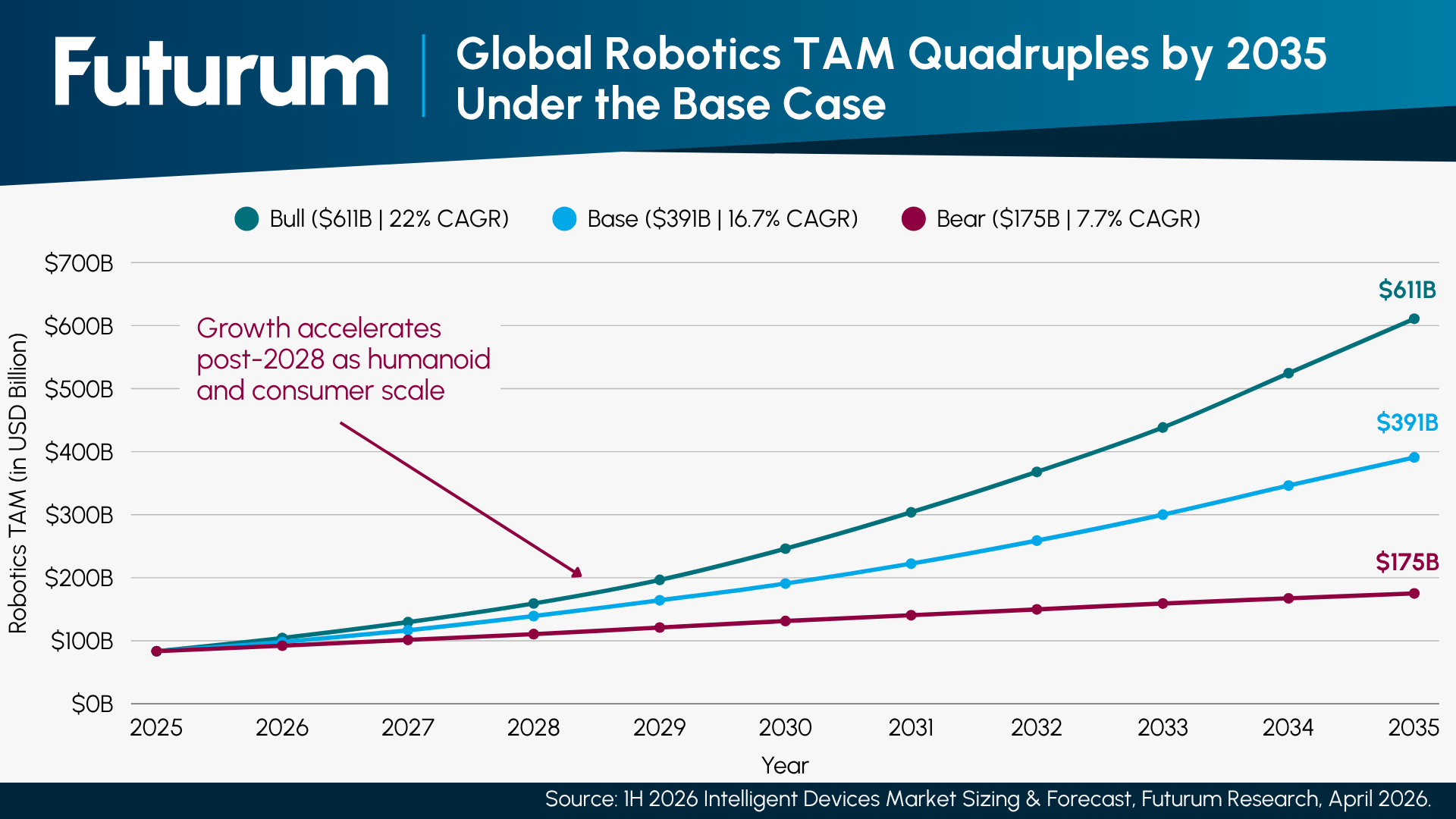
- Futurum’s robotics TAM model projects the global market growing from $83B in 2025 to $391B by 2035 in the base case, a 16.7% CAGR. The bull and bear cases land at $611B and $175B.
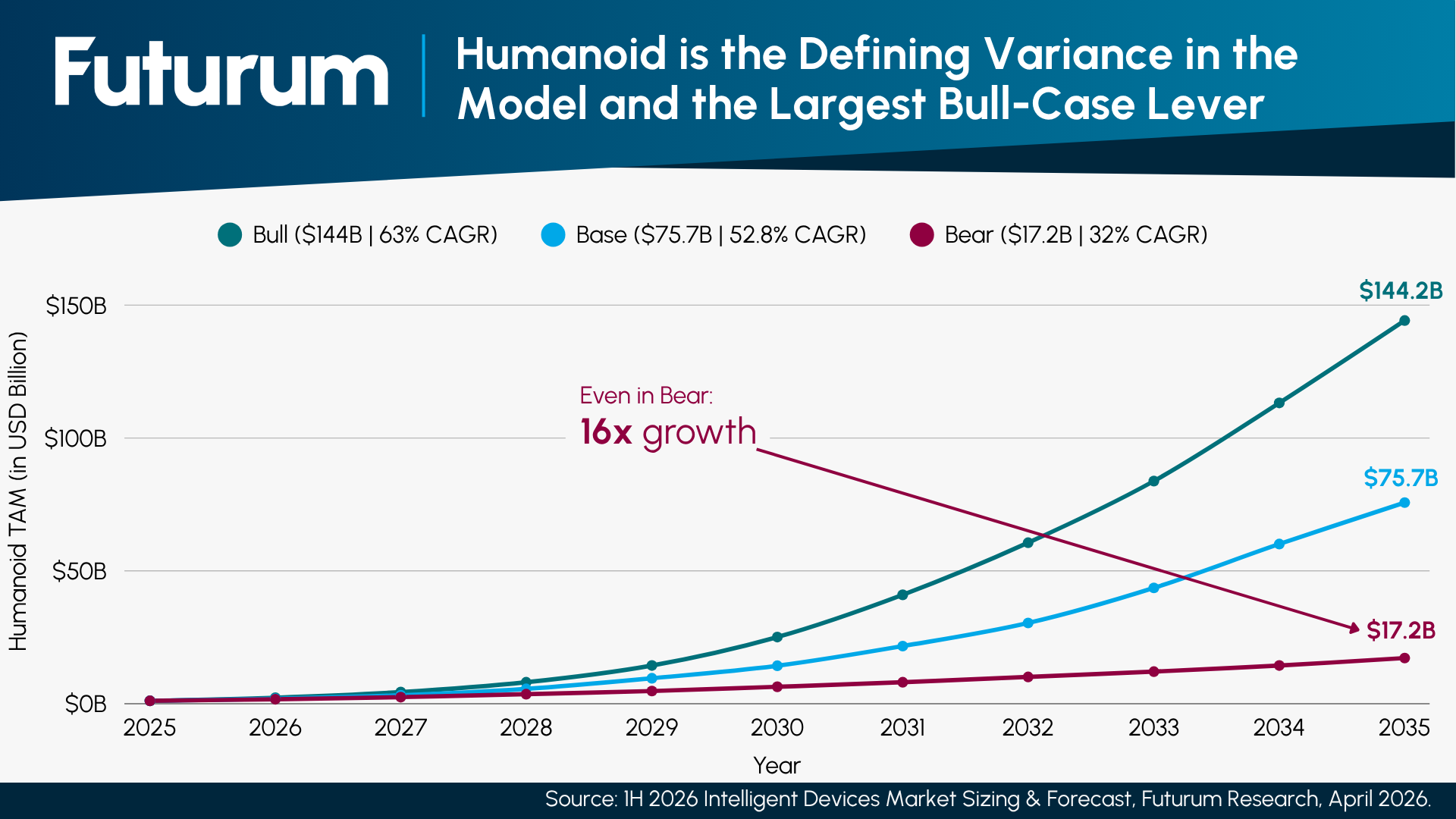
- Public discussion of intelligent robotics has centered on general-purpose humanoid robots as the category most likely to redefine the market over the next decade. While humanoid TAM expands from $1.1B in 2025 to $75.7B by 2035, a 52.8% CAGR, humanoids will still account for only 19% of the market mix.
- Mobile ground robots, which include AGVs (automated guided vehicles), AMRs (autonomous mobile robots), last-mile delivery, and heavy machinery automation, reach $125B by 2035 in the base case at a 23.8% CAGR. That makes Mobile ground the largest of six form factors in the model, and the earliest to scale.
- Electronics content as a share of robot ASP varies by form factor l, ranging from 9.3% for Fixed Industrial to 27.7% for Consumer & Service. Mobile ground sits at 15.7% and Humanoids at 9.7%.
The Futurum View on Physical AI: 6 Primary Form Factor Categories Drive The Segment
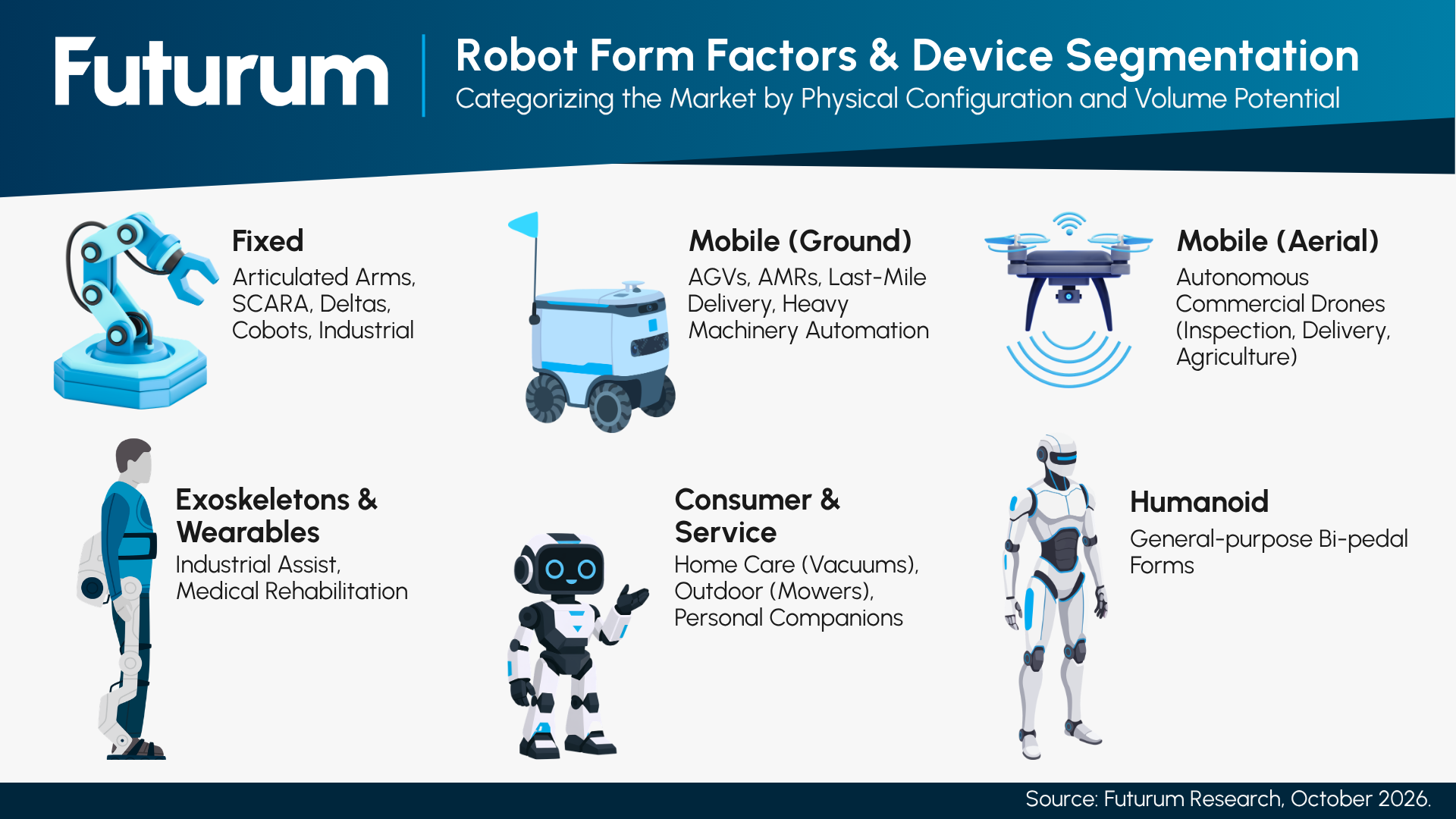
To understand what the physical AI robotics market will look like in the next decade, let’s start by segmenting robot categories by form factor. For the sake of simplicity, we have identified six primary categories of robots:
- Fixed Industrial: Articulated arms, SCARA, Deltas, Cobots, and Industrial
- Mobile Ground: AGVs, AMRs, last-mile delivery, heavy machinery automation
- Mobile Arial: Autonomous commercial drones for delivery, inspection, agriculture, etc.
- Exoskeletons & Wearables: Industrial assist, medical assist, and medical rehabilitation
- Consumer & Service: Home care (vacuums, outdoor care (mowers), personal companions
- Humanoid: General-purpose bi-pedal forms
We prioritize form factors over use cases and industry verticals to make it easier to track IP, components, BOMs, and vendors.
Figure 1: Robot for Factors
The Robotics TAM Quadruples by 2035 Under the Base Case
Our research continues to confirm the two primary drivers of physical AI demand across most segments where we see robotics adoption accelerate.
The first is wage arbitrage: Labor costs in warehousing, agriculture, and light manufacturing have risen past the total cost of ownership for capable mobile and humanoid robots. At current wage trajectories, payback falls just inside of two years. This is the critical threshold, at least for now, for enterprise capital deployment in instances where the financial ROI of replacing a human worker with a robot begins to make sense.
The second focuses more on operational efficiency and risk mitigation: For highly repetitive and predictable tasks, robots tend to be more consistent, precise, and reliable. Thanks to advanced telemetry and AI-enabled diagnostic solutions, impending failures and necessary maintenance are increasingly self-reporting and manageable, which translates not only in higher productivity but also to a shrinking risk of unexpected downtime. As these systems become better at minimizing unexpected failure and optimizing performance, they help enterprises minimize risk better than through the employment of human workers in the same roles.
Looking at three different scenarios (bear case, base case, and bull case) to map how the robotics TAM will scale between now and 2035, we find that even under the most high-friction, slow growth model, the segment reaches $175B in 2035, with a 7.7% CAGR. More realistically, the base case predicts a $391B TAM for 2035, driven by a 16.7% CAGR. Lastly, in our bull case, we predict that the robotics TAM could reach $611B by 2035, with a 22% CAGR. Note that all three of our scenarios anticipate the start of an acceleration post-2028, as physical AI systems become more autonomous and more capable of processing information, making decisions, and performing tasks at the edge and in real time.
Figure 2: Global Robotics TAM
The Robotics TAM Belongs to Robots That Move Goods
The robotics TAM will initially be won on warehouse floors, loading docks, and delivery routes, not in humanoid innovations. Futurum’s base case puts Mobile ground at $125B in 2035, ahead of Fixed Industrial at $99B and Humanoids at $76B. That is about 32% of the $391B total, and 37% of the model’s 2035 serviceable addressable market. Humanoids are a growth-rate story. Mobile ground is a scale story, and scale is what enterprise budgets and supplier revenue actually follow.
Figure 3: The Mix Shifts Dramatically – Mobile ground and Humanoid Drive the Second Decade
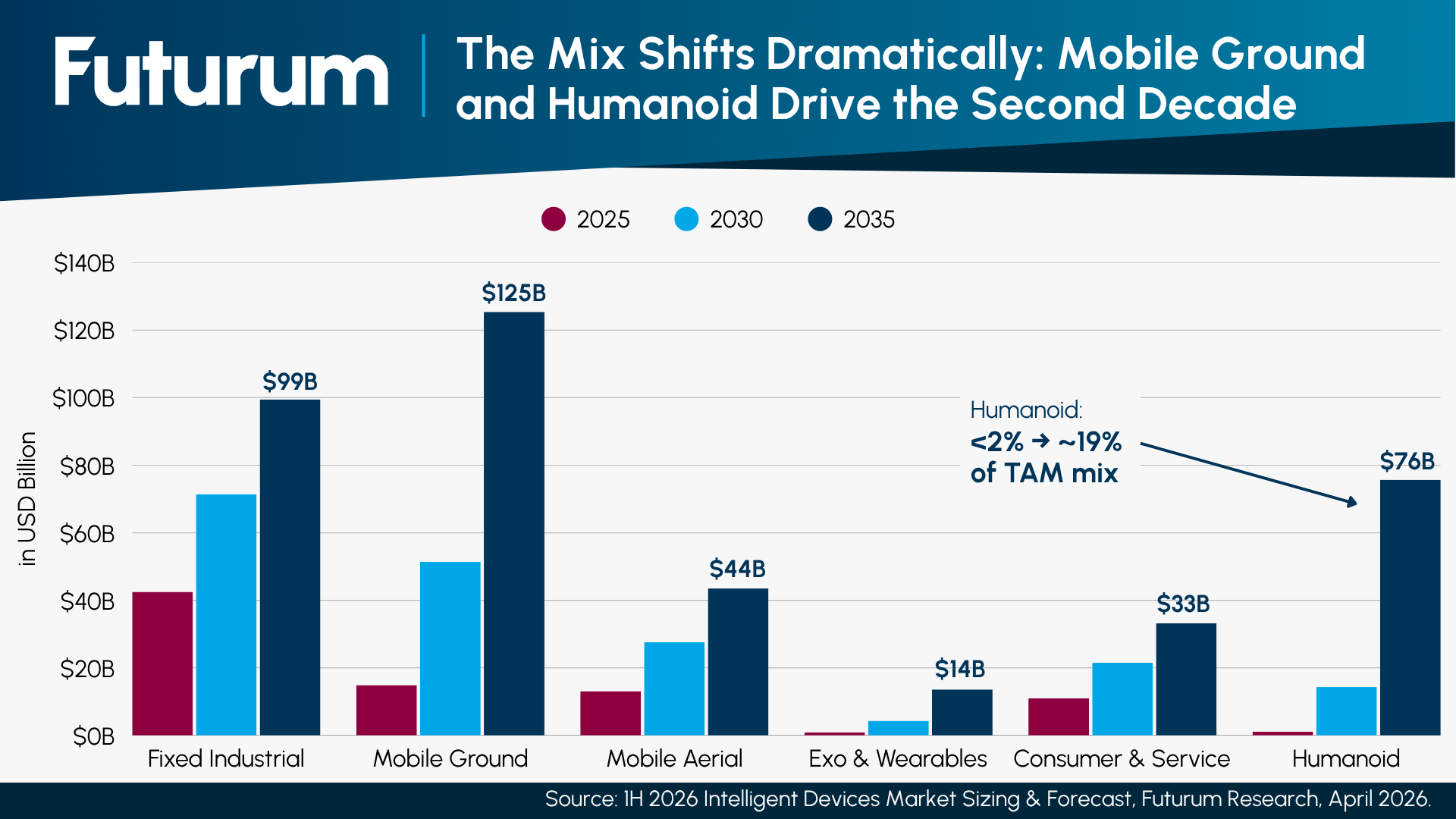
The driver is true payback in invested capital. Labor costs in warehousing, agriculture, and light manufacturing have risen past the total cost of ownership for capable mobile robots, and payback now falls within two years, that is, the threshold where enterprise capital moves from pilot budgets to program budgets. Mobile ground’s 23.8% CAGR is the output of that arithmetic, and the base case assumes no technical breakthrough to get there. It is the most durable growth in the model because it depends on math that already works.
The downstream value reinforces the point. Applying the model’s fixed electronics ratios to base case 2035 TAM, Mobile ground carries roughly $19.6B in electronics content against about $7.3B for Humanoids, a gap of more than 2.5x. This is because every mobile unit also needs WiFi, 5G, or Bluetooth connectivity to operate as part of a fleet. For compute, sensing, and connectivity suppliers, the mobile fleet is both the larger and the more forecastable revenue base.
The mix shift also changes who the market’s center of gravity serves. Fixed Industrial, the articulated arms, SCARA, delta, and cobot-installed base that defined robotics for decades, remains a $99B segment in 2035, but it is no longer the largest. It also carries the lowest electronics share in the model at 9.3% of ASP. The robots that are gaining share are the ones that navigate, perceive, and coordinate across open environments, and those capabilities are where intelligent edge compute, sensing, and connectivity earn their place in the bill of materials.
The Humanoid Counterargument
Humanoids are the largest lever in the model, and the area where the market outlook is most foggy: the bull case reaches $144B at a 63% CAGR, which would exceed Mobile ground’s base case outright. If general-purpose bipedal robots clear adoption friction quickly, the leadership question could flip before 2035.
That outcome requires several things to go right at once. The bull case assumes wage arbitrage clears broadly, consumer and humanoid categories scale aggressively, and adoption friction collapses. Conversely, for mobile ground robotics to take off requires only that installed-base trajectories and replacement cycles continue. Timing matters as well: humanoid growth accelerates after 2028, so most of its value lands in the back half of the decade, after the planning window in which enterprises and suppliers make their structural commitments.
The learning flywheel also favors the fleets deployed first. Foundation models and imitation learning let each deployed unit improve every other unit in the fleet, at near-zero marginal cost. Those gains accrue to whoever has robots in the field, and in 2026, that is overwhelmingly mobile ground fleets, not humanoids.
Figure 4: Humanoid Is the Defining Variance in the Model
What This Means for Enterprise Automation
Enterprises should treat mobile ground robotics as the program and humanoids as the option. The operational consequence goes beyond hardware selection. Fleet orchestration, safety monitoring, facility layout, and connectivity become the control plane that governs physical automation. Organizations that build around mobile fleets now will be positioned to absorb humanoids into it later, rather than standing up a second, disconnected automation stack when humanoids mature.
Governance is the less visible half of that work. Mobile fleets operate in shared human spaces, receive continuous over-the-air improvements, and generate operational data that feeds the next round of learning. Decisions about safety validation, change control for fleet-wide updates, and ownership of fleet data will outlast any single hardware generation. Enterprises that treat those decisions as facilities or procurement details, rather than as operating policy, will find them harder to unwind once fleets scale.
The regulatory environment for aerial drones is vastly different from what we see in controlled industrial environments and even in mobile ground delivery. Due to their impact on airspace safety and potential risk of collision with commercial and private aircraft, aerial drones are subject to more stringent regulatory regimes. The flip side of that coin is that the rules guiding the operation of aerial drones tend to be more mature and transparent, which provides clearer guardrails and guidelines concerning their use. As automated collaboration between aerial drones and mobile ground robots across a broad swath of environments (such as manufacturing, logistics, agriculture, defense, and delivery) begins to take shape, look to solutions vendors with low-friction platform integration and smoother interoperability.
While exoskeleton systems don’t get quite as much attention as other form factors, we see a significant opportunity for growth in the segment. Primary commercial use cases are human enhancement in manufacturing and logistics (fulfillment) environments, enabling human workers to safely carry and/or move heavy loads. These systems will likely continue to scale in industrial, warehouse, retail, and delivery environments, but we also anticipate a second wave of growth in construction, defense, and mining as the ruggedness of these systems improves. Lastly, one of the most promising opportunities for exoskeletons is in the healthcare space, with applications ranging from medical rehabilitation to assisting users with mobility challenges. With roughly 1 in 7 adults in the United States alone already living with mobility challenges, and that proportion increasing to 2 in 5 for the >65 age group, it isn’t difficult to see the potential for the category, especially if it can be at least partly subsidized by insurance and government-funded programs.
The consumer robot segment remains the most uncertain of the six primary categories we are tracking. Part of the reason for it is that, at least for now, consumer use cases are a mixed bag of specific utility with clear value propositions (e.g., yardcare robots, poolcare robots, vacuum cleaner robots, and companion robots) and gadgets (e.g., robot pets, pocket-sized mobile robots, and interactive playmate robots). It is important not to fall for the trap of assuming that any one category of consumer robot has more value than another, since each human user will assign that value subjectively based on their own circumstance and what needs each robot fills for them. What we observe, however, is that the current state of consumer-focused robotics still feels more like a diverse market test for a broad range of use cases, form factors, capabilities, features, user interfaces, and price points than a focused, maturing segment with clear direction and purpose, let alone one that can demonstrate a path to scale. As IP developed specifically for humanoid robots begins to introduce more advanced autonomous motor, behavioral, and interface features to the Physical AI space as a whole, we expect that the consumer robot segment will quickly transition into a more focused, UX-forward, value-driven segment with a credible path to adoption and growth.
Recommendations
Enterprise operations leaders and the vendors that supply them should plan around where robotics value will concentrate, not where attention does.
- Short Term: Build phased automation roadmaps around mobile ground platforms where payback already clears the two-year threshold, and treat humanoid pilots as aspirational/evolutionary rather than must-have programs.
- Medium Term: Vendors should weigh investment in mobile fleets, navigation, sensing, and fleet-scale connectivity more heavily than humanoid-specific bets through 2028. Prioritize partnerships with silicon and component vendors that offer adaptive, agile platforms that can easily transition between current physical AI applications and form factors (mobile ground, drones, and automotive use cases) and humanoid robots.
- Medium to Long Term: Settle form factor prioritization by 2029, before installed bases inflect and the 2035 addressable market becomes effectively locked in.
What to Watch
- Payback Durability: If labor cost trajectories flatten or robot TCO rises, the sub-two-year payback behind Mobile Ground’s 23.8% CAGR weakens, and so does this position.
- Humanoid Unit Economics Before 2028: Evidence that humanoid ASPs and deployment friction are falling faster than the base case assumes would push the market toward the $144B bull case and challenge Mobile Ground’s lead.
- Mixed-Fleet Orchestration: Watch whether fleet management platforms built for AMRs extend to humanoids, or whether humanoid vendors build separate stacks. A shared control plane favors enterprises that invest in mobile fleets first.
- Regulatory and Macro Friction: The bear case compresses demand across all form factors but particularly humanoid, which poses the highest potential TCO risk. Safety standards for mobile robots in shared human spaces and rules governing last-mile delivery are the most direct pressure points for Mobile ground.
- Silicon Roadmap Priorities: To what extent compute, sensing, and connectivity suppliers weigh their 2028+ roadmaps toward mobile platforms or humanoid-specific architectures and form factors will show where the supply side believes the volume is.
Disclosure: Futurum is a research and advisory firm that engages or has engaged in research, analysis, and advisory services with many technology companies, including those mentioned in this article. The author does not hold any equity positions with any company mentioned in this article.
Analysis and opinions expressed herein are specific to the analyst individually and data and other information that might have been provided for validation, not those of Futurum as a whole.
Other Insights from Futurum
Qualcomm + PickNik + Layoffs = The Robotics Segment’s Stakes Are Starting To Feel A Bit More Real
How NVIDIA is Building a Critical Safety Layer for Physical AI
Author Information

Olivier Blanchard is Research Director, Intelligent Devices. He covers edge semiconductors and intelligent AI-capable devices for Futurum. In addition to having co-authored several books about digital transformation and AI with Futurum Group CEO Daniel Newman, Blanchard brings considerable experience demystifying new and emerging technologies, advising clients on how best to future-proof their organizations, and helping maximize the positive impacts of technology disruption while mitigating their potentially negative effects. Follow his extended analysis on X and LinkedIn.