
FY2027 Will Bring More Discipline and Accountability to AI Spending, Though Not Completely
Analyst(s): Mitch Ashley
Publication Date: September 14, 2026
Document #: AINMA202609
What You Need to Know
- AI budget overruns are now a routine part of enterprise adoption. Nearly half of enterprises report spending above plan, while only a small minority comes in below budget.
- When AI spending runs over, enterprises usually fund the gap rather than slow adoption. Supplemental approvals and rolling overages into the next planning cycle are both more common than reducing scope.
- That pattern will not hold for long, as the next budget cycle is where that shift starts to show. FY2027 budgeting will increase the operating discipline applied to AI as is already applied to the rest of enterprise IT spending.
- AI funding is increasingly being pushed outside of IT. More spending is being covered by business-unit budgets, spreading budget authority and control beyond the CIO.
- A more disciplined minority is operating AI against a defined budget and keeping spending close to plan. Vendors that can tie pricing to measurable outcomes will be better aligned with where enterprise buying is headed.
Recommendations
For vendors, this pattern is quietly reshaping where the next AI dollar will be won.
- Sell to the Measurement Gap: Accounts with no clear way to measure AI spending are where finance is most likely to intervene first. Vendors that connect pricing to a defined business result will enter that conversation in a stronger position than vendors selling seats, tokens, or general capacity.
- Position as the Proof Layer: In most enterprises, budget pressure is not yet enough to stop AI projects. The harder challenge is helping CIOs and technology leaders demonstrate value in terms that finance will accept.
- Follow the Money Out of IT: The business unit helping fund AI today may become the buying center that shapes tomorrow’s renewal. Vendors should confirm who actually controls the budget before assuming the CIO remains the primary economic buyer.
Analysis
Governing AI spend has become one of the hardest challenges of enterprise AI adoption, and most enterprises are still behind the curve. In Futurum’s 2H 2026 CIO & Technology Buyers Decision Maker survey, 46.9% of enterprises reported running over budget on AI, while only 5.6% said spending came in below plan (see Figure 1). AI may be producing, or show signs of producing, enough value to sustain momentum, but the discipline to forecast, measure, and manage that spending has not kept pace.
Figure 1: AI Spend Relative to Budget, 2H 2026

Among enterprises, 10% have no formal AI budget to measure against, and another 5.6% do not know where their spending stands. Put together, nearly one in six enterprises lacks even a basic baseline for judging whether AI spend is over, under, or in line. That may be tolerable during an early growth phase, but it is not a condition that finance organizations typically allow to persist.
AI budgets are set once a year, occasionally with a mid-year true-up, while the underlying costs remain highly variable and poorly understood. Usage is driven by increased prompt volume, inference demand, model changes, new services entering production, and broader deployment across the organization. That makes AI spending resemble the early years of cloud cost planning, when consumption outpaced budgeting discipline and experience, and most enterprises learned cost governance the hard way.
The 2026 Response: Fund AI Anyway
Our data show that even when enterprises exceed their AI budgets, most do not slow down. Among the 767 organizations in the survey that reported running over budget, 47.6% sought approval for supplemental funding, and 43.3% absorbed the overrun into the next planning cycle. By contrast, about one-sixth reduced or paused the AI scope (see Figure 2).
Figure 2: Actions Taken by Over-Budget Enterprises, 2H 2026
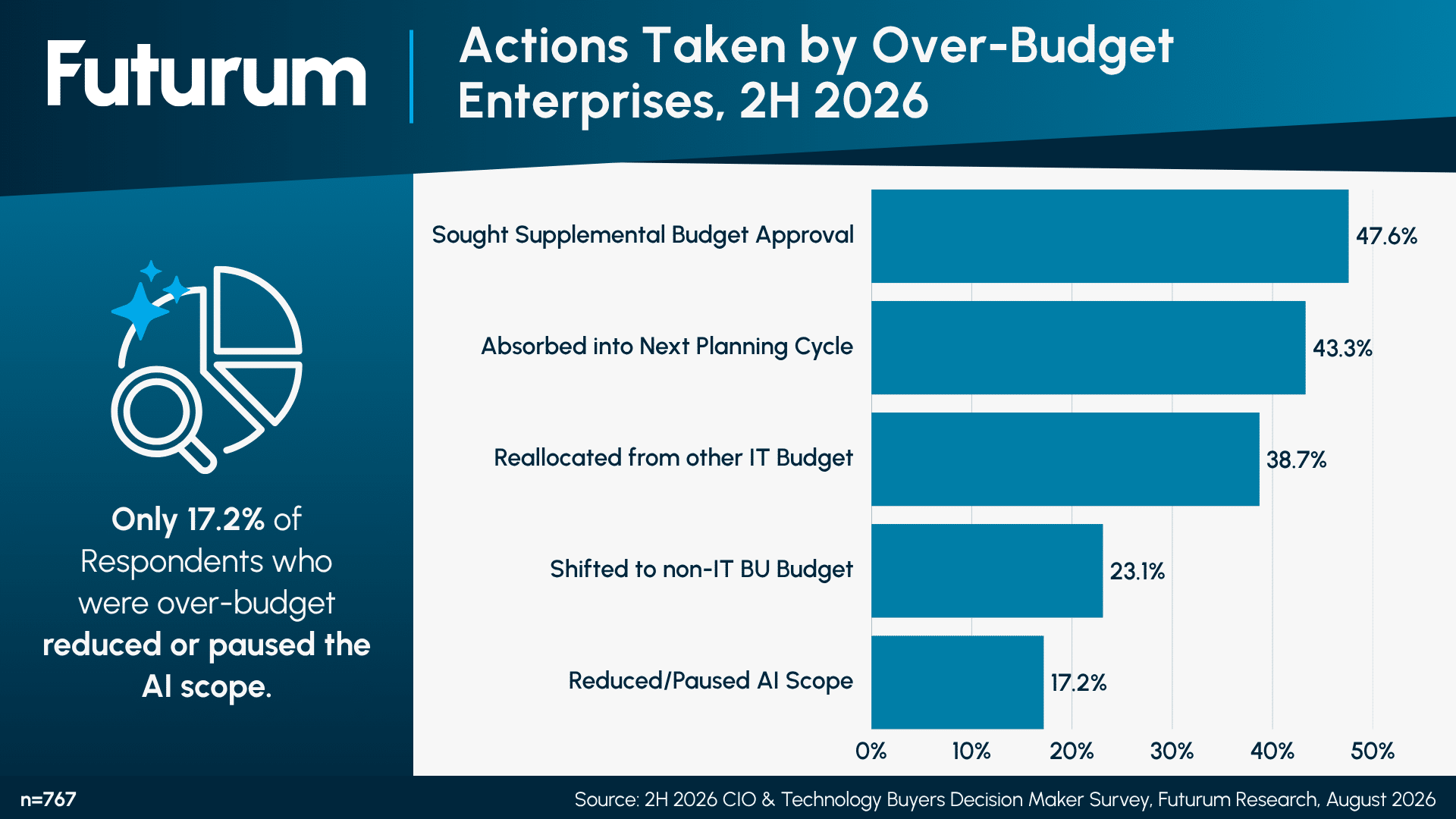
That response matters because the impact extends beyond just budgeted line items. It can also change who owns the buying decision. Among over-budget enterprises, 38.7% reallocated funds from elsewhere in the IT budget, and 23.1% shifted spending to a non-IT business-unit budget. Once marketing, operations, customer support, or other functions start paying part of the AI bill, the economic buyer starts to move with it.
Absorbing the overrun into adjacent budgets or future cycles is the silent response, but not the least consequential one. It pushes AI costs against other planned spending, hides the real size of the overage, and resets next year’s baseline higher. What starts as an exception can quickly become the run rate, making it harder to prove ROI, isolate savings, or bring spending back under control.
A meaningful minority is showing a different pattern. A total of 31.8% kept AI spending approximately in line with their budget. That group demonstrates that discipline is possible even in a fast-moving market. The difference is not cost stability alone; it is the presence of a real operating number, the management behavior to run against it, and transparent tracking of overages and additional funding sources.
FY2027 Budgets: Where AI Budget Overruns Get Corrected
The current habit of funding overruns and moving on is unlikely to be sustained at 2026 levels. Each quarterly review and annual planning cycle creates another opportunity for finance to challenge the assumptions behind AI spending and redirect dollars toward higher-priority work. By the FY2027 budgeting cycle, enterprises with weak or nonexistent AI budget controls will face the strongest pressure first, while the rest will be pushed to make AI spending more predictable, transparent, and defensible.
Pricing dynamics will intensify that pressure. Across the AI market, subscription and usage-based pricing continues to displace seat-based and fixed-price models, while enterprise usage expands. Most organizations are still adding services, testing models, and broadening production footprints rather than settling into a stable operating state. As a result, consumption alone can continue to drive the bill higher, even before new projects are approved.
Underneath the spending pattern is a broader governance issue. Finance is the function most likely to force that issue into the open, and the next budgeting cycle is where that transition is most likely to become visible.
What to Watch
- Finance Formalizes AI Budgeting: The first targets will be enterprises that still lack a baseline for measuring AI spend. Expect AI budget governance to emerge as a more explicit procurement and approval gate over the next couple of planning cycles.
- The Overrun Response Starts to Tighten: Supplemental approvals and deferred absorption are unlikely to remain the dominant response indefinitely. When scope reduction starts to climb in future survey waves, it will signal that the current fund-it reflex is breaking down.
- Buying Power Continues to Drift Out of IT: Business units are already covering part of the AI bill. The next question is whether line-of-business leaders begin setting the commercial terms and success criteria that the CIO once controlled.
- Outcome-Based Pricing Gains Ground: Vendors that tie pricing to measurable business results will be better positioned as financial scrutiny increases. The shift to outcome alignment may become one of the clearest competitive separators in enterprise AI.
Read more in the full report, 2H 2026 CIO & Technology Buyers Decision Maker Survey Report, available to subscribers on the Futurum Intelligence Platform.
Disclosure: Futurum is a research and advisory firm that engages or has engaged in research, analysis, and advisory services with many technology companies, including those mentioned in this article. The author does not hold any equity positions with any company mentioned in this article.
Analysis and opinions expressed herein are specific to the analyst individually and data and other information that might have been provided for validation, not those of Futurum as a whole.
Other Insights from Futurum
AI Implementation Is the New Account Control Point
Selling Agent Provenance to the CIO: Entire Changes Who Signs
Author Information

Mitch Ashley is VP and Practice Lead for the CIO & Technology Buyers and Software Lifecycle Engineering practices at The Futurum Group. A multi-time CIO and CTO with 30+ years leading technical organizations, Mitch built and operated production systems spanning cybersecurity for the U.S. Department of Defense, PKI services for the broadband and 5G industries, SaaS platforms, large-scale telecom and banking systems, and a national broadband network. His work with AI began early, developing expert systems that diagnosed and repaired complex mainframe environments. That operator foundation grounds his analysis in operational consequence, covering the technology buyer's world of software engineering, cybersecurity, DevOps, cloud, and AI.