
Networking Joins AI, Cloud, and Cybersecurity as 2026 Growth Drivers
Analyst(s): Alex Smith
Publication Date: September 1, 2026
Document #: AIOAS202608
Key Points
- AI Is Causing a Seismic Reallocation of Spend Prioritization: Enterprise AI execution bottlenecks are elevating infrastructure hardware, custom software development is usurping commercial off-the-shelf (COTS) software, and legacy sustainability initiatives are losing ground to immediate operational priorities.
- Software Partners Feeling Increasingly Weary About Outlook: Enterprise applications suffered the steepest decline in growth expectations as rising AI token costs, hardware price inflation, cloud marketplace disintermediation, and AI-assisted custom app development become headwinds to software selling practices.
- Services Remain Essential to Partners: Services remain a resilient growth safe-haven, suggesting a future state where the partner ecosystem is increasingly defined by the services they offer rather than the technology they sell.
Decoding the 2H 2026 Partner Ecosystem Reality
The narrative surrounding enterprise technology spending of late has been overwhelmingly dominated by three mega-pillars: AI, Cloud, and Cybersecurity. Recent data from the Futurum Ecosystems, Channels & Marketplace (ECM) Partner Survey (2H 2026, N = 400) confirms that these categories remain primary revenue engines for partners (all three were the top-cited growth drivers for partners in 2025). However, across all three, there was some deterioration in growth sentiment, which may serve as a warning sign for the industry overall. AI software kept its position as the category leader for partners with 64.5% partner participation and 78.3% calling it a growth driver (down slightly from 2025, with 86% partners expecting growth). Cybersecurity has been on a gradual decline, potentially impacted by external market forces such as Anthropic’s Project Glasswing, which raises questions about the sector overall.
Figure 1: Technology Growth Sentiment for Partners Over Time
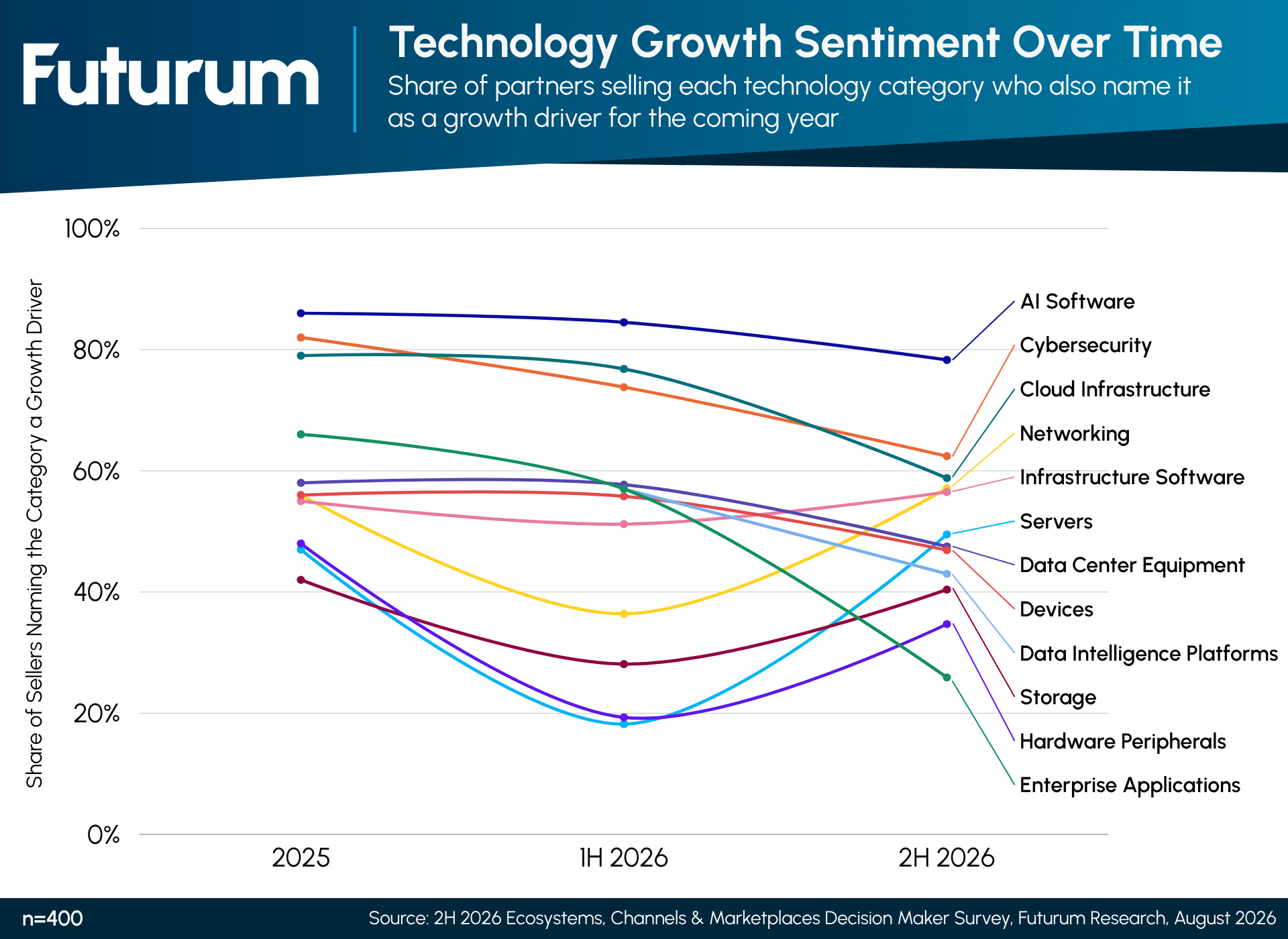
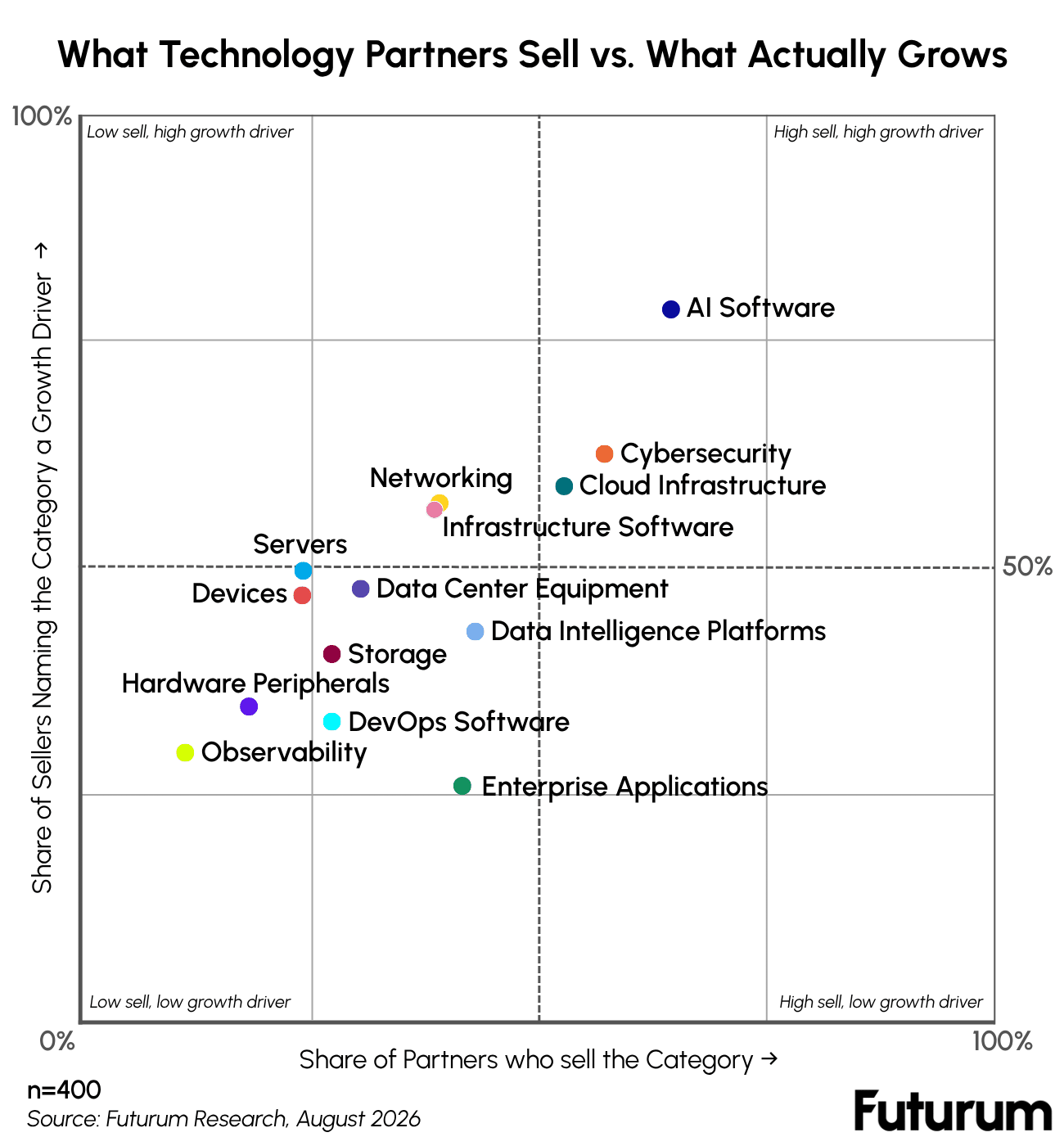
Monitoring these three segments alone paints an incomplete picture for vendors monitoring the health of the partner ecosystem. The spread of sentiment reflects what we see daily, in that the broader technology market is undergoing a major reallocation of spend prioritization, all linked in some capacity to AI. In this latest partner survey, networking and other parts of infrastructure caught up with AI, cloud, and cybersecurity as critical partner growth drivers for 2026. Coupled with the positive sentiment of partner services (discussed later), the broad data reveals a clear evolution: enterprise AI execution bottlenecks are elevating infrastructure hardware, custom software development is usurping COTS software, and legacy sustainability initiatives are losing ground to immediate operational priorities.
Figure 2: What Technology Partners Sell vs. What Actually Grows, 2H 2026
Infrastructure Bottlenecks Shift: Networking Takes Center Stage
During the initial wave of generative AI investments, growth was heavily concentrated in cloud hyperscalers and specialized “neo-cloud” GPU orchestrators. In 2H 2026, the AI spending moved decisively into networking and on-premises server environments.
Networking saw a massive +20.7% increase in growth sentiment compared to 1H 2026, with 57.1% of active networking partners identifying the sector as a major growth driver. This sentiment spike directly reflects real-world market performance from networking leaders such as Cisco. As enterprises attempt to pull AI models out of localized sandboxes and distribute them across hybrid multi-cloud environments, legacy campus and data center fabrics are choking on east-west traffic volume, telemetry demands, and latency requirements. Partners specializing in high-throughput switching and automated network orchestration are capturing substantial high-margin refresh business as enterprise CIOs realize that high-performance compute is useless without modern networking fabrics.
The server category recorded the single largest sentiment leap across the entire technology taxonomy, rocketing +31.3% in positive growth expectations versus early 2026 figures. Nearly half (49.5%) of those participating now class servers as a primary driver of top-line expansion. This channel finding validates the 1H 2026 financial reporting from tier-1 server OEMs such as Dell Technologies and Lenovo, both of which reported exceptional enterprise server unit growth and expanding average selling prices (ASPs). Several macro factors are driving this tailwind. Enterprise buyers are moving inference workloads on-premises or into localized colocation facilities to satisfy data privacy, sovereignty, and egress cost requirements, moving beyond cloud-only execution. Simultaneously, rising costs for DRAM, high-bandwidth memory (HBM), and storage components have driven up server ASPs. For value-added resellers (VARs) and systems integrators operating on percentage-based margin structures, higher component pricing translates directly to expanded transaction values.
Paired with servers, infrastructure software (backup, virtualization, orchestration) maintained high growth sentiments, with 56.5% of partners marking it as a growth engine. Overall, 2026 is looking positive for partners with deep infrastructure practices.
The Enterprise SaaS Collapse: Why Merchant Software Is Struggling
The most concerning finding in the 2H 2026 survey data is the steep decline of Enterprise Applications (CRM, ERP, HCM, and commercial productivity software). Historically viewed as a solid growth area for partners, enterprise software was named as a growth driver by only 25.9% of participating partners in the most recent study. This represents a staggering -31.1% drop in positive growth sentiment compared to the start of 2026, when more than half (57.0%) of selling partners expected SaaS applications to drive revenue growth. Several structural dynamics may explain this sentiment collapse as it pertains to partners:
- Budget Cannibalization from Hardware and AI Inference: Enterprise software budgets are facing severe compression. As organizations absorb price increases across server hardware, networking upgrades, and escalating LLM API token consumption fees, IT buyers are aggressively trimming discretionary SaaS seats and delaying multi-year COTS upgrades.
- Disintermediation via Direct GTM and Cloud Marketplaces: Futurum’s 2H 2026 Enterprise Software Decision Makers Survey found that 29% of software spending was with vendors directly, while another 20% was with hyperscaler/cloud marketplaces. Essentially, half the market is bypassing partners. The latter dynamic is being spurred by buyers engaging in pre-committed cloud spending agreements and increasingly using that to purchase software directly.
- The “Build vs. Buy” Paradigm Shift: Generative AI and low-code/no-code coding assistants (Copilots, Claude Artifacts, Devin) are altering software economics. Enterprise IT teams, supported by specialized ISV partners, may be opting to build tailored internal tools rather than license expensive, rigid merchant software suites.
It is worth noting that software buyer data shows a slightly different picture. The Futurum 2H 2026 Enterprise Software Decision Maker Survey indicated robust expansion, with organizations projecting a 15% uptick in annual software expenditures. Yet even within this top-line strength, a structural shift is occurring: rapid application consolidation (35% in-progress, 22% assessing) and a migration toward outcome-based and consumption pricing models are fundamentally eroding the traditional implementation and resale margins that have historically anchored partner profitability. Even if the end-user appetite for off-the-shelf software remains robust, changing dynamics suggest a potentially challenging situation for partners that have historically sold that software.
Services, Including Custom Development, Remains Strong
Despite varying outlooks on selling technology solutions, services remain a high-growth anchor for partners. Across almost all evaluated service lines, a clear majority of partners are expecting solid growth.
At the summit of services for partners is AI consulting. Understandably, companies are trying to understand how to best leverage AI within their workflows and offerings. Partners are meeting this demand with their own AI consulting offerings. While some may be true AI-native Frontier Partners, others are likely to be evolving resellers, integrators, and service providers looking to get in on the action.
Figure 3: What Services Partners Sell vs. What Actually Grows
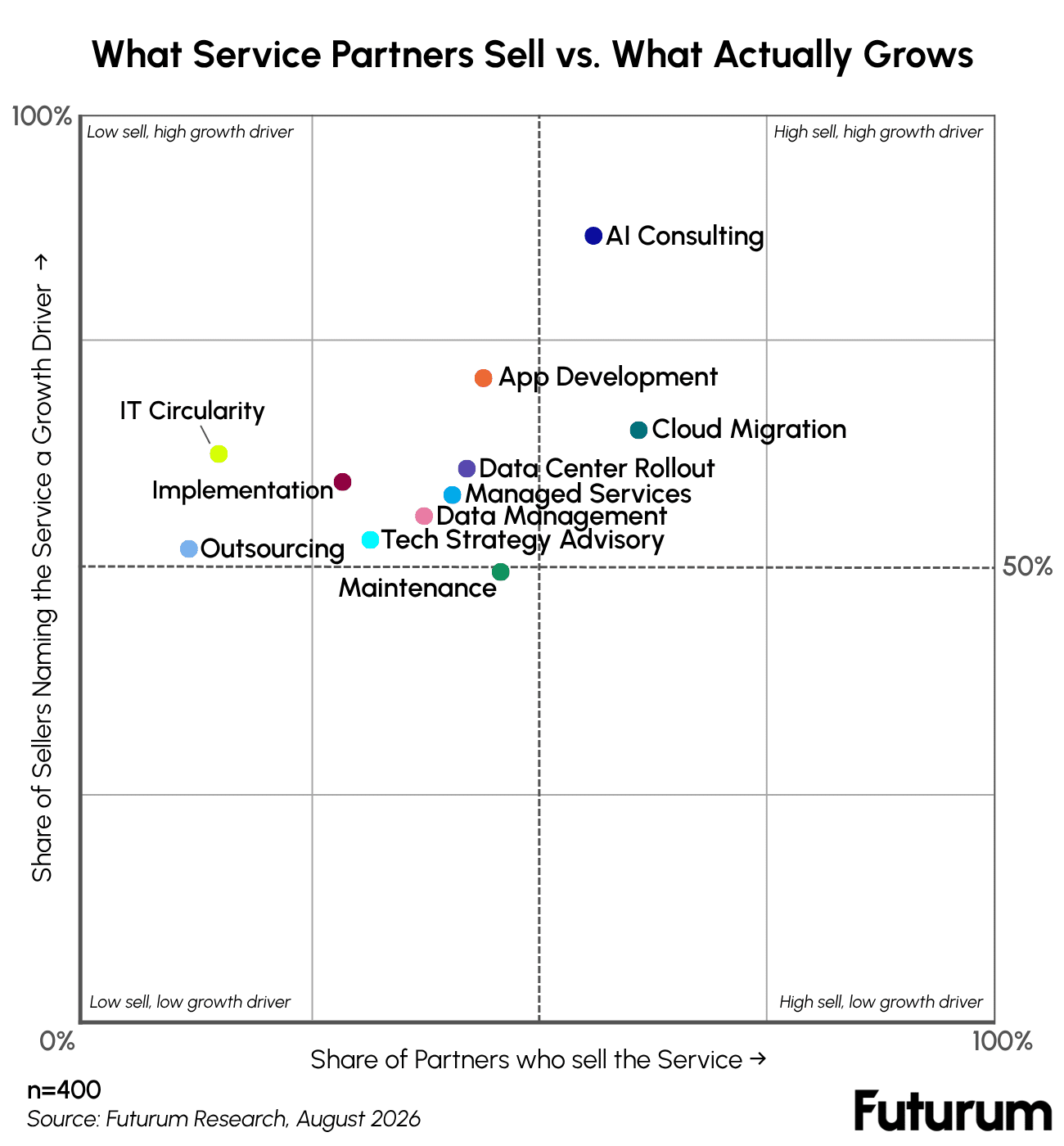
Custom application development remained the second-highest growth category across all services, with 71.0% of active partners identifying it as a primary growth driver. While packaged enterprise software sentiment collapsed (as previously discussed), demand for bespoke software engineering remained robust. Customers are seeking proprietary enterprise intellectual property built on top of open-source or commercial AI foundation models, preferring tailored workflows over general-purpose SaaS platforms.
Technology Strategy Advisory saw a +12.2% sentiment improvement compared to early 2026, with 53.2% of participating partners citing it as a growth vector. As multi-vendor environments grow increasingly complex (spanning multi-cloud, edge, on-premises AI clusters, and strict data governance protocols), customers are paying a premium for vendor-neutral strategic architecture advice.
Outsourcing services experienced the largest drop in partner participation across the survey, plummeting -30.3% compared to 1H 2026, down to just 11.5% overall participation. However, among the specialized partners remaining in the outsourcing space, growth sentiment jumped +19.3% (reaching 52.2%). This indicates consolidation: generalized partners are exiting low-margin commodity IT outsourcing, leaving a concentrated group of specialized managed service providers (MSPs) who command pricing power and high margins.
Simultaneously, IT Circularity services (hardware recycling, asset disposition, refurbishing) saw its participation drop to 14.8%, while growth sentiment dropped -8.0% compared to 1H 2026; the largest growth sentiment decline among all service categories. Corporate ESG mandates generated significant interest between 2022 and 2024, but 2026 spending patterns show that enterprises are reallocating capital toward immediate AI productivity, infrastructure modernization, and cybersecurity defense. Circularity services may be reverting to compliance checkboxes rather than strategic margin drivers for partners, if they are in the picture at all.
An Ecosystem in Active Transformation
The partner landscape is shifting from a technology-first to a services-first model, where value and growth are increasingly driven by specialized service offerings rather than the underlying hardware or software. In this new era, the business of reselling technology will narrow, favoring entities that can achieve massive scale or develop deep, specialized technical expertise.
Looking ahead, the partner ecosystem will be redefined by innovative business models that challenge traditional reselling and even legacy services frameworks. Partners that move beyond simple arbitrage and embed themselves in the custom application and strategic advisory value chain will secure their relevance. The evergreen challenge is stitching technology stacks, AI, and workflows together in a cohesive, outcome-oriented output, while packaging that into a consumable business model. All in all, no easy feat. But those who fail to evolve their operating models risk being left behind in a market where differentiation is no longer built on what you sell, but on how you enable customer outcomes.
What to Watch
- Enterprise Network Refresh Cycles: Monitor how quickly enterprise CIOs upgrade legacy campus and data center network fabrics to eliminate latency and telemetry bottlenecks as AI models transition from cloud sandboxes into distributed, multi-cloud enterprise deployments.
- Shift from COTS Software to Custom AI Solutions: Track customer adoption of bespoke software engineered via low-code and AI-assisted tools versus traditional COTS SaaS suites, evaluating whether custom IP builds continue to cannibalize merchant software licensing budgets.
- Vendor-Partner Conflict in Services Delivery: Watch for rising partner friction if major hardware and software vendors expand their own direct-service offerings, potentially competing with partners in high-growth areas such as AI consulting, systems integration, and technology strategy advisory.
Disclosure: Futurum is a research and advisory firm that engages or has engaged in research, analysis, and advisory services with many technology companies, including those mentioned in this article. The author does not hold any equity positions with any company mentioned in this article.
Analysis and opinions expressed herein are specific to the analyst individually and data and other information that might have been provided for validation, not those of Futurum as a whole.
Other Insights from Futurum
Runaway Token Costs Are Killing the Frontier AI Monolith
The Pricing Split: Why Core Software and AI Can’t Share One Commercial Model
From Technology to Intelligence
Author Information

Alex is Vice President & Practice Lead, Ecosystems, Channels, & Marketplaces at the Futurum Group. He is responsible for establishing and maintaining the Channels Research program as part of the overall Futurum GTM and Channels Practice. This includes overseeing the channel data rollout in the Futurum Intelligence Platform, primary research activities such as research boards and surveys, delivering thought-leading research reports, and advising clients on their indirect go-to-market strategies. Alex also supports the overall operations of the Futurum Research Business Unit, including P&L segmentation, sales and marketing alignment, and budget planning.
Prior to joining Futurum, Alex was VP of Channels & Enterprise Research at Canalys where he led a multi-million dollar research organization with more than 20 analysts. He played an integral role in helping the Canalys research organization migrate into Omdia after having been acquired in 2023. He is an accomplished research leader, as well as an expert in indirect go-to-market strategies. He has delivered numerous keynotes at partner-facing conferences.
Alex is based in Portland, Oregon, but has lived in numerous places, including California, Canada, Saudi Arabia, Thailand, and the UK. He has a Bachelor in Commerce and Finance Major from Dalhousie University, Halifax Canada.