Analyst(s): Brendan Burke, Olivier Blanchard
Publication Date: August 28, 2026
What Is Covered in This Article:
- NXP Tech Days Silicon Valley in Santa Clara on August 18, 2026, with more than 600 attendees and over 50 demonstrations
- Six industrial end markets, with data center and robotics newly broken out as the fastest growers
- The neural axis robotics architecture spanning drones, AMRs, and humanoids
- MCX A5 MCUs pairing 10BASE-T1S Ethernet, topology discovery, and post-quantum security at the endpoint tier
- Neutron NPU acceleration up to 172x over an equivalent CPU, eIQ model support, and data center MCU sockets from satellite management controllers to optical modules
The Event—Major Themes & Vendor Moves: The neural axis architecture that NXP outlined at Computex gained credibility in Santa Clara through reference designs for flight control units, humanoid hands, AMR safety retrofits, and satellite management controllers, backed by over 50 live demonstrations on the floor. Futurum’s edge silicon forecast frames the stakes at $278.1 billion in 2025, growing to $339.7 billion by 2030, with robotics the fastest-growing destination at a 9.9% CAGR. NXP’s Industrial & IoT segment grew 38% year over year to $755 million in Q2 FY 2026, so the edge AI cycle is paying the company well ahead of the humanoid volumes it projects for 2032 and beyond. The open question is timing. Industrial design cycles run years from reference design to production, which means the physical AI positioning will be judged on design wins disclosed between now and 2028.
NXP Tech Days Elevates Data Center and Robotics to Growth Engine Status
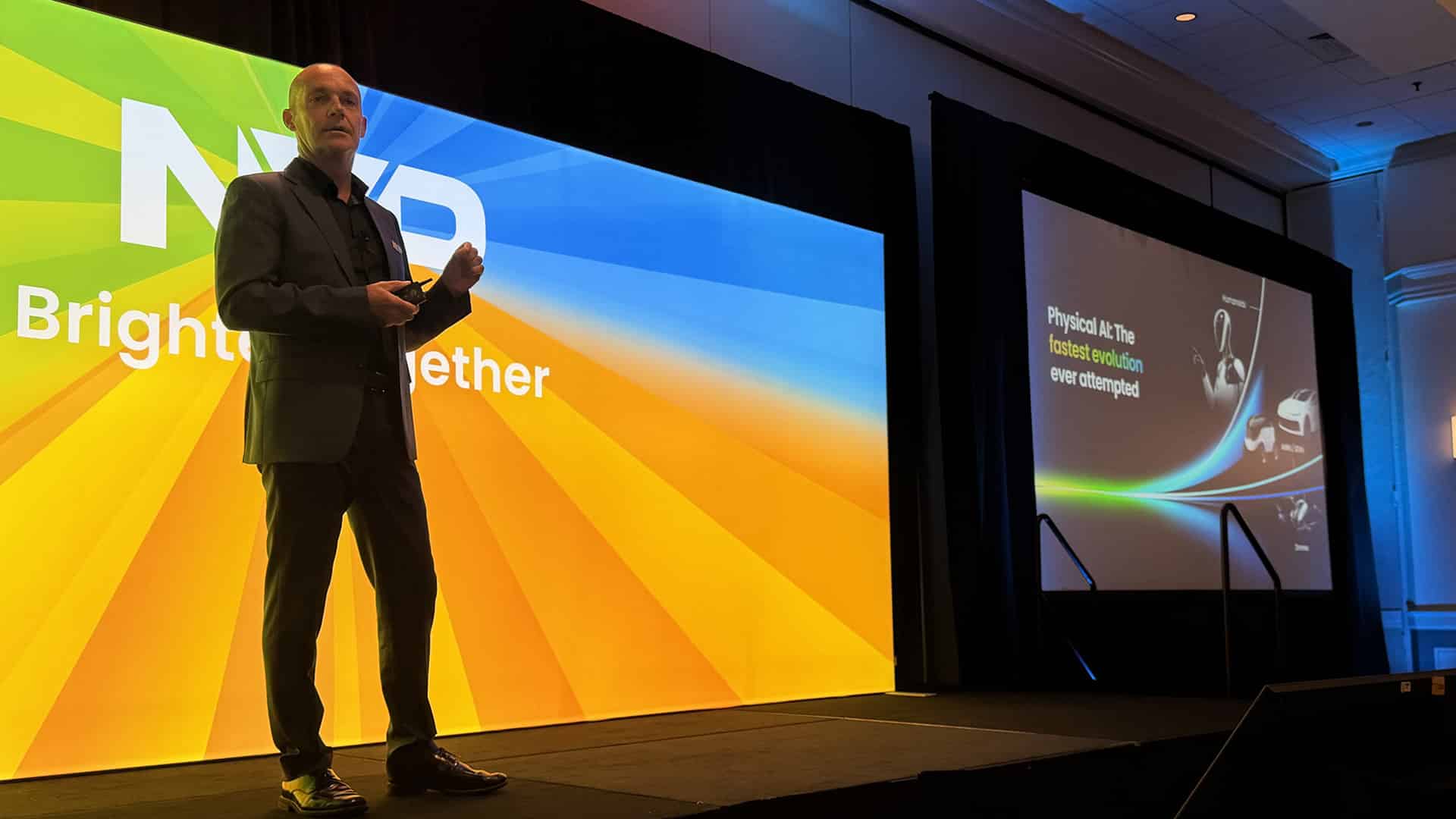
Dachs opened the analyst sessions with the three pressure points that recur across every industrial conversation: labor productivity, energy constraints, and resilience requirements enforced by regulation, with the CRA applying in full on December 11, 2027. His read is that all three push intelligence out of the control room and into distributed edge nodes, because local processing cuts latency, avoids the energy cost of moving data, and requires trust to be designed into every node. NXP now manages six industrial end markets: healthcare, building automation, robotics, factory automation, power and energy, and data center. Building automation and factory automation remain the largest.
Data center and robotics are growing fastest, and both were promoted to standalone status within the past two years, data center out of power and energy and robotics out of factory automation. NXP describes 60% to 70% of its industrial business as mass market, and its answer to that fragmentation is packaged depth: five solution levels running from bare component through reference designs up to pre-certified subsystems, with the port GmbH acquisition supplying the TSN and OPC UA protocol stacks that make the networking production ready. NXP is monetizing a fragmented buyer base that forces component-only competitors into key-account economics.
The Neural Axis Architecture Claims the Robot’s Body While NVIDIA Keeps the Brain
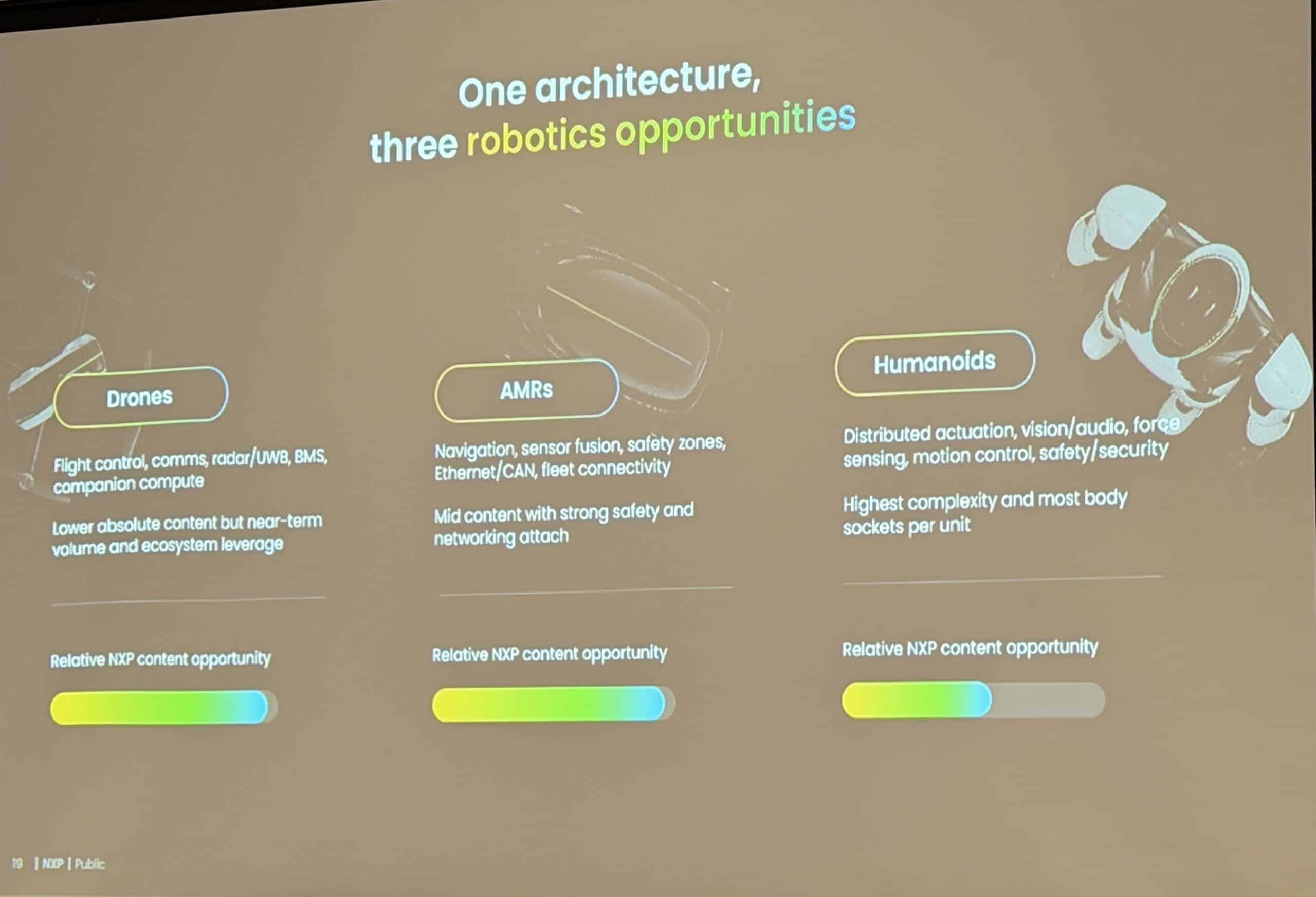
NXP mapped the “neural axis” onto human anatomy: a cerebrum layer running foundation and vision-language-action models, a cerebellum layer for sensor fusion and real-time motion orchestration, and a reflexive layer where motor control loops and safety networks act locally. NXP’s internal attach-rate modeling leads to ambitious content estimates: close to 100% of drone semiconductor content addressable, the majority in AMRs, and roughly 50% of humanoid dollar content, with NVIDIA-class compute modules taking the other half. Those figures deserve validation against production bills of material.
The engagement list gives the estimates some weight:
- Boston Dynamics began with NXP audio silicon for AI noise cancellation and has extended the collaboration into vision and ultra-wideband follow-me capability.
- A quadruped maker in China reached production on an MCX motor-control reference design within a compressed timeline.
- A Chinese logistics AMR operator retrofitted certified safety using MCX and i.MX RT1180 designs.
NXP already publishes a reference design for a humanoid hand and is extending it across a full kinematic chain, a modular subsystem approach that lets an OEM replace a broken finger without recertifying the whole robot. Networking is the enabling layer once again: Aviva Links ASA SerDes for 10 Gbps asymmetric sensor backbones, gigabit Ethernet with TSN in the limbs, and short-range wireless links running up to 11 Gbps that remove fragile cables across humanoid joints. Futurum’s forecast supports the priority, with robotics growing from $10.5 billion in 2025 to $16.6 billion by 2030, while NXP itself dates the humanoid volume inflection to 2032.
MCX A5 Extends NXP’s Networking Moat to the Cheapest Node on the Wire
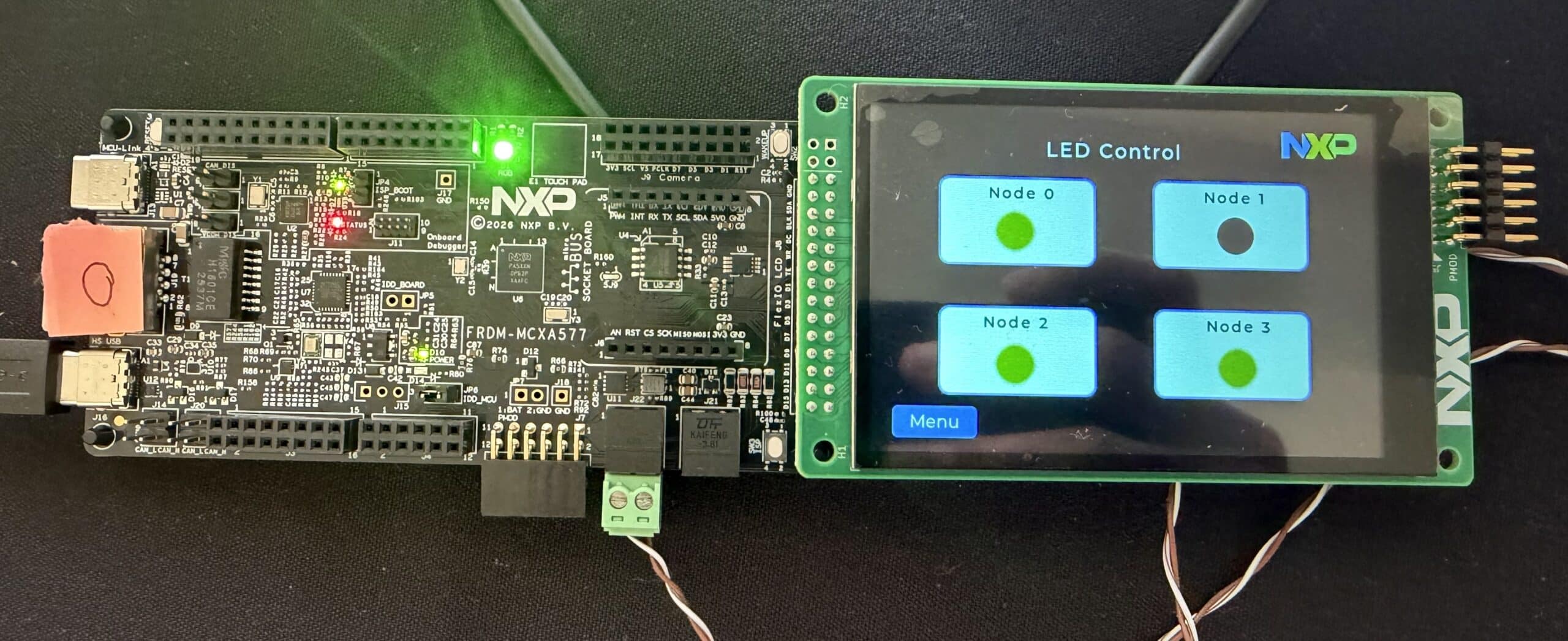
The launch, timed to the event, the MCX A5 family, tests whether the networking franchise will reach the endpoint tier. Futurum’s full analysis of the announcement assesses that the MCX A5 is the first MCU to combine an integrated 10BASE-T1S digital PHY, standards-based topology discovery that locates every node on a multidrop bus to within centimeters, and a post-quantum hardware root of trust. Power over the data line removes the separate supply wiring that RS-485 installations require. The demonstration floor brought the argument to life. Four MCXA577 boards exchanged live temperature readings and LED control commands over a single twisted pair Ethernet connection, with the integrated 10BASE-T1S PHY and Physical Layer Collision Avoidance (PLCA) providing deterministic, collision-free access, no external Ethernet switch, and no central controller.
At the analyst day, NXP’s leaders stated the strategic intent that once every damper, sensor, and actuator has an IP address and a discoverable physical location, the field bus becomes a queryable asset inventory that defensive software agents can read. The competitive field answers with two-chip architectures, Microchip’s LAN8650 and onsemi’s NCN26010 MAC-PHYs attached to a host MCU over SPI. Futurum sees no announced part matching the single-die combination. The same networking capability spans NXP’s three edge theaters of in-vehicle networks, robot bodies, and the factory floor. That breadth can be a moat. IEEE 802.3cg has stalled outside automotive for seven years, which keeps the moat a thesis until T1S node volumes appear in buildings and factories.
Neutron NPU Benchmarks Make eIQ the On-Ramp for Edge AI Models
The edge AI ecosystem story runs through software. NXP owns the Neutron NPU IP outright and scales it from 32 to roughly 4,000 operations per cycle across MCX microcontrollers, i.MX RT crossover parts, and i.MX applications processors, so one compiled model artifact moves across the portfolio. The benchmark data shown at NXP Tech Days came from MLPerf Tiny workloads on the i.MX RT700 measured against a stock Cortex-M33: 18x on anomaly detection, 70x on keyword spotting, 98x on visual wake words, and 172x on image classification. The numbers are NXP-run and await third-party reproduction, and the presenter cautioned attendees against cross-vendor TOPS comparisons.
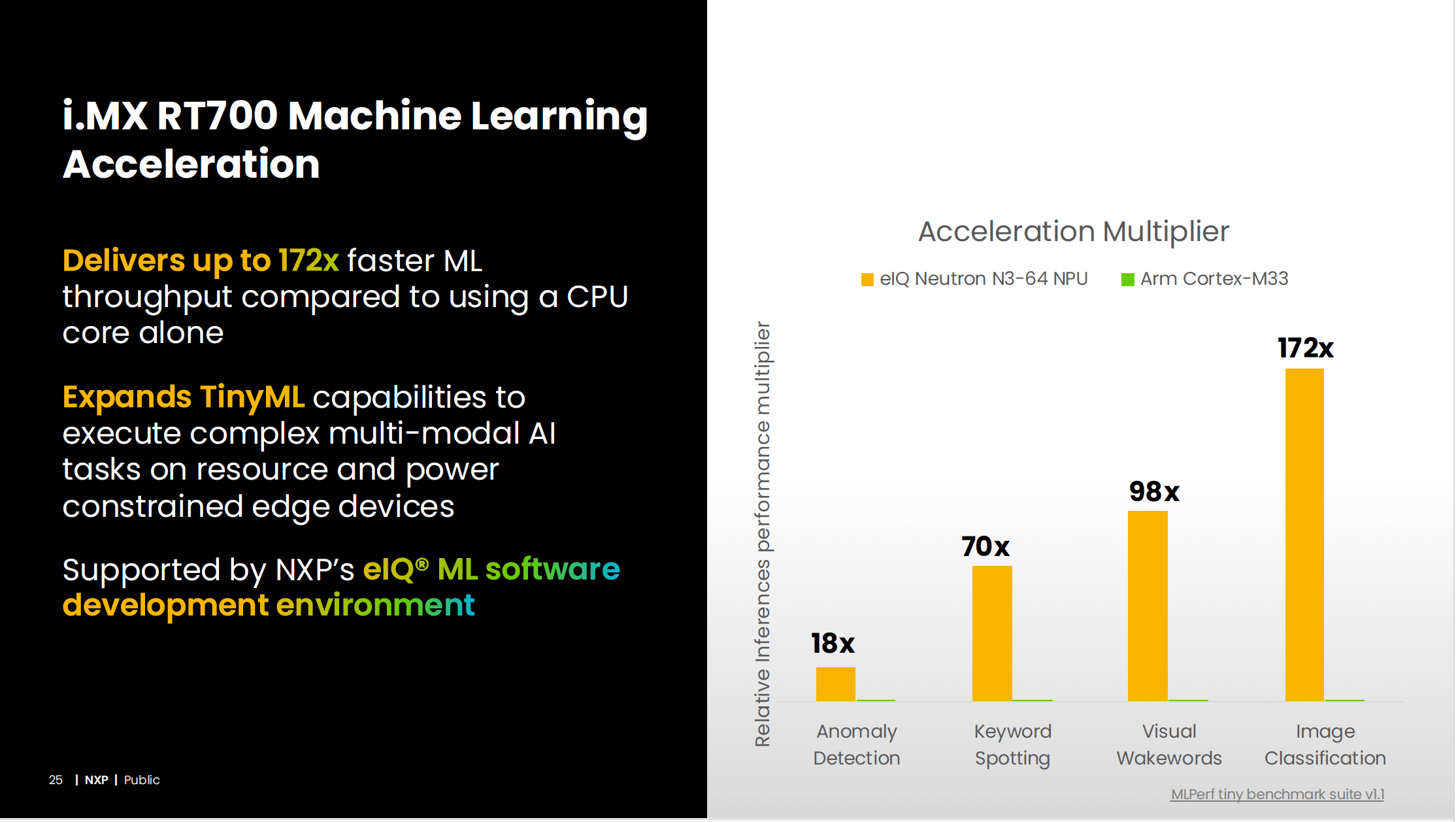
The eIQ toolchain is the durable asset. The Neutron compiler can ingest a quantized TensorFlow Lite model, map supported operators to the NPU, and rely on the Cortex core for the rest, with an inference engine footprint of roughly 100 KB of flash and 10 KB of RAM. eIQ Time Series Studio generates candidate models from a customer’s own sensor data and ranks them by flash, RAM, and accuracy, built for industrial developers without ML staff, and a Model Zoo partnership validates models on i.MX RT700 and MCX N hardware before download. Dachs set the goal as compressing model optimization for a given application from months to days, the correct target for a buyer base that stalls on deployment engineering long before it stalls on TOPS.
Data Center Progress Turns Automotive Discipline Into Control Plane Sockets
The data center track offered the most concrete near-term sockets of the event. NXP frames the opportunity around the control plane: satellite management controllers (SMCs) that give every fan, power supply, and SSD its own monitored microcontroller, I/O expansion behind board management controllers (BMCs), and the MCUs inside optical modules that keep transceiver DSPs thermally stable.
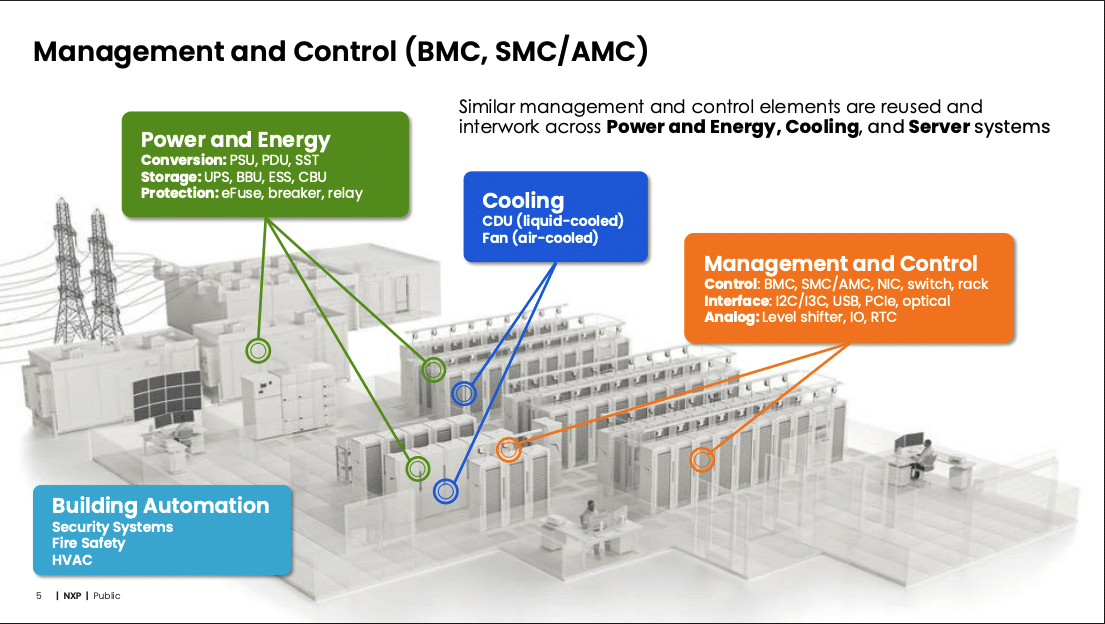
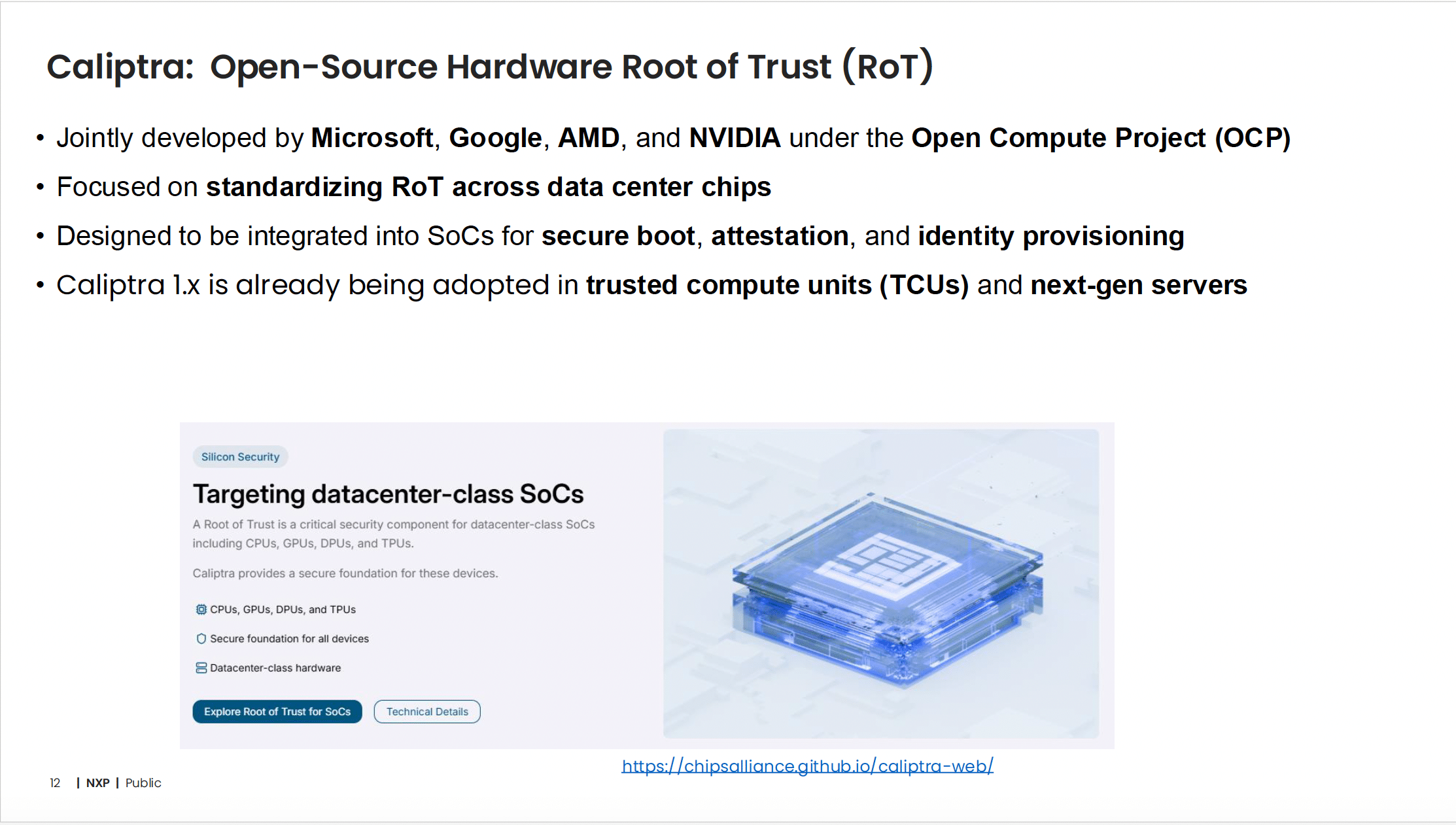
The scale math makes small sockets interesting. NXP cited racks moving toward 1.5 MW, a couple thousand optical links in a Vera Rubin-class rack, annual link failure rates of 0.5% to 1%, and GPU platform refreshes every 6 to 12 months, all inside a market NXP says is growing 30% annually. The standard posture is the differentiation. NXP is an early mover on MCTP over USB for BMC-to-SMC links, demonstrated with NVIDIA at OCP’s EMEA Summit, and it signaled forthcoming support for Caliptra, the open root of trust that Microsoft, Google, AMD, and NVIDIA drove through OCP. Those catalysts can make NXP data center attach a percentage of the $3.7 trillion in data center capex that Futurum forecasts for 2030.
Overall, automotive remains the anchor that feeds the Physical AI expansion. It still produces the majority of NXP’s revenue; its SerDes, TSN, and functional safety assets reappear in robots and racks; and Dachs described the Kinara NPU acquisition as driven by physical AI entering the car. Due to customer demand, the end markets are blurring, and NXP no longer builds a technology for just one of them.
What to Watch:
- Whether NXP begins disclosing robotics and data center revenue as both segments scale
- Whether the MCX A5 design wins outside building automation is announced before Q4 2026 availability
- Whether third parties reproduce the Neutron NPU MLPerf Tiny results on shipping silicon
- Whether the MCTP over USB demonstration with Marvell at OCP Global Summit converts into hyperscaler SMC qualifications
- Whether humanoid customers name NXP subsystem reference designs ahead of the 2032 volume inflection, NXP projects
You can read more about the event series on NXP’s Technology Days website.
Disclosure: Futurum is a research and advisory firm that engages or has engaged in research, analysis, and advisory services with many technology companies, including those mentioned in this article. The author does not hold any equity positions with any company mentioned in this article.
Analysis and opinions expressed herein are specific to the analyst individually and data and other information that might have been provided for validation, not those of Futurum as a whole.
Other Insights From Futurum:
Can NXP MCX A5 MCUs Secure the Industrial Edge Before Agentic Attackers Arrive?
NXP Q2 FY 2026: AI at the Edge Strengthens Automotive and Industrial Demand
Author Information

Brendan is Research Director, Semiconductors, Supply Chain, and Emerging Tech. He advises clients on strategic initiatives and leads the Futurum Semiconductors Practice. He is an experienced tech industry analyst who has guided tech leaders in identifying market opportunities spanning edge processors, generative AI applications, and hyperscale data centers.
Before joining Futurum, Brendan consulted with global AI leaders and served as a Senior Analyst in Emerging Technology Research at PitchBook. At PitchBook, he developed market intelligence tools for AI, highlighted by one of the industry’s most comprehensive AI semiconductor market landscapes encompassing both public and private companies. He has advised Fortune 100 tech giants, growth-stage innovators, global investors, and leading market research firms. Before PitchBook, he led research teams in tech investment banking and market research.
Brendan is based in Seattle, Washington. He has a Bachelor of Arts Degree from Amherst College.

Olivier Blanchard is Research Director, Intelligent Devices. He covers edge semiconductors and intelligent AI-capable devices for Futurum. In addition to having co-authored several books about digital transformation and AI with Futurum Group CEO Daniel Newman, Blanchard brings considerable experience demystifying new and emerging technologies, advising clients on how best to future-proof their organizations, and helping maximize the positive impacts of technology disruption while mitigating their potentially negative effects. Follow his extended analysis on X and LinkedIn.