Analyst(s): Brendan Burke, Olivier Blanchard
Publication Date: August 20, 2026
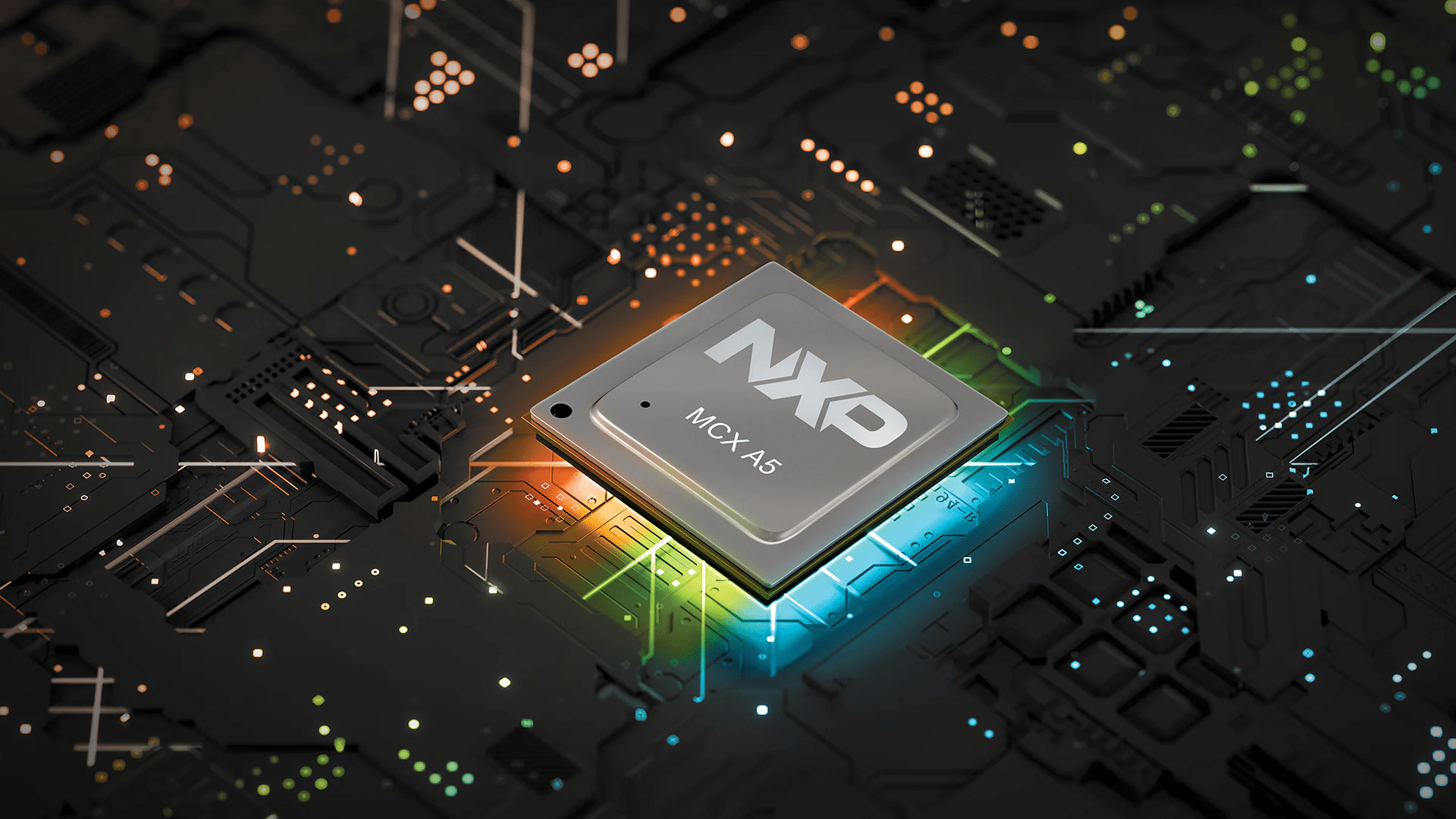
NXP announced the MCX A5 family of MCUs, the first to combine an integrated 10BASE-T1S Ethernet digital PHY, network topology discovery, and a post-quantum hardware root of trust in a single microcontroller. Futurum reads the launch as a compounding of NXP’s two strongest edge franchises, networking and security, aimed at the moment when both attackers and defenders deploy AI agents against industrial networks.
What Is Covered in This Article:
- NXP announced the MCX A5 MCU family, built on an Arm Cortex-M33 core running up to 240 MHz with up to 2 MB flash and 640 KB RAM, sampling now with availability expected in Q4 2026.
- The family integrates a 10BASE-T1S Ethernet digital PHY that brings IP-based, multidrop single pair Ethernet to field bus nodes over roughly 25 meters, replacing RS-485 and CAN links that leave devices invisible to the network.
- Topology discovery, an industry first on a wired MCU by NXP’s account, uses time-of-flight measurement to locate every node on the bus within a few centimeters, converting the field bus into a queryable asset inventory.
- A post-quantum hardware root of trust built on NXP’s co-authored ML-KEM standard anchors secure boot, firmware updates, attestation, and debug authentication, with PSA Certified Level 3 security and Rust support on selected devices.
- Futurum assesses the agentic security implications: Anthropic’s disclosure of an AI-orchestrated espionage campaign that executed 80% to 90% of attack tasks autonomously makes machine-readable network visibility at the edge a defensive requirement rather than a convenience.
The News: NXP Semiconductors N.V. (NASDAQ: NXPI) announced the MCX A5 family of microcontrollers for industrial and IoT edge applications on August 18. The family delivers what NXP describes as the industry’s first implementation of topology discovery on a wired MCU with an integrated 10BASE-T1S Ethernet digital PHY, secured by post-quantum cryptography (PQC). The MCX A5 is built on an ArmCortex-M33 core running up to 240 MHz, offers up to 2 MB flash and 640 KB RAM, and provides UART, I²C, I3C, SPI, CAN FD, High-Speed USB, and FlexIO interfaces. Paired with NXP’s TJF1410 Physical Medium Dependent transceiver as the analog front end, the family forms a complete IEEE 802.3cg- compliant single pair Ethernet node for industrial automation, building automation, and energy infrastructure. Security features include PSA Certified Level 3 and a PQC-based hardware root of trust spanning secure boot, secure firmware updates, secure attestation, and secure debug authentication.
Selected devices support the Rust programming language, and the family runs Zephyr RTOS alongside NXP’s MCUXpresso SDK with Long Term Support releases. “Industrial edge AI cannot realize its full potential without access to real-time data, requiring developers to have expertise in networking, security, software, and long product lifecycles,” said Charles Dachs, Executive Vice President and General Manager, Secure Connected Edge, NXP Semiconductors.
Early customer CAREL points to the same pairing: “The future of industrial AI depends on access to trusted data, requiring connectivity, cybersecurity, and AI to work together seamlessly,” said Paolo Faraldi, Chief Technology Officer, CAREL. The MCX A5 family is sampling now and is expected to be available in Q4 2026.
Can NXP MCX A5 MCUs Secure the Industrial Edge Before Agentic Attackers Arrive?
Analyst Take: The NXP MCX A5 arrives as a modest-sounding microcontroller launch that compounds NXP’s two most defensible edge franchises into a single die. The company has shipped Ethernet-capable silicon for years through the i.MX RT1180 and Layerscape lines, and their cryptographers co-authored CRYSTALS-Kyber, the sole key encapsulation mechanism NIST standardized as ML-KEM in 2024. The MCX A5 pushes both assets down to the cheapest, most numerous tier of industrial silicon: the Cortex-M33 endpoint controller inside a sensor, actuator, or damper.
Futurum sizes the edge AI applications market at roughly $40 billion by 2030, growing near 30% annually, and the binding constraint on that growth is trusted data from brownfield equipment still speaking RS-485. A microcontroller that gives every field bus node an IP address, a verifiable identity, and a discoverable physical location attacks that constraint at its source. The timing question is whether NXP can seed a seven-year-old Ethernet standard across industrial networks before AI agents, offensive and defensive alike, make network visibility at the edge a procurement requirement.
Topology Discovery Converts the Field Bus Into an Inventory Defensive Agents Can Read
The security argument for the NXP MCX A5 begins with an uncomfortable fact about industrial networks: operators frequently maintain node inventories by hand, on spreadsheets, keyed to rotary dials and DIP switches. An RS-485 multidrop bus tells a PLC that devices respond to polling; it reveals nothing about what else sits on the wire. The MCX A5 implements the topology discovery feature of the IEEE 802.3cg standard, sending a ping across the bus with collision avoidance disabled and measuring propagation delay to return every node’s address, ordering, and physical position within a few centimeters.
NXP states it is the first to implement this in a wired MCU, a claim that awaits teardown of competing silicon but matches Futurum’s read of the announced field. The implication is that the network audit that today requires a technician walking a factory floor becomes a query. That query matters more after November 2025, when Anthropic disclosed the first reported AI-orchestrated cyber espionage campaign: a state-sponsored group used agentic tooling to run reconnaissance, exploit development, lateral movement, and exfiltration against roughly 30 organizations, with AI executing 80% to 90% of attack tasks. Reconnaissance is the phase agents automate first, and industrial edge devices that lack IP addresses are invisible to defenders while remaining reachable to an attacker who compromises the gateway, polling them.
Defenders are moving to agents as well: Futurum’s 1H 2026 Enterprise Software Decision Maker Survey of 830 global IT decision-makers found cybersecurity is the leading function for planned agentic AI deployment, cited by 58.7% of enterprises. A defensive agent is only as good as the asset inventory it can enumerate, and topology discovery gives it ground truth: a new node on the bus, a node whose position moved, a node that fails attestation, each becomes a machine-readable signal rather than a gap in a spreadsheet. NXP echoed this framing in its analyst briefing, noting that agents “are going to need to have access and visibility,” and that discovery lets an operator know exactly what is on the network at the press of a button.
The NXP MCX A5 Post-Quantum Root of Trust Lands Ahead of the Mandates That Will Require It
Post-quantum cryptography (PQC) in an endpoint-class microcontroller sounds premature until the deployment math is done: Industrial nodes ship for 10 to 20 years of field life; the BSI, Germany’s federal security office, expects cryptographically relevant quantum computers early in the 2030s; the US CNSA 2.0 timeline requires software and firmware signing to use exclusively quantum-resistant algorithms by 2030. A device designed in 2026 on classical ECC signatures will spend most of its service life inside the window where a quantum-capable adversary could forge its firmware updates.
NXP’s own post-quantum migration whitepaper quantifies why this is hard at the MCU tier: an ECC-256 key occupies roughly 32 bytes, while an ML-KEM-768 public key requires 1,184 bytes and an ML-DSA-65 secret key reaches 4,000 bytes, with fast ML-DSA implementations consuming around 50 KiB of RAM on devices that may have 16 KiB total. The MCX A5 answers with dedicated PQC acceleration and 640 KB of RAM, sized so the root of trust fits without crowding the application.
Regulation shortens the runway. The European Cyber Resilience Act begins enforcing vulnerability reporting obligations on September 11, 2026, weeks after this launch, and applies in full on December 11, 2027; products with digital elements sold into the EU will need demonstrable secure update mechanisms across their lifecycle. The bear case deserves equal weight. NXP’s PQC implementation claims, including the performance of its accelerators under side-channel countermeasures, remain vendor-supplied until third-party certification and customer silicon validation during the sampling period; PSA Certified Level 3 covers the security architecture, and the PQC-specific behavior is the part procurement teams should test. Rust support on selected devices addresses the memory-safety class of vulnerabilities that no cryptography fixes, a quieter feature that may age as well as the PQC block.
Beyond Security: Advanced Device Management For Improved Operational Efficiency, Product Lifecycles, and Peace of Mind
Embedding advanced telemetry and device management capabilities directly into microcontrollers also aims to bring new layers of control for facilities managers, IT departments, and equipment vendors alike. Enterprises have already been capitalizing on AI-enabled devices’ new on-chip remote management-enabling capabilities, paired with AI-powered device management platforms, to detect, diagnose, and correct problems, flag out-of-date software, analyze usage and lifecycle metrics, predict impending device failures, optimize performance, and both recommend courses of action or take action autonomously, as needed. While these types of capabilities have been in use with more complex devices like PCs and printers in the enterprise, and larger equipment in manufacturing, logistics and transportation, adding microcontrollers to that managed ecosystem makes sense, not only for security reasons already covered in our analysis, but also to boost operational efficiency, lower TCO, schedule maintenance, trigger system updates, reduce downtime, and prevent critical system failures. This capability is equally applicable whether the device operates on a factory floor, in a hospital, inside a home, in the air, or along congested highways, and will become increasingly important as physical AI scales to the Edge.
Integration Is the Wedge Against a Two-Chip Competitive Field
Mapped against the field, the MCX A5’s differentiation is consolidation. Microchip’s LAN8650/LAN8651 and onsemi’s NCN26010 are 10BASE-T1S MAC-PHY controllers that attach to a host MCU over SPI, a two-chip architecture with two bills of material and two firmware surfaces; Analog Devices’ ADIN1110 and ADIN2111 target the long-reach 10BASE-T1L segment of process automation rather than the multidrop T1S topology. On the security flank, STMicroelectronics’ ST54M brings a PQC accelerator to mobile, Infineon’s PSOC Control C3 aligns industrial control MCUs with CNSA 2.0, and Microchip’s PIC64HX MPUs implement ML-KEM and ML-DSA for the intelligent edge. Each competitor covers one flank; Futurum finds no announced part that combines the T1S digital PHY, standards-based topology discovery, and a PQC root of trust in one MCU. NXP also gains a portfolio effect: MCX A5 endpoints feed the i.MX RT1180’s TSN-capable Ethernet switch and i.MX applications processors upstream, the stack NXP reinforced with its port GmbH industrial middleware acquisition.
The risk sits in the standard’s track record rather than the silicon. IEEE 802.3cg was ratified in 2019, and seven years on, deployed T1S device volume in industrial settings rounds to zero; adoption to date concentrates in automotive zonal architectures. NXP’s counter is that brownfield upgrades move in stages, a conveyor line or damper loop at a time, and its lead engagements sit in building automation, where RS-485 installations are ripe for replacement. Microchip could integrate its MAC-PHY into a PIC or SAM core within a design cycle, and the openness of 802.3cg means NXP’s evangelism benefits every T1S vendor. Pricing discipline will decide the wedge: NXP argues the integrated part removes the translation gateway and its application software from the system cost, and that claim will be tested against two-chip BoMs once volume pricing is published at launch. Availability in Q4 2026 puts meaningful revenue in 2028 and beyond, inside NXP’s Industrial & IoT segment, which grew 38% year over year to $755 million in Q2 FY 2026.
What to Watch:
- Certification and Validation Milestones: Third-party PSA-certified Level 3 listings for MCX A5 devices, and any published side-channel evaluation of the PQC accelerators during the sampling window through Q4 2026, would convert vendor security claims into procurement evidence.
- Cyber Resilience Act Enforcement: Vulnerability reporting obligations begin September 11, 2026, and full application lands December 11, 2027; watch whether industrial OEMs cite CRA compliance in MCX A5 design wins, which would confirm regulation as the demand driver Futurum expects.
- Competitive Integration: A Microchip or onsemi announcement folding a 10BASE-T1S MAC-PHY into a general-purpose MCU, or an STMicroelectronics or Infineon industrial MCU pairing PQC with single pair Ethernet, would compress NXP’s differentiation window before volume availability.
- T1S Ecosystem Traction: Shipped 10BASE-T1S node volumes outside automotive during 2027, and whether building automation OEMs publicize deployments, will show if the standard’s seven-year adoption stall is breaking.
- Agentic Security Integration: Announcements connecting topology discovery data to security operations tooling or defensive agents, from NXP partners or network management vendors, would validate the visibility thesis at the center of this launch.
See the complete announcement of the MCX A5 family on the NXP website.
Disclosure: Futurum is a research and advisory firm that engages or has engaged in research, analysis, and advisory services with many technology companies, including those mentioned in this article. The author does not hold any equity positions with any company mentioned in this article.
Analysis and opinions expressed herein are specific to the analyst individually and data and other information that might have been provided for validation, not those of Futurum as a whole.
Other Insights From Futurum:
NXP Q2 FY 2026: AI at the Edge Strengthens Automotive and Industrial Demand
Thales Launches Luna 8: A Quantum-Ready Security Solution for the AI Era
A Loud Floor and a Quiet Gap: Security Summer Camp 2026
Featured Image: NXP
Author Information

Brendan is Research Director, Semiconductors, Supply Chain, and Emerging Tech. He advises clients on strategic initiatives and leads the Futurum Semiconductors Practice. He is an experienced tech industry analyst who has guided tech leaders in identifying market opportunities spanning edge processors, generative AI applications, and hyperscale data centers.
Before joining Futurum, Brendan consulted with global AI leaders and served as a Senior Analyst in Emerging Technology Research at PitchBook. At PitchBook, he developed market intelligence tools for AI, highlighted by one of the industry’s most comprehensive AI semiconductor market landscapes encompassing both public and private companies. He has advised Fortune 100 tech giants, growth-stage innovators, global investors, and leading market research firms. Before PitchBook, he led research teams in tech investment banking and market research.
Brendan is based in Seattle, Washington. He has a Bachelor of Arts Degree from Amherst College.

Olivier Blanchard is Research Director, Intelligent Devices. He covers edge semiconductors and intelligent AI-capable devices for Futurum. In addition to having co-authored several books about digital transformation and AI with Futurum Group CEO Daniel Newman, Blanchard brings considerable experience demystifying new and emerging technologies, advising clients on how best to future-proof their organizations, and helping maximize the positive impacts of technology disruption while mitigating their potentially negative effects. Follow his extended analysis on X and LinkedIn.