Analyst(s): Brad Shimmin, Brendan Burke, Fernando Montenegro, Nick Patience
Publication Date: April 29, 2026
Google Cloud Next 2026 marked the end of the generative AI honeymoon phase, ushering in a hard-nosed era of production-scale autonomous agents. Looking across more than 260 announcements made at the show, several stood out to Futurum analysts, including the Gemini Enterprise Agent Platform, the Virgo megascale network fabric, and an Agentic Defense strategy for both Google Security Operations and Wiz to automate threat response. These innovations represent a structural evolution designed to ground AI in a business context while solving the persistent challenge of multi-cloud integration complexity.
What is Covered in This Article:
- Google Cloud’s evolution of Vertex AI into the Gemini Enterprise Agent Platform provides a comprehensive environment for building, governing, and optimizing autonomous agents.
- The introduction of the Agentic Data Cloud and Knowledge Catalog unifies business semantics to provide agents with a reliable, grounded context for decision-making.
- The launch of the Virgo megascale data center fabric and eighth-generation TPUs (8t and 8i) to support the explosive bandwidth and compute demands of agentic workflows.
- The formal integration of Wiz into the Google Cloud security stack, powering an Agentic Defense strategy that employs specialized agents for automated threat hunting and detection engineering.
- Strategic incentives for the partner ecosystem, including a $750 million agentic innovation fund and the integration of third-party agents directly into the Gemini Enterprise marketplace.
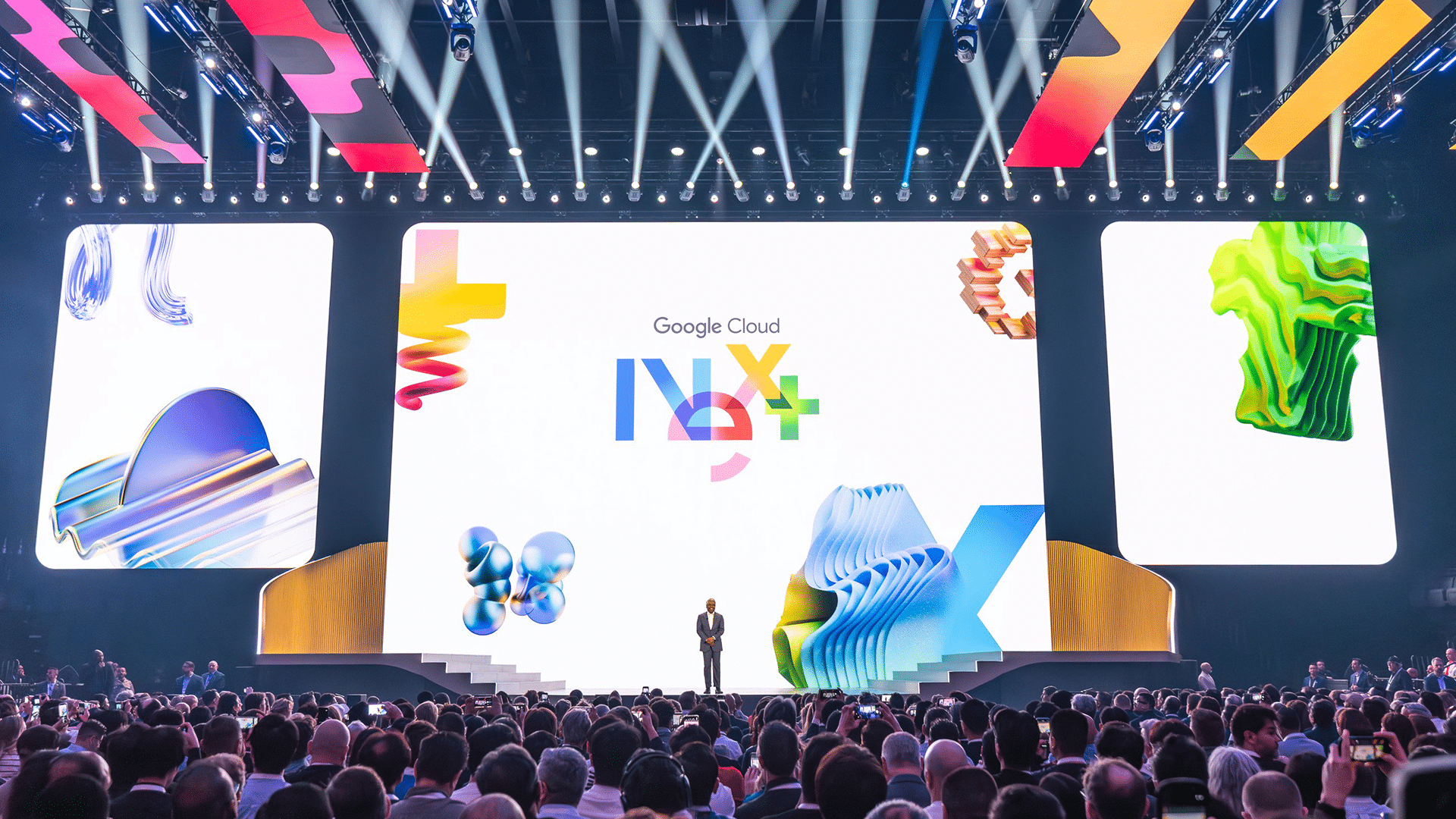
The Event — Major Themes & Vendor Moves: At Google Cloud Next 2026 in Las Vegas, Google Cloud CEO Thomas Kurian unveiled a unified stack strategy designed to move artificial intelligence from pilot projects into enterprise-wide production. The central theme of the event centered on the Agentic Enterprise, supported by the launch of the Gemini Enterprise Agent Platform and the Agentic Data Cloud. Google also showcased its hardware-layer dominance with the Virgo Network, a scale-out fabric capable of linking 134,000 chips in a single compute domain. Following its acquisition of Wiz, Google Cloud further detailed its Agentic Defense roadmap, introducing autonomous security agents that reduce triage times from minutes to seconds. To accelerate adoption, Google announced an Agent Gallery featuring specialized agents from partners including Oracle, Salesforce, and ServiceNow.
From Silicon to Security: Architecting the Autonomous Enterprise at Google Cloud Next 2026
Analyst Take: The announcements at Google Cloud Next 2026 confirm that the market has matured past the chatbot era, entering a much more complex and capable agentic phase. This shift in the Google Cloud Agentic Strategy highlights a move from systems of intelligence—which merely provide information—to systems of action, where agents execute tasks with the same independence as human team members. For enterprise leaders, this is a pragmatic response to the challenges highlighted in the 1H 2026 AI Platforms Decision Maker Survey Report, which found that while organizations run an average of 3.8 different models, they are increasingly concerned with agent reliability and the technical debt of legacy integration. Organizations further along in deployment encounter more production-level technical challenges, with ahead-of-the-curve firms reporting higher rates of agent reliability concerns than those trailing their peers.
Orchestrating with Gemini
Google’s evolution of Vertex AI into the Gemini Enterprise Agent Platform is a direct assault on the integration tax that has plagued enterprise IT for decades. By introducing the Agent Development Kit (ADK) and the Agent Gateway, Google is attempting to standardize how agents interact with each other and with third-party tools. According to the 2H 2025 Cybersecurity Global Enterprise Decision Maker Survey Report, 46% of buyers rank integration complexity as their top challenge, trailing only the difficulty of managing rapid technological changes. Google’s use of the Model Context Protocol (MCP) as a universal interface for data access suggests a future where agents can traverse disparate systems—from BigQuery to SAP or Salesforce—without the need for the fragile, manual ETL pipelines of the past.
The re-engineered Agent Runtime, which supports long-running agents that maintain state for days, addresses a critical gap in current AI implementations. Most generative AI today remains stateless and reactive, lacking the depth for sustained workflows. Google’s new architecture allows for persistent Memory Banks and Memory Profiles that give agents long-term context. This capability is essential for complex business processes like supply chain optimization or multi-step financial auditing. The runtime also delivers sub-second cold starts, allowing organizations to provision new agents in seconds to meet the dynamic needs of the autonomous enterprise.
Google is also addressing the governance gap that often halts AI projects prematurely. The introduction of Agent Identity assigns every agent a unique cryptographic ID, providing a verifiable identity for every autonomous action. This creates a clear, auditable trail that maps back to defined authorization policies, directly addressing concerns regarding the rise of shadow AI. This infrastructure supports a transition from trial-and-error experimentation to production-grade impact, providing the step-by-step visibility required to visualize the flow of intent across multi-agent workflows.
The Knowledge Catalog and Semantic Grounding
The transition to an Agentic Data Cloud represents a fundamental rethink of the data warehouse. In this new architecture, data is grounded in a Knowledge Catalog—an evolution of the Dataplex Universal Catalog—that infers business meaning through aggregation, continuous enrichment, and search. This solves the hallucination problem by ensuring that when an agent queries a metric such as net margin, it uses a defined, enterprise-wide definition rather than a probabilistic guess. The catalog learns how an enterprise actually uses data by analyzing usage logs and profiling data behind the scenes, ensuring that agents never fly blind when interacting with unstructured files in Google Cloud Storage.
The introduction of zero-copy federation with partners like Palantir, Salesforce, and Workday represents a major win for multi-cloud pragmatism. By allowing agents to query data in AWS or Azure without moving it, Google is positioning BigQuery as the central reasoning engine for the entire enterprise data estate. This aligns with findings from the 1H 2026 AI Platforms Decision Maker Survey Report, which notes that Stage 5 organizations uniquely prioritize uptime and availability, reaching 57.8%, while de-emphasizing inference cost. As organizations move into mission-critical production, the ability to access a borderless lakehouse that eliminates proprietary silos becomes a primary differentiator.
The Agentic Data Cloud also features breakthroughs, such as the Lightning Engine for Apache Spark, which delivers up to twice the price-performance of market alternatives. This performance leap is necessary to support the massive workload volume generated as organizations shift to agent scale. By merging analytical history with transactional power in a real-time loop, Google is closing the gap between thinking and doing, allowing agents to act with high-accuracy details and low latency.
Virgo and the Megascale Reality
The most significant long-term differentiator for Google Cloud may be the Virgo megascale data center fabric. As foundational models grow, general-purpose networks are reaching their breaking points. Virgo’s campus-as-a-computer philosophy, which can reach 47 petabits per second of non-blocking bisection bandwidth for a training cluster, offers the deterministic low latency required for massive training runs. For inference, Google’s Boardfly topology was co-designed with DeepMind to minimize the number of hops between any two chips in an inference cluster, trading some aggregate bandwidth for dramatically lower point-to-point latency. This architectural decoupling allows for independent evolution of network domains, ensuring that training and serving demands can be met without system-wide disruptions.
Chip architecture aligns with these non-blocking fabrics to build what can be a computational moat for agentic inference. In the TPU 8i, the Collectives Acceleration Engine resolves chip-to-chip bottlenecks by offloading data communication routines from tensor cores, allowing the main TPU compute cores to stay saturated on tensor math while synchronization happens in parallel on a separate execution path. The net effect is a reduction in the latency valleys that appear at layer boundaries in large distributed models.
While raw power defines the infrastructure layer, Google has engineered this hardware specifically to meet the extreme reliability requirements of the Agentic Era. In a system supporting up to 134,000 chips, hardware failures are inevitable. Virgo is engineered around fault isolation and deep observability, using sub-millisecond telemetry to pinpoint the root causes of slowdowns. Competitors focus on software optimizations instead of underlying protocol architecture, giving Google Cloud an edge in uptime that can attract frontier workloads.
Wiz and Agentic Defense Highlights
The welcoming of Wiz into Google’s security portfolio was, to us, the security highlight of Google Cloud Next 2026. We view Wiz as a strong beachhead for organizations navigating complex multi-cloud environments. Looking ahead, there is substantial potential for the Wiz Security Graph. Currently, it unifies context across the pipeline from code to cloud. Eventually, we suspect this graph could grow into a broader “world model” for cybersecurity, providing the deep, deterministic enterprise context that autonomous systems require to function safely.
This ambition is functionally supported by Wiz’s specific agent framework, which is designed to close the loop between detection and remediation. The “Red” agent autonomously tests external attack surfaces, while the “Blue” agent investigates. Crucially, the “Green” agent takes the validated risk and pushes root-cause fixes directly to a developer’s IDE or coding agent. This approach is a direct attempt to resolve the traditional friction between security and development teams.
Separately from the Wiz portfolio, Google is aggressively deploying its own native security operations agents inside its Security Operations offering. The Triage and Investigation agent has already handled millions of alerts, in some cases compressing typical 30-minute manual tasks into 60-second resolution cycles. Alongside this, new Threat Hunting and Detection Engineering agents actively write rules and generate hunt plans. Importantly, these agents are not generic models; they are informed by Mandiant’s frontline intelligence, providing an important trust layer for enterprise adoption. This signals an important direction Google is moving towards: shifting from “human-in-the-loop” operations to “human-on-the-loop” supervision of an autonomous state machine.
Furthermore, Google is working on access control for agentic deployments. By leveraging open standards such as Secure Production Identity Framework for Everyone (SPIFFE) and an Envoy-based agent gateway, Google assigns runtime agents distinct cryptographic identities, severing them from human user accounts. This converts opaque automation into more governable infrastructure.
Finally, we note that Google is treating data sovereignty as a critical adjacency to this security posture. Recognizing that regulatory environments are continually evolving, the company is positioning its sovereign cloud offerings, which range from data boundaries to partner-led fully air-gapped environments, as an enabler of innovation rather than a hindrance. By providing these strict, localized controls, Google aims to ensure enterprises do not have to choose between adopting advanced AI capabilities and maintaining compliance.
What to Watch:
- Agent Reliability and Trust: Despite the technical advances, the 1H 2026 AI Platforms Decision Maker Survey Report shows that agent reliability remains a top concern, with 58.5% of leading organizations flagging it as a primary challenge. Google’s Agent Simulation and Agent Evaluation frameworks will need to demonstrate they can detect subtle reasoning errors in high-stakes environments such as finance and healthcare.
- Marketplace Momentum: The 2H 2025 Hyperscaler Marketplace Market Sizing & Five-Year Forecast predicts that third-party software purchases through marketplaces will reach $41.8B by 2029. Google’s aggressive move to integrate partner agents from Salesforce, Workday, and ServiceNow directly into the Agent Gallery is a clear attempt to capture a larger share of this shifting procurement power.
- The Regulatory Headwind: As agents move from answering questions to executing transactions, they will trigger closer scrutiny from regulators concerned with autonomous commerce. Google’s new sovereign controls, which allow data processing and storage to be locked to specific regions like the US and EU, represent the first of many localized compliance hurdles.
- Competitive Counter-Moves: Watch for AWS and Microsoft Azure to respond with their own specialized networking fabrics and agent governance protocols. The battle has evolved beyond model performance; the new front is the provision of a reliable action fabric for the enterprise.
See the complete set of announcements made during Google Cloud Next 2026.
Disclosure: Futurum is a research and advisory firm that engages or has engaged in research, analysis, and advisory services with many technology companies, including those mentioned in this article. The author does not hold any equity positions with any company mentioned in this article.
Analysis and opinions expressed herein are specific to the analyst individually and data and other information that might have been provided for validation, not those of Futurum as a whole.
Other Insights from Futurum:
Google Splits Its TPU Line to Enter the Era of Agentic Silicon
Google’s $750M Partner Bet Resets the Agentic Channel Playbook
Google Splits Its TPU Line to Enter the Era of Agentic Silicon
Image Credit: Google
Author Information

Brad Shimmin is Vice President and Practice Lead, Data Intelligence, Analytics, & Infrastructure at Futurum. He provides strategic direction and market analysis to help organizations maximize their investments in data and analytics. Currently, Brad is focused on helping companies establish an AI-first data strategy.
With over 30 years of experience in enterprise IT and emerging technologies, Brad is a distinguished thought leader specializing in data, analytics, artificial intelligence, and enterprise software development. Consulting with Fortune 100 vendors, Brad specializes in industry thought leadership, worldwide market analysis, client development, and strategic advisory services.
Brad earned his Bachelor of Arts from Utah State University, where he graduated Magna Cum Laude. Brad lives in Longmeadow, MA, with his beautiful wife and far too many LEGO sets.

Brendan is Research Director, Semiconductors, Supply Chain, and Emerging Tech. He advises clients on strategic initiatives and leads the Futurum Semiconductors Practice. He is an experienced tech industry analyst who has guided tech leaders in identifying market opportunities spanning edge processors, generative AI applications, and hyperscale data centers.
Before joining Futurum, Brendan consulted with global AI leaders and served as a Senior Analyst in Emerging Technology Research at PitchBook. At PitchBook, he developed market intelligence tools for AI, highlighted by one of the industry’s most comprehensive AI semiconductor market landscapes encompassing both public and private companies. He has advised Fortune 100 tech giants, growth-stage innovators, global investors, and leading market research firms. Before PitchBook, he led research teams in tech investment banking and market research.
Brendan is based in Seattle, Washington. He has a Bachelor of Arts Degree from Amherst College.

Fernando Montenegro serves as the Vice President & Practice Lead for Cybersecurity & Resilience at The Futurum Group. In this role, he leads the development and execution of the Cybersecurity research agenda, working closely with the team to drive the practice's growth. His research focuses on addressing critical topics in modern cybersecurity. These include the multifaceted role of AI in cybersecurity, strategies for managing an ever-expanding attack surface, and the evolution of cybersecurity architectures toward more platform-oriented solutions.
Before joining The Futurum Group, Fernando held senior industry analyst roles at Omdia, S&P Global, and 451 Research. His career also includes diverse roles in customer support, security, IT operations, professional services, and sales engineering. He has worked with pioneering Internet Service Providers, established security vendors, and startups across North and South America.
Fernando holds a Bachelor’s degree in Computer Science from Universidade Federal do Rio Grande do Sul in Brazil and various industry certifications. Although he is originally from Brazil, he has been based in Toronto, Canada, for many years.

Nick Patience is VP and Practice Lead for AI Platforms at The Futurum Group. Nick is a thought leader on AI development, deployment, and adoption - an area he has researched for 25 years. Before Futurum, Nick was a Managing Analyst with S&P Global Market Intelligence, responsible for 451 Research’s coverage of Data, AI, Analytics, Information Security, and Risk. Nick became part of S&P Global through its 2019 acquisition of 451 Research, a pioneering analyst firm that Nick co-founded in 1999. He is a sought-after speaker and advisor, known for his expertise in the drivers of AI adoption, industry use cases, and the infrastructure behind its development and deployment. Nick also spent three years as a product marketing lead at Recommind (now part of OpenText), a machine learning-driven eDiscovery software company. Nick is based in London.