Customers are increasingly seeking out personalized experiences, but have become wary of third-party trackers, and other surreptitious means of capturing information about their behaviors and actions without their consent. However, the use of zero-party data, or data that a customer intentionally and proactively shares with a brand, increasingly is becoming an important personalization tool being leveraged by marketers.
A term first coined by Forrester, zero-party data differs from the other types of data commonly used by marketers to provide personalized products, services, and experiences. First-party data is behavioral data that encompasses a person’s site-wide, app-wide, and on-page behaviors. Examples of first-party data include website actions, such as click history, hovering, scrolling, and active time spent data, as well as information on how the person engages with personalized experiences, such as clicking on recommended products or services. First-party data also can include transactional data, including purchases and downloads, as well as offline data, if it has been captured and integrated into the customer profile.
Meanwhile, third-party data is obtained or purchased from sites and sources that are not owned by the organization, and typically includes demographic information, firmographic data, buying signals (e.g., in the market for a new home or new software), and additional information from customer relationship management (CRM), point-of-sale (POS), and call center systems. This information had most often been collected via the use of third-party cookies, or the digital breadcrumbs used to track cross-site web activity.
While both first-party and third-party data can be somewhat useful in crafting user experiences, as they provide a history of what types of content a user has engaged with in the past, the overall efficacy of relying on these types of data is suspect. For example, a user may click through on several items of interest to conduct research in the interest of completeness, but may only be considering items from one or two manufacturers. Similarly, browsing histories on the internet often are full of unrelated tangents that do not reflect interests that will be acted upon, and may not provide a true picture of a user’s interests and willingness to buy or engage with a company.
Increasingly, though, browser providers (e.g., Apple and Google) have been moving away from allowing the use of third-party cookies to clamp down on the high degree of digital tracking made possible through third-party cookies. Further, as industry regulations such as the General Data Protection Regulation (GDPR) and the California Consumer Privacy Act (CCPA) put an increased focus on safeguarding consumer privacy, both marketers and CX teams are placing a greater value on asking for, receiving, and using data supplied voluntarily by customers.
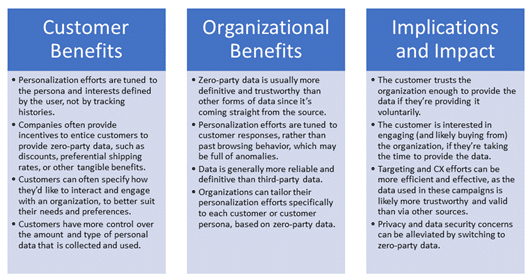
A shift to zero-party data can provide both organizational and customer benefits and may impact the CX market in several ways.
Will CX efforts be saved by zero-party data?
How to collect zero-party data for personalization
Zero-party data can be collected through several different mechanisms, each with its own benefits:
- Walled content forms: By restricting content, the company can identify and serve customers that are truly interested in the information held behind the wall, and are willing to trade their information for access.
- A newsletter signup: Like walled content, newsletters can allow an organization to directly engage with the customers or prospects that are most interested in an organization’s content or offerings. Direct sales or marketing pitches can be intermixed with educational information, thereby providing value to both the customer and the organization.
- Account creation: In addition to collecting basic information, such as a prospect’s name, address, and email, additional fields can capture specific areas or products of interests, as well as communication preferences, such as channel, frequency, and type of communication. This attention to customer preferences puts the customer first and may help develop a better rapport with customers.
- Quizzes and surveys: Some organizations can use quizzes or surveys to elicit zero-party data, particularly if they are positioned as a method to help an organization better personalize their experience.
- Customer feedback: Feedback forms can capture the thoughts on specific interactions with an organization and include questions designed to learn more about the customer.
The key to capturing zero-party data is to request only the data that is used to improve a customer’s experience or provide a more personalized approach. Explain why the information is being captured, how long it will be retained, and how providing that information will benefit the customer. It is also important to ensure that once a piece of data has been captured, the software or platform used to handle this information should not request it again for a set period (often a year), to avoid irritating the customer and making it appear as if the organization is not paying attention to the information provided.
Author Information

Keith Kirkpatrick is VP & Research Director, Enterprise Software & Digital Workflows for The Futurum Group. Keith has over 25 years of experience in research, marketing, and consulting-based fields.
He has authored in-depth reports and market forecast studies covering artificial intelligence, biometrics, data analytics, robotics, high performance computing, and quantum computing, with a specific focus on the use of these technologies within large enterprise organizations and SMBs. He has also established strong working relationships with the international technology vendor community and is a frequent speaker at industry conferences and events.
In his career as a financial and technology journalist he has written for national and trade publications, including BusinessWeek, CNBC.com, Investment Dealers’ Digest, The Red Herring, The Communications of the ACM, and Mobile Computing & Communications, among others.
He is a member of the Association of Independent Information Professionals (AIIP).
Keith holds dual Bachelor of Arts degrees in Magazine Journalism and Sociology from Syracuse University.