If you were to create a word cloud to track the trending words in CX, “empathy” would take up some sizable real estate. The ability to understand the feelings of a customer can lead to a more personalized approach or offering, as well as better resolution to issues. CX practitioners and vendors are taking note. I recently spent 20 minutes on the phone with a customer service rep after my issue was not able to get resolved via messaging. Over the course of those 20 minutes, the rep stated that she understood me, understood the problem, and understood my frustration. The word “understood” was used 12 times during our interaction as the agent attempted to demonstrate that she saw my perspective and was sympathetic. Obviously, some empathy training had been leveraged.
Determining a customer’s underlying thoughts and feelings can be challenging, but there are many technologies that can assist with determining customer emotion, such as using text and sentiment analysis. However, these technologies are often used during or after an interaction. During my CX-PRO certification, the class explored the concept of empathy mapping. Empathy mapping is a visualization that can lay out user behaviors, attitudes, and actions in a way that allows the creator(s) to gauge customer feelings and perspective. Often used in user experience (UX), empathy mapping can also be employed by CX practitioners, marketing & sales, customer support, and product teams to do some empathy prep work that can be used to design a better experience for customers.
There are different versions of the empathy mapping template. In a simple version, there are four quadrants: says, thinks, does, and feels. Other versions include a section for “pains” and “gains.” As an example, the map below demonstrates a condensed empathy map created for a customer considering the purchase of a week-long beach hotel stay.
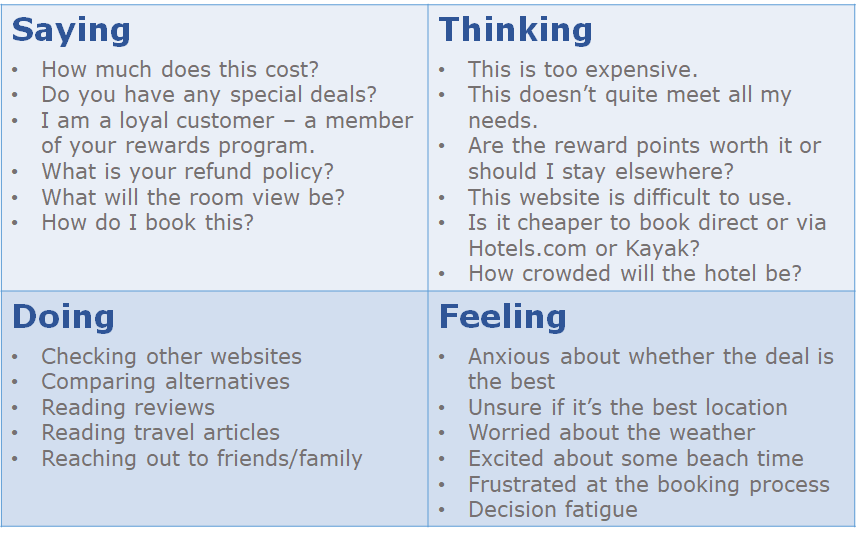
A 2020 research study from Genesys reported that 48% of customers noted a lack of compassion in the way they were treated, demonstrating there is a lot of work to be done on this issue. Empathy maps allow CX practitioners to contemplate not only the outward segments (saying/doing) of a customer journey, but also the inward (thinking/feeling). This information can be used to improve upon a process or experience, identify knowledge gaps, and be proactive in the type of response so the customer feels they are understood.
Author Information

As a detail-oriented researcher, Sherril is expert at discovering, gathering and compiling industry and market data to create clear, actionable market and competitive intelligence. With deep experience in market analysis and segmentation she is a consummate collaborator with strong communication skills adept at supporting and forming relationships with cross-functional teams in all levels of organizations.
Sherril holds a Master of Business Administration in Marketing from University of Colorado, Boulder and a Bachelor of Arts in Psychology from Rutgers University.