Dash Research’s new report, CX in the Telecommunications Industry, focuses on the software platforms and applications used to manage seven functional areas of CX, including customer relationship management (CRM), customer data & analytics, contact center, personalization & optimization, customer data platform (CDP), customer insights & feedback, and employee experience (EX), as well as the associated services revenue used to install, integrate, customize, and maintain the software within the telecommunications industry.
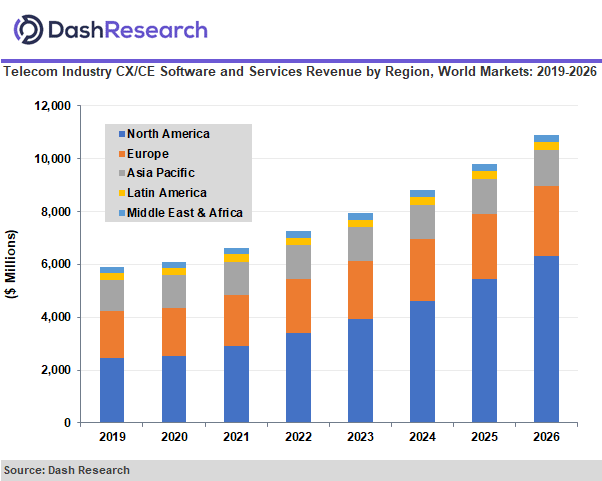
Dash Research projects that the global market for CX/CE software and services in the telecommunications industry will reach $16.4 billion by 2026, up from $8.5 billion in 2019, reflecting a 2019 to 2026 CAGR of 9.7%. The report and forecast also focuses on the impact of the COVID-19 pandemic on the industry, which led some companies to increase spending on CX software and services due to the increased use of in-home telecommunications services, such as voice, TV, internet, and home security monitoring.
While the COVID-19 pandemic served as a catalyst for some providers to invest in CX/CE software and services, telecommunications providers have long been trying to address the organizational and operational issues that created less-than-positive customer experiences, namely long call center wait times, confusing service options and pricing tiers, and a longstanding culture of focusing solely on revenue, rather than on customers.
These issues have often resulted in high rates of customer churn, which is a measure of the percentage of current customers that stop using a service within a given timeframe, most often reported annually or monthly. While addressing churn requires a full and in-depth assessment of an organization’s offerings, policies, pricing structures, and procedures, several tactics that are focused solely on customer interactions can be used to improve the customer’s experience and perception of the provider, which should be reflected in lower churn rates. Some of the key strategies through which technology can be used to help human reps who are averse to change include:
- Ensure all customer-facing associates can access customer data quickly and easily: Workers are more apt to address customer issues and needs if they are able to quickly access customer and service issues, without requiring the aid of a supervisor, or a lengthy data-retrieval mission. Making customer interaction and data easy to access will empower workers to service customers, because the process may be more efficient.
- Support customer-centric approaches to CX: Technology such as machine learning (ML) can be used to review and analyze customer feedback to understand customers’ wants, needs, points of frustration and anger, and positive experiences, and then these insights can be used to reshape and refine the policies, procedures, and actions that are taken during customer interactions to improve the customers’ experiences.
- Understand what factors are driving service interactions: Technology can be used to track and analyze why customers are contacting or interacting with the provider. Once an analysis is conducted, demand can often be managed more efficiently, and by predicting responses to frequently asked queries or actions, deploying automation can reduce the reliance on human workers.
- Incorporate tech to enhance the customer’s service experience: Telecommunications customers are rightfully skeptical that a service request or complaint is being handled, particularly if it involves a service change that will not be applied until the next billing period. Deploying QR- or text-based service acknowledgement and satisfaction-based notifications, along with surveys, can demonstrate that the representative (and the telecom company) is treating the interaction, issue, or complaint as a true point of concern, and demonstrates accountability.
The Dash Research CX in the Telecommunications Industry report delves into the current issues impacting telecommunications CX, and includes CX software and services forecasts segmented by geography, functional area, product offering, and visibility to the customer.
Author Information

Keith Kirkpatrick is VP & Research Director, Enterprise Software & Digital Workflows for The Futurum Group. Keith has over 25 years of experience in research, marketing, and consulting-based fields.
He has authored in-depth reports and market forecast studies covering artificial intelligence, biometrics, data analytics, robotics, high performance computing, and quantum computing, with a specific focus on the use of these technologies within large enterprise organizations and SMBs. He has also established strong working relationships with the international technology vendor community and is a frequent speaker at industry conferences and events.
In his career as a financial and technology journalist he has written for national and trade publications, including BusinessWeek, CNBC.com, Investment Dealers’ Digest, The Red Herring, The Communications of the ACM, and Mobile Computing & Communications, among others.
He is a member of the Association of Independent Information Professionals (AIIP).
Keith holds dual Bachelor of Arts degrees in Magazine Journalism and Sociology from Syracuse University.