Software suite provider Zoho recently launched Trident, a new unified communications platform, in addition to several other technology enhancements which fall under its Zoho Workplace office platform. Combined, these additions are aimed at creating a unified experience and making communication easier across channels. Dash Research was briefed by Zoho Product Strategy Lead Rakeeb Rafeek on the product launch, as well as how Zoho Workplace is supporting companies in their efforts to improve employee experience.
A “Center of Gravity” for Employee Experience
Rafeek provided some grounding to the overall Zoho approach and their goals for the Workplace collection of tools. He emphasized Zoho is creating a “center of gravity” for workers, recognizing that employees are faced with an overwhelming number of tools on a day-to-day basis. Streamlining technologies and using interfaces that employees are already accustomed to removes some friction points, improves productivity, and hopefully results in a smoother employee experience.
“Zoho has been built from Day 1 with the intent that an entire business could be on the Zoho cloud. We really look at our technology holistically and our suite helps to bring peace of mind to users as it brings operational calmness and end user experience calmness,” says Rafeek. “A lot of our end users have told us that initially there is a bit of resistance to the change to Zoho, just like every other change. But they were able to quickly adapt to Zoho because it meant they could do multiple things within the same window. We really want to tie in the operational and end user experience and have worked hard on design consistency and making sure the apps are easy to use.”
In 2017, Zoho introduced its apps coming into one location with the idea of workplace as an experience. Employees would not have to switch between tabs and locations; everything would be in one place. Zoho Workplace historically consisted of four C’s: Collaboration, Context, Convenience and Continuity. Zoho has added Culture as the fifth C, and this is becoming an especially important part of Zoho Workplace.
Workplace is currently Zoho’s fastest growing product in terms of user acquisition. Its customers have historically come from financial services, healthcare, government and public sector, and food and beverage. However, healthcare adoption has been growing by big leaps.
Privacy and value are two differentiators, according to Rafeek. “We have a relentless focus on guarding users’ privacy, and this has been really helping us in the healthcare sector. We have tremendous pride that we don’t monetize our user’s data and we have really been able to build trust in that way.” Rafeek adds, “We have been a frugal company and we don’t have large overhead expenses that we trickle down into our pricing. In that way we are able to provide great value for our customers.”
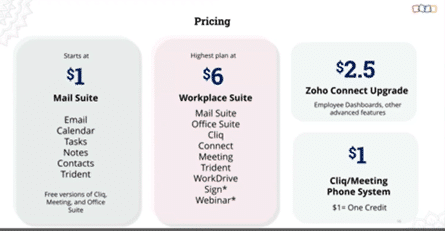
Zoho Connect for Connection and Community
According to Rafeek, Zoho Connect is a tool that has been getting a lot of interest lately as it has proven to be a great way to try to recreate that in-person work environment. Connect has a customizable dashboard and can be another center of gravity for employees, hosting townhalls and forums, communicating leadership messages and company happenings, supporting social networking, and generally bringing to light areas of employee interest.

Rafeek shared two large global companies who used Zoho Connect to improve user experience for employees. One company’s goals were to improve employee engagement, motivation, collaboration, and efficiency and to better connect with corporate identity and leadership. The other company wanted to reduce layers of communication between management and employees, offer quicker collaboration solutions for frontline and deskless workers, and automate mundane processes using customer apps. Both companies found success using the platform.
“Since the pandemic, in the enterprise market, we have really seen increased adoption in technologies like Connect that can help build overall company culture. This has often been an add on after customers have been using other Zoho capabilities. However, increasingly, we are having enterprises become customers of Zoho Connect first, then adding in other capabilities,” says Rafeek.
Building “Beautiful Experiences” for Users: Zoho Trident and Other Product Announcements
The introduction of Zoho Trident, as well as the other recent additions and enhancements, is a major update to the platform. Some of this development has been in the works for years. This update encompasses four areas of focus: unified experiences, unified communications, minimizing tool ambiguity, and doubling down on security.
“Internally we like to refer to our apps as ingredients to a tasty recipe that will provide beautiful experiences for end users. For unified experience, there is not a better example of that than Zoho Trident, our new desktop app,” says Rafeek. Zoho Trident combines mail, messages, audio/video calls, calendar, tasks, and more into the same place. The product was named Trident as it combines various applications and functions that support the three pillars of workspace: communication, productivity, and business. It is Zoho’s first native desktop app for email and chat. Other introductions and updates include:
- Zoho Voice platform is now a full phone system integrated directly within team collaboration app Zoho Cliq and web conferencing app Zoho Meeting. This enables employees to make direct line calls and send SMS messages, as well as pick up inbound calls across the apps.
- Zoho Webinar, within the Zoho Meeting app, enables businesses to broadcast themselves to thousands of attendees and engage with them using polls and Q&As.
- Blue-pencil AI-based grammar tool.
- Mobile Device Management capabilities and OTP-restricted emails have been added to the workplace suite.
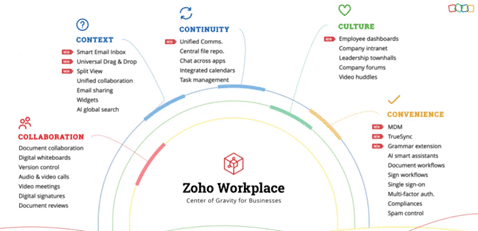
A lot of the work Zoho is doing with Workplace is focused on reducing the number of things employees have to do to get their work done during the day and making their user experience feel very organic. The aim is for the apps to be used daily in ways that people normally interact and for it to be seamless, effortless, and efficient.
The employee-technology interaction is an important one to overall employee experience. Qualtrics data shows that employees who say their technology is enabling productivity are 158% more engaged, have 61% higher intent-to-stay at their companies beyond three years, and are four times as likely to say their EX is exceeding expectations, compared to those who do not feel technology is enabling their productivity. Additionally, 64% of office workers, IT professionals, and C-Suite executives surveyed by Ivanti report the way they interact with technology directly impacts morale.
These latest updates show Zoho is taking note and finding ways to remove the small day-to-day frictions that can make or break and employee experience.
Author Information

As a detail-oriented researcher, Sherril is expert at discovering, gathering and compiling industry and market data to create clear, actionable market and competitive intelligence. With deep experience in market analysis and segmentation she is a consummate collaborator with strong communication skills adept at supporting and forming relationships with cross-functional teams in all levels of organizations.
Sherril holds a Master of Business Administration in Marketing from University of Colorado, Boulder and a Bachelor of Arts in Psychology from Rutgers University.