
A new 10-country survey of 11,000 consumers reveals that more shoppers have been using the mobile apps of retailers so far this year compared to the same time in 2022, with the preference for retail apps extending across various age groups and income levels. The best motivator for consumers to opt in and receive marketing communications from brands are discounts or loyalty awards that can be redeemed by consumers to save on purchases, in part indicating the real-world effects of inflation on consumer buying behavior.
The survey is from mobile app experience (MAX) company Airship, which released its findings this week in Las Vegas at Shoptalk 2023, the conference on retail technologies and the retail business. Completed in partnership with Sapio Research in February 2023, the survey sampled consumers aged 18 and older in the US, Canada, UK, France, Germany, South Africa, Singapore, Thailand, Indonesia, and Brazil.
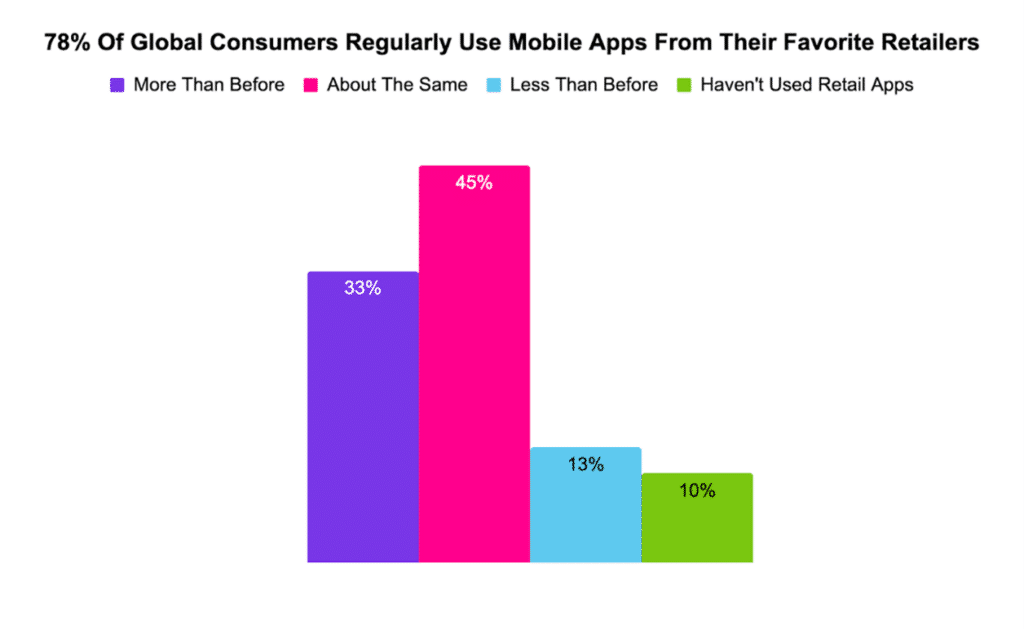
Among respondents, 78% are using the mobile apps of retailers either more often or at about the same rate as last year, as shown by the chart below (Note: All charts were provided by Airship). This year’s frequency rate in retailer app usage applies to 81% of millennials and to 79% of Gen X, followed by 72% of both Gen Y and Boomers. High household incomes lead in the regular use of retail apps at 82%, followed by medium household incomes at 79%, and by low household incomes at 75%—a relatively narrow difference among income levels.
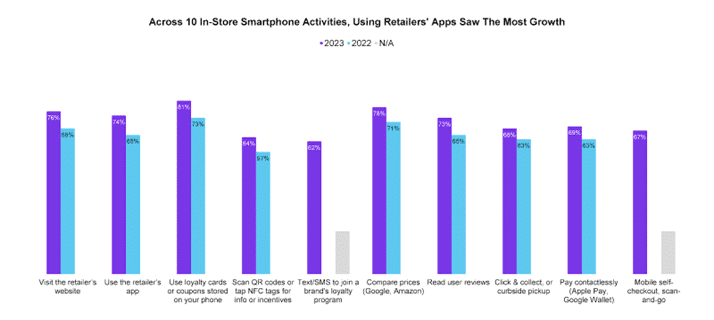
Of all the ways that shoppers might use their smartphones while in stores, the use of retailers’ apps grew most on a year-over-year basis: 74% for 2023, up nine percentage points from 65% in 2022. Big gains—up eight percentage points—were also seen for in-store smartphone use to visit retailer websites, from 68% to 76%; to use loyalty cards or coupons stored on the phone, from 73% to 81%; and to read user reviews, from 65% to 73%.
Because mobile notifications can be served up even on smartphone lock screens, mobile apps have an inherent advantage in reaching people wherever they are at the exact moment it matters most, according to the findings.
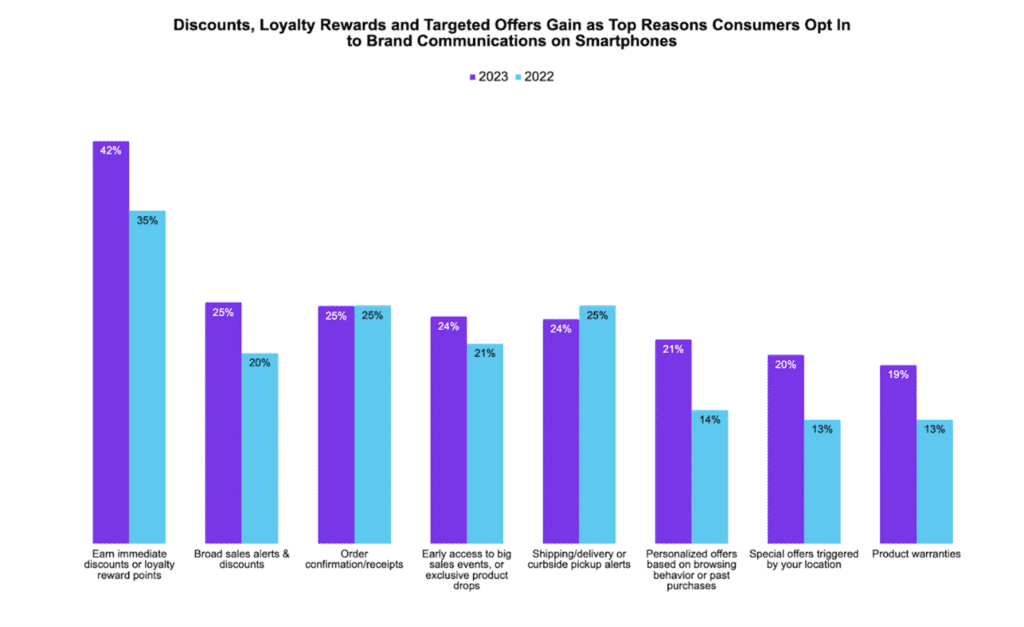
When asked what motivates consumers to receive branded communications on their smartphones, topping the list was the use of discounts and loyalty rewards, tied with the serving up of personalized offers based on browsing behavior or past purchases. Together, both choices made the biggest year-over-year gains.
The data here suggests that inflation and the current economic uncertainty are helping to drive more deal-motivated behaviors by consumers. The results also demonstrate that opportunities exist for retailers to expand their understanding of the customer, as shoppers are more motivated to share personal information in exchange for valuable offers and meaningful experiences that are more appropriate to their needs.
“Today’s consumers are increasingly turning to mobile apps from their favorite retailers to score deals, gain special access, and improve their overall customer experience, particularly while shopping at brick-and-mortar stores,” says Thomas Butta, Airship chief strategy and marketing officer. “As marketing budgets are pinched and consumers face economic pressures, retailers need greater agility to create and optimize valuable app experiences that grow customer understanding and reward them individually, making life easier and better for everyone involved.”
Author Information

Alex is responsible for writing about trends and changes that are impacting the customer experience market. He had served as Principal Editor at Village Intelligence, a Los Angeles-based consultancy on technology impacting healthcare and healthcare-related industries. Alex was also Associate Director for Content Management at Omdia and Informa Tech, where he produced white papers, executive summaries, market insights, blogs, and other key content assets. His areas of coverage spanned the sectors grouped under the technology vertical, including semiconductors, smart technologies, enterprise & IT, media, displays, mobile, power, healthcare, China research, industrial and IoT, automotive, and transformative technologies.
At IHS Markit, he was Managing Editor of the company’s flagship IHS Quarterly, covering aerospace & defense, economics & country risk, chemicals, oil & gas, and other IHS verticals. He was Principal Editor of analyst output at iSuppli Corp. and Managing Editor of Market Watch, a fortnightly newsletter highlighting significant analyst report findings for pitching to the media. He started his career in writing as an Editor-Reporter for The Associated Press.